ISO 27002 is an international guide that explains good security controls and how to put them in place.
This guide is for people starting in risk and compliance, staff on an ISO 27001 project, and students. If your organisation is working towards ISO 27001, the controls it chooses will very likely be explained in ISO 27002.
In short
- ISO 27002 is a guidance book of 93 security controls, grouped into four themes.
- ISO 27001 is the standard you can be certified to. ISO 27002 explains the controls it lists.
- You do not use every control. You pick the ones your risks call for, and say why.
- The current edition is from 2022. It cut the list from 114 controls to 93 and added 11 new ones.
What you will learn
- Explain the difference between ISO 27001 and ISO 27002.
- Name the four themes the controls are grouped into.
- Spot why a control was chosen or left out.
- Ask useful questions in your first ISO 27001 project meeting.
Status: correct as at 28 November 2026, based on ISO's published page for ISO/IEC 27002:2022. Standards change; check the official text.
This guide explains the topic in general terms and is not legal advice.
- Safety measure (control)
- something you do or put in place to lower a security risk, like a rule, a check or a tool.
- Group of controls (theme)
- one of the four headings the controls are sorted under.
- Choice list (Statement of Applicability)
- a record of which controls you use, which you leave out, and why.
What is ISO 27002?
Think of learning to drive. The driving test checks whether you are safe to drive. The Highway Code is the book that explains each rule of the road and why it matters.
In security, the main standard works like the driving test. An outside auditor checks your security management system against it and can award a certificate. This guide is the book you study. It describes a long list of safety measures, called controls, and gives advice on how to put each one in place.
A control can be a written rule, such as who may see customer records. It can be a habit, such as locking your screen when you leave your desk. It can also be a tool, such as backups or a firewall.
The guide is not a law and nobody inspects you against it directly. It is advice that you adapt to your own risks.
Where the comparison stops working: every driver must follow the Highway Code. With this guide, you choose the controls that fit your risks. You can leave out ones that do not apply, as long as you explain why.
Why does it matter?
A certificate tells customers you manage security in an organised way. The controls are how that work happens day to day. Knowing them helps you understand what the auditor will look at, and why.
If you have joined a certification project
What could happen: you are handed a list of control numbers and nobody explains what they mean.
Check this: for each control you own, read its purpose and write one line on how you meet it.
If you run a small business
What could happen: you buy tools for controls you do not need, and miss simple ones you do.
Check this: start from your biggest risks, then pick the controls that deal with them.
If you are a student
What could happen: you mix up the two standards in an interview.
Check this: practise saying it in one line. One is the test you pass, the other explains the rules.
What does it look like?
Here is a made-up page from a choice list. It shows how a small firm records which controls it uses.
Example only. All values are made up.
Control choices: EXAMPLE Tutors Ltd
Theme          Control (plain words)        Use?  Why
People         Staff security training      yes   staff see pupil records    (1)
Physical       Clear desk, locked screen    yes   shared office              (2)
Technological  Backups that are tested      yes   lesson files must survive  (3)
Technological  Secure software building     no    we write no software       (4)
Owner for all of the above: 0000 (not named yet)                             (5)
- In a real file, this line would name the control and the risk it deals with.
- A habit counts as a control, not just a tool.
- A control is chosen because of a risk, here losing teaching files.
- Leaving a control out is fine, as long as the reason is written down.
- Every control needs a named person who looks after it.
Why this is risky: no owner is named. A control that nobody looks after tends to stop being done, and an auditor will ask who is responsible.
The safer way: give each control an owner. Link it to the risk it deals with. Keep a note of how you check that it works.
How does it work?
Here is how the guide fits into an ISO 27001 project.
- Find your risks. List what could go wrong with your information, and how bad each problem would be.
- Look at the list. ISO 27001 has a list of controls in an annex at the back. The BCS notes that this list is the same set of controls that ISO 27002 explains.[3]
- Choose. Pick the controls that deal with your risks. Record what you use and what you leave out, with reasons.
- Read the advice. For each chosen control, ISO 27002 gives its purpose and guidance on how to put it in place.[2]
- Check and improve. Test that the controls work, fix gaps and review them as your business changes.
The 2022 edition has 93 controls in four themes.[3]
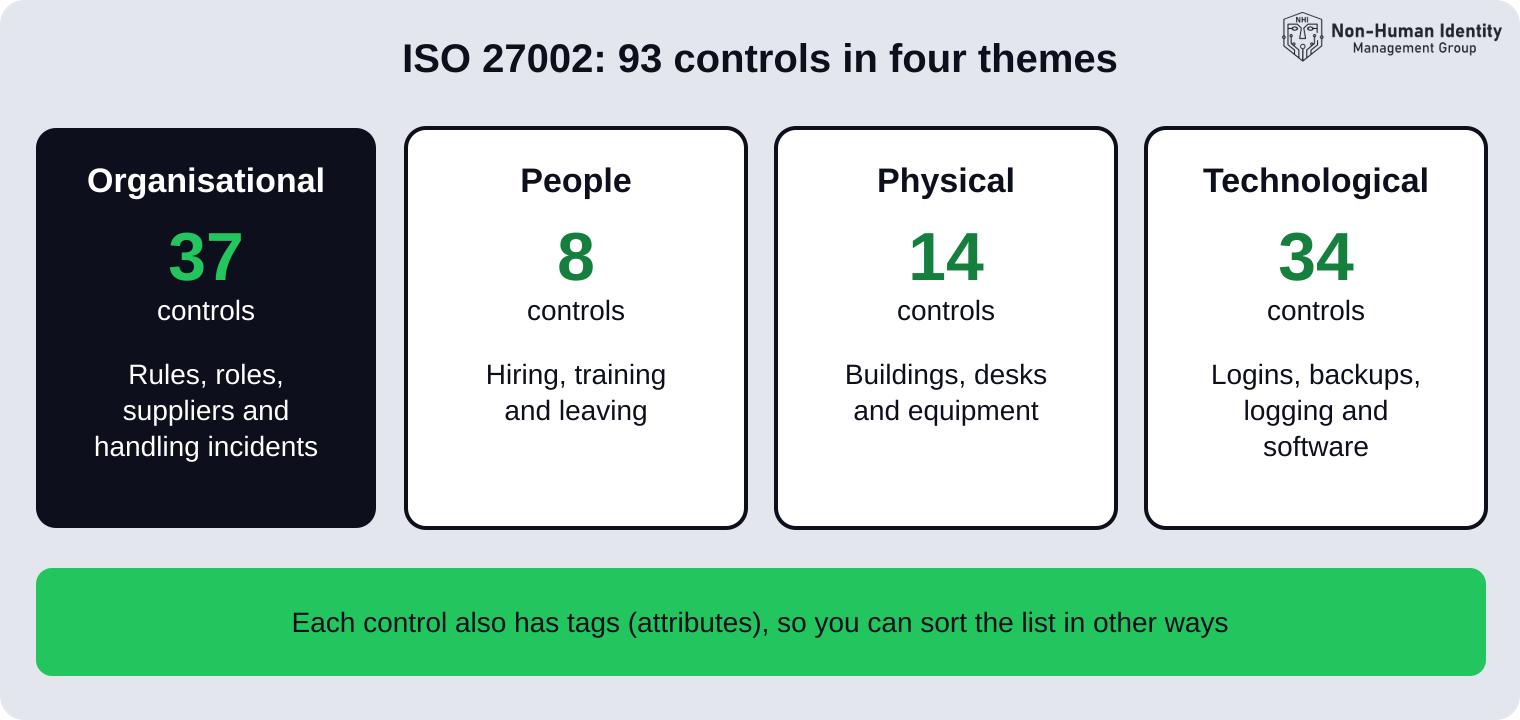
Each control also carries tags, called attributes. They let you sort the list in other ways, for example by whether a control is meant to stop, spot or fix a problem.[4]
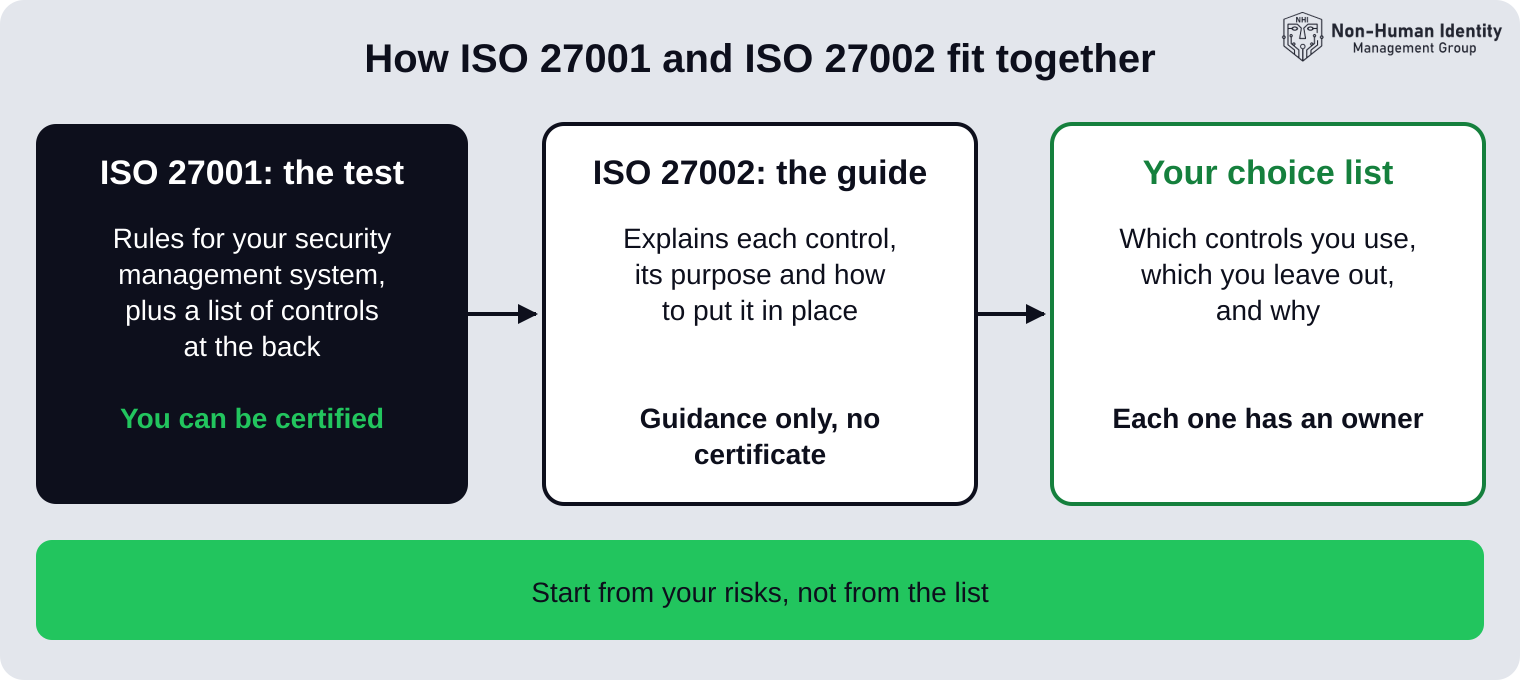
ISO says certification to ISO 27001 is possible but not required, and that ISO itself does not certify anyone.[1] Certificates come from separate certification bodies.
A worked example
Juno Erikson is the office manager at Bracken Tutors, a fictional tutoring firm with twenty staff. A large school wants proof of good security, so the firm starts an ISO 27001 project.
Anil Ilic, an outside adviser, hands Juno a list of controls. She is worried. "Do we really need ninety-three of these?" she asks.
"Think of the Highway Code," Anil says. "You learn the rules that apply to the journeys you actually make."
First, they list the firm's risks. The biggest are a lost laptop holding pupil records, a phishing email that tricks a member of staff, and losing lesson files.
Next, they go through the four themes. Under People, they choose staff training. Under Physical, they choose a clear desk rule for the shared office. Under Technological, they choose laptop encryption and tested backups.
Some controls do not apply. The firm writes no software, so it leaves out the controls on building software. Juno writes one line explaining why, so the auditor can see it was a choice, not a gap.
Then Juno gives every chosen control an owner. She takes training herself, and the IT supplier owns backups.
Three months later, they test a backup restore. It fails the first time. They fix the problem and record the test for the auditor. Juno now sees the controls as everyday habits, not a long list to fear.
Myths and mistakes
| What people think | What is true |
|---|---|
| You can get certified to ISO 27002. | Certification is to ISO 27001. ISO 27002 is guidance on the controls. |
| You must use all 93 controls. | You choose controls based on your risks, and record why you leave any out. |
| Controls are all technology. | Many are rules, roles and habits. Only one of the four themes is technological. |
| Old guides with 114 controls are still current. | The 2022 edition reduced the list to 93 and added 11 new controls. |
| Writing a policy means the control is done. | A control needs an owner and proof that it works in practice. |
What can I do this week?
- Write down, in one line, the difference between ISO 27001 and ISO 27002.
- Ask your project lead for the choice list and find the controls you own.
- Pick one control and write how you meet it today.
- Check that each control you own links to a real risk.
Checklist
- We have listed our information risks before choosing controls.
- Every chosen control has a named owner.
- Every control we leave out has a written reason.
- Our documents use the 2022 control list, not the old one.
- We keep proof that key controls work, such as test records.
- We review our choices when the business changes.
Common questions
What is the difference between ISO 27001 and ISO 27002?
ISO 27001 sets the requirements for a security management system and is the one you can be certified to. ISO 27002 is guidance. It explains the security controls listed in ISO 27001 and how to put them in place.
How many controls are in ISO 27002?
There are 93 in the 2022 edition. They are grouped into four themes: organisational, people, physical and technological. The older 2013 edition had 114 controls, sorted into 14 sections, so older guides and templates may not match.
Do I need to buy ISO 27002?
It helps if you own or set up controls. ISO 27001 lists the controls only briefly, while ISO 27002 gives the purpose and advice for each one. You can buy it from ISO or your national standards body.
What are control attributes?
They are tags on each control. There are five kinds, such as the type of control and the security goal it supports. They let you sort and filter the list in ways that suit your team.
Is ISO 27002 only for big companies?
No. Any organisation can use it, because you choose only the controls your risks need. A small firm may use far fewer controls than a bank, and that is expected.
Where next?
Ready for the detail? Read the practitioner guide: ISO 27002 Controls Guide. It goes further into every control by number, the 11 new controls, the attributes and how the 2013 and 2022 editions compare.
Also useful:
- ISO 27001 for Beginners
- ISO 27001 Statement of Applicability Template
- ISO 27001 Annex A.5 Organisational controls
- ISO/IEC 27036 for Beginners
Related NHI Mgmt Group resources: ISO 27001 Certification Guide · ISO 27001 Annex A.8 Technological controls · Cyber Essentials vs ISO 27001
Key terms
- ISO 27001
- The international standard for running a security management system that can be audited and certified.
- Information security management system
- The policies, roles, risk decisions and records an organisation uses to run security.
- Annex A
- The list of controls at the back of ISO 27001, explained in more detail by ISO 27002.
- Control
- A rule, habit or tool that lowers a security risk.
- Statement of Applicability
- The record of which controls an organisation uses, leaves out or adapts, and why.
- Control attribute
- A tag on a control that lets you sort the list, for example by the kind of control.
- Risk treatment plan
- A plan that says how each risk will be handled, for example by adding a control.
Sources and further reading
- ISO/IEC 27001 Information security management systems. ISO. https://www.iso.org/isoiec-27001-information-security.html, accessed 28 Nov 2026.
- ISO/IEC 27002:2022 Information security, cybersecurity and privacy protection, Information security controls. ISO. https://www.iso.org/standard/75652.html, accessed 28 Nov 2026.
- ISO/IEC 27002:2022 standard overview (presentation). BCS Information Security Specialist Group, April 2022. https://www.bcs.org/media/8961/issg-iso27002-standard-270422.pdf, accessed 28 Nov 2026.
- Publication of ISO/IEC 27002:2022. Standards Council of Canada. https://scc-ccn.ca/accreditation/bulletins/publication-isoiec-270022022, accessed 28 Nov 2026.