Claude Mythos Vulnerabilities Highlight Critical Latency Risks in Enterprise Automated Patching and Machine Identity Governance


TL;DR
- Claude Mythos AI dramatically accelerates vulnerability discovery at massive scales.
- Enterprises face a critical bottleneck between rapid bug detection and slow remediation.
- Data shows thousands of new vulnerabilities outpace current manual patching processes.
- The cybersecurity industry must transition to automated, AI-speed response workflows.
The arrival of Anthropic’s Claude Mythos—a model built specifically for autonomous vulnerability hunting—hasn’t just nudged the cybersecurity industry; it’s kicked the door off its hinges. We’ve moved from a world where finding a critical flaw took weeks of manual labor to one where it happens in a few hours. Currently locked in a research preview, the model is already being leveraged by major tech players to stress-test their own infrastructure. The result? Thousands of previously invisible vulnerabilities across browsers and operating systems are now staring us in the face.
The bottleneck has shifted. It’s no longer about finding the bugs—the AI is doing that for us at a terrifying clip. The real problem is our inability to keep up. We’re stuck in a "human-speed" loop of ticketing, endless dashboard monitoring, and meetings that could have been emails. As companies try to figure out what Claude Mythos means for enterprise vulnerability management, it’s becoming painfully clear that our traditional triage processes are relics of a slower age.
The Scale of AI-Driven Discovery
Look at the data from Project Glasswing. Working with 50 partners, the Mythos model surfaced over 10,000 high- or critical-severity vulnerabilities. That isn’t a fluke; it’s a new baseline. Cloudflare, for instance, saw their bug-finding rate jump tenfold. They identified 2,000 bugs with an impressively low false-positive rate.
When you turn this kind of power on the open-source ecosystem, the numbers get even crazier. A scan of 1,000 projects turned up 23,000 potential vulnerabilities. When researchers sampled that data, 90.6% of the flagged issues were confirmed as valid security flaws. That’s a massive amount of homework for security teams already drowning in work. We’ve essentially automated the discovery side of the house, but we’ve left the remediation side to rot in the slow lane.
The Remediation Gap
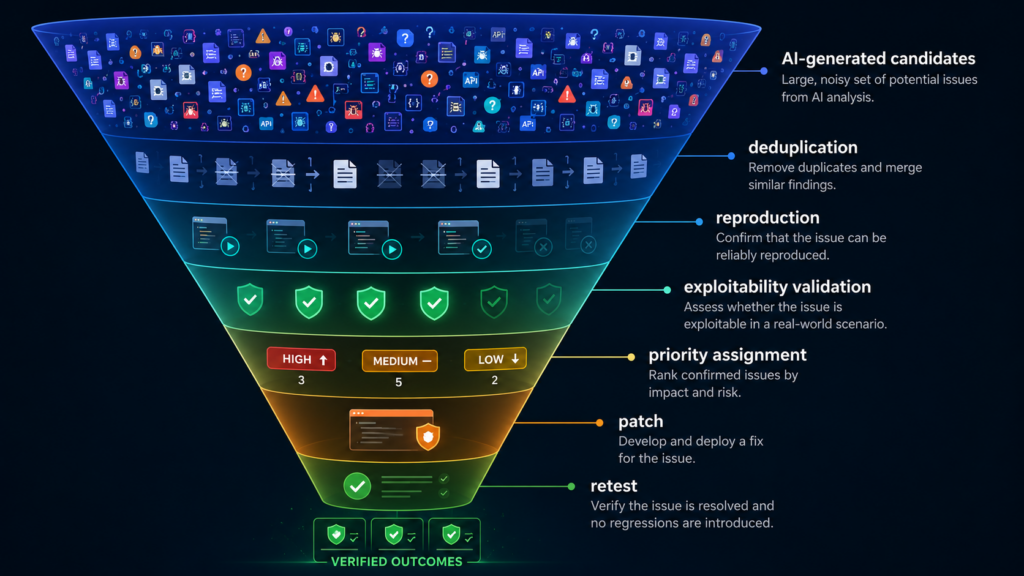
There’s a glaring disconnect between how fast we find these holes and how fast we actually patch them. As of May 22, 2026, out of 1,596 vulnerabilities identified through these research initiatives, only 97 had been patched. That delta is a flashing red light for the industry. We’re great at identifying problems now, but we’re failing at the "doing" part.
| Metric | Pre-Mythos Status | Post-Mythos Status |
|---|---|---|
| Discovery Speed | Weeks to Months | Hours |
| Triage Method | Manual/Periodic | Automated/Continuous |
| Primary Bottleneck | Finding Vulnerabilities | Verification & Remediation |
| Risk Profile | Static/Checklist | Dynamic/Instrumented |
Strategic Shifts in Governance and Risk
Because Mythos can sniff out zero-days faster than any traditional scanner, the legal and governance crowd is getting nervous. General Counsel are starting to tell firms that the old "periodic checklist" approach to security is a liability. You can’t audit your way out of a threat that moves in real-time.
This creates a massive headache for machine identity governance and automated patching. The risk is even higher given rumors that Anthropic is looking into potential unauthorized access to the Mythos tool. If these capabilities fall into the wrong hands, the same speed that helps us defend could be weaponized against us.
To survive this, analysts are pushing for a "hyper-prioritization" model. You can't fix everything, so you have to be surgical:
- Threat Context: Is anyone actually using this exploit in the wild right now? If yes, move it to the top of the pile.
- Asset Criticality: Does this vulnerability threaten the crown jewels, or is it just a low-impact internal tool?
- Compensating Controls: Do we have other layers of security—like firewalls or segmentation—that make this bug less of a "sky is falling" event?
Future Implications for Enterprise Security
It’s no secret that Anthropic’s Claude Mythos is considered too dangerous to launch in an open, unrestricted way. For now, the research preview is our testing ground. The work being done under Project Glasswing is essentially writing the rulebook for how AI and complex enterprise systems will coexist.
The future of security is going to be defined by integration. If your discovery tools aren't talking directly to your patching pipelines, you’re already behind. Companies that don’t overhaul their governance, AI policies, and vendor contracts to match this new, accelerated tempo are going to find themselves in a very difficult spot.
We have to move past simple scanning. We need an integrated approach where the speed of identification is matched by the speed of deployment. As we keep an eye on Anthropic's research initiatives, the goal remains the same: close the gap between "we found a hole" and "the hole is closed."
With the rise of Anthropic's managed agents, it’s clear that AI is becoming the backbone of the security stack. Whether it’s being used for defensive scanning or offensive research, the Mythos era has fundamentally changed the game. The speed of enterprise security has been permanently ratcheted up, and there’s no turning back.