A scalper bot is software that buys scarce items faster than people can, so they can be resold.
This guide is for anyone who has missed out on concert tickets or a limited release, and for people who sell things online. If your shop ever runs a sale with limited stock, bots may be in the queue with your real customers.
In short
- Scalper bots watch for scarce stock and can buy it very fast, often using many fake accounts.
- The scalper then resells the tickets or goods at a higher price, while real fans miss out.
- In the US and the UK, using bots to get round ticket limits can break the law.
- Sellers fight back with per-customer limits, fair queues, account checks and close watching of each sale.
What you will learn
- Explain how a scalper bot buys stock before people can.
- Spot the signs that bots took part in a sale.
- Check which simple defences your shop already has.
- Explain what the law says about ticket bots in plain words.
- Buying robot (scalper bot)
- a program that finds and buys limited items automatically.
- Reselling for profit (scalping)
- buying scarce items to sell them on at a higher price.
- Online queue (waiting room)
- a page that holds visitors in line when too many arrive at once.
What is a scalper bot?
Picture a shop sale where one shopper has a robot that rushes in the moment the doors open. It fills a trolley with every pair in your size before anyone else reaches the shelf.
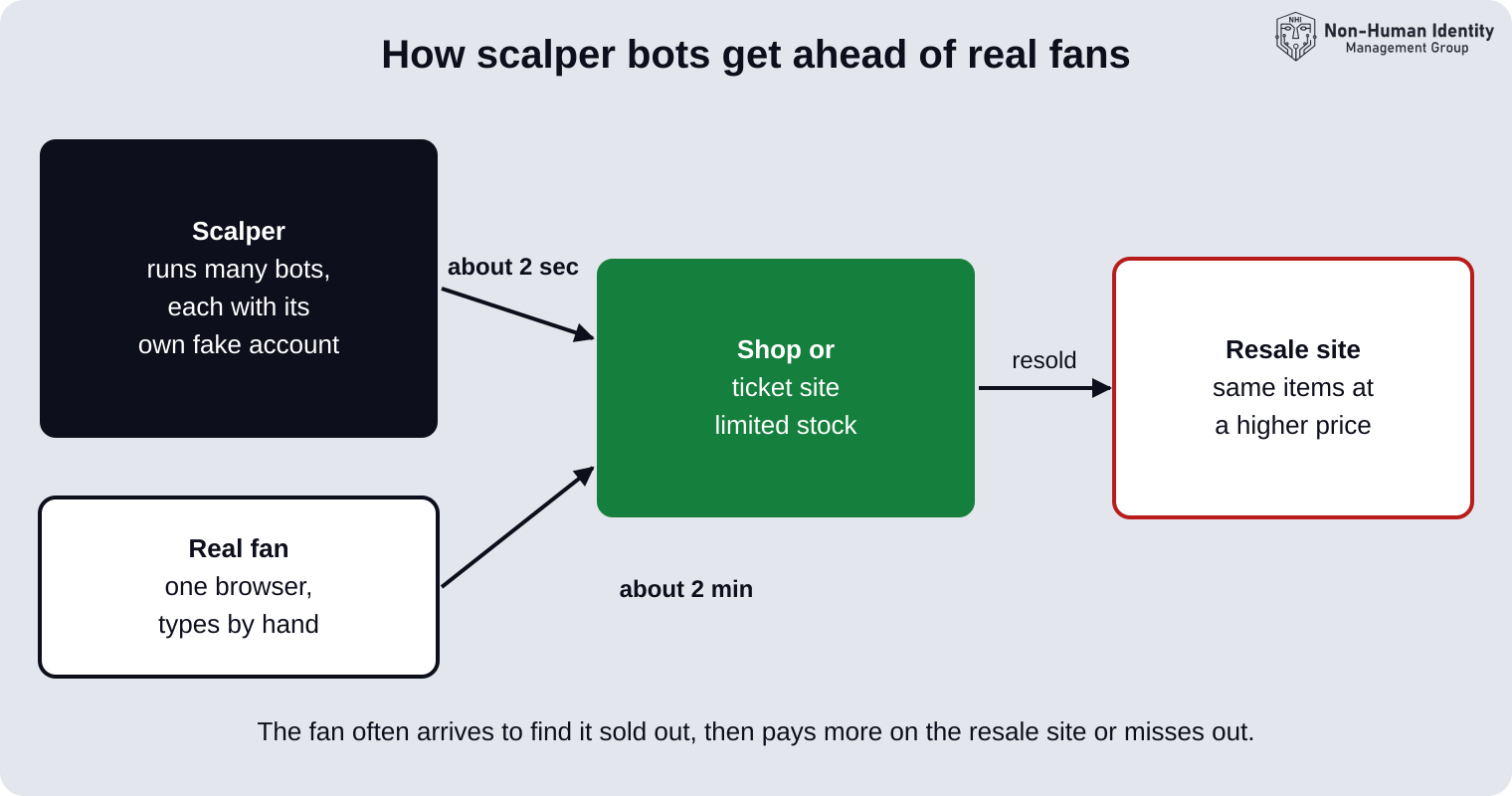
A scalper bot does that online. It is a program that watches a website for tickets or limited goods. When they go on sale, it fills in forms and pays far faster than a person can. Many bots run at once, each pretending to be a different customer.
The person running the bots, called a scalper, then resells what they bought at a higher price. A well-known non-profit web security project lists this as a known kind of automated attack. Its other names include ticket touting, sneaker bots and Grinch bots.[1][5]
Where the comparison stops working: a robot in a real shop is easy to see. Online, each bot can look like a normal shopper, with its own account, card and internet address.
Why does it matter?
Bots can make limited stock disappear very quickly, so real customers miss out.[1] The first case under the US ticket bot law shows the scale. The regulator said three ticket brokers used bots and hundreds of fake accounts to buy more than 150,000 tickets.[3]
If you buy tickets or limited releases
What could happen: you queue for an hour, the item sells out, and it appears on a resale site at three times the price.
Check this: buy from the official seller or its approved resale site, and be wary of deals that look too good.
If you run an online shop
What could happen: your limited run sells out almost at once, loyal customers get nothing, and you face angry messages and refund requests.
Check this: set a per-customer limit and look at who bought after each launch.
If you organise events
What could happen: fans pay inflated prices to resellers, and some resold tickets turn out to be fake or cancelled.
Check this: ask your ticketing platform how it limits bots and how it handles resale.
What does it look like?
Here is a made-up summary of orders from the first minute of a trainer launch at a small online shop. It shows the kind of pattern a seller might notice.
Example only. All values are made up.
Launch: 10:00:00, 200 pairs, limit 1 per customer
10:00:01  order 0001  [email protected]   (1)
10:00:01  order 0002  [email protected]
10:00:02  order 0003  [email protected]
...
10:00:09  sold out: 200 orders              (2)
140 orders ship to 1 Example Street, Faketown (3)
Average time from page to payment: 2 seconds  (4)
- New accounts made the night before, with very similar email names.
- All stock gone in under ten seconds.
- Most orders go to one address, so the "1 per customer" limit was dodged with fake customers.
- Far faster than a person can type a card number.
Why this is risky: a per-customer limit only works if each "customer" is a real, separate person. Bots can make as many accounts as they need.
The safer way: combine the limit with checks on new accounts, delivery addresses and payment cards, and review orders before they ship.
How does it work?
Most scalping follows the same pattern. The steps below describe it so you can spot it, not copy it.
- Getting ready. The scalper sets up many accounts, cards and delivery addresses so each bot looks like a different shopper.[3]
- Watching. Bots check the product or ticket page again and again, waiting for the sale to open.
- Rushing in. The moment it opens, each bot adds items and pays, far faster than a person.
- Hiding. Scalpers may hide where the bots really are, so the seller sees many different internet addresses.[3]
- Reselling. The scalper lists the items on resale sites at a higher price.[1]
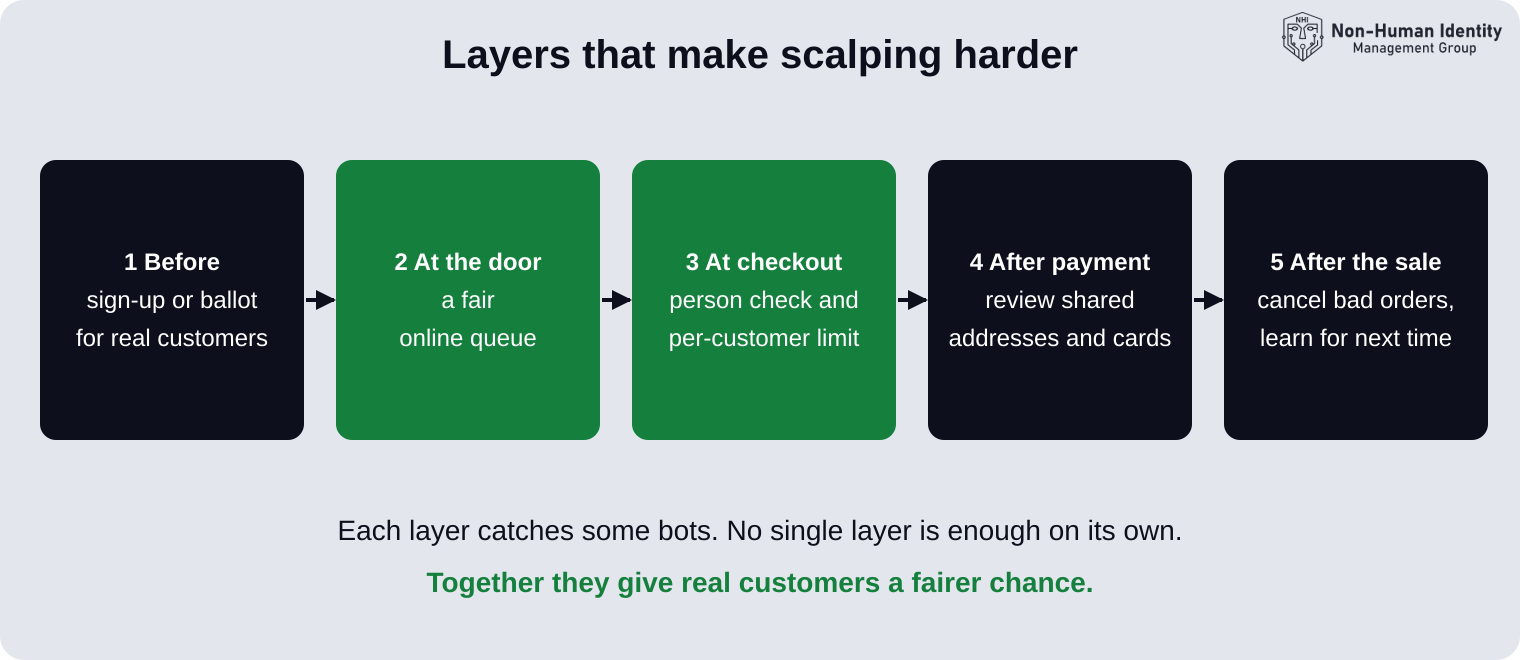
Sellers have several ways to push back. A virtual waiting room is an online queue. It holds visitors in line when too many arrive, and lets them in as space frees up.[6] Other common defences include per-customer limits and a sign-up or ballot before the sale. Sellers also check that visitors are people and review orders before they ship. No single defence is enough on its own, so we suggest layering them.
The law can help too. In the US, a 2016 law called the BOTS Act covers events at venues of more than 200 people. It bans getting round the security measures or purchase limits of online ticket sellers.[2][3] In the UK, a rule in force since July 2018 covers event tickets. It is an offence to use software to buy more than the sale limit in order to make money.[4] These laws are about tickets, not trainers or other goods. This is general information, not legal advice.
A worked example
Yara Strand runs a small online shop selling limited-run trainers. Her last launch sold 200 pairs in nine seconds. Within the hour, they were on a resale site at triple the price.
Her regular customers were not happy. "I was ready at ten on the dot," wrote one, "and it was already gone."
Yara thinks of the robot with the trolley. Her "one pair each" rule had not stopped it. When she looks at the orders, 140 of the 200 went to the same street address.
For the next launch she makes four changes. First, she runs a sign-up week, and only accounts older than a month with a past order can enter a ballot. Second, she turns on the online queue her shop platform offers, so everyone who arrives on time gets a fair place in line.
Third, she limits orders to one pair per card and per delivery address, not just per account. Fourth, she holds all orders for a day so she can check them before posting.
On launch day she still cancels 23 orders that share addresses and cards, and refunds them. The rest go to people with real order histories.
The launch takes a little longer to sell out. Her inbox fills with thank-you messages instead of complaints, and she writes down what worked for next time.
Myths and mistakes
| What people think | What is true |
|---|---|
| A "one per customer" rule stops scalpers. | Bots can use many fake accounts. Limit by card and address too.[3] |
| A puzzle check keeps all bots out. | It slows some bots down, but it is one layer. Use it with limits, queues and order checks. |
| Selling out fast means the launch went well. | A very fast sell-out can be a warning sign. Check who bought before you celebrate. |
| Scalping is legal everywhere because it is just reselling. | Using bots to get round ticket limits can be an offence in the US and the UK.[2][4] |
| Only big ticket sites get targeted. | Any limited stock that resells at a profit can attract bots, including small shops.[1] |
What can I do this week?
- Look at your last launch. Count orders that share an address or card.
- Check if your shop offers a queue, buying limits or bot checks. Turn them on.
- Write a short rule for when you cancel odd orders, and add it to your terms.
- If you buy tickets, save a link to the official seller and its resale site.
Checklist
- Limited launches have a per-customer limit that covers accounts, cards and delivery addresses.
- Big launches use an online queue or a ballot.
- New accounts made just before a launch get extra checks.
- Orders are reviewed before shipping for shared addresses and cards.
- Our terms say we may cancel orders that break the limits.
- We look back at each launch and note what bots tried.
- Customers know which sellers and resale sites are official.
Common questions
Are scalper bots illegal?
For event tickets, often yes. The US BOTS Act and UK rules from 2018 target using software to get round ticket limits. For trainers, games consoles and other goods, the rules differ by country, but shops can still set limits and cancel orders that break them.
How do scalper bots buy so fast?
They skip the slow human parts. A bot fills in forms and payment details automatically and can send its order in a second or two. Many bots run at once, each with its own account, so they reach the stock before most people finish loading the page.
Does an online queue stop bots?
Not on its own. A queue keeps the site running and lets people in fairly as space frees up. Bots can still join the queue. So it works best with purchase limits, checks that buyers are people and a review of orders after the sale.
Is it safe to buy resold tickets?
Usually the safest choice is the official seller's own resale site. Tickets from unofficial sellers may cost far more, may be fake or may be cancelled by the organiser. Check the event's terms before you pay.
What is the difference between a scalper bot and other bots?
A scalper bot is one type of bad bot with one goal: buying scarce stock to resell. Other bots guess passwords, copy website content or check stolen cards. Many of the same defences help against all of them.
Where next?
Ready for the detail? Read the practitioner guide: Ticket Scalping and Inventory Hoarding Bots Guide. It goes further into how scalping shows up in sales data, the controls to set before a drop and lessons from enforcement cases.
Also useful:
- Bots and Bot Traffic for Beginners
- CAPTCHA for Beginners
- Online Shop Security for Beginners
- Bot Management Guide
Related NHI Mgmt Group resources: Bot Management Buyer's Guide · CAPTCHA and bot challenges
Key terms
- Scalper bot
- A program that buys limited tickets or goods automatically so they can be resold.
- Scalping
- Buying scarce items, often unfairly, to sell them on at a higher price.
- Virtual waiting room
- An online queue that holds visitors in line when a site gets busy.
- CAPTCHA
- A check, such as a puzzle, that tries to tell people and bots apart.
- Rate limiting
- Capping how many requests or orders one user can make in a set time.
- Bot management
- Tools and checks that spot automated traffic and decide what to let through.
Sources and further reading
- OAT-005 Scalping. OWASP Automated Threats to Web Applications, OWASP Foundation. https://owasp.github.io/www-project-automated-threats-to-web-applications/assets/oats/EN/OAT-005_Scalping, accessed 28 Nov 2026.
- Better Online Ticket Sales Act. US Federal Trade Commission, Legal Library. https://www.ftc.gov/legal-library/browse/statutes/better-online-ticket-sales-act, accessed 28 Nov 2026.
- FTC Brings First-Ever Cases Under the BOTS Act. US Federal Trade Commission, 22 January 2021. https://www.ftc.gov/news-events/news/press-releases/2021/01/ftc-brings-first-ever-cases-under-bots-act, accessed 28 Nov 2026.
- The Breaching of Limits on Ticket Sales Regulations 2018 (SI 2018/735). legislation.gov.uk. https://www.legislation.gov.uk/uksi/2018/735/made, accessed 28 Nov 2026.
- OWASP Automated Threats to Web Applications. OWASP Foundation. https://owasp.org/www-project-automated-threats-to-web-applications/, accessed 28 Nov 2026.
- Waiting Room. Cloudflare Docs, Cloudflare. https://developers.cloudflare.com/waiting-room/, accessed 28 Nov 2026.