Segregation of duties means splitting important tasks so that no one person can complete them alone.
This guide is for new IT staff, finance managers, students and anyone who has been told "you cannot approve your own request". It matters in any organisation that pays bills, handles data or gives people access to systems.
In short
- If one person can start, approve and hide a task, a mistake or a fraud can go unnoticed.
- Splitting the steps between people means someone else sees the work.
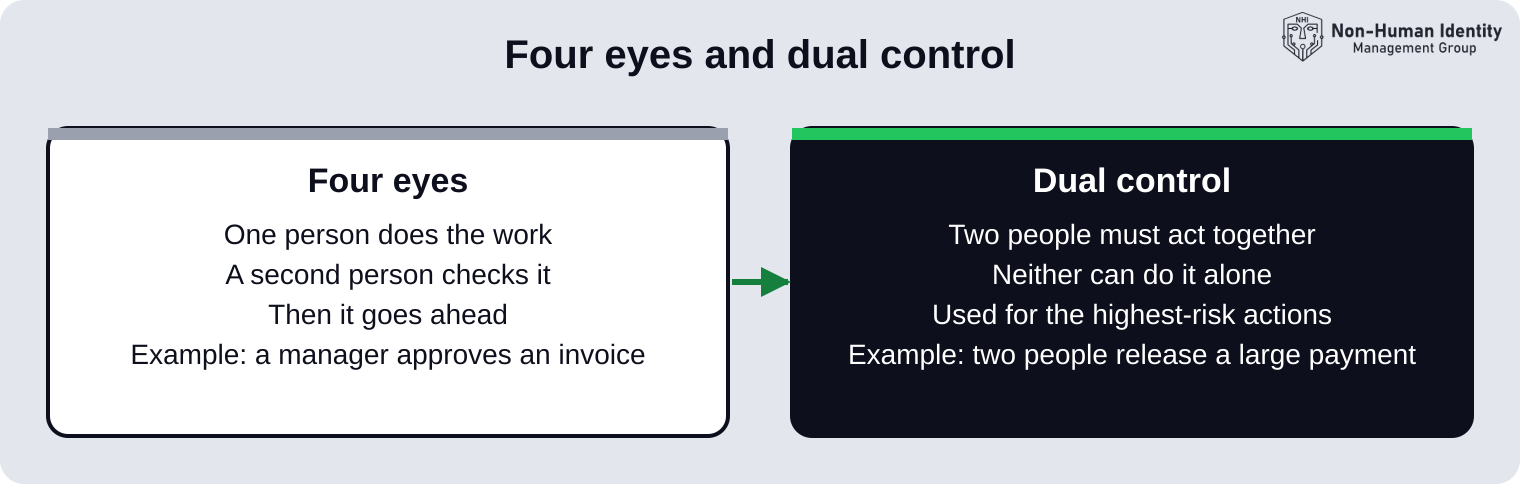
- Two related ideas help: a second person checks the work (four eyes), or two people must act together (dual control).
- Small teams that cannot split every task use extra checks instead, such as an owner reviewing payments.
What you will learn
- Explain segregation of duties in plain words.
- Spot a risky mix of tasks held by one person.
- Check who can approve payments or access in your team.
- Ask for a second check when a task is high risk.
- Splitting the job (segregation of duties)
- dividing a process so different people do the key steps.
- Second pair of eyes (four-eyes principle)
- a rule that a second person checks and approves the work.
- Two keys (dual control)
- a rule that two people must act together before something can happen.
What is segregation of duties?
Think of a football match. The players do not referee the game they are playing in. Someone else decides if a goal counts. Segregation of duties works the same way at work.
In plain terms, the person who does a task should not be the only person who checks it. A US standards body puts it simply: no user should have enough access to misuse a system on their own.[1]
It is also called separation of duties. Both names mean the same thing.
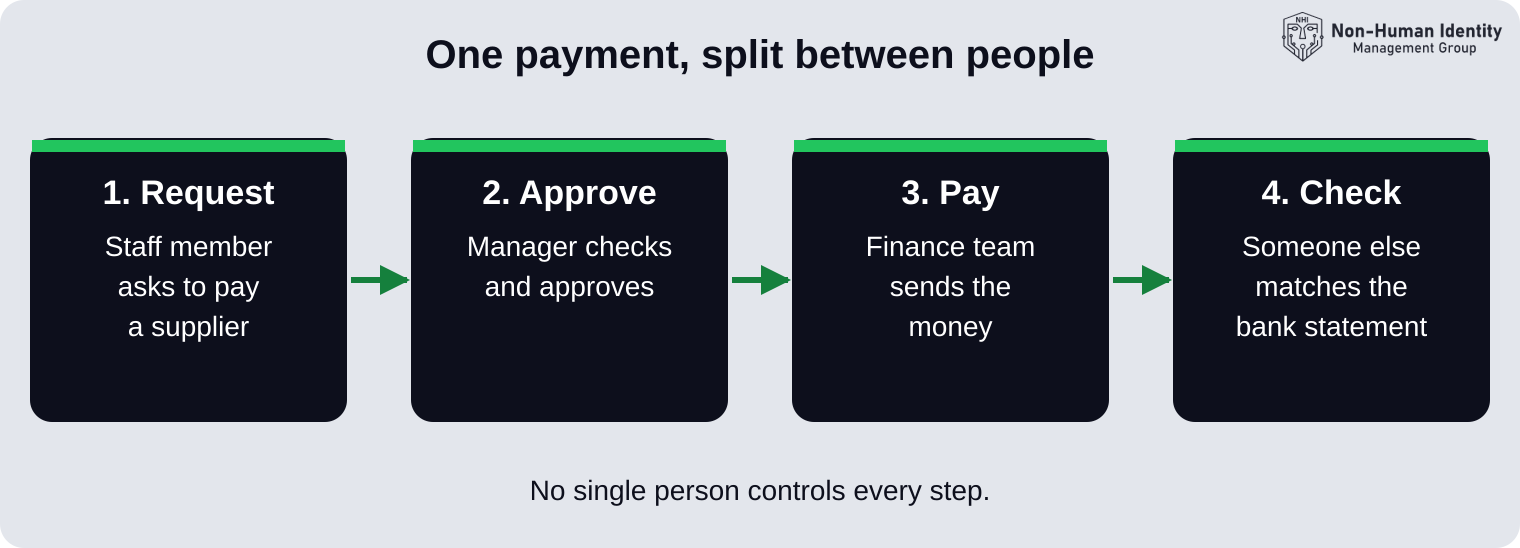
A common example is paying a bill. One person adds a new supplier. A different person approves the payment. A third person checks the bank statement. Nobody controls the whole chain.
Where the comparison stops working: a referee is there for every match. At work, the checker is often busy, and approvals can become a quick click. A split only helps if the second person really looks.
Why does it matter?
It guards against honest mistakes as well as fraud. In one large study of workplace fraud, a lack of internal controls was the most common weakness, named in 32% of cases.[2]
If you are new to IT work
What could happen: you are asked to give yourself extra access "just for today", and nobody else ever reviews it.
Check this: ask for access through the normal request, so someone else approves it.
If you manage a finance team
What could happen: one person can change a supplier's bank details and pay them, so a fake request goes straight through.
Check this: make sure bank detail changes need a second person, who confirms them by phone.
If you are a student
What could happen: you study access control but miss why roles are split, a common exam and interview topic.
Check this: practise naming the steps in one process and who should do each.
What does it look like?
Here is a made-up access summary for one person in a small finance team.
Example only. All values are made up.
User: [email protected]    Team: Accounts
Add or edit suppliers         Yes   (1)
Change supplier bank details  Yes   (1)
Approve payments              Yes   (2)
Send payments from bank       Yes   (2)
Check bank statement          Yes   (3)
Give access to others         No
- This person can set up a supplier and decide where the money goes.
- They can also approve and send the payment.
- And they are the one who checks the statement afterwards.
Why this is risky: one person holds every step. A fake supplier, a typo or a scam email could pass with nobody else seeing it. Pairs of tasks like this are sometimes called a toxic combination: access that is fine on its own but risky together.
The safer way: keep supplier changes with one person and approvals with another. Give the bank statement check to a third person, or to the owner.
How does it work?
- Map the process. Write down the steps, such as request, approve, carry out, record and check.
- Find the risky pairs. Look for steps that should not sit with one person, such as "create supplier" and "approve payment".
- Split the steps. Give the risky pairs to different people. Systems can enforce this with roles, so a single user cannot hold both.[1]
- Add a second check where needed. With the four-eyes principle, a second person approves the work. With dual control, two different people must take part at the same time, like two keys for one safe. Standards call this the two-person rule.[1]
- Use extra checks if you cannot split. In a tiny team, the owner might review every payment or every new access. These are called mitigating controls.
- Review regularly. People change jobs and collect access over time. A regular access review spots new risky mixes.
The same idea applies to software. A non-human identity (NHI) is a digital identity, or the credential behind it, used by a machine, app, service or AI agent. An automated tool that can both create and approve a payment breaks the split as surely as a person can.
A worked example
This story is made up to show how it can happen.
Anil Castell owns Larch Laundry, a commercial laundry with twelve staff. Xena Brandt is the bookkeeper. Last year, Anil and Xena agreed a simple rule. Xena can add suppliers and prepare payments. Anil approves every payment and every bank detail change. Each month, Anil reads the bank statement himself.
In March, Rania Delmar joins as office manager. On her second day, an email arrives that looks like it is from their detergent supplier. It says the supplier has a new bank account and asks for the next invoice to be paid there.
Rania wants to help, and she has been given access to the supplier list. She starts to update the bank details. The system saves the change as "waiting for approval", because only Anil can approve it.
Anil sees the request. Following the rule, he calls the supplier on the number in their old contract, not the one in the email. The supplier has not changed banks. The email was a scam.
The FBI advises checking requests to change account details through a second channel.[3] Anil's rule built that check into the process.
What made the difference: Rania made an honest mistake, but she could not finish the task alone. The second step gave Anil the chance to catch it.
Myths and mistakes
| What people think | What is true |
|---|---|
| Segregation of duties means we do not trust our staff. | It protects staff too. It catches honest mistakes, and it means nobody can be blamed for something they could not have done alone. |
| It is only for big companies. | Small firms can use simple splits, or an owner's review where a split is not possible. |
| Once roles are split, the job is done. | Access builds up as people change jobs. Review it regularly. |
| An approval is a check, however quickly it is clicked. | A rubber-stamp approval adds little. The checker needs time and the facts to say no. |
| Automated tools do not need this. | A script or AI agent that can create and approve the same thing is a toxic combination too. |
What can I do this week?
- Pick one process, such as paying suppliers, and list its steps.
- Write who can do each step today.
- Mark any person who can do two risky steps.
- Make bank detail changes need a second person and a phone check.
- Ask your IT team when access was last reviewed.
Checklist
- Our key processes are written down step by step.
- No one person can add a supplier and approve paying them.
- Bank detail changes need a second person to approve.
- Nobody can approve their own access request.
- Someone independent checks the bank statement.
- Where we cannot split a task, there is an extra check.
- Access is reviewed regularly, especially after job changes.
- Automated tools follow the same splits as people.
Common questions
Is segregation of duties the same as separation of duties?
Yes. They are two names for the same idea. "Separation of duties" is common in US standards, and "segregation of duties" is common in finance and audit. Both mean splitting important tasks so no single person can complete them alone.
What is the difference between four eyes and dual control?
Four eyes means a second person checks the work before it goes ahead. Dual control means two people must act together, at the same time, for it to happen at all. Dual control is stricter, so it is kept for the highest-risk actions.
How is this different from least privilege?
They work together. Least privilege gives each person only the access they need. Segregation of duties makes sure no one person holds a risky mix of access. Someone can have very little access and still hold a dangerous pair of tasks.
What if my team is too small to split tasks?
Use extra checks instead. The owner can approve all payments, read the bank statement each month or review new access. These mitigating controls do not remove the risk, but they make it much more likely that a mistake or fraud is noticed.
Does this apply to IT administrators?
Yes. An administrator who can change a system and also delete its logs could hide a mistake. Common splits include one person making a change and another approving it, and keeping logs where admins cannot edit them.
Where next?
Ready for the detail? Read the practitioner guide: Segregation of Duties Guide. It goes further into building a conflict ruleset, preventive and detective controls, and how to measure progress across systems.
Also useful:
- Segregation of Duties Matrix Template
- Segregation of Duties vs Least Privilege
- Access Reviews and Certification for Beginners
- AI Agent Segregation of Duties Guide
- Insider Threats for Beginners
Related NHI Mgmt Group resources: Least Privilege for Beginners · Payment Fraud for Beginners · Non-Human Identities for Beginners
Key terms
- Segregation of duties
- Splitting important tasks so that no one person can complete them alone.
- Four-eyes principle
- A rule that a second person must check and approve work before it takes effect.
- Dual control
- A rule that two people must act together before an action can happen.
- Two-person rule
- A form of dual control where the second person must be different from the first.
- Mitigating control
- An extra check used when a risk cannot be removed, such as a manager reviewing a report.
- Access review
- A regular check that each person still needs the access they have.
- Least privilege
- Giving each person or program only the access it needs to do its job.
Sources and further reading
- Separation of duty (glossary entry, citing NIST SP 800-192). NIST Computer Security Resource Center. https://csrc.nist.gov/glossary/term/separation_of_duty, accessed 28 Nov 2026.
- Occupational Fraud 2024: A Report to the Nations. Association of Certified Fraud Examiners (ACFE), 2024. https://legacy.acfe.com/report-to-the-nations/2024/, accessed 28 Nov 2026.
- Business Email Compromise: The $55 Billion Scam (Alert I-091124-PSA). FBI Internet Crime Complaint Center (IC3), 11 September 2024. https://www.ic3.gov/PSA/2024/PSA240911, accessed 28 Nov 2026.