A Sybil attack is when one person or group runs many fake identities to look like a crowd.
This guide is for students, newcomers to security and anyone who runs an online community, poll, review page or reward scheme. You do not need to be technical to be affected: any system that counts people, votes or reviews can be bent by fake ones.
In short
- A Sybil attack is one actor pretending to be many people, accounts or computers.
- It works against anything that counts heads, such as votes, reviews, rewards or computers in a shared network.
- The usual defence is to make each new identity cost something, such as a check, a fee or time.
- Look for clusters: many accounts that appear together, behave alike and point to the same place.
What you will learn
- Explain what a Sybil attack is in one sentence.
- Spot the signs of one actor behind many accounts.
- Explain why making identities cost something helps.
- Check how a vote, poll or reward scheme you run counts people.
- Fake member (Sybil identity)
- one of many accounts or computers secretly run by the same actor.
- Cost of joining (Sybil resistance)
- how hard a system makes it to add lots of identities cheaply.
What is a Sybil attack?
Think of a village meeting that decides things by a show of hands. One person slips out, changes hat and coat, and comes back to vote again. Do that twenty times and one person outvotes the room.
A Sybil attack works the same way online. Many systems trust the crowd. They count votes, reviews, sign-ups or computers, and assume each one is a separate person. One actor who can make lots of identities cheaply can pretend to be that crowd.
The name comes from a 2002 research paper by John Douceur. It showed that one faulty or hostile party can present many identities and so control a large share of a shared network of computers.[1] The paper argued that, without some trusted body that vouches for identities, this kind of attack is generally possible.[1]
Where the comparison stops working: in a village hall, someone may notice the same face. Online, a new account is just a name and an email address, so a thousand fakes can look as normal as a thousand people.
Why does it matter?
Plenty of everyday systems rely on "one person, one vote" without checking it. Fake crowds can push a product, win a prize draw, hide a scam or sway a group decision.
If you run a community, club or poll
What could happen: one member makes many accounts and swings a vote the real members did not want.
Check this: decide what counts as one member before the vote, not after it.
If you run a small online shop
What could happen: a rival floods your page with fake bad reviews, or a seller near you buys fake good ones.
Check this: look for bursts of reviews from new accounts with similar wording.
If you are into crypto
What could happen: farmers run hundreds of wallets to grab free token giveaways, leaving less for real users.
Check this: read a project's rules on fake wallets before you take part.
If you are studying computing
What could happen: a shared network you build trusts every new computer equally, so one attacker can join many times.
Check this: ask what stops one person from adding a hundred members.
What does it look like?
Here is a made-up summary from a club's online poll, the kind of thing an organiser might see.
Example only. All values are made up.
Poll: Choose the new club kit colour
Votes for Green:  41
Votes for Orange: 212                       (1)
New accounts in last 24 hours: 180          (2)
Sign-up emails: [email protected] ... [email protected]   (3)
Most votes for Orange arrived 02:00 to 02:20  (4)
- A sudden, lopsided result compared with past polls.
- Many accounts created just before the vote.
- Email addresses that follow the same numbered pattern.
- Votes bunched into a short window in the middle of the night.
Why this is risky: the poll counts accounts, not people. Each pattern alone can be innocent, but together they suggest one actor behind many accounts.
The safer way: agree what counts as one voter, such as one paid-up member. Then check a few things at sign-up and look for clusters before you announce a result.
How does it work?
Most Sybil attacks follow the same simple path.
- Find a headcount. The attacker spots a system that gives power or rewards per identity, such as a vote, a review score or a giveaway.
- Make identities cheaply. They create many accounts, wallets or computers, often with automated tools. A list of security threats to websites names bulk account creation as its own threat, used for spam, fake reviews and skewed surveys.[4]
- Make them look real. The fakes get names, profile pictures or a little activity so they blend in.
- Act together. At the right moment, all the identities vote, review, claim or connect at once.
- Take the prize. The attacker wins the vote, grabs the rewards or gains control of part of the system.
Defences work by making step 2 costly or step 4 easy to see. Some systems check that each account belongs to a real, unique person. A US government guide calls this checking that each claimed identity matches one single person.[6] Others make joining cost something. Big public blockchains are shared record books run by many computers. They ask people who run them to spend a lot of energy or lock up money. The Ethereum project describes this as an economic deterrent to Sybil attacks.[2]
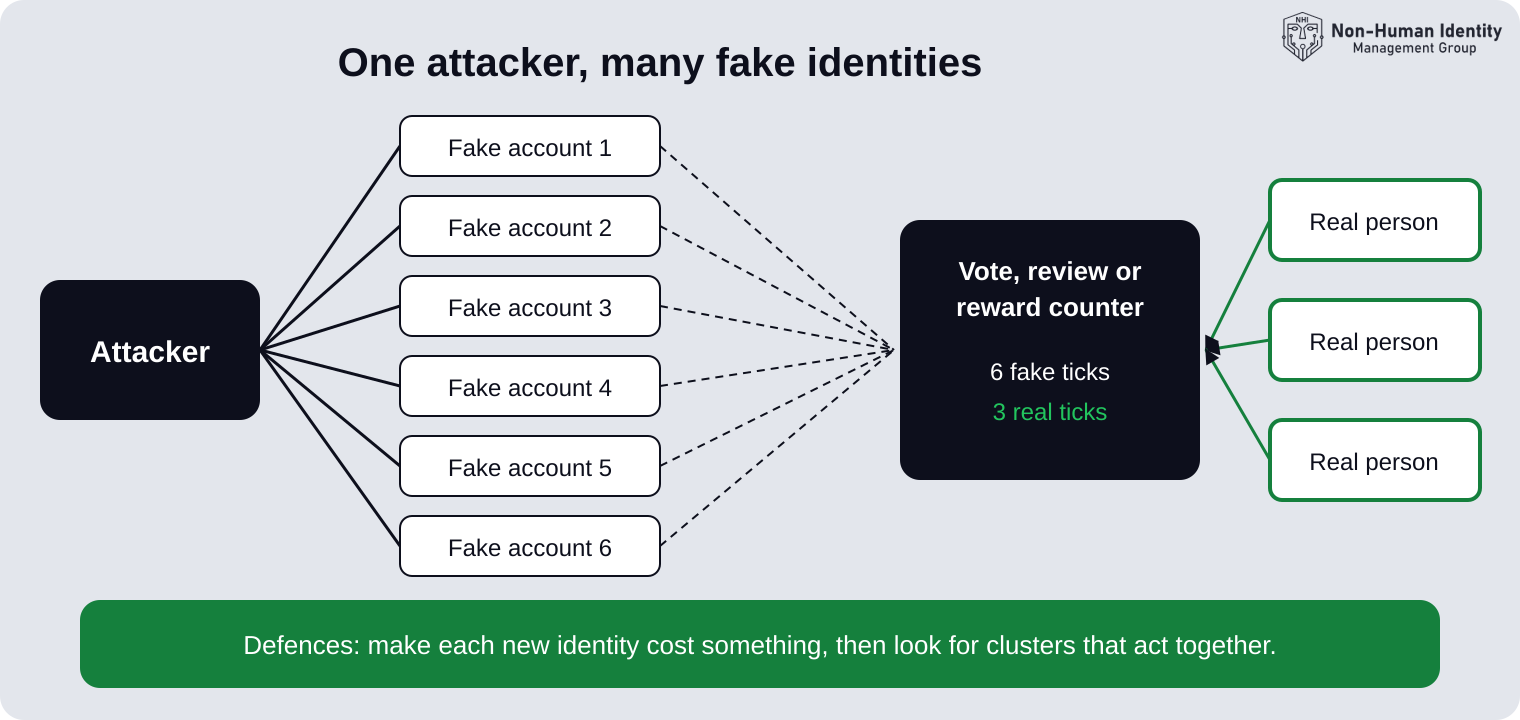
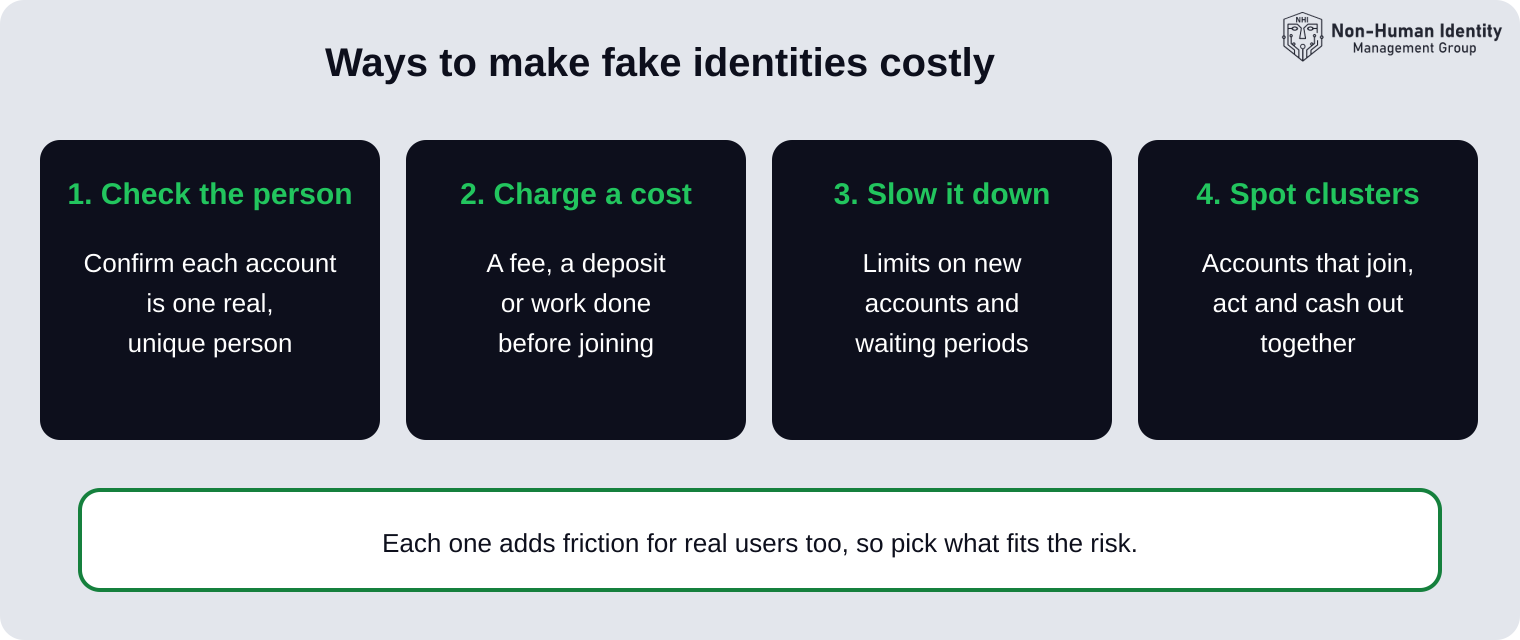
Real cases rarely use the word Sybil, but the pattern shows up. The Arbitrum network gave out free tokens in 2023. Its published rules took points off wallets that looked like throwaways. They also excluded addresses flagged as Sybil in an earlier hunt.[3] The Tor Project runs a privacy network made of volunteer computers. It has written about removing dozens of its relays that appeared to come from one unknown operator.[7]
A worked example
Fen Gallardo is the volunteer secretary of a fictional running club with about ninety members. Each year the club runs an online poll to pick a charity to support.
This year the poll closes with a shock. A charity nobody had talked about wins with over two hundred votes. That is more votes than the club has members.
Fen remembers the village hall picture. Someone may be changing hats. She opens the poll's admin page with Bea Engel, the club treasurer, who keeps the membership list.
They see the signs from the sample. Most winning votes came from accounts made the night before. The email addresses follow a numbered pattern, and nearly all the votes arrived within twenty minutes.
Fen does not accuse anyone. She cannot tell who made the accounts, and it may not be a member at all. Instead, she and Bea agree three changes.
First, only people on Bea's membership list can vote, so each member gets one private link. Second, the poll opens for a week, and new sign-ups during that week cannot vote. Third, they publish the rules before the next vote, so everyone knows what counts.
They rerun the poll. Seventy-two members vote, and the result looks like the conversations people have been having at training.
The lesson for Fen is simple. The poll had been counting accounts, not people. Once each vote was tied to a real member, a fake crowd had far less to gain.
Myths and mistakes
| What people think | What is true |
|---|---|
| Sybil attacks only matter for crypto. | The idea started with shared computer networks and applies to votes, reviews, sign-up offers and social media too.[1] |
| A CAPTCHA puzzle solves it. | A puzzle slows down simple bots. A determined actor can still make many accounts by hand or with paid help. |
| Fake accounts are always bots. | Some are run by tools, some by people, and some are real accounts that were bought or taken over.[5] |
| Asking for full ID from everyone is the best fix. | Strong checks cut fakes but also turn away real people and collect personal data. Match the check to what is at stake. |
| If each account looks normal, there is no problem. | Sybil accounts often look normal one by one. The warning signs show up when you look at them as a group. |
What can I do this week?
- List anything you run that counts people, such as polls, reviews, referrals or giveaways.
- Write down what counts as one person for each, and how you check it.
- Add a simple limit, such as one vote per member or a waiting period for new accounts.
- Look at your last result for bursts of new accounts acting together.
Checklist
- Every vote, review or reward has a clear rule for what counts as one person.
- The rule is published before the vote or offer opens.
- New accounts face a limit, delay or check before they count.
- Someone looks for clusters of accounts that join, act or cash out together.
- The level of checking matches what a fake crowd could win.
- There is a plan for what to do if a result looks rigged, such as a rerun.
Common questions
Why is it called a Sybil attack?
It is named after a 2002 research paper called "The Sybil Attack". The paper showed one party posing as many members of a shared computer network. The name has stuck for this pattern.[1]
Is a Sybil attack the same as a botnet?
No. A botnet is a group of infected devices that one criminal controls. A Sybil attack is about fake identities in a system that counts heads. A botnet can be used to run a Sybil attack, but many Sybil attacks need no infected devices.
Can Sybil attacks be stopped completely?
Not in most open systems. The original paper argued that, without a trusted body vouching for identities, they stay generally possible.[1] The practical aim is to make fakes costly and easy to spot, so the attack is not worth it.
Are fake reviews a kind of Sybil attack?
Often, yes, when one business or person writes many reviews under different names. They can also break the law. In 2024 a US consumer watchdog, the Federal Trade Commission, banned fake reviews. It also banned fake follower counts made by bots or hijacked accounts.[5]
Is it wrong to have two accounts?
Not usually. Many people have a work and a personal account. It becomes a Sybil attack when extra accounts are used to get more votes, rewards or influence than the rules allow one person.
Where next?
Ready for the detail? Read the practitioner guide: Sybil Attacks Guide. It goes further into defence families and their trade-offs, Sybil risk among AI agents, and how to measure and detect fake-identity clusters.
Also useful:
- Fake Account Creation Fraud Guide
- Bots and Bot Traffic for Beginners
- Distributed Systems Security for Beginners
- Identity Proofing and Verification for Beginners
Related NHI Mgmt Group resources: Address Poisoning and Airdrop Scams Guide · CAPTCHA and Bot Challenges Guide · Blockchain and Distributed Ledger Security Guide
Key terms
- Sybil attack
- When one actor creates many fake identities to sway a system that counts heads.
- Sybil risk
- The chance that one actor uses many identities to tilt access, votes, rewards or reputation.
- Fake account
- An account made to abuse a service rather than to use it.
- Bot
- Software that acts automatically, often at a scale no person could match.
- Identity proofing
- Checking that a person is who they claim to be before giving them an account.
- Proof of stake
- A way for a blockchain to choose who adds records, based on money they lock up.
- CAPTCHA
- A small test that tries to tell people apart from automated software.
Sources and further reading
- The Sybil Attack. John R. Douceur, Microsoft Research, Proceedings of the 1st International Workshop on Peer-to-Peer Systems (IPTPS), January 2002. https://www.microsoft.com/en-us/research/publication/the-sybil-attack/, accessed 28 Nov 2026.
- Consensus mechanisms. ethereum.org developer documentation, Ethereum Foundation. https://ethereum.org/en/developers/docs/consensus-mechanisms/, accessed 28 Nov 2026.
- Airdrop eligibility and distribution specifications. Arbitrum Foundation documentation (snapshot 6 February 2023). https://docs.arbitrum.foundation/airdrop-eligibility-distribution, accessed 28 Nov 2026.
- OAT-019 Account Creation. OWASP Automated Threats to Web Applications, OWASP Foundation. https://owasp.github.io/www-project-automated-threats-to-web-applications/assets/oats/EN/OAT-019_Account_Creation, accessed 28 Nov 2026.
- Federal Trade Commission Announces Final Rule Banning Fake Reviews and Testimonials. US Federal Trade Commission, 14 August 2024. https://www.ftc.gov/news-events/news/press-releases/2024/08/federal-trade-commission-announces-final-rule-banning-fake-reviews-testimonials, accessed 28 Nov 2026.
- SP 800-63A-4, Digital Identity Guidelines: Identity Proofing and Enrollment. National Institute of Standards and Technology (NIST), 2025. https://pages.nist.gov/800-63-4/sp800-63a.html, accessed 28 Nov 2026.
- Malicious relays and the health of the Tor network. The Tor Project blog, 25 April 2022. https://blog.torproject.org/malicious-relays-health-tor-network/, accessed 28 Nov 2026.