A threat can cause harm, a vulnerability is a weak spot, and risk is the chance and size of harm.
This guide is for students, new starters and managers who hear these three words used as if they mean the same thing. You do not need a technical background. If you decide where a team spends time or money, knowing the difference helps you fix the right things first.
In short
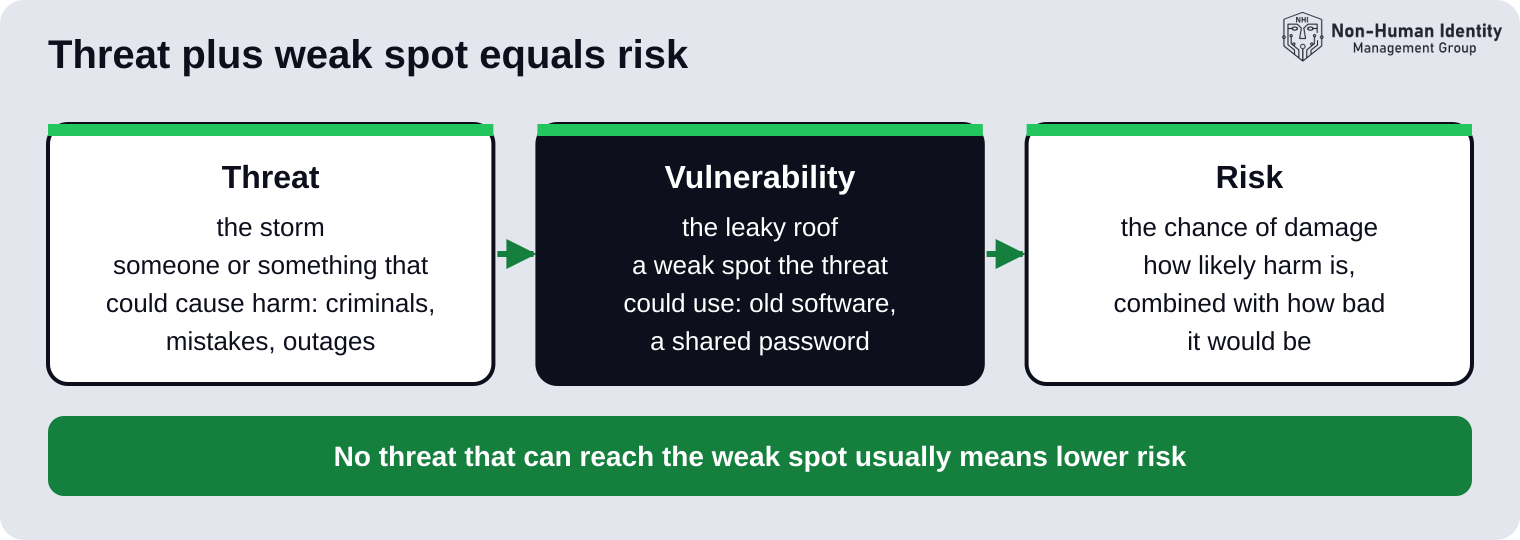
- A threat is someone or something that could cause harm, like a criminal gang or a power cut.
- A vulnerability is a weak spot the threat could use, like old software or a shared password.
- Risk is the chance that harm happens, combined with how bad it would be.
- A weakness with no threat that can reach it is usually lower risk than one that is open to attack.
What you will learn
- Explain the difference between a threat, a vulnerability and a risk.
- Sort everyday examples into the right group.
- Check how likely and how harmful a problem is before you rank it.
- Ask better questions when someone says "this is high risk".
- Danger (threat)
- someone or something that could cause harm to your systems or data.
- Weak spot (vulnerability)
- a gap or flaw that a danger could use to cause harm.
- Chance times damage (risk)
- how likely the harm is, combined with how bad it would be.
What are threats, vulnerabilities and risk?
Think of a house in stormy weather. The storm is the threat. A leaky roof is the vulnerability. The risk is how likely the storm is to hit that roof, and how much water damage it would cause.
Computers work the same way. A threat is anything that could harm your systems or data. It could be a criminal, a careless mistake or a flood in the server room.[1]
A vulnerability is a weakness that a threat could use. It might be a bug in software, a missing update or a weak password.[2]
Risk joins the two. It asks two questions. How likely is it that the threat uses the weakness? And if it does, how bad is the harm?[3]
So a leaky roof in a dry desert is a small risk. The same roof in a rainy town is a bigger one.
Where the comparison stops working: storms do not choose your house on purpose. Many cyber threats are people who look for weak spots and pick the easiest target.
Why does it matter?
Teams rarely have time to fix every weakness at once. Mixing up the three words can mean fixing the loudest problem, not the most harmful one. The UK's cyber agency says risk work should focus on the real risks to your organisation, not just on ticking boxes.[6]
If you are a student
What could happen: you lose marks or interview points for using the three words as if they were the same.
Check this: for any example, ask "Is this the danger, the weak spot or the chance of harm?"
If you manage a team
What could happen: you approve money to fix a scary-sounding weakness that nobody can reach.
Check this: ask how likely the harm is and what it would cost, not only how serious the weakness sounds.
If you are new to IT work
What could happen: you patch in score order and miss a weakness that attackers are already using.
Check this: look at whether a weakness is known to be in use, not just its score.
What does it look like?
Here is a made-up note from a team meeting. Each item has been sorted into the right group.
Example only. All values are made up.
Team notes: Example Shop Ltd (shop.example.com)
"Criminals sending fake invoices"        THREAT         (1)
"Old version of our website software"    VULNERABILITY  (2)
"Staff share one admin password"         VULNERABILITY  (3)
"Fake invoice tricks finance into         RISK           (4)
 paying: likely, and costly"
"Ransomware"                             THREAT, not yet a risk (5)
- A danger from outside. On its own it is not yet a risk.
- A weak spot. Attackers may know how to use old versions.
- A weak spot in how people work, not in the software.
- A full risk: who could cause harm, the weak spot, how likely it is and how bad it would be.
- One word is not a risk. It needs a weak spot, a likelihood and a cost to become one.
Why this is risky: a list that only says "Ransomware" or "Hackers" cannot be ranked, owned or fixed.
The safer way: write each risk as a short story. Say who could do it, which weak spot they would use, what would happen and how likely that is.
How does it work?
You can turn the three words into a simple habit.
- List what matters. Write down the data, systems and services your work depends on.
- Name the threats. Ask who or what could harm each one, such as criminals, mistakes or outages.
- Find the weak spots. Look for missing updates, weak passwords, wide access or gaps in backups.
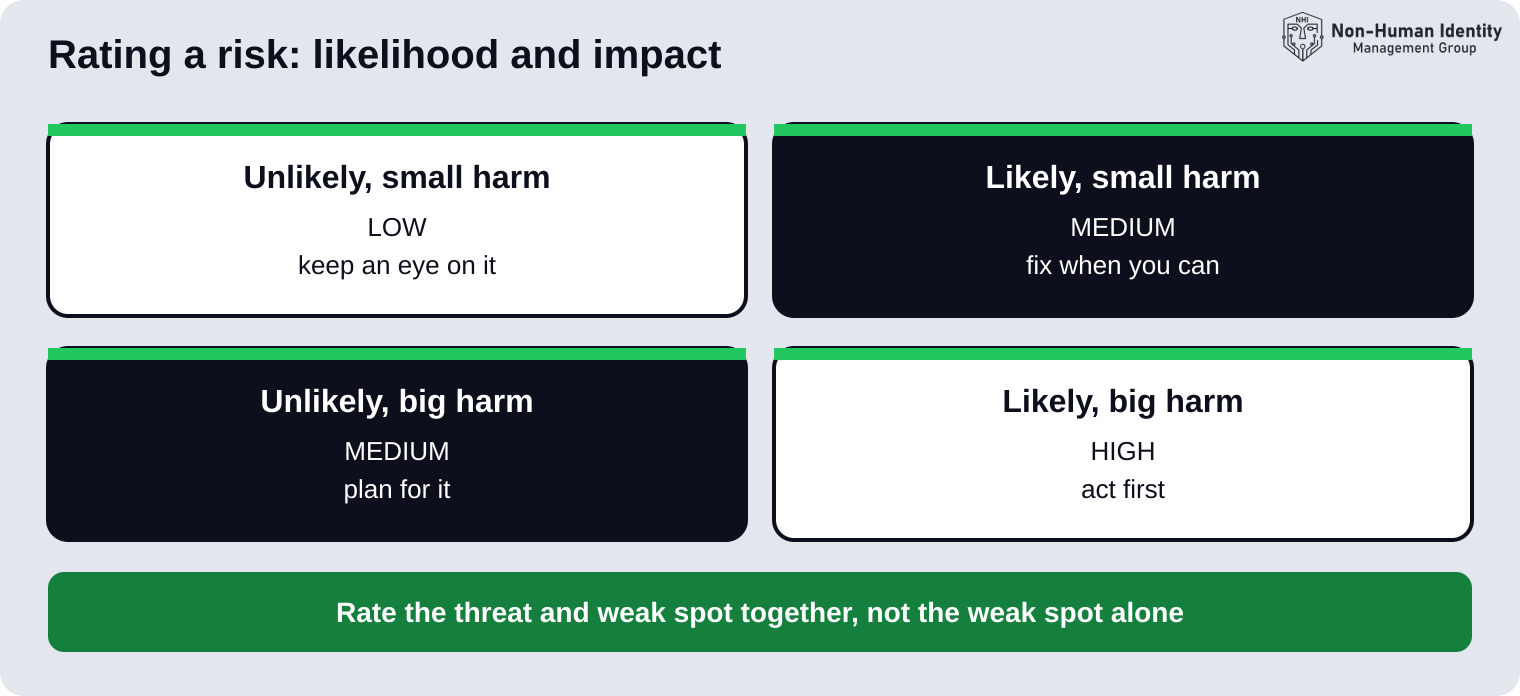
- Rate the risk. For each threat and weak spot together, ask how likely harm is and how bad it would be.[3]
- Decide and review. Fix, reduce, share or accept each risk, give it an owner and look again later.
Many weaknesses come with a severity score. The most common scoring system says its score shows how severe a weakness is compared with others. It is meant as one input to a risk decision, alongside facts about your own systems.[4] Lists of weaknesses that attackers are known to be using can also help you decide what to fix first.[5]
A worked example
Kaia Tanaka has just joined Linden Nursery, a fictional garden business with 20 staff, as office manager. Her boss, Fen Lindahl, hands her a report from their IT supplier.
The report lists 40 weaknesses. Three are marked "critical". Fen asks Kaia which ones to fix first.
Kaia thinks of the leaky roof. A leak only matters if rain can reach it. So she looks at each critical item and asks the supplier two questions. Can an outsider reach this? And what would happen if they used it?
The first critical item is on an old till that is not connected to the internet. Rain cannot easily reach that roof. The supplier rates the risk as lower.
The second is on the nursery's online shop. Anyone on the internet can reach it, and the supplier says attackers are already using this weakness. If it were used, customer details could leak. That is likely and harmful, so it goes first.
Kaia also spots something that is not in the report. Five staff share one password for the payments account. Criminals often send fake invoices. A shared password makes it harder to see who approved a payment.
She writes three short risk stories, each with an owner. Fen approves fixing the shop first, the shared password next, and the till at its next planned update.
Myths and mistakes
| What people think | What is true |
|---|---|
| Threat, vulnerability and risk all mean the same thing. | A threat is the danger, a vulnerability is the weak spot, and risk is how likely and how bad the harm is. |
| A critical score means critical risk. | The score shows how severe the weakness is. Your risk also depends on who can reach it and what it would harm.[4] |
| "Hackers" is a risk. | "Hackers" is a threat. Add the weak spot, likelihood and harm to make it a risk. |
| We have no weaknesses, so we have no risk. | New weaknesses are found all the time, and mistakes and outages are threats too. |
| Once rated, a risk stays the same. | Threats and systems change, so review your ratings regularly. |
What can I do this week?
- Pick three things your work depends on and list one threat to each.
- For each threat, write down one weak spot it could use.
- Rate each pair as low, medium or high, using likelihood and harm.
- Ask your IT team or supplier which weaknesses attackers are already using.
Checklist
- I can explain threat, vulnerability and risk in one sentence each.
- Our risk list describes stories, not single words like "Hackers".
- Each risk names a threat, a weak spot, a likelihood and a harm.
- We do not rank fixes on severity scores alone.
- We check whether a weakness is known to be in use.
- Every risk has an owner and a review date.
Common questions
What is the difference between a threat and a vulnerability?
A threat is the danger and a vulnerability is the weak spot. A criminal gang is a threat. An unpatched website is a vulnerability. The threat uses the vulnerability to cause harm. You can often fix vulnerabilities yourself, but you rarely control threats.
Is a risk the same as a vulnerability?
No. A vulnerability is a weak spot. Risk is the chance that a threat uses that weak spot, combined with how bad the harm would be. The same weakness can be high risk in one place and low risk in another, depending on who can reach it.
How do you measure risk?
Most simply, by rating likelihood and impact. Likelihood is how probable the harm is. Impact is how bad it would be. Many teams score each from low to high and combine them. Some use money figures instead, which is covered in risk quantification.
Can you have a risk without a vulnerability?
Rarely in a useful sense. Harm needs a way in, even if that way is a person who can be tricked or a single power supply. If you cannot find any weak spot, look again. Weak spots in how people work count too.
Where does an exploit fit in?
An exploit is the method or code that uses a vulnerability. It sits between the threat and the weak spot. When working exploits are widely available, the likelihood of harm usually goes up, so the risk rating should go up too.
Where next?
Ready for the detail? Read the practitioner guide: Threat vs Vulnerability vs Risk Guide. It goes further into the formal definitions from the standards, how to write risk scenarios and how to choose a treatment for each risk.
Also useful:
- Cyber Risk Management for Beginners
- Threat Modelling for Beginners
- CVE and CVSS for Beginners
- The CISA KEV Catalogue for Beginners
- Cyber Risk Quantification for Beginners
Related NHI Mgmt Group resources: Risk Register Template · CISA KEV Catalogue Guide · Business Impact Analysis vs Cyber Risk Assessment
Key terms
- Threat
- Anything that could cause harm to an organisation's systems, data or work.
- Vulnerability
- A flaw or weakness in code, settings or how things are done that could be abused.
- Risk
- The likelihood of a harmful event combined with how bad its effects would be.
- Threat actor
- A person or group that sets out to harm systems, data or trust.
- Exploit
- A method or code that uses a weakness to get in or cause disruption.
- Likelihood
- The estimated chance that a threat uses a weakness and causes harm.
- Risk register
- A list of risks with their likelihood, impact, owner and plan.
- CVSS
- A standard way to rate how severe a software weakness is.
Sources and further reading
- Threat (glossary entry, from NIST SP 800-30 Rev. 1). NIST Computer Security Resource Center. https://csrc.nist.gov/glossary/term/threat, accessed 28 Nov 2026.
- Vulnerability (glossary entry, from NIST SP 800-30 Rev. 1 and SP 800-53 Rev. 5). NIST Computer Security Resource Center. https://csrc.nist.gov/glossary/term/vulnerability, accessed 28 Nov 2026.
- Risk (glossary entry, from NIST SP 800-30 Rev. 1). NIST Computer Security Resource Center. https://csrc.nist.gov/glossary/term/risk, accessed 28 Nov 2026.
- Common Vulnerability Scoring System v4.0: Specification Document. FIRST. https://www.first.org/cvss/v4.0/specification-document, accessed 28 Nov 2026.
- Known Exploited Vulnerabilities. Cybersecurity and Infrastructure Security Agency (CISA). https://www.cisa.gov/known-exploited-vulnerabilities, accessed 28 Nov 2026.
- Risk management. National Cyber Security Centre (NCSC). https://www.ncsc.gov.uk/collection/risk-management, accessed 28 Nov 2026.