A ticket or holiday booking scam sells you tickets, trips or rooms that are fake or do not exist.
This guide is for anyone who buys event tickets or books trips and holiday lets online. You do not need to be careless to be caught: fake listings often copy real photos and real company names.
In short
- Scammers post cheap tickets or holiday lets, often on social media, then vanish once you pay.
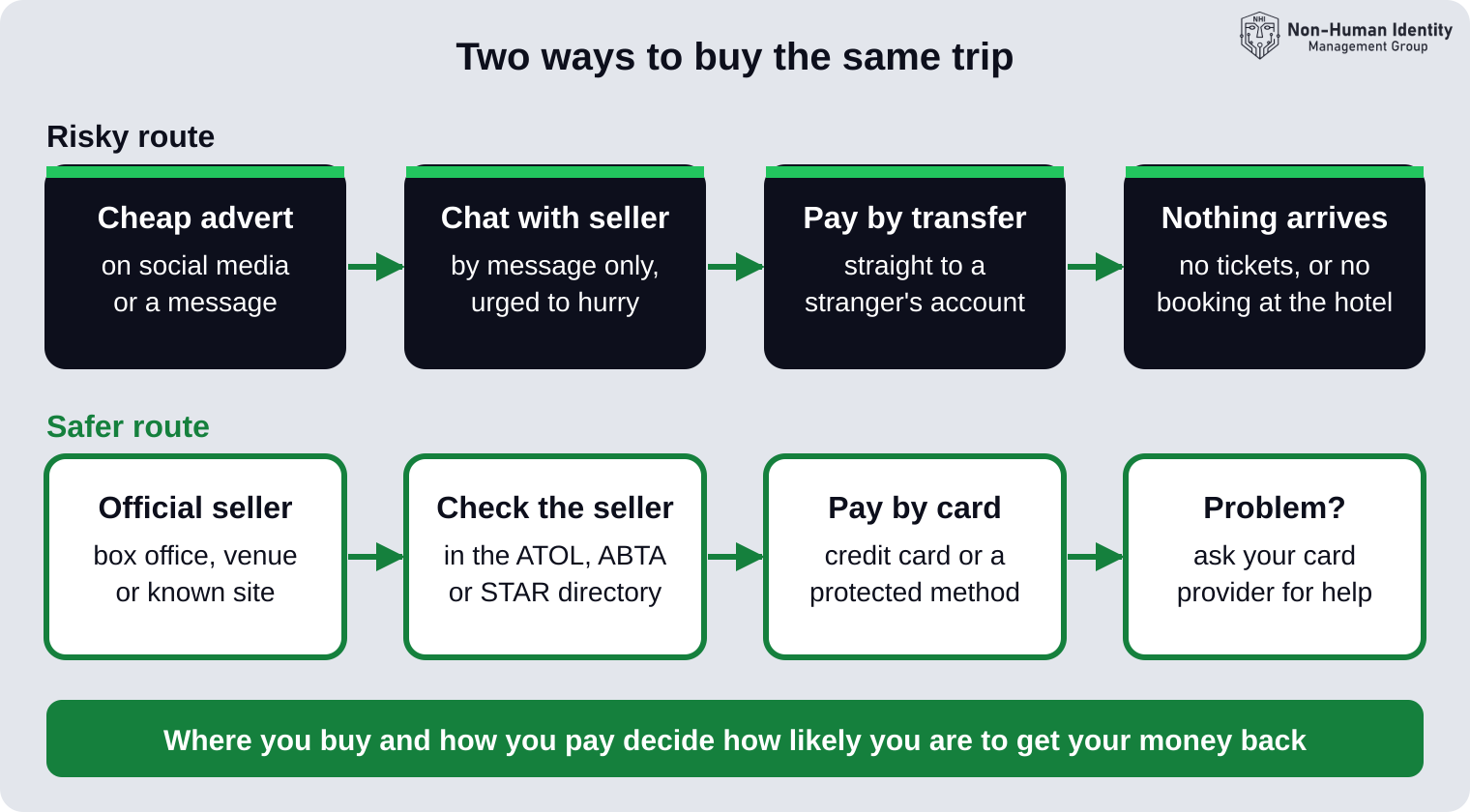
- Warning signs include prices that look too good, pressure to hurry and a request to pay by bank transfer.
- Buy from the venue, an official seller or a travel firm you can check in an official directory.
- Paying by credit card gives you a better chance of getting money back than a bank transfer.
What you will learn
- Spot the signs of a fake ticket or holiday listing.
- Explain why the way you pay matters so much.
- Check a seller or travel firm before you book.
- Know what to do first if you think you have been scammed.
- Fake advert (fake listing)
- an advert for tickets, a trip or a room that the seller does not have.
- Direct payment (bank transfer)
- sending money straight from your bank account to someone else's, which is hard to undo.
- Travel protection badge (ATOL)
- a UK licence for firms that sell flights and package holidays, which you can check online.
What are ticket and holiday booking scams?
Think of a stranger who sells you the key to a holiday flat they do not own. The key looks real, and the photos look lovely. When you arrive, the door does not open.
Ticket and holiday booking scams work the same way. Someone advertises tickets, a trip or a place to stay. You pay, and then nothing arrives, or the booking does not exist.[1][2]
Common types include:
- Fake tickets: tickets for sold-out shows, shows not yet on sale, or events that do not exist.[1]
- Copied holiday lets: real photos taken from genuine travel sites and posted with the scammer's contact details.[2][4]
- Fake travel firms: look-alike websites with names or web addresses close to real sellers.[1]
- Cheap deals by message: texts, emails or posts offering trips or tickets at very low prices.[2]
Where the comparison stops working: a fake key is a single object you could inspect. An online listing can look perfect, so the checks have to happen around it: who is selling, and how you pay.
Why does it matter?
These scams cost real money and can ruin a trip you planned for months. In 2024, UK victims reported losing over 11 million pounds to holiday fraud, and over half of reports mentioned social media.[3]
If you are buying tickets for a gig or match
What could happen: you pay a stranger for tickets that never arrive, or turn out to be fake at the gate.
Check this: buy from the venue, the official seller or a member of the UK ticket sellers' trade body, called STAR.
Next: Ticket Scams Guide
If you are booking a holiday or holiday let
What could happen: you arrive to find no booking, or a property that is not for rent.
Check this: look up the firm in the ATOL, ABTA or ABTOT directory, not just its logo.
If you rent out a holiday home
What could happen: a scammer copies your photos to sell fake stays, and angry guests turn up at your door.
Check this: search for your own photos and address now and then, and report copies to the site.
What does it look like?
Example only. All values are made up.
Seaview Cottage, sleeps 4. Only GBP 300 a week!   (1)
Two other families are asking, so book today.     (2)
I am abroad, so no viewings, sorry.               (3)
Pay the full amount by bank transfer:             (4)
  Name: EXAMPLE Lettings   Account: 0000 0000
Message me here, not on the booking site.         (5)
- A price far below what similar places cost.
- Pressure to decide fast, so you do not stop to check.
- An excuse for why you cannot see the property or meet anyone.
- A request to pay by bank transfer. In a real message, this line would hold the scammer's own account details.
- A push to leave the booking site, where its own protections and messages apply.
Why this is risky: each sign on its own can have an innocent reason. Together, they match the pattern police and consumer agencies warn about.[2][4]
The safer way: book through the site or firm directly, check the firm in an official directory, and pay by credit card.
How does it work?
This is a simple view so you can spot it. It is not a guide to doing it.
- The bait. The scammer posts a cheap advert, often on social media, or sends you a message.
- The trust. They use real photos, a believable name and sometimes fake badges or reviews.[3]
- The rush. They say others are interested, so you feel you must pay now.
- The payment. They ask for a bank transfer, cash, gift cards or crypto, which are hard to trace or undo.[2][4]
- The silence. Once paid, they stop replying. You find out at the venue or the airport.[2]
Badges can be faked. A travel firm can copy the ATOL or ABTA logo onto its website, so check it in the official directory instead.[3]
A worked example
This story is made up to show how it can happen.
Mira Wojcik wants a week by the sea for her family. Scrolling social media one evening, she sees a cottage advert. It has lovely photos and costs about half what similar places charge.
She messages the owner. He replies fast and is very friendly. He says two other families are keen, so she should book tonight. He is abroad, so there are no viewings. He asks for the full amount by bank transfer.
Mira feels the rush, but she pauses. She remembers that a price far below the norm is a classic warning sign. She copies one of the photos into an image search. The same cottage appears on a big holiday site, under a different name and at the normal price.
She contacts the cottage through that holiday site instead. The real owner says he has no connection to the social media advert. He has seen his photos copied before.
Mira books through the holiday site and pays by credit card. She reports the fake advert to the social media platform. She also reports it to Report Fraud, the UK fraud reporting service.[2]
What made the difference: Mira treated the low price and the rush as reasons to check, not reasons to hurry.
Myths and mistakes
| What people think | What is true |
|---|---|
| Real photos mean a real listing. | Scammers often copy photos from genuine sites.[2] Search the photos and the address. |
| An ATOL or ABTA logo on the site proves the firm is safe. | Logos can be faked. Check the firm in the official directory.[3] |
| Paying by bank transfer is fine if the seller seems nice. | Bank transfers to strangers are hard to undo. A credit card gives you a better chance of getting money back.[1] |
| Sold-out tickets are easy to find if you look hard enough. | Sold-out events are a favourite bait for fake ticket sellers.[1] Use the official resale route if there is one. |
| Someone who offers to get my money back for a fee can help. | Offers to recover lost money for a fee are often a second scam.[1] |
What can I do this week?
- Bookmark the official sites for the venues, airlines and travel firms you use most.
- Learn how to check a firm in the ATOL, ABTA and STAR member lists.
- Decide now that you will not pay strangers by bank transfer for tickets or trips.
- Turn on two-step sign-in for your email and booking accounts.[1]
- Save the Report Fraud website so you know where to go if something goes wrong.
Checklist
- I buy tickets from the venue, an official seller or a STAR member.
- I check travel firms in the official ATOL, ABTA or ABTOT directory.
- I search the photos and address of a holiday let before paying.
- I pay by credit card or another protected method, not bank transfer.
- I keep messages and payments inside the booking site.
- I treat a very low price and pressure to hurry as reasons to check.
- I know to call my bank straight away if I think I have been scammed.
Common questions
What should I do first if I think I paid a scammer?
Call your bank or card provider straight away, using the number on your card. They may be able to stop or recover the payment. Keep the adverts and messages as evidence. Then report it to Report Fraud, or to Police Scotland if you live in Scotland.
Why is a credit card safer than a bank transfer?
Card providers often have ways to help when goods or services never arrive. A bank transfer to a stranger is harder to undo. Report Fraud and ATOL both suggest paying by credit card where you can, and avoiding bank transfers to people you do not know.
How can I check a ticket seller?
Start with the venue's own website, which usually names its official sellers. In the UK, you can also look for members of STAR, the ticket sellers' trade body. Its members follow a code and can use its approved complaints service.
Is it safe to book a holiday let I found on social media?
It can be, but take extra care. Search the photos and address, check reviews from sites you trust and try to book through a known holiday site. If the owner insists on a bank transfer and no viewing, treat that as a warning sign.
Where next?
Ready for the detail? Read the practitioner guide: Rental and Holiday Booking Scams Guide. It goes further into how booking platforms are abused, the payment routes scammers prefer and what platforms and banks can do.
Also useful:
- Ticket Scams Guide
- Online Scams for Beginners
- Reporting Scams and Cybercrime for Beginners
- Payment Fraud for Beginners
Related NHI Mgmt Group resources: Online Marketplace Buying and Selling Safely Guide · Consumer Reporting Routes Map · Scalper Bots for Beginners
Key terms
- Fake listing
- An advert for tickets, a trip or a room that the seller does not have or has no right to sell.
- A scam where you are tricked into sending a bank payment yourself.
- Website spoofing
- Making a fake website that looks like a real seller's, often with a similar name or address.
- Tricking people into doing something, such as paying, by playing on trust or a sense of hurry.
- ATOL
- A UK licence for firms that sell flights and package holidays, which gives financial protection to holidays it covers.
Sources and further reading
- Ticket fraud. Report Fraud (City of London Police). https://www.reportfraud.police.uk/ticket-fraud/, accessed 28 Nov 2026.
- Holiday fraud. Report Fraud (City of London Police). https://www.reportfraud.police.uk/holiday-fraud/, accessed 28 Nov 2026.
- Don't let fraudsters trip you up this summer: new alert issued as people look to snap up online holiday deals (Action Fraud holiday fraud data for 2024, with ABTA, ATOL and ABTOT). ATOL, UK Civil Aviation Authority, 24 February 2025. https://www.atol.org/news-and-blogs/2025/02/24/dont-let-fraudsters-trip-you-up-this-summer-new-alert-issued-as-people-look-to-snap-up-online-holiday-deals/, accessed 28 Nov 2026.
- Rental listing scams. Federal Trade Commission (FTC), consumer advice, updated June 2026. https://consumer.ftc.gov/articles/rental-listing-scams, accessed 28 Nov 2026.