A crypto investigator follows stolen or criminal cryptocurrency and links it to real people and services.
This guide is for career changers, students and anyone curious about the people who trace crypto crime. You do not need to own cryptocurrency or know how to code to read it. If you work in fraud, policing, banking or data analysis, you may already have half the skills.
In short
- Most big cryptocurrencies keep a public record of every payment, so investigators can follow money from one address to the next.
- The record shows addresses, not names. The real skill is linking addresses to people, firms or services that know who their customers are.
- Investigators work for police and government, crypto exchanges, banks and specialist tracing firms.
- People come in from fraud, financial crime, policing, digital forensics and data jobs, then add crypto tracing skills.
What you will learn
- Explain what a crypto investigator does in one sentence.
- Describe how money can be followed on a public record.
- Spot why a trace on its own is rarely the end of a case.
- Check which of your skills the job already uses.
- Shared public record (blockchain)
- a list of payments copied across many computers that is very hard to change once written.
- Account number for crypto (wallet address)
- a long string of letters and numbers that can send or receive cryptocurrency.
- Crypto business (exchange)
- a company that swaps cryptocurrency for normal money and usually checks who its customers are.
What is a crypto investigator?
Think of footprints in fresh snow. You can follow every step from the start of the trail to the end. But the prints do not tell you the walker's name.
Most big cryptocurrencies work the same way. Each payment is written on a shared public record called a blockchain. On open networks, anyone can read it, and the records are generally public.[1] Users are not named. They show up as account numbers called addresses, and one person can make as many addresses as they like.[1]
A crypto investigator follows those footprints. They trace where the money went, then try to find the point where it touched a business that knows its customers, such as an exchange. That link turns an address into a lead that police, courts or compliance teams can act on.
Where the comparison stops working: snow melts, but a blockchain record usually stays. And criminals can split money into many small trails, mix them together or jump to another network to make the trail harder to follow.
Why does it matter?
Crypto crime causes large losses. In 2024, the FBI's internet crime centre received complaints involving cryptocurrency with reported losses of about 9.3 billion US dollars.[2] Investigators help victims, police and businesses understand where that money went.
If you work in fraud or financial crime
What could happen: crypto cases land on your desk and you pass them on because the topic feels unfamiliar.
Check this: list the skills you use on bank fraud cases. Most of them, such as following money and writing case notes, carry across.
If you work in policing
What could happen: a victim brings you a list of crypto payments and nobody on the team knows what to do with it.
Check this: ask whether your force has a crypto or economic crime unit you can learn from.
If you are a student or data analyst
What could happen: you assume the job is all about trading, and miss that it is really careful research.
Check this: look up a public blockchain explorer and follow one old, well-known payment from start to end.
What does it look like?
Investigators keep careful notes of each step in a trace. Here is a made-up, simplified case note.
Example only. All values are made up.
CASE 0000-EXAMPLE  Fake investment site
Start:   victim payment to FAKE-ADDR-0001        (1)
Hop 1:   FAKE-ADDR-0001 -> FAKE-ADDR-0002        (2)
Hop 2:   split into 5 smaller payments           (3)
Hop 3:   3 of 5 reach EXAMPLE Exchange Ltd       (4)
Link:    exchange account holder: unknown        (5)
Next:    formal request to exchange (pending)    (6)
- The payment the victim made. In a real file, this line would contain the actual address and payment reference.
- The money moves to a second address, often within hours.
- It is split up, which makes the trail harder to follow.
- Part of it arrives at a business that checks its customers.
- The trace shows where the money went, but not yet who controls it.
- Only the exchange can say who owns the account, usually after a formal legal request.
Why this is risky: a trace alone is not proof of who did it. Guessing a name from a pattern could point at the wrong person.
The safer way: record every step, label what is fact and what is a guess, and let the exchange or the courts confirm identities.
How does it work?
Cases differ, but many follow these steps.
- Collect the starting facts. The investigator gathers the victim's payment details, the addresses used and the dates and amounts.
- Follow the money. Using the public record and tracing software, they follow each payment from address to address.
- Find a link to the real world. They look for points where the money reached an exchange or other business that checks customer identity.
- Check against lists. Some governments publish crypto addresses linked to sanctioned people. The US Treasury, for example, adds such addresses to its sanctions list, while warning the list is not complete.[3]
- Write it up. They turn the trace into a clear report. Police, lawyers or a compliance team can then act on it, for example by asking an exchange to freeze an account.
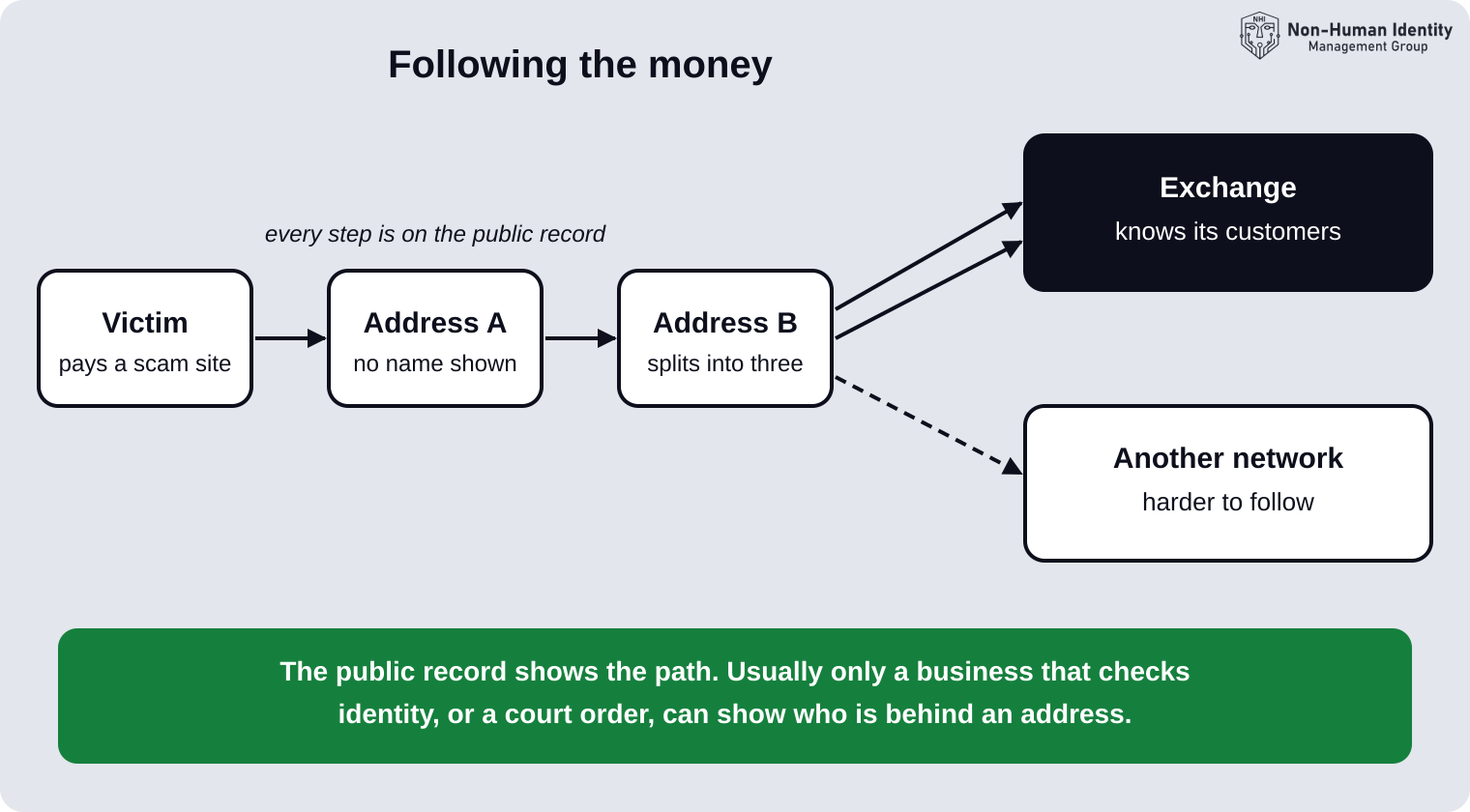
Rules help investigators here. A global anti-money laundering body extended its standards to crypto businesses in 2019. Under those standards, exchanges and similar firms are expected to check who their customers are and keep records.[4] Those records are what let a trace end in a name.
Skills and tools
- Following money. The same habits used in fraud and financial crime work.
- Blockchain basics. How addresses, payments and different networks work.
- Tracing software. Tools that draw the flow of money and label known services.
- Careful records. Notes that someone else could check step by step.
- Clear writing. Reports that a court or compliance team can understand.
- Knowing the rules. Anti-money laundering and sanctions basics.
Routes in
There is no single route. Many investigators start in fraud, anti-money laundering, policing, digital forensics or data analysis. They then add crypto tracing skills through training and practice. Employers include police and government agencies, crypto exchanges, banks and specialist tracing firms.
A worked example
Hugo Engel is a retired engineer. He paid savings in cryptocurrency into what looked like an investment website. When he tried to withdraw, the site vanished. He reported it to the police and kept every payment receipt.
Vida Strand is a crypto investigator in the financial crime team at a fictional exchange. A week later, she receives a formal police request. It lists Hugo's payments and asks whether any of the money reached her exchange.
Vida thinks of footprints in snow. She starts at Hugo's first payment and follows each step on the public record. The money moved twice within a day, then split into five smaller payments.
Three of those payments arrived at accounts on her own exchange. The other two went to a different network, where the trail gets harder to follow.
Vida does not guess who is behind the accounts. She checks the exchange's own customer records, as the police request allows. Under the exchange's policy, she places a hold on the funds still in those accounts.
Her colleague Orla Iyer reviews the trace step by step before it goes out. They mark which points are confirmed and which are likely but unproven.
Vida sends the police a short report with the account details, the trace and a clear list of what is known and what is not. The police take the case forward. Hugo learns that some of his money has been located. Whether he gets it back will depend on the legal process.
Myths and mistakes
| What people think | What is true |
|---|---|
| Cryptocurrency is anonymous, so it cannot be traced. | On many networks every payment is public. Users appear as addresses, not names, which is why it is called pseudonymous.[1] |
| Tracing the money proves who stole it. | A trace shows where money went. Linking it to a person usually needs records from a business or a court. |
| You need to be a crypto trader. | Investigation skills matter more. Many investigators come from fraud, policing or data work. |
| Stolen crypto is always recovered once traced. | Sometimes funds are frozen or seized. Often they have already moved on or been cashed out. |
| Investigators can see inside anyone's wallet. | They see what is on the public record. Private details need lawful requests to the businesses that hold them. |
What can I do this week?
- Read three crypto investigator job adverts and list the tasks they share.
- Open a public blockchain explorer and follow one old, well-known payment.
- Read our Crypto Scams for Beginners guide to see the cases investigators work on.
- Ask someone in fraud work how crypto cases reach their team.
Checklist
- I can explain what a crypto investigator does in one sentence.
- I know what a blockchain, a wallet address and an exchange are.
- I understand why a trace shows addresses, not names.
- I know why exchanges and their customer records matter to a case.
- I can point to times I followed a trail of evidence or kept careful notes.
- I have checked official sources for pay, not just job boards.
- I have a plan for one first learning step.
Common questions
Do I need to own cryptocurrency to do this job?
No. You need to know how it works, not to invest in it. Many people learn with free public tools that show the record, and with free training. Employers want careful, honest case work and clear reports. Trading skill is not the point.
Who employs crypto investigators?
Several kinds. Police and government agencies look into crime. Crypto exchanges and banks have teams that check their own customers. Tracing firms help victims, lawyers and businesses. Job titles vary, so also search for blockchain analyst.
How is this different from a cyber crime investigator?
It is a narrower job. A cyber crime investigator looks at many kinds of online crime, such as hacking. A crypto investigator mainly follows crypto money. The two often work together, because many cyber crimes end with a crypto payment. See Cyber Crime Investigator for Beginners.
How much does a crypto investigator earn?
Pay varies by country, employer and experience. Official bodies do not publish a figure for this exact job, so we do not quote one. For a related investigative job, see the US government's page on private detectives and investigators.[5]
Can a crypto investigator get my money back?
Not on their own. Private firms cannot order a seizure. Exchanges freeze accounts only through their own processes or legal steps. The FBI warns that fake recovery firms target scam victims and ask for fees upfront.[6] If you have lost money, report it to the police first.
Where next?
Ready for the detail? Read the practitioner guide: Crypto Investigator Career Guide. It goes further into the tools and techniques investigators use, anti-money laundering and sanctions rules, certifications and how careers progress.
Also useful:
- Blockchain Analytics for Beginners
- Cyber Crime Investigator for Beginners
- AML and Financial Crime Analyst Career Guide
- Cryptocurrency Laundering by Cybercriminals
- Digital Forensics for Beginners
Related NHI Mgmt Group resources: Cybersecurity Careers Guide · Career Change into Cyber Security Guide · Crypto Wallets and Keys for Beginners
Key terms
- Blockchain
- A shared record of transactions, copied across many computers, that is very hard to change once written.
- Cryptocurrency
- Digital money that is sent and recorded on a blockchain rather than through a bank.
- Wallet address
- A public string of characters that can send or receive cryptocurrency.
- Blockchain analytics
- Using software to follow and label payments on a blockchain.
- Money laundering
- Hiding where criminal money came from so it looks legitimate.
- Virtual asset service provider
- A business, such as an exchange, that handles cryptocurrency for customers.
- Cryptocurrency mixer
- A service that blends many users' payments together to make them harder to trace.
Sources and further reading
- Blockchain Technology Overview (NISTIR 8202). US National Institute of Standards and Technology, October 2018. https://csrc.nist.gov/pubs/ir/8202/final, accessed 28 Nov 2026.
- Internet Crime Report 2024. FBI Internet Crime Complaint Center (IC3), 2025. https://www.ic3.gov/AnnualReport/Reports/2024_IC3Report.pdf, accessed 28 Nov 2026.
- Frequently Asked Question 562: digital currency addresses on the SDN List. US Treasury Office of Foreign Assets Control. https://ofac.treasury.gov/faqs/562, accessed 28 Nov 2026.
- Virtual assets. Financial Action Task Force (FATF). https://www.fatf-gafi.org/en/topics/virtual-assets.html, accessed 28 Nov 2026.
- Private Detectives and Investigators, Occupational Outlook Handbook. US Bureau of Labor Statistics, last modified 29 October 2026. https://www.bls.gov/ooh/protective-service/private-detectives-and-investigators.htm, accessed 28 Nov 2026.
- Increase in Companies Falsely Claiming an Ability to Recover Funds Lost in Cryptocurrency Investment Scams (I-081123-PSA). FBI and IC3, 11 August 2023. https://www.ic3.gov/PSA/2023/PSA230811, accessed 28 Nov 2026.