A cyber crime investigator is a person who looks into online crimes, gathers proof and helps bring offenders to account.
This guide is for students, career changers and anyone who has wondered what happens after a hack or online fraud is reported. You do not need a technical background to read it. If your business is ever hit by online crime, these are the people who may pick up the case.
In short
- Cyber crime investigators look into hacking, online fraud, ransomware and similar crimes.
- They talk to victims, gather proof, trace who did it and decide with others what action to take.
- Many cases cross borders, so they work with other police forces, agencies and companies.
- People get in through the police, national crime agencies, degrees, and IT or fraud jobs.
What you will learn
- Explain what a cyber crime investigator does in one sentence.
- Spot how an investigator differs from a forensics analyst.
- Check which of your skills already fit the job.
- Ask good questions about the routes in before you apply.
- Proof from computers (digital evidence)
- files, messages and records that can show what happened online or on a device.
- Hand-over record (chain of custody)
- a note of who held the evidence, when and why.
- Taking a case to court (prosecution)
- charging a suspect and asking a court to decide if they are guilty.
What is a cyber crime investigator?
Think of a detective in a crime story. A crime is reported. The detective talks to the people involved, follows the clues and builds a case that will stand up later.
A cyber crime investigator does the same, but the crime happened through computers. It might be a hacked firm, a stolen bank login or a ransomware attack, where criminals lock files and demand money. The US government's list of cyber security jobs says this role investigates online intrusions and crimes.[1]
The job is wider than the computer work. Investigators interview victims and witnesses. They work out whether a law was broken and what proof is needed. They write reports and may help lawyers explain the technical side in court.[1]
Where the comparison stops working: a story detective can usually knock on the suspect's door. Online criminals and their computers are often in other countries, so investigators rely on partners abroad.[2]
For how victims should report these crimes, read Reporting Scams and Cybercrime for Beginners. This page is about the job and the people who do it.
Why does it matter?
Online crime hurts people and firms of every size. Investigators help stop the people behind it. They also learn how the crimes work, so others can be warned.
If you are a student choosing a path
What could happen: you think policing and computing are two separate careers, and miss a job that joins them.
Check this: look at police and crime agency careers pages for cyber or digital roles.
If you run a small business
What could happen: after an attack, you wipe the computers straight away. The clues an investigator needs are lost.
Check this: know who you would report a crime to, and keep emails and records safe until you have.
If you work in fraud or IT
What could happen: you think your job does not count. In fact, careful checking and clear notes carry straight over.
Check this: list times you traced a problem back to its cause and wrote up what you found.
What does it look like?
A lot of the job is careful case notes. Here is a made-up page from an investigator's case log.
Example only. All values are made up.
CASE 0000-EXAMPLE      Officer: A. Example
Victim:   Example Ltd, small firm                    (1)
Crime:    fake invoice email, payment sent           (2)
Evidence: email copy saved, hash 0000FAKE0000        (3)
Lead:     payee bank account EXAMPLE-0000            (4)
Action:   request to bank sent 11:40                 (5)
Next:     check for other victims of same email
- Who reported the crime. The victim's account is the start of the case.
- What happened, in plain words. This helps decide which law may have been broken.
- In a real file, this line would contain a long code worked out from the saved email. It shows the copy has not changed.
- A lead: where the money went. Following the money is a common way to trace offenders.
- Each request is logged with a time, so the case can be checked later.
Why this is risky: if a step is missing from the log, a defence lawyer may later ask whether the evidence was changed.
The safer way: write each step down when it happens. Keep the log with the evidence.
How does it work?
Every case is different, but many follow a pattern like this.
- Report. A victim reports the crime, or a partner such as a bank or a security firm passes on a tip.
- Assess. The investigator works out what happened, whether a law was broken and how serious it is.[1]
- Gather evidence. They collect and protect digital evidence, keeping a chain of custody, a record of who held it and when. Forensics specialists often help here.[1]
- Trace. They follow leads such as accounts, payments and web addresses, often with partners in other countries.[2]
- Act. With others, they choose a next step. That might be an arrest and prosecution, shutting down the criminals' tools, or gathering more information first.[1]
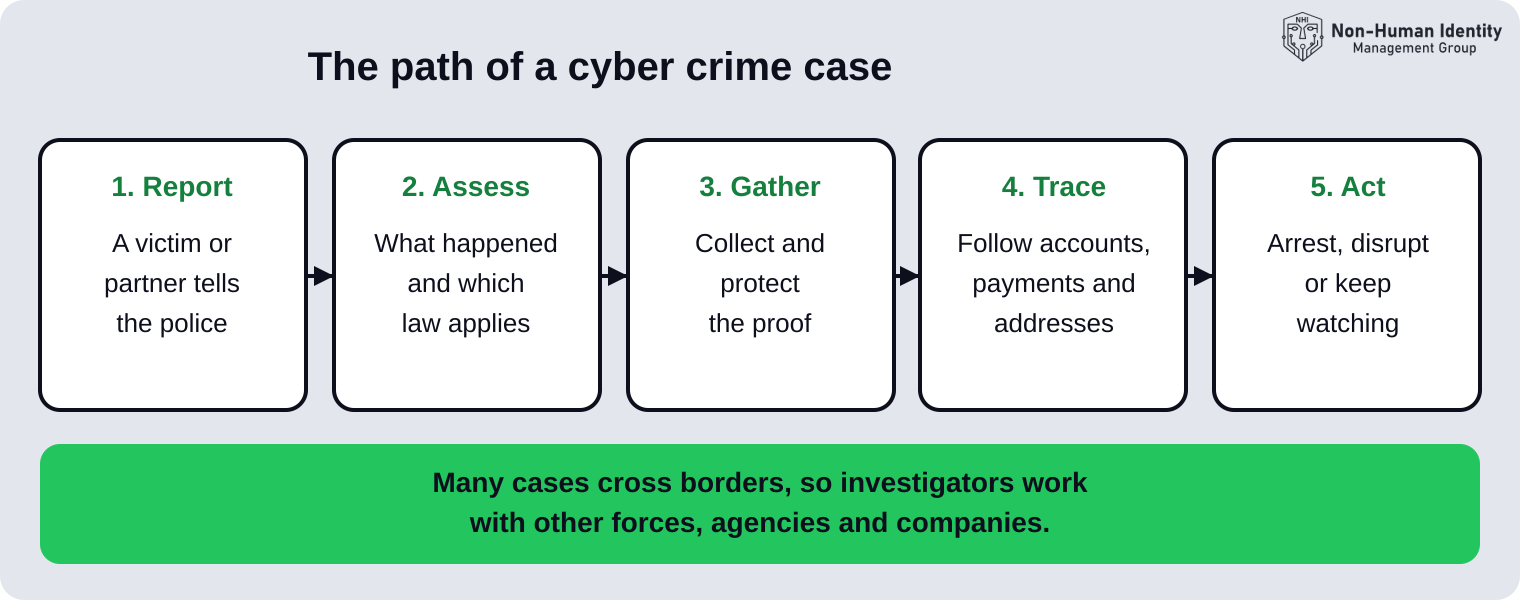
In the UK, the National Crime Agency works with police forces, regional crime units, other countries and private firms to share information and act together.[2] Not every case ends in court. Sometimes stopping the harm quickly matters more.
Skills and tools
The US government's job list describes the skills this role needs.[1] In plain words, they are:
- Knowing how computers, networks and the internet work.
- Knowing how online criminals work and what tools they use.
- Handling evidence with care, so it can be trusted in court.
- Interviewing people and judging what they say.
- A working grasp of the laws on computer crime, privacy and evidence.
Investigators use case software, forensic tools and tools for searching public websites. Each force or agency has its own set. Clear writing and calm talking with upset victims matter just as much.
Routes in
There is no single way in. Common routes include:
- Joining the police, then moving into investigation work. In England, routes include a degree apprenticeship and entry schemes for people who already have a degree.[4]
- Training as a detective. Police officers can move into the criminal investigation department, and there is also a national detective entry scheme.[4]
- Joining a national agency. The UK's National Crime Agency hires people from many backgrounds, not only policing.[3]
- Moving across from IT, cyber security, bank fraud teams or forensics work.
Police and agency jobs need background checks, and police officers must pass a fitness test.[4] Check each employer's own pages for rules on age and nationality.
How the role connects to others
Investigators work closely with forensics analysts, who examine devices in depth. They also work with prosecutors, banks, security firms and victim support teams. Inside a firm, an incident responder deals with the attack itself, and the investigator focuses on the crime.
A worked example
Bruno Marlow is a cyber crime investigator in a fictional regional police unit. Before this, he spent four years on a bank's fraud team.
On Monday a report arrives from Calla Lomax, who runs Cedar Accountants, a fictional firm. Her office manager paid a supplier invoice that came by email. The supplier now says it never sent it. The money went to a stranger's account.
Bruno thinks of a story detective. The crime has happened. His job is to follow the clues and build a case that others can check.
He calls Calla first. He asks her to keep the email and not to delete anything. He saves a copy of the email and notes where it came from and when.
Next, he looks at the account the money went to. He sends a formal request to the bank and logs the time. The bank replies that the account was opened a week earlier.
His colleague, Hugo Whitlock, searches the unit's records. Two other firms reported near-identical emails last month. The same account appears in one of them. The case is now bigger than one firm.
Bruno does not jump to blame anyone. The account holder may be a victim too, used by the real criminals to move money.
By Friday, Bruno has written up what the evidence shows and what it does not. He passes the linked cases to a specialist team. He also sends Calla advice on checking bank details by phone before paying.
Myths and mistakes
| What people think | What is true |
|---|---|
| It is all hacking, like on TV. | Much of the job is interviews, careful notes, requests for records and report writing.[1] |
| You must be a police officer. | Many investigators are officers, but agencies also hire people from other backgrounds.[3] |
| Online criminals cannot be caught. | Cases can be hard, especially across borders, but forces and agencies work together to act against offenders.[2] |
| Every case should end in court. | Sometimes disrupting the crime or gathering more information is the better choice.[1] |
| The investigator and the forensics analyst do the same job. | They overlap. The investigator runs the case. The forensics analyst examines the devices in depth. |
What can I do this week?
- Read three cyber crime investigator job adverts and list the tasks they share.
- Read the official police officer careers profile to see the routes in.[4]
- Learn how to report a scam or cyber crime where you live.
- Read our Digital Forensics for Beginners guide.
Checklist
- I can explain what a cyber crime investigator does in one sentence.
- I know what digital evidence and a chain of custody are.
- I know how an investigator differs from a forensics analyst.
- I know why many cases need partners in other countries.
- I have looked at real job adverts for the role.
- I have checked the background check rules for jobs near me.
- I have checked official sources for pay, not just job boards.
Common questions
Do I need to join the police first?
Not always. Many investigators are police officers who moved into cyber work. But national agencies such as the UK National Crime Agency hire people from many backgrounds. Check each employer's careers pages for the routes they offer.[3]
Is an investigator the same as a forensics analyst?
No, though they work closely. The investigator runs the case, talks to people and decides what proof is needed. The forensics analyst examines devices in depth. See Digital Forensics Analyst for Beginners.
What kinds of crime do they look into?
Many kinds. Common ones are hacking, fake emails that trick people into paying, ransomware and online fraud. Some teams focus on the most harmful groups. Others help local victims. The mix depends on the unit and the country.[2]
How much does an investigator earn?
Pay varies a lot by country, employer and rank, so we do not quote a figure here. Use official sources. In the UK, the National Careers Service profile for police officers gives a guide.[4] Job adverts in your area also help.
Where can the job lead?
Many paths. Investigators can lead teams, join national or international units, or move into intelligence work. Some move to banks or security firms, where they look into fraud and attacks for the business.
Where next?
Ready for the detail? Read the practitioner guide: Crypto Investigator Career Guide. It goes further into one fast-growing kind of investigation work: the skills, tools, certifications and ethics of tracing criminal money.
Also useful:
- Digital Forensics Analyst for Beginners
- Reporting Scams and Cybercrime for Beginners
- Cybercrime as a Service for Beginners
- Engaging Law Enforcement During a Cyber Incident Guide
Related NHI Mgmt Group resources: Cybersecurity Careers Guide · Cybercrime Law Enforcement Takedowns Guide · Cybercrime Ecosystem Guide
Key terms
- Digital evidence
- Files, messages and records that can show what happened online or on a device.
- Chain of custody
- A record of who collected, held and passed on evidence, and when.
- Digital forensics
- Finding and examining evidence on computers and phones in a way others can check.
- Ransomware
- Harmful software that locks files and demands money to unlock them.
- Business email compromise
- A scam where criminals use a real or fake business email to trick staff into paying.
- Phishing
- Fake messages that trick people into giving away details or clicking harmful links.
Sources and further reading
- Cybercrime Investigation, work role. NICE Workforce Framework for Cybersecurity (NIST SP 800-181 Rev. 1), NICCS, US Cybersecurity and Infrastructure Security Agency. https://niccs.cisa.gov/workforce-development/nice-framework/work-role/cybercrime-investigation, accessed 28 Nov 2026.
- Cyber crime. National Crime Agency (UK). https://www.nationalcrimeagency.gov.uk/what-we-do/crime-threats/cyber-crime, accessed 28 Nov 2026.
- Careers. National Crime Agency (UK). https://www.nationalcrimeagency.gov.uk/careers, accessed 28 Nov 2026.
- Police officer, job profile. National Careers Service (England). https://nationalcareers.service.gov.uk/job-profiles/police-officer, accessed 28 Nov 2026.