A cyber policy analyst studies security problems and turns them into clear rules, plans and advice for decision makers.
This guide is for students, career changers and anyone who likes reading, writing and debating more than coding. You do not need a technical background to follow it. Every time a government announces a new cyber law or a company updates its security rules, policy analysts have usually done the groundwork.
Status: correct as at 28 November 2026, based on official government and standards body sources cited below. Laws and policies change; check the official text.
This guide explains the topic in general terms and is not legal advice.
In short
- A cyber policy analyst researches a security problem, weighs the options and writes advice that leaders can act on.
- They work in government, regulators, think tanks, industry bodies and large companies.
- Most of the day is reading, talking to experts, writing short papers and answering questions about rules.
- People come in from politics, law, international relations, journalism, IT and security jobs. Clear writing matters most at the start.
What you will learn
- Explain what a cyber policy analyst does in one sentence.
- Spot the difference between public policy work and company policy work.
- Check which of your current skills the job uses.
- Ask good questions about a policy job before you apply.
- Written rule (policy)
- a statement of what an organisation or government expects people to do, and why.
- Short advice paper (policy brief)
- a few pages that explain a problem, the options and a recommendation.
- Public feedback round (consultation)
- a period when a government asks the public and businesses what they think of a planned rule.
What is a cyber policy analyst?
Think of a map maker for a city council. They do not build the roads. They study how people travel, then draw plans that help leaders decide where the roads should go.
A cyber policy analyst does a similar job for online security. They study a problem, such as ransomware or weak passwords on smart devices. Then they set out the choices and write clear advice.
There are two broad kinds of work. Public policy means helping a government, regulator or think tank decide on national rules and plans. A national cyber strategy is one example of this kind of work.[1] Organisational policy means writing and updating the security rules inside one company or public body.
A US government guide to cyber jobs lists tasks for policy and planning work. They include writing security policies, folding laws into those policies and advising managers and staff on them.[2]
Where the comparison stops working: a road plan can take years and stays put once it is built. Online threats change fast, so cyber policy is checked and rewritten often.
Why does it matter?
Good rules help many people at once. A poor rule can cost money and still leave gaps. Policy analysts help leaders choose rules that are clear, fair and workable.
If you are studying politics, law or history
What could happen: you assume cyber security is only for coders, and miss a job that uses your research and writing.
Check this: read one government cyber strategy summary and note the problems it tries to solve.
If you run a small business
What could happen: a new rule arrives and you only hear about it when a customer asks if you comply.
Check this: look out for public feedback rounds on rules that affect your sector.
If you already work in IT
What could happen: you get asked to explain a new law to managers and are not sure where to start.
Check this: find the official summary of the law and write down three things it asks of your team.
What does it look like?
A lot of policy work ends up as a short advice paper. Here is the outline of a made-up one.
Example only. All values are made up.
POLICY BRIEF 0000-EXAMPLE
To:       Director, Digital Department (FAKE)
Problem:  Small firms rarely report cyber attacks   (1)
Evidence: Survey EXAMPLE, interviews with 0 firms   (2)
Option A: Do nothing                                (3)
Option B: Free advice line plus simple guide
Option C: Make reporting a legal duty
Advice:   Option B first, review in 00 months       (4)
Risks:    (not yet written)                         (5)
- The problem, in one plain line.
- Where the facts come from. In a real file, this line would contain named sources that a reader can check.
- Doing nothing is always an option, so leaders can compare.
- The recommendation, with a date to check whether it worked.
- The risks box. Here it is empty, so leaders cannot see the downsides.
Why this is risky: a brief that hides the downsides can lead to a rule that fails, or that costs small firms more than expected.
The safer way: list the risks and costs of each option, say who was asked and say what is still unknown.
How does it work?
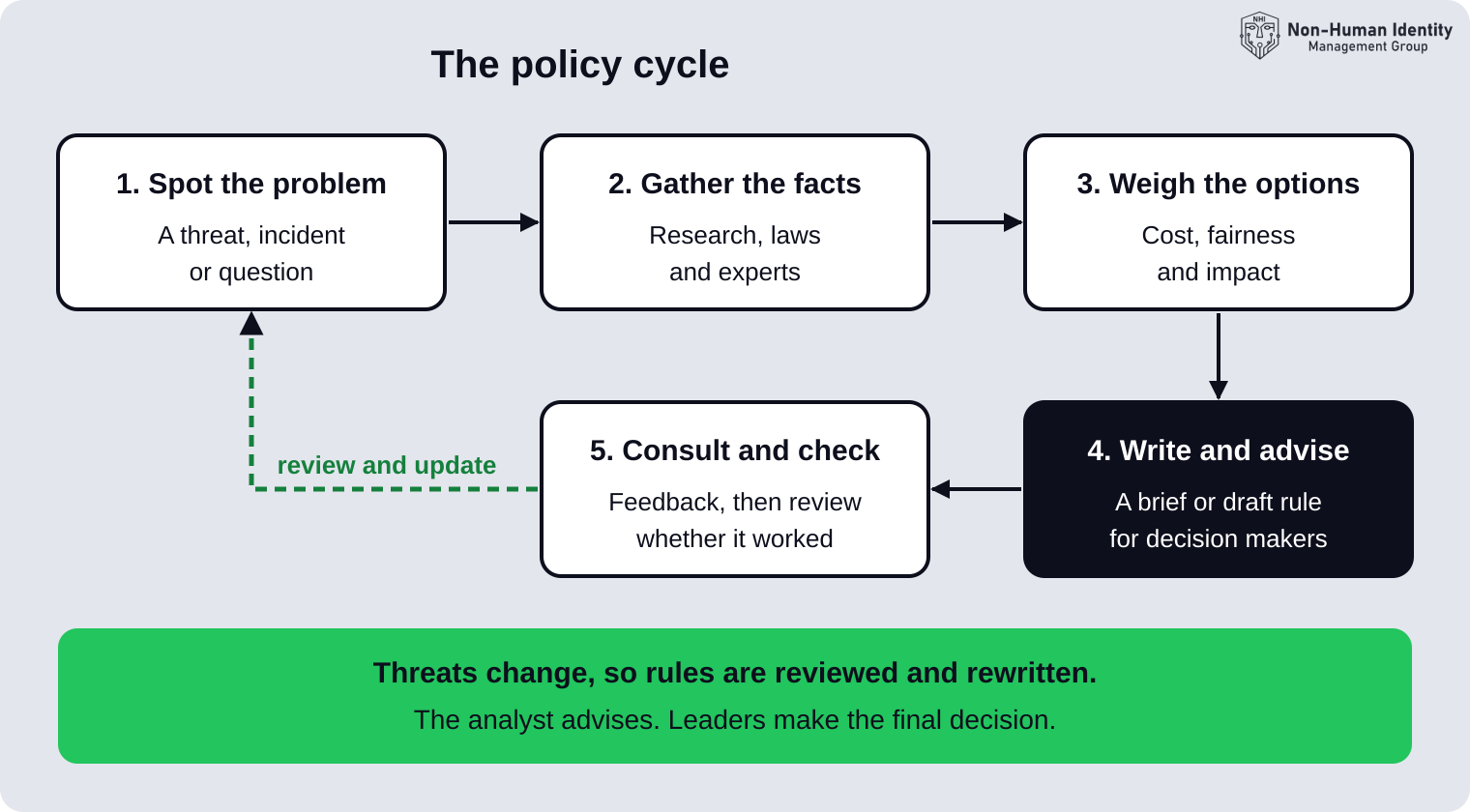
Every team works a little differently, but policy work often follows a cycle like this one.
- Spot the problem. The work often starts with a new threat, a big incident or a question from a minister or a manager.
- Gather the facts. The analyst reads research and existing laws, and talks to technical experts and the people who would be affected.
- Weigh the options. They compare choices on cost, fairness, how easy each is to follow and how much it would help.
- Write and advise. They write a brief or a draft rule and explain it to the people who decide.
- Consult and check. A public body often asks for feedback before a rule is final. Later, someone checks whether the rule worked.
Skills and tools
- Clear writing. Short papers that a busy reader can follow in a few minutes.
- Research. Finding good sources and telling strong evidence from weak.
- Enough technical knowledge. Knowing how attacks and safeguards work in broad terms, so you can ask experts the right questions.
- Listening and judgement. Weighing different views, including people who disagree.
- Everyday tools. Word processors, spreadsheets, official law databases and shared drafting tools. Most of the work needs no special software.
Routes in vary. Some people join a government graduate scheme or a think tank internship. Others move across from law, journalism, IT support or a security team. Europe's skills framework has a profile for people who handle cyber law, policy and compliance, which shows how employers describe this kind of work.[3]
A worked example
Ivo Quist is a junior cyber policy analyst in a fictional government department. His team has been asked a question: why do so few small firms report cyber attacks?
On Monday he reads past surveys and the department's own guidance. He thinks of the map maker. Before drawing a plan, he needs to know how people really travel.
On Tuesday he calls Imani Kowal, who owns Hazel Joinery, a fictional small furniture maker. Last year her email was taken over by a scammer. She did not report it. "I did not know who to tell, and I was worried it would cause trouble," she says.
Ivo hears similar stories from four other owners. He notes them carefully and keeps names out of his notes.
On Wednesday he drafts a two-page brief with three options. Doing nothing. A free advice line with a simple guide. A legal duty to report. He writes down the cost and the downsides of each one.
His manager, Jonah Vance, asks a hard question. Would a legal duty scare firms away from asking for help? Ivo adds this to the risks box.
On Friday the brief goes to the director. It recommends the advice line first, with a review in a year. It also suggests a public feedback round before any new legal duty.
Ivo does not decide the rule. His job is to make sure the people who decide can see the facts and the trade-offs clearly.
Myths and mistakes
| What people think | What is true |
|---|---|
| You need to be a hacker to work in cyber policy. | Most of the job is research and writing. Broad technical knowledge helps, and it can grow over time. |
| Policy analysts make the law. | Analysts advise. Elected officials, regulators or company leaders make the final call. |
| Policy work is only in government. | Companies, regulators, think tanks and industry bodies hire for similar work. |
| A longer paper shows more effort. | Busy readers want a short paper with a clear recommendation and honest risks. |
| Once a rule is written, the job is done. | Rules are checked and updated as threats and technology change. |
What can I do this week?
- Read the summary of your country's national cyber strategy and list its main goals.
- Write a one-page brief on a cyber problem you care about, with three options.
- Look at three cyber policy job adverts and mark the skills you already have.
- Read our Governance, Risk and Compliance for Beginners guide.
Checklist
- I can explain what a cyber policy analyst does in one sentence.
- I know the difference between public policy and company policy work.
- I have read at least one national cyber strategy or official summary.
- I can write a short brief with options, risks and a recommendation.
- I have looked at real job adverts for the role.
- I have checked official sources for pay, not just job boards.
- I have one first learning step planned.
Common questions
Do I need a technical degree to be a cyber policy analyst?
No, not always. Many analysts studied politics, law, history or economics. You do need to know how attacks and safeguards work in broad terms. Short courses, reading and time with technical friends at work help you build that knowledge as you go.
How is a cyber policy analyst different from a GRC analyst?
The two jobs overlap. A GRC analyst usually works inside one firm, keeping track of risks and showing that the rules are followed. A policy analyst more often helps write the rules, sometimes for a whole country or a whole trade. See GRC Analyst for Beginners.
Where do cyber policy analysts work?
In many places. They work for government departments, watchdogs, think tanks, trade bodies and big firms with a policy team. Some work for advice firms that help these groups. Job titles vary a lot, so read the list of duties in each advert.
How much does a cyber policy analyst earn?
Pay varies by country, employer and experience, so we do not give a figure here. Use official sources. In the US, see the government's job outlook pages.[4] In the UK, see the National Careers Service.[5]
Where can the job lead?
There are several paths. Analysts often move up to senior adviser jobs, or into work with a watchdog, a rules team or a security leadership team. Some move into law or work abroad. See Cyber Legal, Policy and Compliance Officer Career Guide.
Where next?
Ready for the detail? Read the practitioner guide: US Federal Cybersecurity Executive Orders. It shows the kind of material policy analysts work with every day: real orders, official memos, changing deadlines and how rules reach suppliers.
Also useful:
- Cyber Legal, Policy and Compliance Officer Career Guide
- GRC Analyst for Beginners
- NIS2 for Beginners
- AI Regulation for Beginners
- The UK Cyber Security and Resilience Bill for Beginners
Related NHI Mgmt Group resources: Cybersecurity Careers Guide · Career Change into Cyber Security Guide · NHI Governance for Beginners
Key terms
- Security policy
- A written rule that says how staff and systems must handle security.
- Compliance
- Meeting the rules, laws, contracts and standards an organisation has agreed to follow.
- Risk assessment
- Working out what could go wrong, how likely it is and how much harm it would do.
- Policy brief
- A short paper that explains a problem, the options and a recommendation.
- Consultation
- A period when a government or regulator asks for views on a planned rule.
- National cyber strategy
- A government plan that sets out its goals for online security across a country.
Sources and further reading
- National Cyber Strategy 2022. Cabinet Office, UK Government, first published 15 December 2021, updated 15 December 2022. https://www.gov.uk/government/publications/national-cyber-strategy-2022, accessed 28 Nov 2026.
- NICE Framework, Cybersecurity Policy and Planning work role (tasks). CISA National Initiative for Cybersecurity Careers and Studies. https://niccs.cisa.gov/tools/nice-framework/work-role/cybersecurity-policy-and-planning, accessed 28 Nov 2026.
- European Cybersecurity Skills Framework (ECSF). European Union Agency for Cybersecurity (ENISA). https://www.enisa.europa.eu/topics/skills-and-competences/skills-development/european-cybersecurity-skills-framework-ecsf, accessed 28 Nov 2026.
- Information Security Analysts, Occupational Outlook Handbook. US Bureau of Labor Statistics, last modified 27 August 2026. https://www.bls.gov/ooh/computer-and-information-technology/information-security-analysts.htm, accessed 28 Nov 2026.
- Explore careers. National Careers Service (England). https://nationalcareers.service.gov.uk/explore-careers, accessed 28 Nov 2026.