A digital forensics analyst is a person who finds, protects and explains evidence stored on computers and phones.
This guide is for students, career changers and anyone curious about the people called in after a cyber attack or a fraud. You do not need a technical background to read it. If your firm ever needs to prove what happened on a laptop, this is who it calls.
In short
- Forensics analysts examine laptops, phones and online accounts to find out what happened and when.
- They work on careful copies, not the original device, and write down every step.
- Much of the job is patient checking and clear writing, not fast typing.
- People get in through degrees, apprenticeships, police or IT support jobs, and career changes.
What you will learn
- Explain what a digital forensics analyst does in one sentence.
- Spot the main steps in a forensic case.
- Check which of your skills already fit the job.
- Ask good questions about a forensics job before you apply.
- Computer evidence (digital evidence)
- files, messages and records that can show what happened on a device.
- Exact copy (forensic image)
- a full copy of a device's storage, made so the original stays untouched.
- Hand-over record (chain of custody)
- a note of who held the evidence, when and why.
What is a digital forensics analyst?
Think of a fire investigator. They arrive after the fire is out. They look at what is left and work out where it started and why.
A digital forensics analyst does the same for computers. Something has already happened. A firm was hacked, money went missing or a staff member took files. The analyst looks at the devices and accounts involved. They recover digital evidence (files, messages and records), even when it has been hidden or deleted.[1]
The aim is to answer plain questions. What happened? When? Who or what was involved? Then the analyst writes it up so other people can trust the answer.
Some analysts work for the police on crimes. Others work for companies, consultancies or law firms, on hacks, fraud and staff disputes.[1]
Where the comparison stops working: a fire leaves marks everyone can see. Computer evidence is often invisible, easy to change and spread across many devices and online services.
For a broader look at the subject itself, read Digital Forensics for Beginners. This page is about the job and the people who do it.
Why does it matter?
After an attack, people need facts, not guesses. Careful evidence work can show what was taken, help a firm recover and stand up if a regulator or court asks later.[3]
If you are a student choosing a path
What could happen: you pick a general course without knowing forensics is a job of its own.
Check this: look at course pages for modules in digital forensics or investigation.
If you work in IT support
What could happen: you wipe and rebuild a laptop after a problem, and the clues are lost with it.
Check this: ask whether your team has a rule for keeping a device untouched after a suspected attack.
If you are changing career
What could happen: you assume your past job does not count, when careful note-taking and report writing carry straight over.
Check this: list times you investigated something and wrote up what you found.
What does it look like?
Much of the work is careful record keeping. Here is a made-up page from an analyst's case notes.
Example only. All values are made up.
CASE 0000-EXAMPLE      Analyst: A. Example
Item:     Laptop, label FAKE-01                  (1)
Received: 09:05 from office manager (signed)     (2)
Copy made: 10:20, original sealed in bag 0000    (3)
Fingerprint of copy: 0000EXAMPLE0000FAKE         (4)
Question: Were customer files sent outside?      (5)
Finding:  (not yet written)
- Each device gets its own label so it is never mixed up with another.
- The first line of the hand-over record: who gave it, and when.
- The analyst works on the copy. The original is sealed and stored.
- In a real file, this line would contain a long code worked out from the copy. If the copy changes, the code changes.
- The question the client wants answered. It keeps the work focused.
Why this is risky: if any line is missing, someone can later ask whether the evidence was changed or swapped. The finding may then be doubted.
The safer way: fill in each line at the time it happens, not later from memory, and keep the record with the evidence.
How does it work?
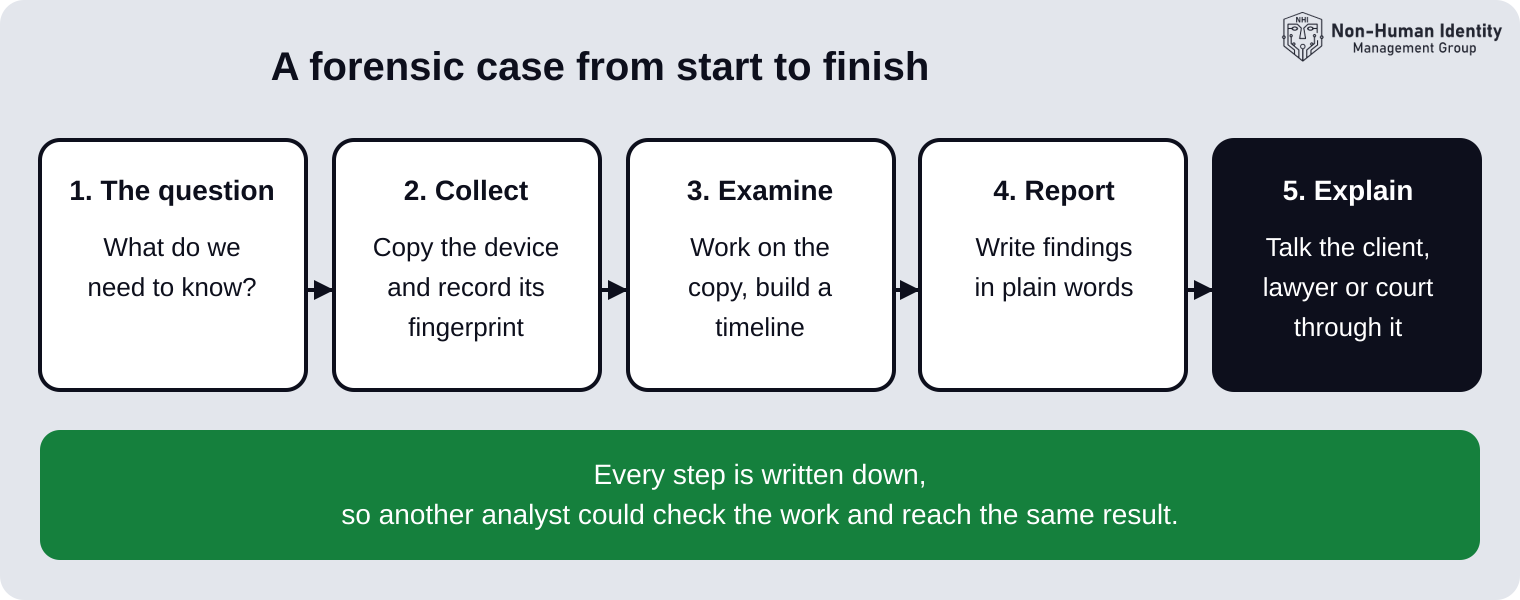
Every case is different, but the work often follows a pattern like this.
- Agree the question. The analyst finds out what the client, manager or police officer needs to know.
- Collect. They make a forensic image, an exact copy of the device's storage. They record a hash, a short code that acts like a fingerprint for the copy.
- Examine. On the copy, they recover files and put events in time order. This is called timeline analysis.[2]
- Report. They write the findings in plain words, with each step documented.[1]
- Explain. They talk the client or lawyer through the report. In some cases they give evidence in court.[1]
The US government's list of cyber security jobs describes this role in a similar way. It covers finding, collecting, examining and keeping evidence, using controlled and documented methods.[2] That word "documented" sums up the job.
Skills and tools
The UK National Careers Service lists the skills employers look for.[1] In plain words, they are:
- Patience and attention to detail. One wrong time stamp can change the story.
- Problem solving. Evidence is often partial, hidden or protected.
- Clear writing and speaking. Findings must make sense to people who are not technical.
- A good grasp of how computers, phones and apps store data.
Analysts use specialist forensic software to copy devices and search the copies. Many tools exist, and each employer has its own set. Learning the ideas first makes any tool easier to pick up later. Some roles also need you to pass security checks.[1]
Routes in
There is no single way in. Common routes include:[1]
- A degree in computer science, cyber security or digital forensics.
- A higher apprenticeship for digital forensic technicians, in England.
- Starting in IT support, networking or software, then moving across with training on the job.
- Professional training through bodies such as BCS, usually once you already work in IT security.
How the role connects to others
Forensics analysts work closely with incident responders, who contain and fix an attack while it is happening. They also work with SOC analysts, lawyers, HR and sometimes the police. In small teams, one person may do both response and forensics.
A worked example
Orla Pajari is in her second year as a forensics analyst at a fictional consultancy. Before this, she worked on an IT help desk for three years.
At 9am a call comes in from Alder Joinery, a fictional furniture maker. A salesperson left last week. The owner thinks he took the customer list with him. His work laptop is sitting in a cupboard.
Orla thinks of the fire investigator. The event is over. Her job is to find out what really happened, without disturbing anything.
She drives to the workshop and signs for the laptop. She notes the time, the label and who handed it over. Back at the lab, she makes an exact copy and records its fingerprint. The original goes into a sealed bag.
Working on the copy, she builds a timeline. Two days before he left, a large file was copied to a USB stick. She checks the file name against the firm's records. It matches the customer list.
She does not jump to blame. The salesperson might have had a work reason. She writes down only what the evidence shows, and what it does not show.
Her senior colleague, Tomas Rosen, reviews her notes. He repeats one check and gets the same result. That is the point of good notes.
On Friday, Orla explains the report to the owner and the firm's solicitor in plain words. They decide the next steps. Orla's part is done.
Myths and mistakes
| What people think | What is true |
|---|---|
| It is like the crime dramas on TV. | Real cases take days or weeks of careful checking and writing, not a few minutes of typing. |
| Deleted means gone. | Deleted data can often be recovered, which is part of the job.[1] |
| You must work for the police. | Many analysts work for companies, consultancies and law firms.[1] |
| The tools do the thinking. | Tools find data. The analyst decides what it means and explains it. |
| The goal is to prove someone guilty. | The goal is to report what the evidence shows, fairly, whichever way it points. |
What can I do this week?
- Read three digital forensics job adverts and list the tasks they share.
- Read the official careers profile for forensic computer analysts.[1]
- Practise keeping time-stamped notes on a small task, such as setting up a new phone.
- Read our Digital Forensics for Beginners guide.
Checklist
- I can explain what a digital forensics analyst does in one sentence.
- I know what a forensic image and a chain of custody are.
- I know the difference between forensics and incident response.
- I have looked at real job adverts for the role.
- I have checked whether the jobs near me need security checks.
- I have checked official sources for pay, not just job boards.
- I can show I keep careful, dated notes.
Common questions
Do I need a degree to become a forensics analyst?
Not always. A degree in computing, cyber security or digital forensics is a common route. In England there is also a higher apprenticeship, and some people move across from IT support jobs with training on the job.[1]
Is a forensics analyst the same as an incident responder?
No, though they work closely. An incident responder stops an attack and gets systems running again. A forensics analyst works out exactly what happened, with evidence that can be checked. In small teams one person may do both. See Incident Responder vs Digital Forensic Analyst.
Will I have to go to court?
Sometimes. Police and legal cases may need the analyst to explain findings in court. Many company cases never reach court, but the work is still done as if it might. That is why careful records matter so much.[1]
How much does a forensics analyst earn?
Pay varies a lot by country, sector and experience, so we do not quote a figure here. Use official sources. In the UK, the National Careers Service profile gives a guide.[1] Job adverts in your area also help.
Where can the job lead?
Many paths. Analysts can become senior or lead analysts, run a forensics team or work as consultants.[1] The habit of checking facts carefully also helps in incident response and threat hunting.
Where next?
Ready for the detail? Read the practitioner guide: Incident Response and Forensics Certifications Compared Guide. It goes further into the certifications employers ask for, how they differ and which suit each stage of a forensics career.
Also useful:
- DFIR Analyst Career Guide
- Digital Forensics for Beginners
- Incident Responder for Beginners
- SOC Analyst for Beginners
- Incident Responder vs Digital Forensic Analyst
Related NHI Mgmt Group resources: Cybersecurity Careers Guide · Digital Forensics (DFIR) Guide · Chain of Custody Form Template
Key terms
- Digital forensics analyst
- A person who finds, protects and explains evidence from computers, phones and online accounts.
- Digital evidence
- Files, messages and records that can show what happened on a device.
- Forensic image
- An exact copy of a device's storage, made so the original stays untouched.
- Hash
- A short code worked out from data. If the data changes, the code changes.
- Chain of custody
- A record of who collected, held and passed on evidence, and when.
- Timeline analysis
- Putting events from the evidence in time order to show what happened when.
- Incident response
- The work of stopping an attack, limiting harm and getting systems running again.
Sources and further reading
- Forensic computer analyst, job profile. National Careers Service (England). https://nationalcareers.service.gov.uk/job-profiles/forensic-computer-analyst, accessed 28 Nov 2026.
- Digital Evidence Analysis, work role. NICE Workforce Framework for Cybersecurity (NIST SP 800-181 Rev. 1), NICCS, US Cybersecurity and Infrastructure Security Agency. https://niccs.cisa.gov/workforce-development/nice-framework/work-role/digital-evidence-analysis, accessed 28 Nov 2026.
- Cyber incident response processes, Incident management collection. National Cyber Security Centre (UK). https://www.ncsc.gov.uk/collection/incident-management/cyber-incident-response-processes, accessed 28 Nov 2026.