A SOC manager leads the team that watches for cyber attacks and makes sure it can respond well.
This guide is for career changers, SOC analysts thinking about the next step and anyone curious about who leads a security team. You do not need a technical background to read it. If your organisation has a security monitoring team, someone in this role keeps it working.
In short
- A SOC manager leads a security operations centre (SOC), the team that spots and handles attacks.
- Most of the job is about people, rotas, processes and reporting, not handling alerts.
- They decide what the team measures and explain risks and results to senior leaders.
- Most SOC managers spent several years as analysts or responders before leading a team.
What you will learn
- Explain how a SOC manager's day differs from an analyst's.
- Spot the four main areas a SOC manager looks after.
- Check which leadership skills you already use.
- Ask good questions about the step from analyst to manager.
- Security team room (SOC)
- the team that watches for attacks and responds, also called a security operations centre.
- Work timetable (rota)
- the plan for who works which shift, so the team is covered.
- Progress number (metric)
- a number the team tracks to see whether its work is improving.
What is a SOC manager?
Think of the head chef in a busy restaurant kitchen. They do not cook every dish. They plan the menu, set the rota, train the cooks and check that every plate leaving the kitchen is right.
A SOC manager does the same for a security team. The team's main job is to spot and respond to cyber attacks that get past other defences.[1] Analysts handle the alerts. The manager makes sure there are enough skilled people, clear ways of working and tools that help.
The manager also looks after budgets and staff, plans improvements and keeps the team running if something breaks.[2] In some organisations, the SOC manager reports to the head of security or the head of IT.[2]
Where the comparison stops working: a kitchen closes at night. Many security teams watch around the clock, and the "orders" are attacks that nobody chose to place.
Why does it matter?
A security team is only as good as the way it is run. Tired staff, unclear rules or the wrong targets can let a real attack slip through.
If you are a SOC analyst now
What could happen: you get promoted for being great with alerts, then find the new job is mostly people and planning.
Check this: ask your manager what fills their week, and which parts they did not expect.
If you are changing career
What could happen: you have led teams before, but do not know how security work is organised.
Check this: read how a SOC works, then note which of your leadership skills carry over.
If you are a senior leader
What could happen: you receive a monthly report full of numbers that do not show whether you are safer.
Check this: ask your SOC manager which two numbers matter most, and why.
What does it look like?
A big part of the job is a short report for leaders. Here is a made-up weekly summary.
Example only. All values are made up.
SOC WEEKLY SUMMARY   week 00 (EXAMPLE)
Alerts reviewed:        0000                     (1)
Real incidents:         2, both contained        (2)
Average time to respond: 0 h 00 m (FAKE)         (3)
Staffing:               1 night shift uncovered  (4)
Top risk:               old system with no logs  (5)
Ask:                    approve 1 new analyst
- How busy the team was. Volume alone says little about safety.
- What actually mattered this week.
- How quickly the team acted. In a real file, this line would show the trend over several weeks.
- A gap in cover, said plainly.
- One risk leaders can help fix, with a clear ask.
Why this is risky: a report that only counts alerts can look impressive while hiding a gap, such as a shift with nobody on it.
The safer way: report a few numbers that show change over time, plus the gaps, risks and decisions you need from leaders.
How does it work?
Every SOC is different, but a manager's work usually covers these areas. Figure 1 groups them into four.
- People. Hiring, training and keeping good analysts. Security skills are in short supply, so keeping staff is a big part of the job.[2]
- Rota and cover. Planning shifts so the team is covered at the times the organisation needs.
- Process. Making sure there are clear written steps, called playbooks, for common kinds of attack.
- Tools. Choosing and improving the tools analysts use, such as a SIEM, a tool that gathers security records in one place.
- Measures and reporting. Choosing what to track and explaining results to leaders.[2]
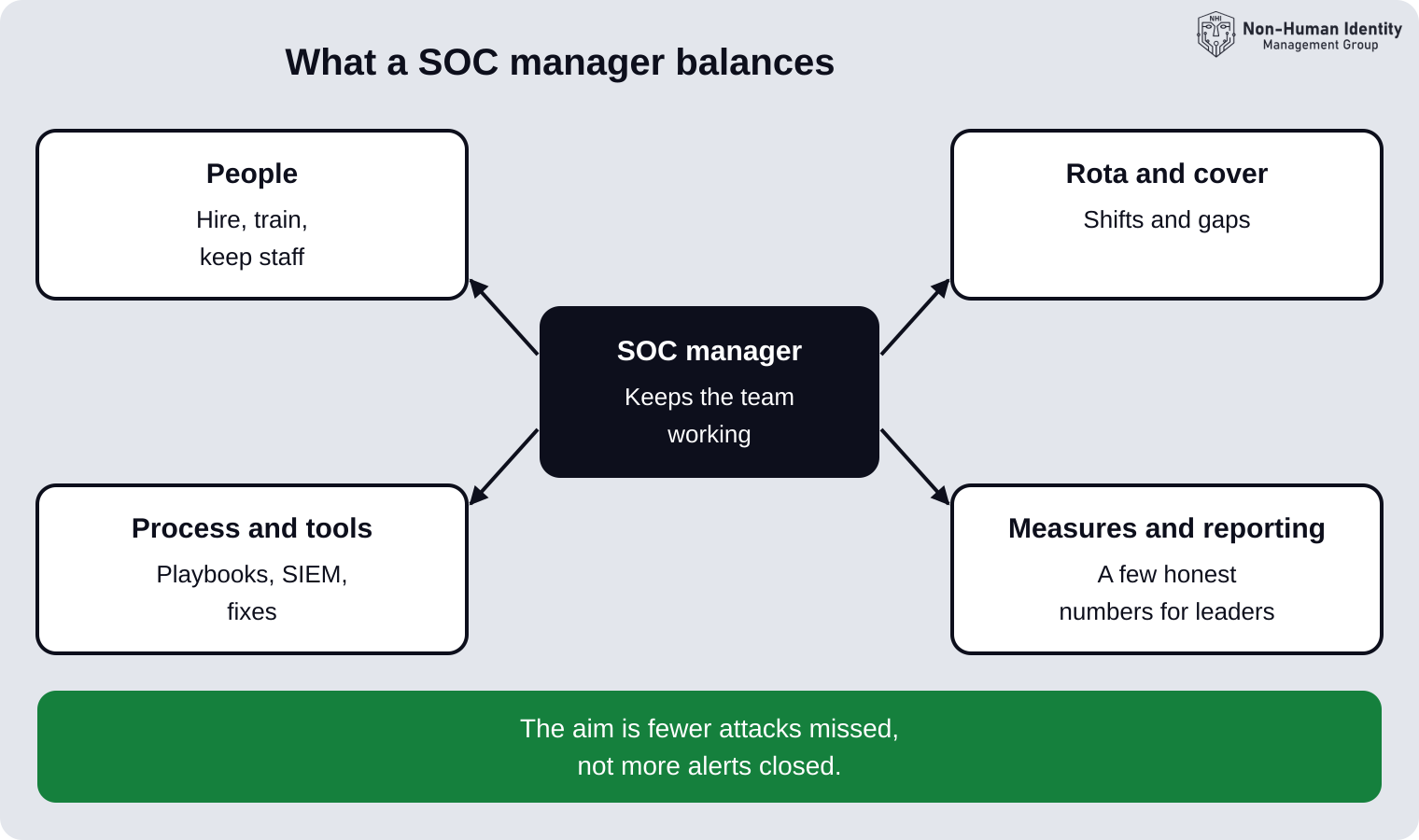
Measures need care. A guide on running security teams warns that not every measure leads to good results.[2] For example, giving analysts a rigid time limit per alert can push them to rush.[2]
Skills and tools
- Leadership. Coaching people, handling conflict and spotting burnout early.
- Security operations experience. Knowing how alerts, investigations and responses really work.
- Planning. Rotas, budgets and hiring plans.
- Decision-making under pressure. Calm choices during a live incident.[3]
- Clear reporting. Turning technical results into plain words for leaders.
- Tool knowledge. Enough about SIEM and response tools to judge what helps.
Routes in
Most manager jobs in IT need several years of related work first. For a security manager, that often means time as a security analyst.[3] A common path is SOC analyst, then senior analyst or incident responder, then team lead, then manager. Many employers also look for a degree, and some prefer certification for security managers.[3]
How the role connects to others
The SOC manager links the analysts with the wider business. They work with IT teams who fix systems, incident leads during big events, and the head of security. Some later become heads of security operations or security leaders.
A worked example
Elif Vance is the SOC manager at a fictional security company. Her team of twelve watches the systems of several clients, including Wren Printers, a fictional print firm.
Her Monday starts at 8am with the shift handover. The night lead reports a quiet night, but one analyst called in sick. Elif checks the rota and asks a day analyst to cover a late shift on Thursday.
At 10am she reviews last week's numbers. Alerts are up by a third, but real incidents are flat. She thinks of the head chef: more orders is not the same as better food. She asks a senior analyst to tune the two rules causing most of the noise.
At midday, an analyst escalates a real case. A Wren Printers staff account is sending odd emails. Elif does not take over the investigation. She checks the playbook is being followed, makes sure the client has been called and keeps notes for the report.
In the afternoon she runs a one-to-one with a new analyst, who says the night shifts are wearing him down. Elif agrees a change to his pattern and notes a wider question about night cover.
At 4pm she writes her weekly summary. She leads with the Wren Printers case, the noisy rules and the uncovered shift. Her one clear ask is approval to hire another analyst.
Myths and mistakes
| What people think | What is true |
|---|---|
| The SOC manager is the best analyst on the team. | The job is mostly people, planning and reporting. Strong analysts do not always enjoy it. |
| More alerts closed means a better team. | Closing alerts fast can hide mistakes. Some measures lead to bad habits.[2] |
| Managers do not need technical skill. | They need enough to judge risks, tools and their team's work. |
| A big team is always a good team. | The right size depends on the threats faced and what needs protecting.[1] |
| Burnout is just part of SOC work. | Good managers plan rotas, tune noisy rules and watch for tired staff. |
What can I do this week?
- Read three SOC manager job adverts and list the tasks they share.
- Read our Security Operations Centres for Beginners guide.
- Ask a team leader you know how they plan a rota and handle gaps.
- Write a five-line summary of your own week, as if for a busy boss.
Checklist
- I can explain how a SOC manager's job differs from an analyst's.
- I know the four main areas a SOC manager looks after.
- I know why some measures can lead to bad habits.
- I have read real adverts for the role.
- I know the usual steps from analyst to manager.
- I have checked official sources for pay, not just job boards.
- I have a plan for one first learning step.
Common questions
Can I become a SOC manager without being an analyst first?
Sometimes, but it is less common. Most IT manager jobs need several years of related work first, and for security managers that often means analyst work.[3] People who led teams elsewhere may get in through a deputy or team lead role first.
Does a SOC manager work shifts?
Usually not in the same way as analysts. Many work office hours but are on call for serious incidents. If the team watches around the clock, the manager plans those shifts and may step in when cover is short. Ask about this at interview.
How much does a SOC manager earn?
Pay varies a lot by country, sector and team size, so we do not quote a figure here. Use official sources. In the US, see the government's job outlook page for computer and information systems managers.[3] In the UK, check official careers and pay data.
What does a SOC manager measure?
A small set of numbers that show change over time. A common one is the average time taken to respond to a real incident. Good managers pair numbers with plain notes on gaps and risks, because some measures can push teams into bad habits.[2]
Where can a SOC manager job lead?
Often to bigger leadership roles. Some become head of security operations, run several teams or move into wider security management. Others go back to hands-on specialist work, such as incident response, if they miss it. Both paths are normal.
Where next?
Ready for the detail? Read the practitioner guide: SOC Guide. It goes further into how a SOC is designed, staffed, measured and improved.
Also useful:
- Security Operations Manager Career Guide
- SOC Manager Interview Questions
- SOC Analyst for Beginners
- SOC Metrics for Beginners
- Incident Commander for Beginners
Related NHI Mgmt Group resources: Cybersecurity Careers Guide · Building a SOC from Scratch Guide · Monthly Security Operations Report Template for Management
Key terms
- SOC
- A security operations centre: the team that watches for attacks, checks alerts and responds.
- SIEM
- A tool that collects security records from many systems in one place and raises alerts.
- Playbook
- A written set of steps for handling one kind of alert or incident.
- Key performance indicator
- A number used to check whether a team or process is meeting its goals.
- MTTR
- The average time taken, after an attack is spotted, to respond to it or recover from it.
- Alert fatigue
- When so many low-value alerts arrive that important ones get harder to notice.
- Escalation
- Passing an alert or case to a more senior person when it cannot be handled at the current level.
Sources and further reading
- Building a Security Operations Centre (SOC). National Cyber Security Centre (UK). https://www.ncsc.gov.uk/collection/building-a-security-operations-centre, accessed 28 Nov 2026. See also the Operating model section: https://www.ncsc.gov.uk/collection/building-a-security-operations-centre/operating-model.
- Knerler, K., Parker, I. and Zimmerman, C. 11 Strategies of a World-Class Cybersecurity Operations Center. The MITRE Corporation, 2022. https://www.mitre.org/sites/default/files/2022-04/11-strategies-of-a-world-class-cybersecurity-operations-center.pdf, accessed 28 Nov 2026.
- Computer and Information Systems Managers, Occupational Outlook Handbook. US Bureau of Labor Statistics, last modified 27 August 2026. https://www.bls.gov/ooh/management/computer-and-information-systems-managers.htm, accessed 28 Nov 2026.