Tactics, techniques and procedures (TTPs) describe how attackers behave, from their goal down to their exact steps.
This guide is for anyone who has seen "TTPs" in a security report or job advert and wants a plain explanation. You do not need to be a security expert for this to matter: it shapes how your team spots attacks and what it asks suppliers to watch for.
In short
- A tactic is the attacker's goal, a technique is the method, and a procedure is the exact way one group does it.
- Defenders use TTPs as a shared language, so reports from different teams can be compared.
- Attackers can swap an internet address or a file quickly. Changing their habits takes much more effort.
- So spotting behaviour tends to protect you for longer than blocking one list of bad addresses.
What you will learn
- Explain the difference between a tactic, a technique and a procedure.
- Spot TTPs in a threat report, apart from simple clues like addresses.
- Explain why behaviour is harder for attackers to change than their tools.
- Ask your team or supplier which attacker behaviours they can detect.
- Attacker habits (TTPs)
- the goals, methods and exact steps an attacker tends to use.
- Clue left behind (indicator)
- a small piece of evidence, like an internet address or a file, linked to an attack.
- Threat report (threat intelligence)
- shared knowledge about who attacks and how they do it.
What are tactics, techniques and procedures?
Think of how detectives describe a burglar's habits. They note what the burglar wants, how they get in and the small details they repeat every time. Tactics, techniques and procedures do the same job for attackers online.
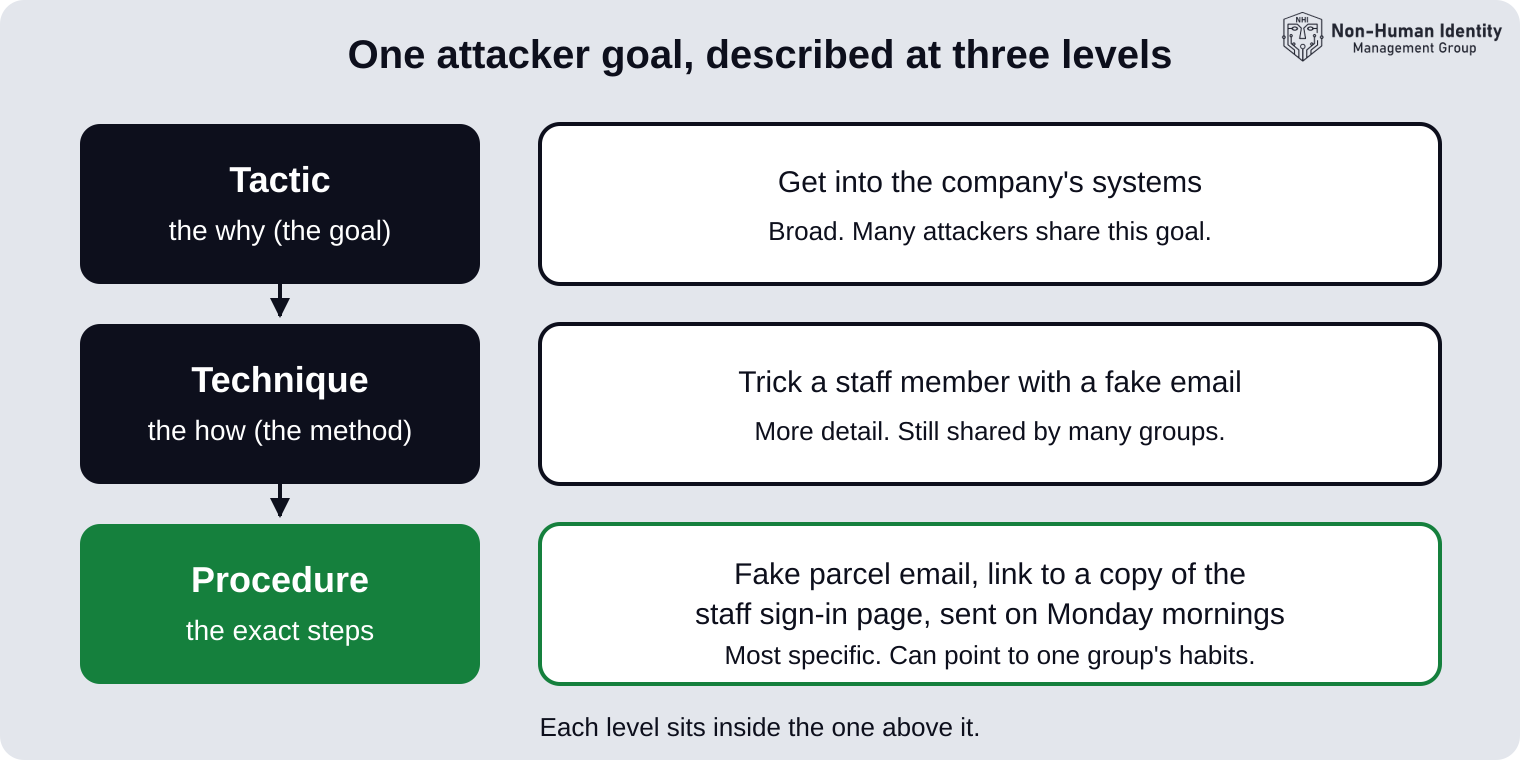
A US standards body defines TTPs simply as "the behavior of an actor".[1] The three words are levels of detail:
- Tactic: the goal, or the "why". For example, getting into a company's systems.
- Technique: the method, or the "how". For example, sending a fake email to trick staff.
- Procedure: the exact way one attacker carries out that method. For example, a fake parcel email sent every Monday morning.
Each level sits inside the one above it. Many attackers share a tactic. Fewer share the exact procedure.[2]
Where the comparison stops working: a burglar works in one place at a time. Online attackers can try the same method on thousands of firms at once, and several groups may copy the same steps.
Why does it matter?
TTPs turn "we were attacked" into "this is what they did", which helps you check whether it could happen to you.
If you manage a team or a budget
What could happen: you pay for alerts that block old addresses, while the attacker simply moves to new ones.
Check this: ask your provider which attacker behaviours it watches for, not just how many bad addresses it blocks.
If you are new to a security team
What could happen: you read a threat report and copy only the list of addresses, missing the part that would still help next month.
Check this: for every report, write down the goal, the method and the exact steps in one line each.
If you run a small business
What could happen: a warning about a scam aimed at firms like yours goes unread, because it is full of jargon.
Check this: when a warning arrives, ask "what do they do, step by step?" and compare it with how your staff work.
Next: Phishing for Beginners
What does it look like?
Here is a short, made-up note from a threat report. It is split into TTPs and clues.
Example only. All values are made up.
THREAT NOTE: group "EXAMPLE-GROUP-0000"
Goal:   get into staff email accounts            (1)
Method: fake sign-in page sent by email          (2)
Steps:  parcel-themed email on Monday mornings,  (3)
        then sets up a rule to forward mail out
Clues:  sign-in page at login.example.invalid    (4)
        sent from 192.0.2.10
- The tactic: what they want.
- The technique: how they get it.
- The procedure: the steps this group repeats.
- The clues. In a real file, these lines would contain the attacker's web and internet addresses.
Why this is risky: if you act only on line 4, the attacker can set up a new site and carry on.
The safer way: block the clues. Then check you would spot the steps in line 3. For example, would you see a new rule that sends mail out?
How does it work?
Defenders use TTPs in a simple cycle.
- Something is seen. A team investigates an attack, or reads a report about one.
- It is written down as behaviour. They describe the goal, method and steps, not only the addresses and files.
- It is matched to a shared list. Many teams use a public catalogue called MITRE ATT&CK, which a US government cyber agency describes as a common language for attacker analysis.[4] It is built mainly from public threat reports.[2]
- It is checked against your own systems. The team asks: would we see this? A detection rule, a saved check that raises an alert, can then be written for the gap.
- It is shared. Because the words are shared, other teams can use the finding too.
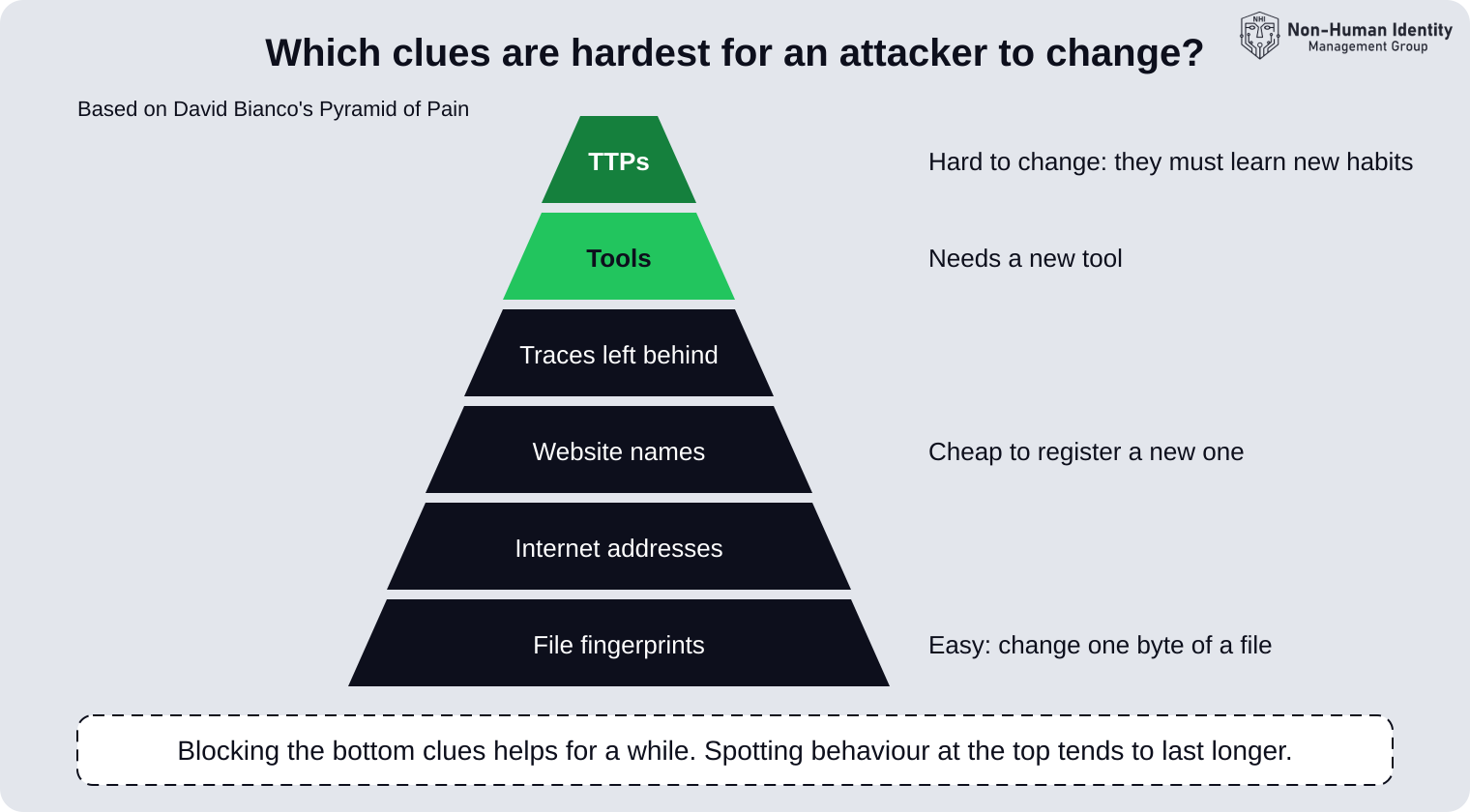
Why focus on behaviour? In 2013 security researcher David Bianco drew the Pyramid of Pain. It ranks clues by how much effort they cost an attacker to change.[3] A file fingerprint, called a hash, changes if one byte of the file changes. Internet addresses are easy to swap. TTPs sit at the top. He wrote that countering them forces attackers "to do the most time-consuming thing possible: learn new behaviors".[3]
A worked example
This story is made up to show how it can work.
Yara Takahashi has just joined the small IT team at Northwind Couriers, a delivery firm. Her manager, Nils Whitlock, forwards her a threat report from an industry group. It warns of attacks on delivery firms.
The report ends with a list of ten internet addresses. Yara's first idea is to block them and close the email. Nils asks her to read the middle section too.
She writes three lines on a sticky note. Goal: get into staff email. Method: a fake sign-in page sent by email. Steps: a parcel-themed message, then a hidden rule that forwards mail to an outside address.
Next she blocks the ten addresses. That takes ten minutes. Then she asks a harder question: would Northwind notice if a staff mailbox started forwarding mail outside the company?
She checks the email settings with Nils. Alerts for new forwarding rules are switched off. They turn them on and test the alert with a made-up test account.
Three weeks later, the alert fires for a real account. The addresses in the original report were not involved. The group had moved to new ones, but their steps were the same. Nils resets the account's password, removes the rule and signs the account out of every device.
What made the difference: Yara looked past the clues to the behaviour, and that check was still useful after the addresses had changed.
Myths and mistakes
| What people think | What is true |
|---|---|
| Blocking the addresses in a report is enough. | It helps, but attackers can swap addresses quickly. Also check you would see the behaviour. |
| TTPs are only for big security teams. | Anyone can ask "what is the goal, the method and the steps?" when reading a warning. |
| A technique belongs to one attacker. | Many groups share techniques. The exact procedure is what may point to one group. |
| Mapping a report to a catalogue means you are protected. | Mapping only describes the attack. Protection comes from checks and controls you test. |
What can I do this week?
- Pick one recent threat warning and write its goal, method and steps in one line each.
- Ask your IT team or supplier which of those steps they would notice today.
- Read one public advisory from your national cyber agency and find its section on attacker behaviour.
- Agree who in your team reads new threat reports and passes on the behaviour, not only the clue lists.
Checklist
- We can explain tactic, technique and procedure in plain words.
- Threat reports we receive are read for behaviour as well as for addresses and files.
- Someone owns reading and sharing new threat reports.
- For important warnings, we have asked "would we see this?" and written down the answer.
- Gaps we find become a tested alert or a change in a setting.
- Our provider can tell us which attacker behaviours it detects.
Common questions
What does TTP stand for?
TTP stands for tactics, techniques and procedures. Together they describe how an attacker behaves. The tactic is the goal. The technique is the method used to reach it. The procedure is the exact way one attacker does it.
How are TTPs different from indicators of compromise?
Indicators are small clues, such as an internet address, a website name or a file fingerprint. TTPs describe behaviour. Attackers can change clues quickly and cheaply. Changing behaviour takes far more effort, so checks based on TTPs tend to last longer.
Is MITRE ATT&CK the same as TTPs?
No. TTPs are the idea, and MITRE ATT&CK is a free public catalogue that lists many real tactics and techniques with names and examples. Teams use it so everyone describes the same behaviour in the same words. Our separate beginner guide explains the catalogue itself.
Can TTPs tell us exactly who attacked us?
Sometimes they help, but rarely on their own. Different groups often share methods, and some copy each other. Experts usually combine TTPs with other evidence before naming a group, and even then they tend to state how confident they are.
Do I need special tools to use TTPs?
Not to start. Reading a report and writing down the goal, method and steps needs only care. Turning those steps into alerts usually needs your logs and security tools, which is where your IT team or provider comes in.
Where next?
Ready for the detail? Read the practitioner guide: Strategic vs Operational vs Tactical Threat Intelligence. It goes further into the levels of threat intelligence, who uses each one and how TTPs feed day-to-day defence.
Also useful:
- MITRE ATT&CK for Beginners
- Mapping Threat Reports to MITRE ATT&CK Guide
- Indicators of Compromise vs Indicators of Attack Guide
- Detection Robustness Guide
Related NHI Mgmt Group resources: Threat Intelligence for Beginners · Threat Intelligence Guide · Threat Intelligence for Identity and NHI Guide
Key terms
- Tactics, techniques and procedures (TTPs)
- The behaviour of an attacker, from the goal down to the exact steps.
- Tactic
- The attacker's goal at a given stage, the "why".
- Technique
- The method an attacker uses to reach a goal, the "how".
- Procedure
- The exact way a particular attacker carries out a technique.
- Indicator of compromise
- A clue, such as an address or file fingerprint, that suggests an attack.
- Pyramid of Pain
- A model that ranks clues by how hard they are for attackers to change.
- Threat actor
- A person or group that carries out attacks.
- Detection rule
- A saved check that raises an alert when certain activity is seen.
Sources and further reading
- Glossary: tactics, techniques, and procedures (TTP). NIST Computer Security Resource Center, citing NIST SP 800-150. https://csrc.nist.gov/glossary/term/tactics_techniques_and_procedures, accessed 28 Nov 2026.
- ATT&CK FAQ. MITRE ATT&CK, The MITRE Corporation. https://attack.mitre.org/resources/faq/, accessed 28 Nov 2026.
- The Pyramid of Pain. David J. Bianco, Enterprise Detection and Response blog, 1 March 2013, updated 17 January 2014. https://detect-respond.blogspot.com/2013/03/the-pyramid-of-pain.html, accessed 28 Nov 2026.
- Best Practices for MITRE ATT&CK Mapping. Cybersecurity and Infrastructure Security Agency (CISA), June 2021, updated January 2023. https://www.cisa.gov/news-events/news/best-practices-mitre-attckr-mapping, accessed 28 Nov 2026.