AI is changing cyber security jobs by taking on routine tasks, while people keep the judgement and decisions.
This guide is for students, career changers and anyone curious about working in cyber security. You do not need a technical background to read it, and it does not promise any job outcome.
In short
- Many security teams are using or testing AI tools, mostly to speed up routine work.
- AI can summarise alerts and draft searches, but a person still checks the answer and decides what to do.
- Surveys show teams are short of skills, especially AI and cloud security skills.
- Strong basics, curiosity and clear writing still matter, and learning to use AI tools well adds to them.
What you will learn
- Explain how AI tools are used in everyday security work.
- Spot which tasks AI speeds up and which still need a person.
- Check which skills employers say they need most.
- Plan a first step that suits you this week.
- Security helper tool (AI assistant)
- software you can ask questions in plain words, which drafts answers for you.
- Security control room (SOC)
- a team that watches for attacks and responds to warnings.
What is AI in cyber security work?
Think of a power drill in a carpenter's workshop. It makes holes much faster than a hand drill. But the carpenter still decides where to drill, and checks the work is straight.
AI tools work in a similar way in security. An AI assistant is software you can ask questions in plain words. A security operations centre, or SOC, is a team that watches for attacks. There, an assistant can sum up a pile of warnings into a short report. It can also turn a plain question into a search of the records.[1]
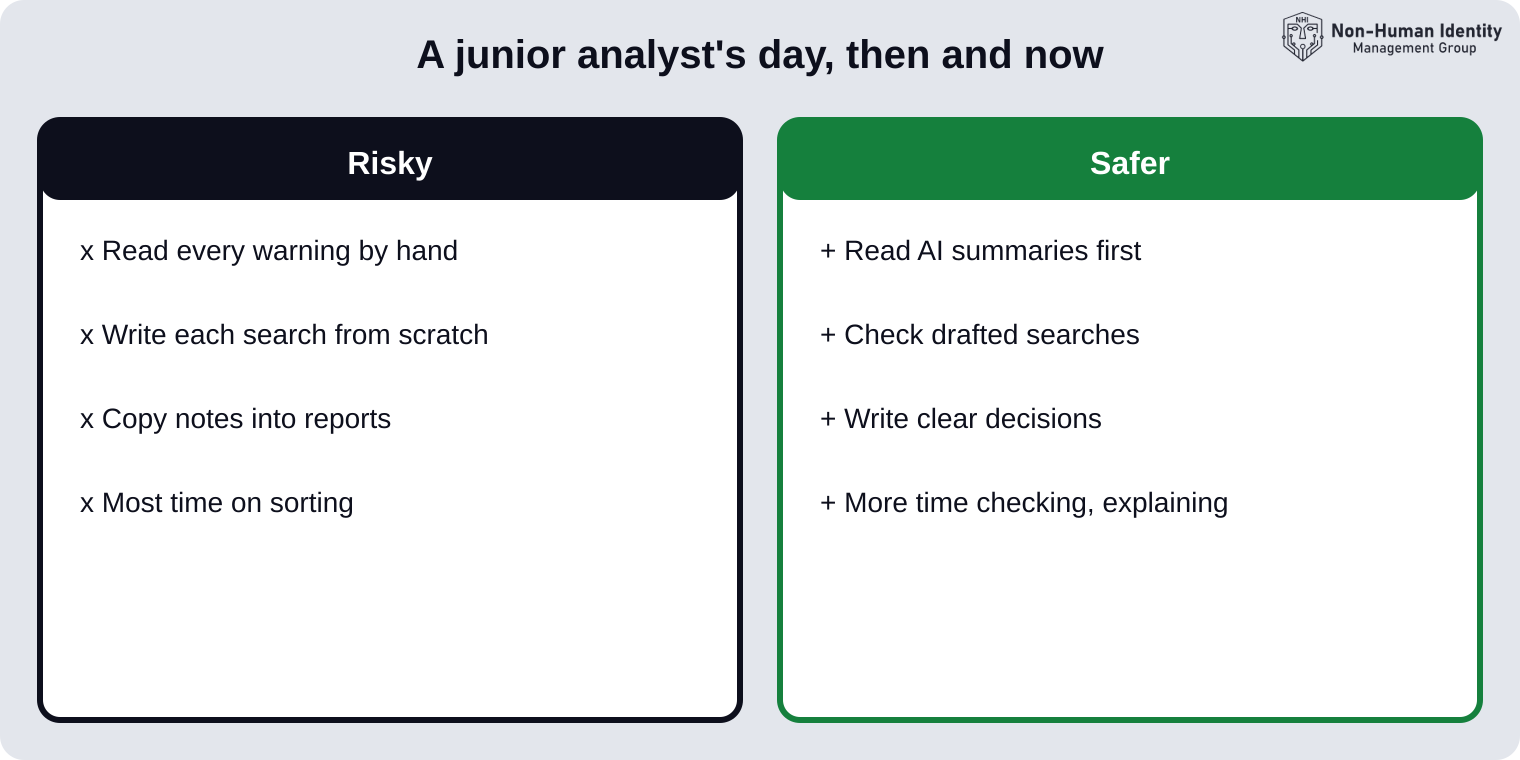
That changes the shape of many jobs. Less time goes on copying, sorting and writing first drafts. More time goes on checking, deciding and explaining.
Where the comparison stops working: a drill does exactly what you point it at. An AI tool can give an answer that sounds sure but is wrong, so a person has to check it.
Why does it matter?
If you are starting out, it helps to know which skills are rising. In a 2025 survey of over 16,000 security workers, 41% said their team needed AI skills, more than any other skill.[2]
If you are a student
What could happen: you learn to rely on AI answers without learning the basics behind them.
Check this: can you explain, in your own words, why the AI's answer is right?
If you are changing career
What could happen: you assume AI has closed the door, and do not apply.
Check this: look at which skills your past work already gives you, such as writing or problem-solving.
If you manage or hire people
What could happen: you cut junior roles and later have nobody trained to step up.
Check this: plan how new starters will learn the basics alongside AI tools.
What does it look like?
Here is a made-up note an AI assistant might write for a junior analyst. The notes show what the analyst still has to do.
Example only. All values are made up.
AI summary of warning EXAMPLE-0000
What happened: 40 failed sign-ins for user FAKE-USER,
then one success from a new country.                   (1)
Likely cause: password guessing.                      (2)
Suggested search: sign-ins for FAKE-USER, last 7 days  (3)
Suggested action: lock the account and reset it.       (4)
- A quick summary that saves reading 41 separate log lines.
- A best guess. The analyst checks it against the records.
- A drafted search. The analyst runs it and reads the results.
- A suggestion only. A person decides, often after asking the user.
Why this is risky: the AI did the sorting and the first draft quickly. But it could still be wrong. Maybe the user is simply on holiday.
The safer way: treat the summary as a starting point. Check the facts, then make and record the decision yourself.
How does it work?
A simple way to see the change is to split a security task into steps, and ask who does each one.
- Collect. Tools gather warnings and records from many systems. This was already mostly automatic.
- Sort and sum up. AI tools can now sum up warnings and suggest which matter most.[1]
- Draft. AI can turn a plain question into a search, or explain a strange script in plain words.[1]
- Check. A person reviews the answer and tests whether it is right.[1]
- Decide and explain. A person chooses what to do, tells the people affected and writes it up.
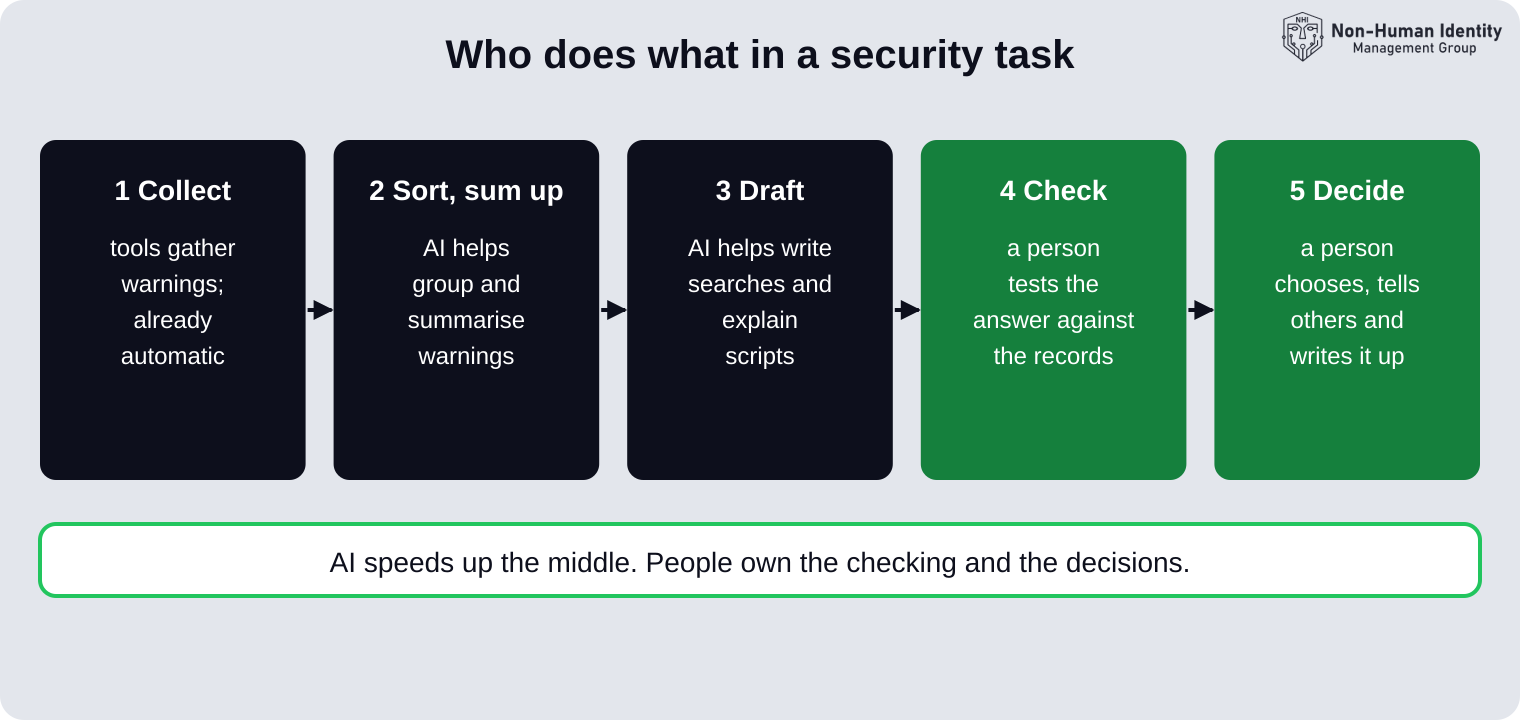
This is why survey answers point to new skills, not just fewer people. In the same 2025 survey, 73% expected AI to create demand for more specialised security skills.[2] A wider jobs report from the World Economic Forum lists AI and big data as the fastest-growing skills. Networks and cyber security come close behind.[3]
The survey also says the skills shortage now matters more than the number of people. Teams named AI, cloud security and risk assessment as their top skills needs.[2]
To see how security jobs fit together, many people use a skills framework. A US government one, the NICE Framework, breaks security work into roles, and lists the tasks, knowledge and skills behind each one.[4] It can help you match what you already know to a role.
Attackers use AI too. The UK's National Cyber Security Centre judges that AI will almost certainly keep making parts of cyber attacks more effective.[5] So defenders need people who understand both security and AI.
A worked example
Leila Haddad is a fictional career changer. She spent eight years in a bank's customer complaints team. She wants to move into cyber security, but worries AI will take the starter jobs.
She talks to Sana Jensen, a fictional SOC team lead. Sana shows her the team's AI assistant. It sums up overnight warnings into a short list each morning.
"It saves us an hour a day," Sana says. "But last week it called a backup job an attack. A junior analyst spotted it, because she knew what normal looks like."
Leila thinks of the power drill. The tool is fast, but someone has to know where to aim it.
Sana points out skills Leila already has. She handles upset customers calmly. She writes clear case notes. She spots when a story does not add up. Those skills matter when you check an AI answer and explain a decision.
Leila makes a plan. She will learn networking and security basics first, using free courses. She will set up a small practice lab at home. She will also try an AI assistant on practice tasks, and check every answer it gives.
Three months later, she applies for a junior SOC role. In the interview, she talks about checking an AI summary and finding a mistake. The team lead says that is the habit they want.
Myths and mistakes
| What people think | What is true |
|---|---|
| AI will replace all security jobs. | Surveys point to changing skills needs. Teams report skills gaps, with AI skills at the top.[2] |
| If AI writes the search, I do not need to understand it. | You need to check what it does. A wrong search can miss an attack. |
| You need a computer science degree to start. | Many people enter from IT or other jobs. In the 2025 survey, IT was the most common route in.[2] |
| Only technical skills matter now. | Hiring managers in the survey ranked problem-solving as the top non-technical skill.[2] |
| Learning AI tools is enough. | Tool skills help, but they sit on top of security basics like networks, logins and risk. |
What can I do this week?
- Pick one beginner course on networking or security basics and start it.
- Try an AI assistant on a practice question, then check its answer against a trusted source.
- Read about two or three security roles and note which suit your skills.
- Write down three skills from your past work that would help in security.
- Find one person in the field to ask how AI has changed their day.
Checklist
- I can explain what a SOC does in one sentence.
- I know which tasks AI tools help with and which need a person.
- I check AI answers before I trust them.
- I am learning the basics: networks, logins, risk.
- I have a practice space, such as a home lab or online exercises.
- I have looked at a skills framework to match my skills to roles.
- I can describe my non-technical strengths with an example.
Common questions
Will AI take entry-level cyber security jobs?
Nobody can say for sure. Surveys show AI is changing tasks, and teams report skills gaps rather than surplus staff. Starter work may shift towards checking AI output and explaining decisions. Strong basics and a habit of checking make you more useful, not less. See How AI Is Changing Cyber Security Jobs.
Do I need to learn to code to work with AI in security?
Not to start. Many roles need clear thinking and good writing more than coding. Basic scripting helps over time, because it lets you check and adjust what tools produce. See Scripting and Automation Basics for Beginners.
Which security roles involve AI the most?
SOC analysts often use AI assistants day to day. Some roles focus on securing AI itself, such as AI security engineers. Governance and risk roles also look at how a company uses AI. See AI Security Engineer for Beginners.
Are certifications still worth it?
Often, yes. A certification can show an employer you know the basics, especially when you have no security job yet. Choose one that matches the role you want, and pair it with hands-on practice. See Cyber Security Certifications for Beginners.
Is it safe to paste work data into an AI tool?
Only if your employer has approved that tool for that data. Many public AI tools may keep what you type. Follow your workplace rules, and never paste passwords, keys or customer details into an unapproved tool. See AI Acceptable Use Policies for Beginners.
Where next?
Ready for the detail? Read the practitioner guide: How AI Is Changing Cyber Security Jobs. It goes further into which tasks are being automated, which roles are growing and how to adapt at each career stage.
Also useful:
- SOC Analyst for Beginners
- Cyber Skills Frameworks for Beginners
- AI in Incident Response for Beginners
- Cybersecurity Careers Guide
Related NHI Mgmt Group resources: Career Change into Cyber Security Guide · The Cyber Skills Gap for Beginners · AI Copilots at Work for Beginners
Key terms
- AI assistant
- Software you can ask in plain words, which drafts answers or actions for you.
- Security operations centre
- A team that watches for attacks and responds to warnings.
- Generative AI
- AI that creates new text, images or code from what it has learned.
- AI hallucination
- An AI answer that sounds confident but is wrong or made up.
- NICE Framework
- A US skills framework that describes security roles and the tasks, knowledge and skills behind them.
- Upskilling
- Learning new skills to keep up as a job changes.
Sources and further reading
- What is Microsoft Security Copilot? Microsoft Learn, Microsoft. https://learn.microsoft.com/en-us/copilot/security/microsoft-security-copilot, accessed 28 Nov 2026. (One vendor's product, used here as an example of the task types.)
- 2025 ISC2 Cybersecurity Workforce Study. ISC2, 4 December 2025. https://www.isc2.org/insights/2025/12/2025-isc2-cybersecurity-workforce-study, accessed 28 Nov 2026.
- The Future of Jobs Report 2025: Digest. World Economic Forum, 7 January 2025. https://www.weforum.org/publications/the-future-of-jobs-report-2025/digest/, accessed 28 Nov 2026.
- NICE Framework current versions. National Institute of Standards and Technology (NIST). https://www.nist.gov/itl/applied-cybersecurity/nice/nice-framework-resource-center/nice-framework-current-versions, accessed 28 Nov 2026.
- Impact of AI on cyber threat from now to 2027. National Cyber Security Centre (NCSC), 7 May 2025. https://www.ncsc.gov.uk/report/impact-ai-cyber-threat-now-2027, accessed 28 Nov 2026.