An AI-powered cyber attack is a familiar trick, such as a scam email or fake call, made stronger with AI.
This guide is for anyone who wants to know how criminals use AI and what still keeps people safe. You do not need any technical background. If your business pays invoices or moves money on someone's say-so, these attacks are aimed at people like you.
In short
- AI mostly makes old attacks faster, cheaper and more convincing. Scam messages and fake calls are still the main tools.
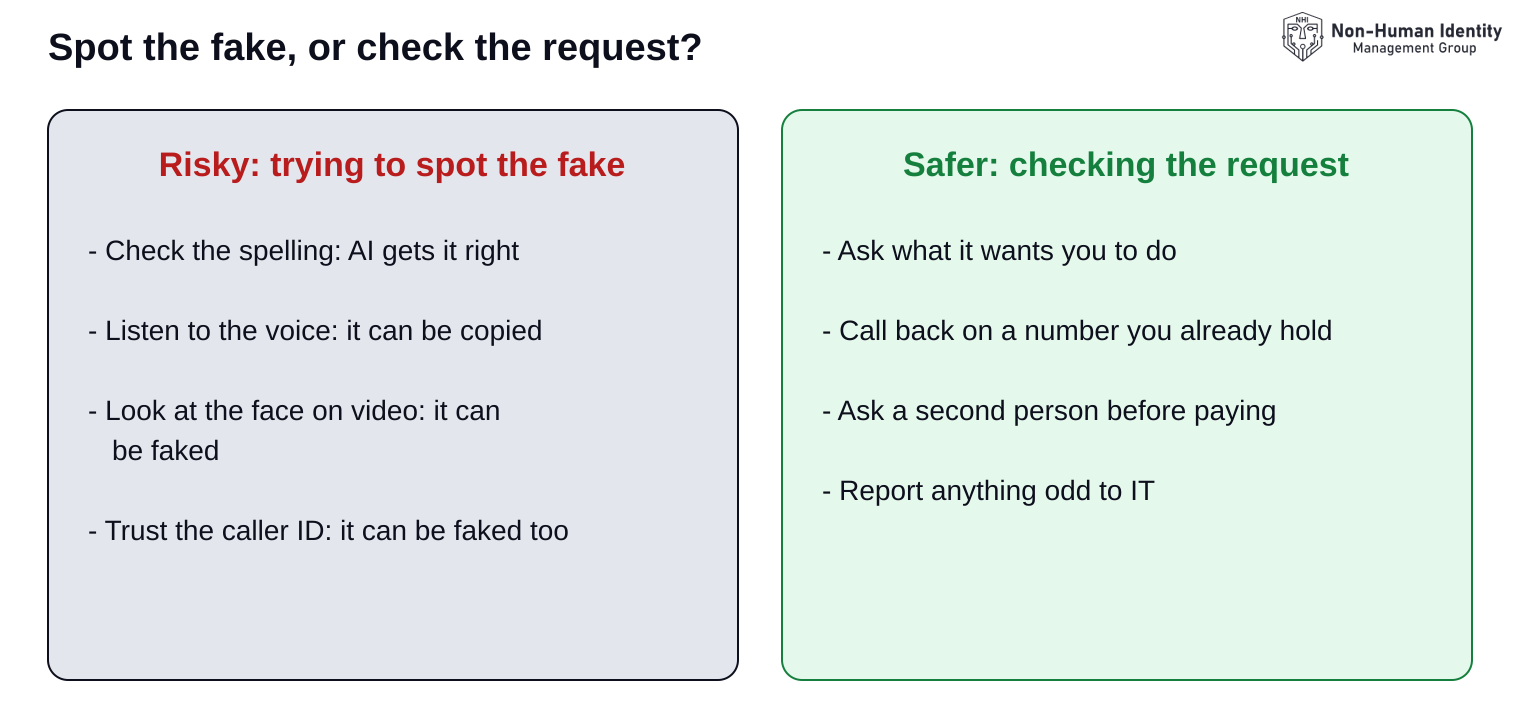
- Good spelling is no longer a safety sign. Judge a message by what it asks you to do.
- Voices and faces can be faked, so a familiar voice is not proof of who is calling.
- Simple habits still work: call back on a number you already have, use strong sign-in, update devices and ask a second person before paying.
What you will learn
- Explain what makes an attack "AI-powered".
- Spot the warning signs of an AI-assisted scam.
- Check whether your payment process relies on recognising voices.
- Ask for the simple defences that still work.
- Scam message (phishing)
- a fake email, text or call that tricks you into clicking, sharing a password or paying.
- Fake voice or video (deepfake)
- sound or video made by AI to copy a real person.
- Call-back check
- hanging up and phoning the person on a number you already hold.
What is an AI-powered cyber attack?
Think of a con artist who suddenly gets a print shop, a voice coach and a team of researchers. The con is the same as before. It just looks far more convincing and reaches far more people.
A cyber attack is any attempt to break into, misuse or damage computers, accounts or data. It is "AI-powered" when the attacker uses AI tools somewhere along the way.
Criminals use AI in four main ways. They use it as a writing and research helper for scam messages. They use it to fake people, by copying a voice or face. They build it into harmful software, called malware. And some use AI agents, software that can carry out many steps by itself.
AI does not make the criminal cleverer. It makes them faster, and lets one person do the work of many.
Where the comparison stops working: a print shop and a voice coach cost money and take skill. Many AI tools are cheap and easy to use. And AI can shape each message to the person reading it, which a print run cannot.
Why does it matter?
The old warning signs, like clumsy spelling or a stranger's voice, are less reliable now. The UK's national cyber security agency expects AI to keep making attacks more effective, and more frequent.[1]
If you pay invoices or move money
What could happen: a perfectly written email and a call in your boss's voice ask for an urgent payment to a new account.
Check this: never change bank details or rush a payment without a call-back check.
If you run a small business
What could happen: criminals target you because AI makes it cheap to try thousands of small firms at once.
Check this: make sure payments need a second person and email accounts use strong sign-in.
If you are new to a security job
What could happen: you are asked whether AI changes your firm's risks and cannot explain it simply.
Check this: learn the four ways criminals use AI and the defences that still work.
What does it look like?
Here is a made-up scam email, written the way AI can write it: polite, fluent and personal.
Example only. All values are made up.
From: Sam Example <[email protected]>   (1)
Subject: Quick favour before my flight - Riverside project   (2)
Hi, sorry to rush you. The Riverside printers have
moved banks, so please pay their invoice today to the
new account below. Keep this between us for now.   (3)
New account: FAKE-BANK 00-00-00 / 00000000   (4)
I'm boarding soon, so just reply once it's done.   (5)
- The sender's address looks close to the real one. In a real message, this line would show an address that differs by a letter or two.
- A project name copied from the studio's website makes it feel genuine.
- Urgency and secrecy are classic pressure signs.
- A request to pay a new bank account.
- A reason why you cannot call to check.
Why this is risky: the writing is flawless, so the usual "bad spelling" warning sign is missing.
The safer way: ignore how well it is written. Call the sender on a number you already hold, and follow your normal payment checks.
How does it work?
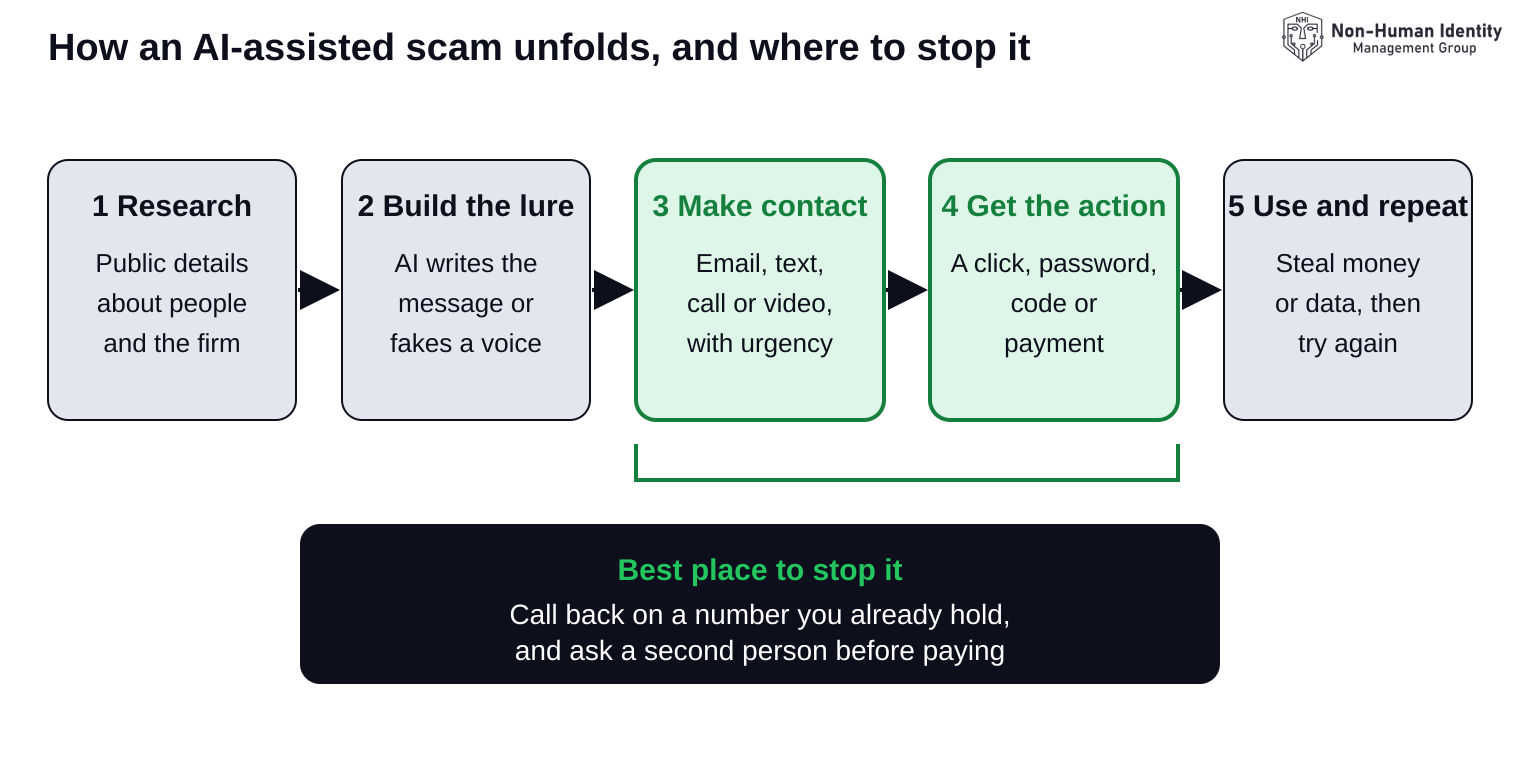
Most AI-assisted attacks follow the same path as older ones. This is a simple defender's view, not instructions:
- Research the target. Attackers gather public details, such as names, job titles and recent news. Google reports that state-backed groups use AI for this early research.[6]
- Build the lure. AI writes a believable message about an invoice, a meeting or a request from the boss. It can also fake a voice or video.
- Make contact. The lure arrives by email, text, phone or video call, often with urgency or secrecy.
- Get the action. The aim is a click, a password, a code or a payment. Some attacks instead use AI to find weak spots in systems faster.[2]
- Use the access and repeat. Attackers steal money or data. Because AI makes each try cheap, they can try again with new versions.
Fake voices are a growing part of this. The FBI has warned that criminals use AI-generated voice messages to pose as public figures and people the victim knows. It says AI-generated content is often difficult to identify.[3]
AI agents are starting to do more of the hacking itself. The AI company Anthropic reported a campaign it linked to a Chinese state-sponsored group. The group used AI for 80 to 90% of the work against about 30 targets, and succeeded in a small number.[4] Anthropic also noted the AI sometimes made up login details that did not work.[4]
AI inside malware is still early. Google reported its first sighting of malware asking an AI model for instructions during live attacks in 2025. Another AI-based family it found seemed to be still in testing.[6]
A worked example
Farah Strand looks after accounts at a small made-up design studio. She pays supplier invoices.
On a Thursday afternoon, Farah gets an email that seems to come from Amara Rosen, one of the studio's partners. It is perfectly written. It names a real project and asks her to pay a supplier's invoice today, to a new bank account.
Ten minutes later, her phone rings. It sounds just like Amara. She says she is about to board a flight and asks Farah to send the money now.
Farah feels the pressure. But the studio has a simple rule. Any new bank account, or any rushed payment, must be checked by calling the person back on the number in the staff list. A second person must also approve it.
Farah hangs up and calls Amara's mobile from the staff list. Amara answers from her desk upstairs. She sent no email and made no call.
Farah does not pay. She forwards the email to the firm that runs the studio's IT and reports the call. The IT firm checks whether Amara's email account was broken into, and warns the rest of the team.
The studio was not saved because Farah spotted a fake voice. She could not be sure either way. It was saved because the payment process did not rely on recognising voices.
Real cases show the cost when it does. In 2024, a finance worker at the engineering firm Arup joined a video call with AI-made copies of senior colleagues. He made 15 transfers totalling HK$200 million, about US$25.6 million.[5] Read more in our write-up of the Arup deepfake fraud.
Myths and mistakes
| What people think | What is true |
|---|---|
| You can spot scam emails by their bad spelling. | AI writes fluent text in many languages. Focus on what the message asks you to do. |
| If I can hear their voice, it must be them. | Voices can be copied. The FBI says AI-generated content is often difficult to identify.[3] Call back on a number you already hold. |
| AI attacks need AI tools to stop them. | Special tools can help, but call-back checks, strong sign-in, updates and a second approver block many AI-assisted tricks. |
| AI can hack anything by itself now. | AI is speeding attacks up, but real cases show it still makes mistakes and needs people to guide it.[4] |
| Only big companies get targeted. | AI makes attacks cheap to repeat, so small firms are common targets too. |
What can I do this week?
- Agree a call-back rule. Any request to pay, change bank details or reset access is checked on a number you already hold.
- Add a second approver. Make new payees and rushed payments need two people.
- Turn on strong sign-in. Switch on multi-factor authentication, a second check beyond your password, for email and banking.
- Switch on automatic updates. Do this for phones, computers and the software your business relies on.
- Make reporting easy. Tell everyone who to contact about an odd message or call.
Checklist
- Staff know that perfect spelling and a familiar voice are not proof a message is genuine.
- Payments and bank detail changes need a call-back check and a second approver.
- Staff feel able to pause and check urgent requests, even from senior people.
- Email and finance accounts use multi-factor authentication.
- Devices and websites get security updates promptly.
- Unused websites, services and remote access are switched off.
- There is one clear, easy way to report suspicious messages and calls.
- We know who to call if money has been sent or a password shared.
Common questions
Are AI attacks completely new?
Mostly not. They are usually familiar tricks, such as scam emails and fake calls, made faster, cheaper and more convincing. That is good news, because the habits that beat older scams, like call-back checks and a second approver, still help against the AI versions.
How can I tell if a call is a deepfake?
Often you cannot be sure, so do not rely on your ears. Hang up and call back on a number you already hold. The FBI also suggests listening to tone and word choice, and checking who the person is before you act.[3]
Can AI write malware?
It can help. Attackers can use AI to write or change harmful code, and Google has reported malware that asks an AI model for instructions while it runs.[6] Keeping devices updated and using security software remain the main defences.
Do I need special AI security tools?
Not to start. Most small organisations gain the most from the basics: payment checks, strong sign-in, prompt updates and staff who feel able to pause. Australia's cyber agency publishes tiered advice for small and medium businesses.[2]
What should I do if I think I have been targeted?
Stop and do not act on the request. Report it to your IT or security contact straight away. If you shared a password or code, change it and tell them. If money was sent, call your bank at once on the number on its website or card.
Where next?
Ready for the detail? Read the practitioner guide: AI-Powered Cyber Attacks Guide. It goes further into how security teams detect these attacks, the shared catalogues that describe them and defences by organisation size.
Also useful:
- Phishing for Beginners
- Social Engineering for Beginners
- Deepfakes and AI Fraud for Beginners
- Malware for Beginners
- AI-Generated Phishing Defence Guide
Related NHI Mgmt Group resources: Deepfake and AI Impersonation Guide · ASD Defending Against AI-Enabled Cyber Attacks Guidance Guide · Vishing and Smishing Guide · Agentic Ransomware Defence Guide
Key terms
- AI-generated phishing
- Scam messages written with AI so they read well and can be sent in large numbers.
- Phishing
- Fake messages or websites that trick people into sharing passwords, opening harmful files or paying.
- Using lies, urgency and authority to push a person into a risky action.
- Deepfake
- AI-made audio, video or images that show a person saying or doing something they never did.
- Voice Cloning
- Using AI to make speech that sounds like a real person.
- Business email compromise
- A scam where someone poses as a trusted person or firm to redirect payments.
- AI-powered malware
- Harmful software that uses AI, for example to get instructions while it runs.
- Multi-Factor Authentication
- Signing in with a second check as well as a password, such as a code or security key.
Sources and further reading
- Impact of AI on cyber threat from now to 2027. National Cyber Security Centre (NCSC), 7 May 2025. https://www.ncsc.gov.uk/report/impact-ai-cyber-threat-now-2027, accessed 28 Nov 2026.
- Defending against AI-enabled cyber attacks. Australian Signals Directorate, Australian Cyber Security Centre. https://www.cyber.gov.au/business-government/secure-design/artificial-intelligence/defending-against-ai-enabled-cyber-attacks, accessed 28 Nov 2026.
- Senior US Officials Impersonated in Malicious Messaging Campaign (Alert I-051525-PSA). Federal Bureau of Investigation, Internet Crime Complaint Center (IC3), 15 May 2025. https://www.ic3.gov/PSA/2025/PSA250515, accessed 28 Nov 2026.
- Disrupting the first reported AI-orchestrated cyber espionage campaign. Anthropic, 13 November 2025. https://www.anthropic.com/news/disrupting-AI-espionage, accessed 28 Nov 2026.
- Arup revealed as victim of $25 million deepfake scam involving Hong Kong employee. CNN, 16 May 2024 (news report including Arup's statement). https://edition.cnn.com/2024/05/16/tech/arup-deepfake-scam-loss-hong-kong-intl-hnk, accessed 28 Nov 2026.
- GTIG AI Threat Tracker: Advances in Threat Actor Usage of AI Tools. Google Threat Intelligence Group, Google Cloud blog, 5 November 2025. https://cloud.google.com/blog/topics/threat-intelligence/threat-actor-usage-of-ai-tools, accessed 28 Nov 2026.