Automated decision-making is when a computer system makes a decision about a person without a human really taking part.
This guide is for anyone who has been turned down by an app or form and wondered whether a person ever looked. It also helps small teams that use software to sort loan, job or housing applications. You do not need a legal or technical background.
In short
- Automated decision-making, or ADM, covers decisions made by software with no meaningful human involvement.
- In the EU, people have rights when such a decision has a legal or similarly significant effect, such as a refused loan.
- Those rights include asking for a human to review the decision, giving your side and challenging the result.
- The UK and California have their own rules, and the details differ from place to place.
What you will learn
- Explain what counts as an automated decision and what does not.
- Spot when a decision is significant enough for the extra rights to apply.
- Ask for human review, and know what a real review looks like.
- Check whether a tool your team uses makes decisions on its own.
Status: correct as at 28 November 2026, based on the GDPR text on EUR-Lex, UK regulator draft guidance updated 31 March 2026, and the California rules in force from 1 January 2026.[4][5] Laws change; check the official text.
This guide explains the topic in general terms and is not legal advice.
- A computer decides (automated decision-making)
- a decision about a person made by software, with no meaningful human involvement.
- A computer sizes you up (profiling)
- using data to judge or predict things about a person, such as how likely they are to repay a loan.
- A person checks it (human review)
- a trained person looks at the decision again and has the power to change it.
What is automated decision-making?
Picture an automatic ticket barrier at a station. It decides in a second whether you may pass, and nobody watches each choice. Automated decision-making works the same way for decisions about people.
A system takes in data about you and gives a result, such as yes, no or a price. When no person really takes part, the decision is called solely automated.[2] It does not need clever AI. A simple set of rules in a spreadsheet can count.
Often the system first builds a profile. Profiling means using data about you to judge or guess things, such as your money, health or habits.[1] A credit score is a common example.
The EU law gives two examples. One is a loan form online that is turned down with no person involved. The other is online hiring with no human step.[1]
Where the comparison stops working: when a barrier wrongly blocks you, a staff member is usually standing nearby. With an online decision, you may not know a computer made it, or who to ask. That is why the law gives people a right to be told and to reach a human.
Why does it matter?
Software can make thousands of decisions a day. If the data or the rules are wrong, many people can be treated unfairly before anyone sees it.
So the extra rights apply to decisions with big effects on people's lives. Think of money, work, housing, school or health care.[1][5]
If you apply for loans, jobs or homes
What could happen: an app turns you down at once, and you do not know why or how to ask again.
Check this: read the privacy notice for a line about automated decisions, then ask for a person to review yours.
If you run a small business
What could happen: a hiring or credit tool you bought rejects people on its own, and you cannot explain why.
Check this: ask the supplier whether the tool decides on its own, and who can overturn it.
If you work with data or AI
What could happen: a model learns unfair patterns from old data and repeats them at scale.
Check this: test results across different groups, and make sure a person can step in.
Next: AI Bias for Beginners
What does it look like?
Here is a made-up "Am I affected?" card a person might fill in after an online refusal.
Example only. All values are made up.
Decision: car loan refused, EXAMPLE Finance app
Time from submit to result: 4 seconds             (1)
Did a person look at my case? Not stated          (2)
Effect on me: no loan, so no car for work         (3)
Privacy notice mentions automated decisions? Yes  (4)
How to ask for review: [email protected]       (5)
Reference: REF-0000-FAKE
- A very fast answer hints that no person took part. It does not prove it.
- If no person really took part, the decision may be solely automated.
- A refused loan is the kind of big effect the rules are about.
- Firms must tell people when a computer makes big decisions about them.
- In a real message, this line would give the way to ask for a person to look again.
Why this is risky: many people accept the refusal and move on. If they do not ask, they miss the review and the chance to fix wrong data.
The safer way: note the facts like this. Then ask in writing for a person to look again and give the main reasons.
How does it work?
The rules differ by place, but they follow a similar pattern.
- Is it solely automated? If a person really looks at the case and can change the result, it is not. A person who just clicks approve on every result does not count.[2][3]
- Is the effect big enough? The rights apply to decisions with legal or similarly significant effects. Examples are credit, jobs or access to services.[1]
- Is it allowed? In the EU, such decisions are allowed only in set cases. These are where it is needed for a contract, allowed by law, or based on the person's explicit consent.[1]
- Tell people. The firm must say it uses automated decisions. It must also explain the logic and the likely effects in a useful way.[1]
- Offer the safeguards. People can ask for a human to step in, give their point of view and challenge the decision.[1][3]
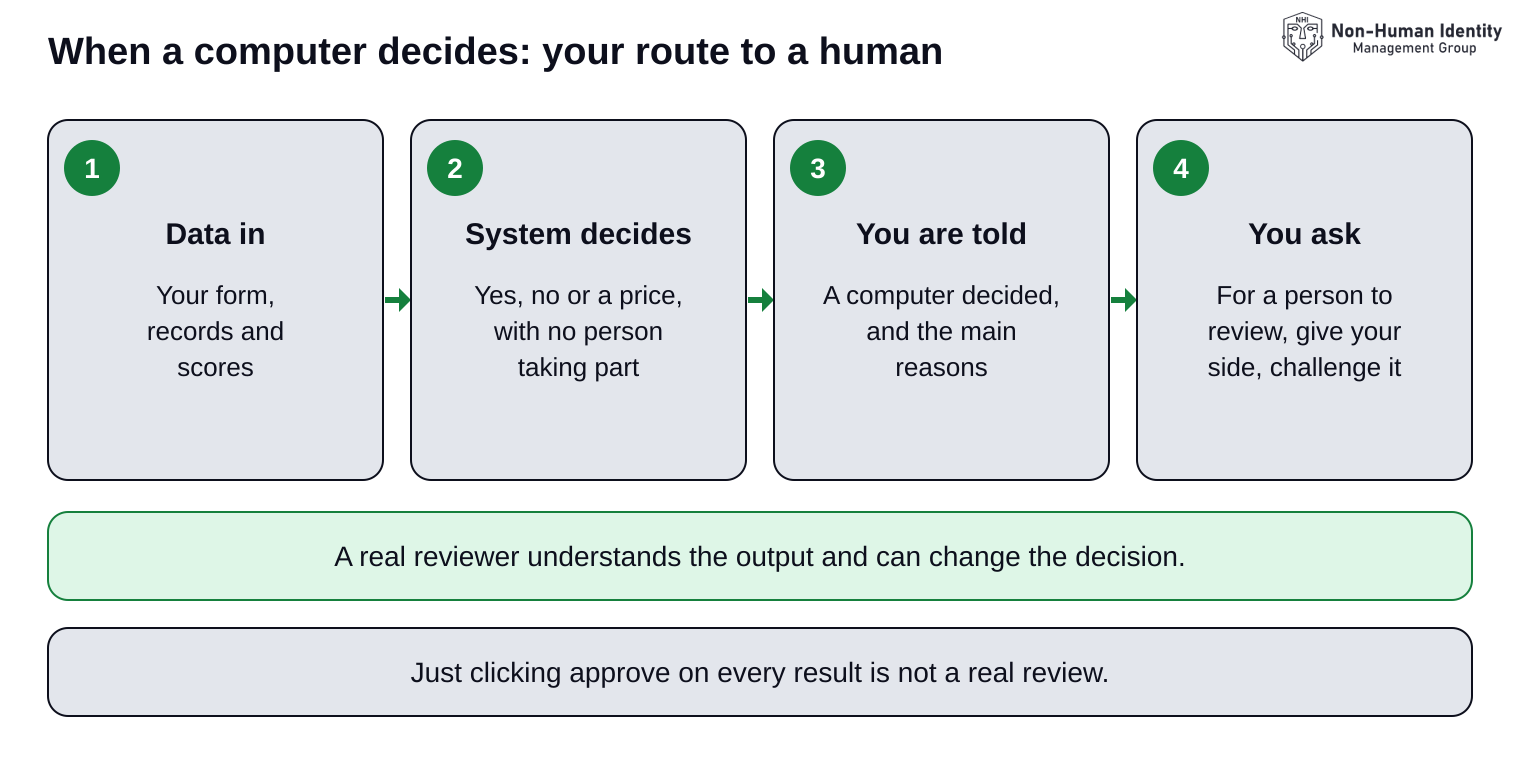
The UK changed its version of these rules through the Data (Use and Access) Act. Draft guidance from the UK regulator lists four safeguards. People get facts about the decision, a chance to make their case, a human review and a way to challenge it. Spot checks or a token review do not meet the bar.[3]
California's privacy rules use the term automated decisionmaking technology, or ADMT. They cover significant decisions about lending, housing, education, jobs and pay, and healthcare. Advertising is not included.[5] Businesses must give a notice before use, an opt-out or a human appeal, and access to information about how the tool was used.[5] Businesses already using ADMT for such decisions must comply by 1 January 2027.[5]
A worked example
Yara Nakamura applies online for a car loan so she can take a new job across town. Four seconds after she presses submit, the app says no. There is no reason and no name.
She checks the lender's privacy notice. A section says the lender uses automated decisions for loan applications. It explains she can ask for a person to review the decision, and gives an address.
Yara writes a short message. She asks for a human review, the main reasons for the refusal, and the chance to add facts. She mentions that she has just started a better-paid job, which her old records would not show.
Bodhi Grover, a credit officer at the lender, picks up her request. He has been trained to read the system's score, and he has the power to change the result.
Bodhi sees that the score relied on an old address linked to missed payments by a previous tenant. He checks Yara's documents and her new job offer. He decides the refusal was based on wrong data.
The lender approves a smaller loan than she asked for, explains why, and corrects the address record. Yara is not fully happy with the amount. But she now knows the reasons, and she was told how to challenge the decision further if she wants to.
The lender also learns something. It adds a check so that old address data is reviewed before the score is used.
Myths and mistakes
| What people think | What is true |
|---|---|
| It only counts if AI is involved. | Simple rules can count too. What matters is that no person meaningfully takes part.[2] |
| Any human in the process makes it fine. | A person who rubber-stamps every result is not meaningful involvement. They need to understand the output and be able to change it.[3][5] |
| The rules cover every automated choice. | The extra rights are for significant decisions. Showing you an advert is not one under the California rules.[5] |
| You can only accept a computer's decision. | For significant decisions, you can usually ask for human review and challenge the result.[1][3] |
| A company can refuse to explain because the system is secret. | The EU rules require meaningful information about the logic. California allows some details to be withheld, such as trade secrets, but not the whole answer.[1][5] |
What can I do this week?
- Read one privacy notice from your bank or insurer. Look for a part on automated decisions.
- Save a note of any fast online refusal, with the date, the service and the reference.
- List your team's tools that score, rank or approve people. Mark the ones that act alone.
- Name a reviewer for each tool. Pick someone who can read its results and change them.
Checklist
- I can explain what makes a decision solely automated.
- I know which kinds of decisions count as significant.
- We know which of our tools decide about people without a person taking part.
- Our privacy notice says where we use automated decisions and what they mean for people.
- People have a clear route to ask for a human review.
- Our reviewers understand the tool's output and can change the decision.
- We check results for unfair patterns across different groups.
Common questions
How do I know if a computer made a decision about me?
Start with the privacy notice. Firms must say when a computer makes big decisions about people, and explain the logic in a useful way.[1] If it is unclear, ask them in writing whether a person took part in your decision.
Can I ask for a person to look at my case?
Usually, yes, for decisions with legal or similarly significant effects. In the EU and UK, the safeguards include human intervention, giving your point of view and challenging the decision.[1][3] In California, a business may offer a human appeal in place of an opt-out.[5]
Is profiling the same as automated decision-making?
No, but they often go together. Profiling judges or guesses things about you, such as a risk score. The decision is what is done with it, such as setting your insurance price. The UK regulator gives an example like this.[2]
How quickly must an organisation reply?
Usually within weeks, but the time limit depends on the law. UK draft guidance says within one month, extendable by two months for complex requests.[3] California's rules give businesses 45 days for access requests, extendable to 90.[5] Check the rules where you live.
Where next?
Ready for the detail? Read the practitioner guide: CCPA Risk Assessment and ADMT Regulations Guide. It goes further into California's notice, opt-out and appeal duties, the risk assessments behind them and the compliance dates.
Also useful:
- GDPR Article 22 Automated Decision-Making Guide
- AI Bias for Beginners
- AI and Privacy for Beginners
- AI in Hiring and Employment Decisions Laws Map
Related NHI Mgmt Group resources: GDPR for Beginners · AI and GDPR Guide · US Privacy Laws for Beginners
Key terms
- Automated decisioning
- Using software or models to make or trigger decisions without a person approving each one.
- Automated decisionmaking technology (ADMT)
- California's term for technology that makes, or largely makes, decisions about people without real human involvement.
- Profiling oversight
- Reviewing and controlling automated analysis that judges or predicts things about people.
- Meaningful human review
- A check by a person who can really examine, challenge and change an automated decision.
- Automation bias
- The habit of trusting a computer's answer just because a computer gave it.
- Explicit consent
- A clear yes, confirmed in words, to a specific use of data.
Sources and further reading
- Regulation (EU) 2016/679 (General Data Protection Regulation), Recital 71 and Articles 13 and 22. European Parliament and Council, 27 April 2016, EUR-Lex. https://eur-lex.europa.eu/legal-content/EN/TXT/HTML/?uri=CELEX:32016R0679, accessed 28 Nov 2026.
- What is ADM? (draft guidance, updated 31 March 2026). Information Commissioner's Office (UK). https://ico.org.uk/for-organisations/uk-gdpr-guidance-and-resources/individual-rights/automated-decision-making/what-is-adm/, accessed 28 Nov 2026.
- What are the ADM safeguards? (draft guidance, updated 31 March 2026). Information Commissioner's Office (UK). https://ico.org.uk/for-organisations/uk-gdpr-guidance-and-resources/individual-rights/automated-decision-making/what-are-the-adm-safeguards/, accessed 28 Nov 2026.
- CCPA updates, cybersecurity audits, risk assessments and ADMT regulations (rulemaking page). California Privacy Protection Agency. https://cppa.ca.gov/regulations/ccpa_updates.html, accessed 28 Nov 2026.
- California Consumer Privacy Act Regulations, approved text, sections 7001, 7021, 7200, 7220 to 7222. California Privacy Protection Agency, approved 22 September 2025. https://cppa.ca.gov/regulations/pdf/ccpa_updates_cyber_risk_admt_appr_text.pdf, accessed 28 Nov 2026.