The CJIS Security Policy is the FBI's set of minimum security rules for protecting US criminal justice information.
This guide is for people who work with US police or justice agencies, the companies that supply them, and students curious about the rules. You do not need to be technical. If you write software, run IT or clean offices for a body that handles police records, these rules may reach you too.
In short
- The policy sets minimum security rules for criminal justice information that comes from FBI systems, such as fingerprints and criminal records.
- It covers police and justice agencies, and also the contractors and private companies that work with that data.
- Core rules include background checks with fingerprints, security training before access, strong sign-in checks and encryption.
- Agencies are checked regularly, and the policy is updated, so always work from the current version.
What you will learn
- Explain what the CJIS Security Policy is in one sentence.
- Spot whether your work could bring you under it.
- Check the core rules: vetting, training, sign-in and encryption.
- Ask the right questions when an agency asks you to follow it.
Status: correct as at 28 November 2026, based on the FBI CJIS Security Policy version 6.1, dated 25 June 2026. Rules change; check the official text.
This guide explains the topic in general terms and is not legal advice.
- Police data (criminal justice information)
- records from FBI systems that police and justice agencies use, such as fingerprints and criminal histories.
- Background check (personnel screening)
- checking a person's records before they are allowed near sensitive data.
- Strong sign-in (multi-factor authentication)
- proving who you are with two different things, such as a password and a code on your phone.
What is the CJIS Security Policy?
Think of the records room at a police station. Only vetted people get a key. Everyone signs the book on the way in. Files leave only in locked cases.
The CJIS Security Policy sets similar rules for computer systems. CJIS stands for Criminal Justice Information Services, a division of the FBI. Its policy sets the minimum security that agencies and their partners must meet to use FBI systems and the data in them.[1]
That data is called criminal justice information. It is the data the FBI's systems provide that police and other agencies need for their work, such as fingerprints and criminal records.[1]
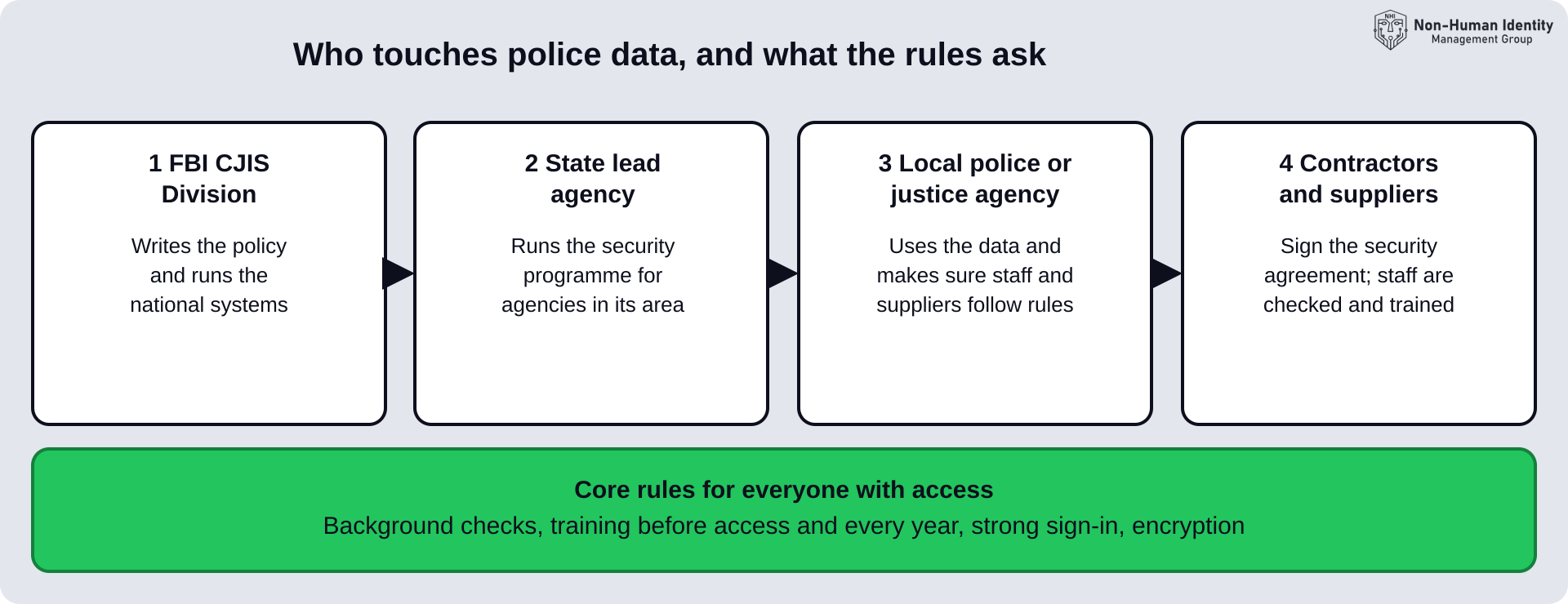
The policy does not stop at police forces. It applies to every person with access, including contractors and private companies.[1] A software firm, a cloud provider or an IT support company may all be covered.
Where the comparison stops working: a records room is in one building. Digital records can be copied, sent and stored in many places at once, including on phones and in the cloud. That is why the policy covers networks, devices and suppliers, not only buildings.
Why does it matter?
Criminal records can affect people's freedom, jobs and safety. If they leak or are changed, the harm can be serious and hard to undo.
If you work for a company that supplies police
What could happen: your staff can reach police data, but nobody has done the required background checks.
Check this: ask the agency which of your staff need checks before they start.
If you are new to IT at a public agency
What could happen: you set up an account with only a password, when the rules call for a stronger sign-in.
Check this: ask your security officer which systems need multi-factor sign-in.
If you are a student or career changer
What could happen: you apply for public sector IT jobs without knowing why vetting takes time.
Check this: expect fingerprint checks and training before you are given access.
Next: Encryption for Beginners
What does it look like?
Here is a made-up "Am I affected?" list. A supplier might fill it in before work starts.
Example only. All values are made up.
EXAMPLE supplier check (fake) - Example County Sheriff
[x] Our product stores or shows police records       (1)
[x] Our staff could see records that are not encrypted (2)
[ ] Signed security agreement with the agency         (3)
[ ] Staff fingerprint checks done                     (4)
[ ] Staff security training done
[x] Records sent over the internet are encrypted      (5)
- If you store or show police records, the rules are likely to apply.
- People who can see records in plain form need checks.
- Firms sign a security deal with the agency. It is called the Security Addendum.
- In a real file, this line would contain the date each check was completed.
- Records sent over the internet must be scrambled.
Why this is risky: the first two ticks mean the rules apply. But the deal, checks and training are not done yet.
The safer way: finish all three with the agency first. Only then should staff get access.
How does it work?
The policy is long, but a few core rules come up again and again.
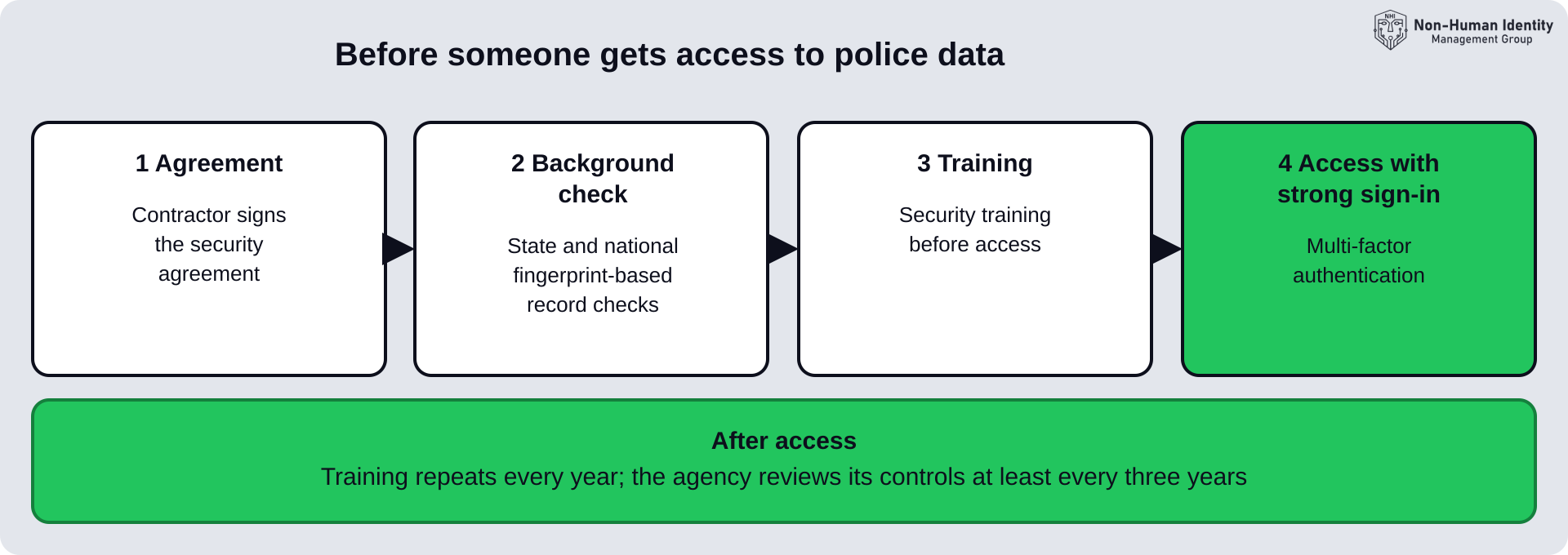
- Agreements first. When an agency hires a private contractor, the contract includes the CJIS Security Addendum, which binds the contractor to the rules.[1]
- People are checked. Anyone with unescorted access to unencrypted records is screened before access. This includes state and national fingerprint-based record checks.[1]
- People are trained. New users get security training before they can access the data, and again every year.[1]
- Sign-in is strong. The policy has rules on multi-factor authentication, which means proving who you are in two different ways, for everyday accounts as well as admin accounts.[1]
- Data is scrambled. Records must not travel unencrypted across public networks. Encryption tools must meet a US government standard, and devices such as phones need encryption too.[1]
- It is checked. Agencies assess their controls at least once every three years.[1] Each state also has a lead agency that runs the security programme for its users.
A worked example
Fen Ueda runs IT for a small fictional software company. The company has won a contract to supply a case notes app to a county sheriff's office in the US.
The sheriff's office sends Fen a long document and a note: "Your team must meet the CJIS Security Policy." Fen has never heard of it.
Fen thinks of the records room picture. Who gets a key? How are they checked? How do files travel? Fen writes those three questions at the top of a page.
First, Fen checks whether the policy applies. The app will store arrest details from the sheriff's systems, and two support engineers could see them. So it applies.
Next, Fen asks the sheriff's office for the security agreement for contractors. Fen signs it and asks how to book fingerprint checks for the two engineers. The agency explains that checks and training must be finished before the engineers get access.
Then Fen looks at the app itself. Records travel over the internet between the office and the app, so Fen confirms they are encrypted with an approved tool. Fen also turns on multi-factor sign-in for every account that can reach the data.
Finally, Fen puts dates in the calendar: yearly training for the engineers, and a reminder to check for new versions of the policy. Fen keeps a simple record of each step, ready for the agency's next review.
Myths and mistakes
| What people think | What is true |
|---|---|
| It only applies to police officers. | It applies to everyone with access, including contractors and private companies.[1] |
| There is a CJIS certificate a supplier can buy. | As far as we can tell, the policy does not set up a single central certificate. In practice, agencies decide whether a supplier meets the rules and check this in their reviews. |
| Training once is enough. | Training comes before access and then every year.[1] |
| Background checks can wait until after someone starts. | Screening happens before access to the system is authorised.[1] |
| A password is enough for police systems. | The policy includes rules on multi-factor authentication for both everyday and admin accounts.[1] |
What can I do this week?
- Find out if your team stores, sees or sends any police records.
- Ask the agency for the latest version of the rules and the contract terms.
- List everyone who could see records in plain form, and check their vetting.
- Check that every account with access uses a strong sign-in.
- Check that records sent over the internet are scrambled.
Checklist
- We know whether we handle criminal justice information.
- We have the current version of the policy from the FBI.
- Contractors have signed the CJIS Security Addendum.
- Everyone with unescorted access to unencrypted records has been screened.
- Everyone has had security training before access, and yearly after.
- Accounts that reach the data use multi-factor sign-in.
- Records are encrypted when they travel over public networks.
- We keep records of checks and training for the agency's reviews.
Common questions
Who has to follow the CJIS Security Policy?
Anyone who can access criminal justice information from FBI systems. That includes police and justice agencies, other government bodies that use the data, and the contractors and private companies that support them. If you are unsure, ask the agency you work with.
Is CJIS a law?
It is generally described as an FBI policy rather than a law passed by Congress, though you should check with your agency. Agencies that use FBI systems agree to meet it, and they pass the rules on to their suppliers through contracts. For an organisation that needs the data, it works much like a binding rulebook.
Does the CJIS Security Policy apply outside the US?
It is a US policy for data from FBI systems. A company based elsewhere could still be covered if it supplies a US agency and can reach that data. Other countries have their own rules for police data.
Can criminal justice information be stored in the cloud?
Yes, if the cloud setup meets the policy. The cloud provider is treated like any other contractor. The agency is still responsible for checking that the rules on vetting, encryption and access are met.
How often does the policy change?
The FBI updates it regularly. Version 6.1, dated 25 June 2026, is the current one at the time of writing. Always check the FBI's resource centre,[2] and ask your agency which version they audit against.
Where next?
Ready for the detail? Read the practitioner guide: CJIS Security Policy Guide. It goes further into the policy areas, the priority tiers and audit timetable, and what the sign-in rules mean for people and for software accounts.
Also useful:
- FedRAMP for Beginners
- Multi-Factor Authentication for Beginners
- Encryption for Beginners
- Insider Threats for Beginners
Related NHI Mgmt Group resources: Third Party Risk Management for Beginners · Security Awareness for Beginners · FedRAMP vs FISMA
Key terms
- Criminal justice information
- Data that police and justice agencies use to identify people and support cases, such as fingerprints and criminal records.
- Personnel security
- Checking and managing the people who can reach sensitive data, including background checks.
- Multi-factor authentication
- Proving who you are in two or more different ways before you get in.
- Encryption
- Scrambling data so only someone with the right key can read it.
- CJIS Security Addendum
- The agreement that binds a private contractor to the CJIS Security Policy.
Sources and further reading
- Criminal Justice Information Services (CJIS) Security Policy, Version 6.1. Federal Bureau of Investigation, CJIS Division, 25 June 2026. https://le.fbi.gov/file-repository/cjis_security_policy_v6-1_20260625-1.pdf, accessed 28 Nov 2026.
- CJIS Security Policy Resource Center. Federal Bureau of Investigation. https://le.fbi.gov/cjis-division/cjis-security-policy-resource-center, accessed 28 Nov 2026.