A cognitive bias is a mental shortcut that leads people to the same kind of wrong judgement, again and again.
This guide is for students, people new to security work and anyone who makes quick calls about alerts, emails or risks. You do not need a psychology or IT background. If your job involves deciding "is this normal or not?", these shortcuts affect you too.
In short
- Everyone uses mental shortcuts. Most of the time they help, but under pressure they can lead to the wrong answer.
- In security, the common traps are seeing what you expect, sticking with your first idea and judging risk by what you remember best.
- Knowing about a bias is not enough on its own. Simple habits work better, such as writing down your first guess and looking for evidence against it.
- Experienced people are affected too, so build the checks into the team's routine.
What you will learn
- Explain what a cognitive bias is in one sentence.
- Spot three common biases in everyday security work.
- Check your own first guess with a few simple questions.
- Ask for team habits that catch thinking errors early.
- Mental shortcut (cognitive bias)
- a habit of thinking that leads to the same kind of mistake under certain conditions.
- Seeing what you expect (confirmation bias)
- noticing the facts that fit your first idea and missing the ones that do not.
- Sorting alerts (triage)
- quickly deciding which security warnings need action first.
What is a cognitive bias?
Think of an optical illusion. Two lines can look different lengths even when you know they are the same. Knowing the trick does not make your eyes see it differently.
A cognitive bias works the same way, but for judgement. Your brain takes a shortcut to save time. Often the shortcut is right. But in some conditions it leads you to the same kind of wrong answer each time.
A well-known study of how intelligence analysts think describes these biases as predictable mental errors. They come from the simple ways our minds handle a lot of information.[1] The same writer compares them to optical illusions: the error can still feel convincing even when you know about it.[1]
A bias is not the same as being careless or not knowing enough. Clever, experienced people have biases too. Security work makes them more likely, because people make many fast decisions with only part of the picture.
Where the comparison stops working: you can measure the lines in an illusion with a ruler. In security there is often no ruler. You may never find out that your judgement was wrong, so the habit carries on unnoticed.
Why does it matter?
Attacks often look like normal activity at first. A biased first reading can close a real case or send a team down the wrong path for days.
If you are new to a security team
What could happen: you close an alert as "the usual false alarm" because the last ten were.
Check this: before closing, name one fact that would show this alert is different.
If you manage a team
What could happen: the team agrees with the first idea from the most senior person, and nobody tests it.
Check this: ask one person to argue the other side in big decisions.
If you are a student or career changer
What could happen: you learn tools well but not how to question your own conclusions.
Check this: practise writing down your first guess and what would prove it wrong.
If you work anywhere with email
What could happen: a message from a name you trust feels safe, so you skip the usual checks.
Check this: check unusual requests the same way, whoever they seem to come from.
What does it look like?
Here is a made-up note an analyst might write while looking at an alert. Each marked line shows a bias at work.
Example only. All values are made up.
Alert EX-0000: large file upload from server EXAMPLE-01
09:02  Probably the nightly backup again.            (1)
09:05  Upload size looks like a backup. Fits.        (2)
09:06  Destination address is new. Ignore for now.   (3)
09:07  Last big scare was ransomware, and this
       is not ransomware, so low risk.               (4)
09:08  Closed: false alarm.
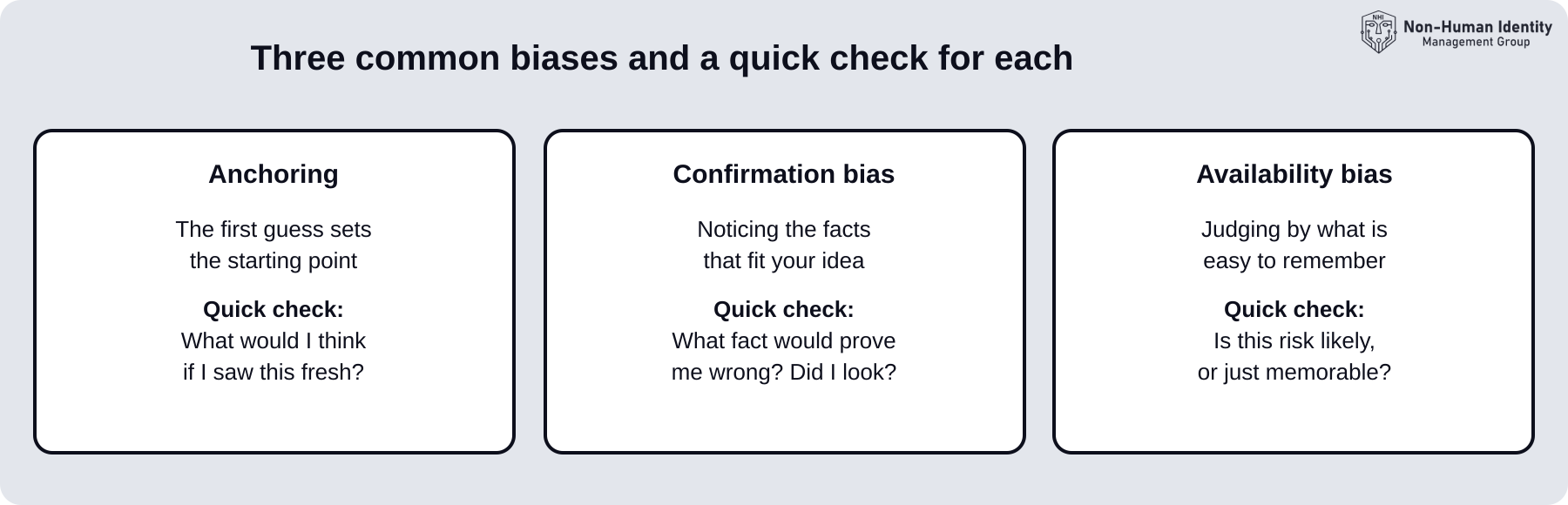
- Anchoring: the first guess sets the starting point for everything after it.
- Confirmation bias: a fact that fits the guess gets attention.
- A fact that does not fit (a new destination) gets set aside.
- Availability bias: the risk is judged against the last vivid incident, not this one.
Why this is risky: each step feels sensible on its own. Together, they close a case without ever testing the idea that data is being taken.
The safer way: write the first guess down as a guess. Then ask what else could explain the alert, and look for the one fact that would rule each idea out.
How does it work?
Most thinking traps in security follow a similar path.
- A first idea forms fast. A US government guide on analysis says people tend to see what they expect to see, and that once a mindset forms, it resists change.[2]
- The first idea becomes an anchor. People adjust from a starting point, but the adjustment is usually too small. The final view stays closer to the start than it should.[1]
- Fitting facts stand out. Information that agrees with the first idea is noticed more clearly than information against it.[1]
- Memory skews the odds. Things that are easy to remember, because they were recent or dramatic, seem more likely than they really are.[1] This is called availability bias.
- The case closes early. Other explanations are never checked. Analysts call this premature closure, which means settling on an answer too soon.[2]
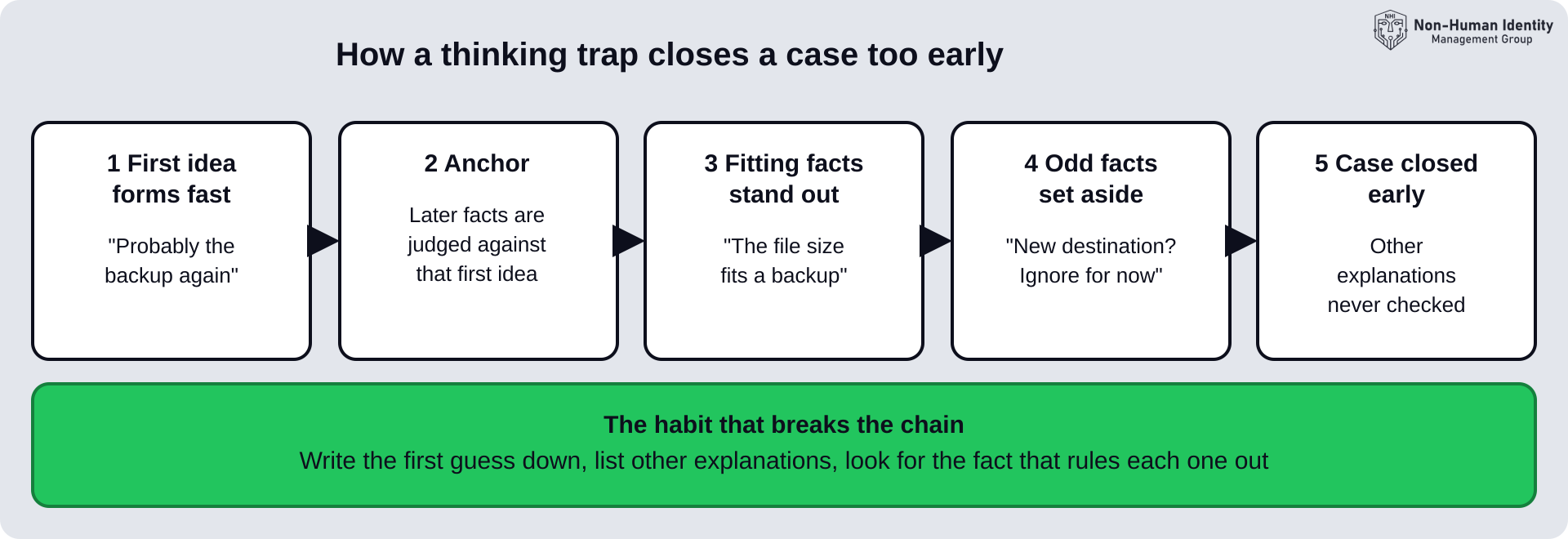
The fix is not to "try harder". The same writer notes that knowing about a bias does not, by itself, make the error go away.[1] What helps are small, structured habits that force other ideas into view.
- Check your assumptions. List the things you are taking as true, and ask which ones you have not checked.[2]
- Compare explanations. Write down every sensible explanation, then look at which facts count against each one. Focus on ruling ideas out, not proving one.[2]
- Argue the other side. One person builds the best case for a different answer, as a check on a view the whole team shares.[2]
A worked example
Leila Vance has been a junior analyst at a fictional online shop for three months. On Monday morning she sees an alert: a staff account signed in from another country at 3am.
Her first thought is that it must be Rania Varga from sales, who travels a lot. Leila has seen alerts like this for Rania before, and they were always her.
Leila starts to write "known traveller, closed". Then she remembers the habit her team lead, Yara Fairweather, asked everyone to use. Write the first guess down as a guess. Then name one fact that would prove it wrong.
So Leila writes: "Guess: Rania travelling. Would be wrong if Rania is in the office today." She checks the team calendar. Rania is marked as working from the London office all week.
Now Leila lists other explanations. Perhaps Rania is using a private network that hides her location. Perhaps someone else has her password.
She sends Rania a quick message through the company chat. Rania replies that she is at her desk and has not signed in from abroad.
Leila raises the case with Yara. They reset Rania's password, end the other session and check what the account touched. In the records available to them, the session had only opened Rania's inbox.
At the review, Yara does not blame Leila's first guess. Instead, the team adds a line to its checklist: "What would prove my first idea wrong, and have I checked it?"
Myths and mistakes
| What people think | What is true |
|---|---|
| Only beginners fall for biases. | Experienced people are affected too. Past success can make a familiar way of thinking feel even more reliable. |
| Once I know about a bias, I will stop doing it. | Knowing helps a little. The error can still feel convincing, so habits and checklists do more of the work.[1] |
| Lots of evidence for my idea means it is right. | Look at the evidence against each idea. The best answer is often the one with the least against it.[2] |
| If there were a problem, I would see signs of it. | Missing records and unwatched systems leave no signs. Ask what you cannot see. |
| Biases are a personal weakness. | They are a normal part of how minds work. Treat them as a team process problem, not a reason to blame people. |
What can I do this week?
- Write down your first guess on your next three decisions, and label it as a guess.
- For each guess, name one fact that would prove it wrong, then look for it.
- Ask a colleague to argue the opposite view on one open case.
- Look back at one closed case and ask which shortcut may have shaped it.
- Suggest one bias question for your team's checklist.
Checklist
- I write down my first idea as a guess, not a fact.
- I name at least one other explanation before closing a case.
- I look for the fact that would prove my idea wrong.
- I ask what data is missing, not only what is there.
- I check whether "it is always this" is really true for this case.
- Big decisions have someone arguing the other side.
- Our case notes record how sure we are, and why.
Common questions
What is the most common cognitive bias in security?
Confirmation bias is one of the most talked about. It means noticing the facts that fit your first idea and missing those that do not. In security it often shows up when an alert is closed as a false alarm because it looks like earlier false alarms.
Is a cognitive bias the same as a mistake?
Not quite. A mistake can happen once for any reason. A bias is a pattern: the same kind of error under the same kind of conditions. That pattern is useful, because it means you can plan checks for the moments when it is most likely.
Do attackers use cognitive biases?
Yes. Scam emails often use urgency, authority or a familiar name to rush people past their usual checks. That is the attacker side, covered in the social engineering guide. This page is about how defenders' own thinking can go wrong.
Can tools or AI remove bias?
Tools can help, for example by showing context or flagging unusual details. But people still choose what to look at and how to read it. Tools can also carry the assumptions of the people who built them, so keep the human checks in place.
How long does it take to build better habits?
Small habits can start at once, such as writing your first guess down. Making them part of the team's routine takes longer. Adding one question to a shared checklist is a good first step, because it does not rely on memory under pressure.
Where next?
Ready for the detail? Read the practitioner guide: Cognitive Biases in Security Analysis. It goes further into the full list of biases in security operations and investigations, structured analysis methods and how to state how confident you are in a finding.
Also useful:
- Alert Fatigue Reduction Guide
- SOC Analyst for Beginners
- Threat Intelligence Analyst for Beginners
- Social Engineering for Beginners
Related NHI Mgmt Group resources: Incident Response for Beginners · Security Awareness for Beginners · SOC Analyst Career Guide
Key terms
- Cognitive bias
- A predictable mental shortcut that can lead to the same kind of wrong judgement, especially under pressure.
- Confirmation bias
- Reading evidence in a way that supports what you already believe.
- Availability bias
- Judging how likely something is by how easily examples come to mind.
- Anchoring
- Letting a first guess or number set the starting point, then not moving far enough from it.
- Triage
- Quickly sorting alerts by urgency so the team deals with the most important first.
- False positive
- An alert that looks like a threat but turns out to be harmless.
Sources and further reading
- Richards J. Heuer Jr. Psychology of Intelligence Analysis. Center for the Study of Intelligence, Central Intelligence Agency, 1999. https://www.cia.gov/resources/csi/static/Pyschology-of-Intelligence-Analysis.pdf, accessed 28 Nov 2026.
- A Tradecraft Primer: Structured Analytic Techniques for Improving Intelligence Analysis. US Government, March 2009. https://www.cia.gov/resources/csi/static/Tradecraft-Primer-apr09.pdf, accessed 28 Nov 2026.