CyberSecure Canada is a voluntary certification that shows a Canadian business has basic cyber security in place.
This guide is for owners and staff of small and medium firms in Canada, the IT suppliers who help them, and students new to security. You do not need to be technical: most of the controls are good habits, such as updates, backups and strong sign-in checks.
In short
- CyberSecure Canada certifies that a small or medium organisation has a set of basic security controls in place.
- The controls are aimed at everyday cybercrime, not at highly targeted attacks.
- An independent, accredited certification body checks your controls and gives you a quote for the audit.
- Since 31 March 2023, the Standards Council of Canada has been the place to go for current certification information.
What you will learn
- Explain what CyberSecure Canada is and who it is for.
- Spot the main kinds of control it asks for.
- Check how ready your business is with a simple list.
- Ask a certification body the right questions before you start.
Status: correct as at 28 November 2026, based on the Innovation, Science and Economic Development Canada (ISED), Standards Council of Canada (SCC) and Canadian Centre for Cyber Security pages listed in Sources. The scheme and its standard are updated from time to time; check the official pages before you apply.
This guide explains the topic in general terms and is not legal advice.
- Basic safety list (baseline controls)
- a short set of security steps that most small firms can put in place.
- Checker (certification body)
- an independent firm, approved to audit your controls and certify you.
- Approval of the checker (accreditation)
- when a national body confirms a certification body is fit to do audits.
What is CyberSecure Canada?
Think of the food safety certificate on a restaurant wall. It does not promise every meal will be perfect. It shows an inspector has checked that the kitchen follows the basic rules.
CyberSecure Canada does the same for cyber security. It is a free choice, not a must. It is a federal scheme for small and medium firms and other groups in Canada.[2] A business puts a set of basic security controls in place. Then an independent checker audits them. If they pass, the business can show a certification mark on its website and premises.[2]
The controls started as a free guide from the Canadian Centre for Cyber Security. That is the country's lead cyber agency. The guide is for groups with fewer than 500 staff.[4]
Where the comparison stops working: a kitchen is checked where it stands. Your systems are spread out, on laptops, phones and online services. So the controls also cover the cloud, phones and your website.
Why does it matter?
Customers often want to know a supplier takes security seriously. The SCC says the mark is an easy way for customers, partners and others to see that a firm has lowered its risk.[3]
If you own a small business
What could happen: a larger customer asks for proof of basic security, and you have nothing to show.
Check this: ask your main customers whether they value or expect a certification.
If you are an IT supplier to small firms
What could happen: a client asks you to get them certified, and the controls touch systems you manage.
Check this: read the free baseline controls and note which ones you look after.
Next: CyberSecure Canada
If you are new to security work
What could happen: you are asked to help with readiness and do not know where to start.
Check this: take the free course for small and medium organisations from the national cyber centre.
What does it look like?
Here is a made-up "Am I ready?" card. A small firm might fill it in before it talks to a checker.
Example only. All values are made up.
Readiness check: EXAMPLE Bakery Supplies Ltd       Staff: 0040
Incident plan written                  yes
Automatic updates on                   yes
Default passwords changed              some     (1)
Two-step sign-in for admin and email   no       (2)
Backups tested                         never    (3)
Staff security training                yes
Cloud services reviewed                no       (4)
- Some devices may still use the password they came with from the shop.
- Two-step sign-in adds a second check, like a code on a phone.
- A backup that has never been tried may not work when you need it.
- In a real file, this line would list each online service and who checked it.
Why this is risky: each "no" or "some" is a gap. A criminal could use it, and the checker is likely to find it.
The safer way: close the gaps first, using the free guide. Then ask a checker to look at how ready you are and give you a quote.
How does it work?
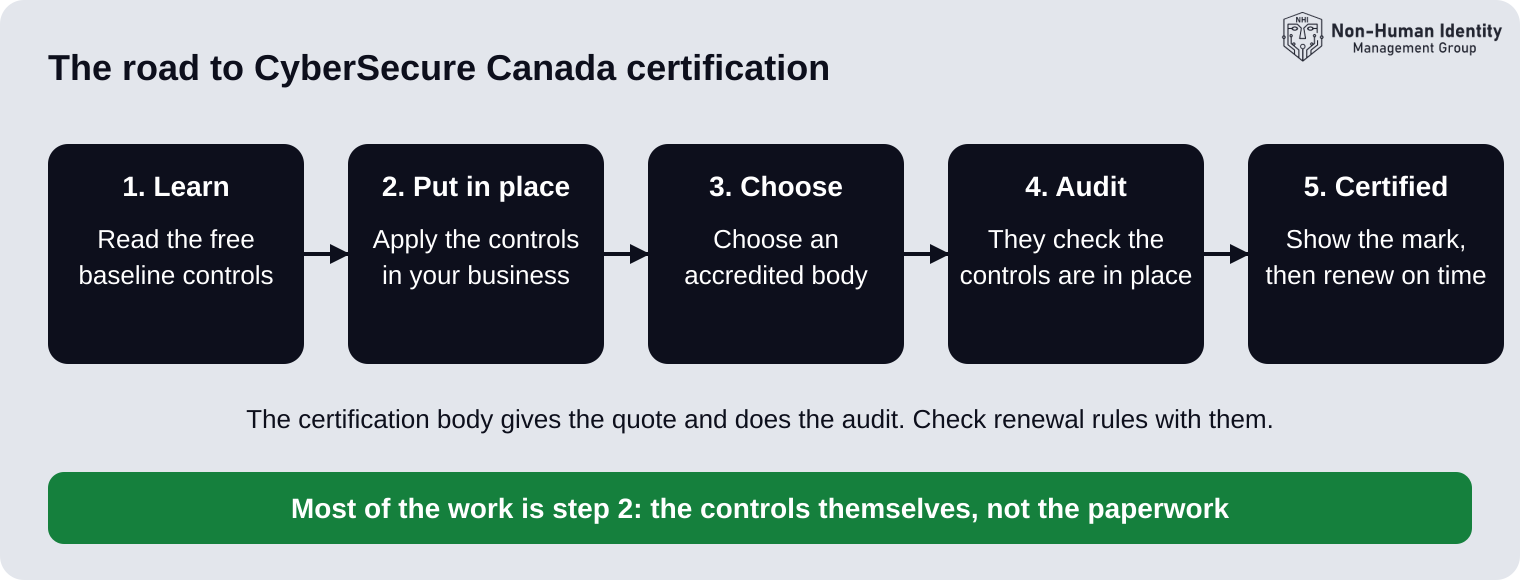
- Learn the controls. Read the free baseline controls from the Canadian Centre for Cyber Security. The original guide lists 13 of them.[4]
- Put them in place. This is most of the work. The controls include an incident plan, automatic updates, secure device set-up, strong sign-in checks, staff training, backups, and secure cloud services and websites.[4]
- Choose a certification body. Pick one accredited by the Standards Council of Canada. It checks how ready you are and gives you a cost estimate.[2]
- Have the audit. The certification body checks that the controls are really in place in your business.
- Get certified and renew. Once certified, you can show the mark. The original scheme sheet says the mark lasts two years.[2] That sheet is older than the 2023 handover, so confirm the current rules with your certification body.
Who does what has changed since the scheme began. ISED launched it, but says it stopped being the program authority on 31 March 2023. It now sends people to the Standards Council of Canada for current certification and renewal information.[1] The control set has also become a National Standard of Canada, which the SCC lists in a 2024 revision.[3] The practitioner guide explains the versions.
A worked example
Pia Corrigan owns a made-up bakery supply firm in Ontario with forty staff. A large grocery chain wants to buy from her. Its supplier form asks, "Do you hold a recognised cyber security certification?"
Pia calls Reza Ilic, who runs the small IT firm that looks after her computers. Reza suggests CyberSecure Canada, because it is built for firms her size.
First, Reza reads the free baseline controls and fills in a readiness card. Most things are in place. But there are gaps. The office router still has its factory password. Email has no two-step sign-in. Backups run every night, but nobody has ever tried to restore one.
Over six weeks, Reza closes the gaps. He changes the router password and turns on two-step sign-in for email and admin accounts. Then he tests a restore from backup. Pia writes a one-page incident plan and runs a short training session for staff.
Next, Pia contacts two accredited certification bodies for quotes. She picks one, and its auditor checks each control. One small finding comes back: a shared tablet has no screen lock. Reza fixes it the same day.
Pia's firm is certified. She ticks "yes" on the grocery chain's form and adds the mark to her website. The certificate does not make her firm immune to attack. But the most common gaps are now closed.
Myths and mistakes
| What people think | What is true |
|---|---|
| CyberSecure Canada is required by law. | It is voluntary. Some customers may still ask for it, or for something like it. |
| Certification means we cannot be hacked. | It shows basic controls are in place against common cybercrime. Higher-risk firms need more.[4] |
| The government audits us directly. | An accredited, independent certification body does the audit. |
| Old blog posts tell us how it works today. | The scheme moved to new arrangements in 2023. Check the SCC and your certification body for current rules. |
| Once certified, we can forget about it. | Controls need to stay in place, and the certificate has to be renewed. |
What can I do this week?
- Read the free baseline controls from the Canadian Centre for Cyber Security.
- Fill in a simple readiness card like the one above.
- Turn on two-step sign-in for email and admin accounts.
- Test that you can restore one file from your backup.
- Ask your IT supplier which controls they already look after.
Checklist
- We have a written incident response plan.
- Automatic updates are on for software and devices.
- Devices are set up securely, with default passwords changed.
- Admin, finance and email accounts use two-step sign-in.
- Staff have had security awareness training.
- Data is backed up, and we have tested a restore.
- Our cloud services and website have been reviewed for security.
- We know which accredited certification body we will use, and its renewal rules.
Common questions
Who can apply?
The scheme is for small and medium firms and other groups in Canada. The controls it grew from are for groups with fewer than 500 staff.[4] Bigger or higher-risk groups can still use the controls, but will likely need more.
How much does it cost?
The official pages do not set one fee. The checker gives you a cost estimate after looking at how ready you are. Ask a few bodies for quotes. The controls themselves may also cost time or money to put in place.
Is it the same as Cyber Essentials?
They are alike in spirit. Both are basic security schemes for smaller firms. Cyber Essentials is the UK scheme with five technical controls.[5] CyberSecure Canada is the Canadian one. Its list is wider and also covers things like incident plans and staff training.
Who runs it now?
ISED started the scheme. It says it stopped running it on 31 March 2023. For current certification and renewal, it points to the Standards Council of Canada.[1] The SCC approves the checkers who do the audits.
Where can I learn the controls for free?
The national cyber centre gives away the controls guide for free. ISED also points to a free course on the centre's Learning Hub, called Cyber Security for Small and Medium Organizations.[1] Both are good starting points before you talk to a certification body.
Where next?
Ready for the detail? Read the practitioner guide: CyberSecure Canada. It goes further into who runs the scheme today, the versions of the standard, each control in detail and how to prepare for the audit.
Also useful:
- Cyber Essentials for Beginners
- Small Business Cyber Security for Beginners
- Baseline Security Schemes Compared
- Canada's Privacy Laws for Beginners
Related NHI Mgmt Group resources: Canada Bill C-8 Guide · Cyber Security Agencies for Beginners · Cyber Insurance for Beginners
Key terms
- Baseline security controls
- The minimum security steps an organisation applies everywhere to cut common risks.
- Certification body
- An organisation that checks whether you meet a standard and issues the certificate.
- Accredited certification body
- A certification body that a national body has approved to do audits.
- Two-factor authentication
- A sign-in check that needs two different proofs, such as a password and a phone code.
- Incident response plan
- A written set of steps for what to do when a security problem happens.
- Cyber Essentials
- The UK's basic security certification, built around five technical controls.
Sources and further reading
- Innovation, Science and Economic Development Canada. CyberSecure Canada. Page last modified 24 September 2025. https://ised-isde.canada.ca/site/cybersecure-canada/en (accessed 28 Nov 2026).
- Innovation, Science and Economic Development Canada. CyberSecure Canada information sheet. https://ised-isde.canada.ca/site/cybersecure-canada/en/node/13 (accessed 28 Nov 2026).
- Standards Council of Canada. CyberSecure Canada accreditation program. https://scc-ccn.ca/accreditation/accreditation-programs/management-systems/cybersecure-canada (accessed 28 Nov 2026).
- Canadian Centre for Cyber Security. Baseline cyber security controls for small and medium organizations. https://www.cyber.gc.ca/en/guidance/baseline-cyber-security-controls-small-and-medium-organizations (accessed 28 Nov 2026).
- National Cyber Security Centre (UK). Cyber Essentials: overview. https://www.ncsc.gov.uk/cyberessentials/overview (accessed 28 Nov 2026).