A national cyber security agency is a government body that helps keep a country safe online.
This guide is for members of the public, students and small business owners who keep hearing names like NCSC, CISA or ENISA. You do not need a technical background. If you run a business, these agencies publish free advice you can use today.
In short
- Most countries have a government body that gives cyber security advice, warns about threats and helps in big attacks.
- Examples include the NCSC in the UK, CISA in the US, ENISA for the EU and the Cyber Centre in Canada.
- Their free guides, alerts and reporting services are open to anyone, including small firms.
- For scams and stolen money, you usually report to your bank and the police or fraud service, not the agency itself.
What you will learn
- Explain what a national cyber security agency does in one sentence.
- Name the main agency for the UK, the US, the EU and Canada.
- Spot which kind of help you can get from an agency and which you cannot.
- Check where to report a scam email or an attack.
Status: correct as at 28 November 2026, based on the agencies' own websites. Roles and services change; check the official pages.
This guide explains the topic in general terms and is not legal advice.
- Cyber agency (national cyber security agency)
- a government body that gives advice and helps defend a country online.
- Emergency team (CSIRT)
- a team that helps handle serious computer attacks, like a fire crew for computers.
- Country plan (national cyber strategy)
- a government document that sets out how a country will stay safe online.
What is a national cyber security agency?
Think of a national public health service. It shares advice on staying well, tracks outbreaks and steps in when something big spreads. You still look after your own health each day.
A national cyber security agency does the same job for computers and the internet. It writes plain advice. It sends out warnings about new attacks. It helps when an attack hits something big, like a hospital. Many agencies also run a national CSIRT. That is a response team of experts who help handle serious attacks.
Here are four well-known examples:
- UK: the National Cyber Security Centre (NCSC). It is part of GCHQ, a UK intelligence agency, and has worked to protect the UK since 2016.[1]
- US: the Cybersecurity and Infrastructure Security Agency (CISA). It is part of the Department of Homeland Security and leads work to protect key services.[2]
- EU: the EU Agency for Cybersecurity (ENISA), set up in 2004. It mainly helps the EU and its member countries.[3]
- Canada: the Canadian Centre for Cyber Security, opened in 2018. It is part of an intelligence agency called CSE and is also Canada's national CSIRT.[4]
Most countries also write a national cyber strategy. This is a plan for how the country will stay safe online. The UK, for example, published one in December 2021.[5] The agency is one of the main teams that carries the plan out.
Where the comparison stops working: a health service can treat you in person. A cyber agency rarely fixes one person's laptop. It gives advice to all, and keeps hands-on help mainly for big attacks.
Why does it matter?
Agencies turn what they learn from many attacks into free, plain advice. Knowing who does what saves time when something goes wrong.
If you use the internet at home
What could happen: you get a scam email and are not sure who to tell.
Check this: find your country's scam email reporting service before you need it.
If you run a small business
What could happen: you pay for advice that your national agency gives away for free.
Check this: read your agency's small business guide and see what you already do.
If you are a student
What could happen: you read news about an attack and cannot tell which source to trust.
Check this: compare the news story with the agency's own alert or advice page.
What does it look like?
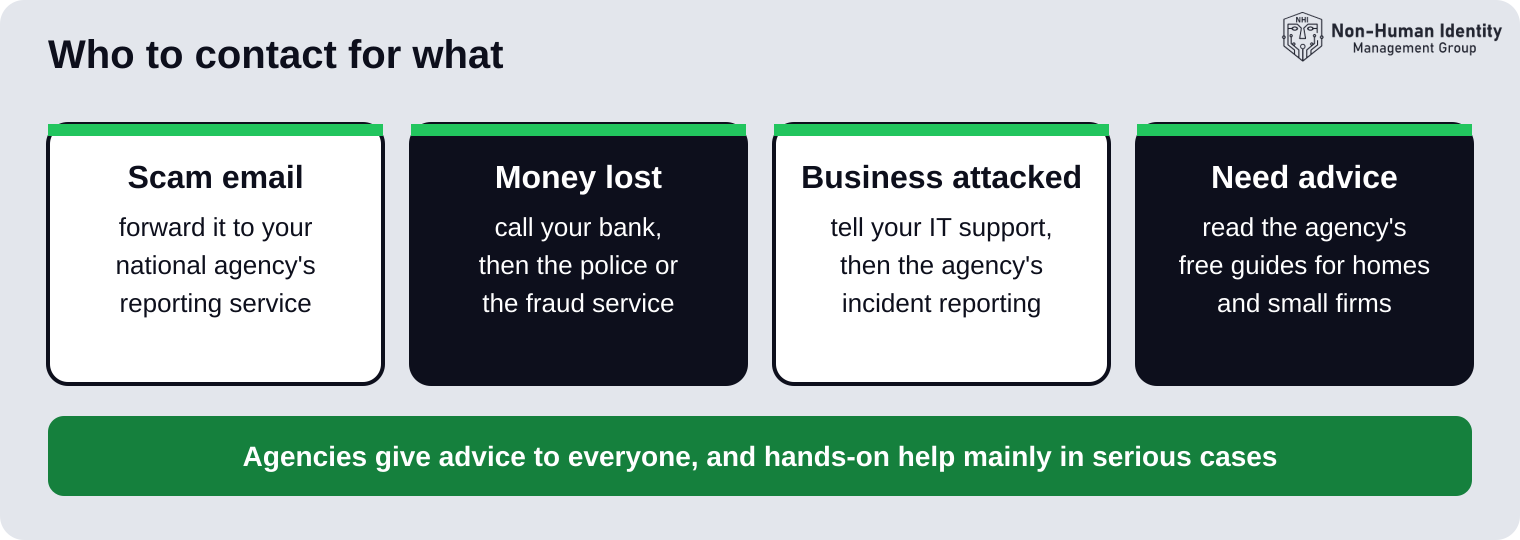
Here is a made-up scenario card. It shows which kind of help fits which problem.
Example only. All values are made up.
Problem                                   Who usually helps first
A strange email asks me to "verify" (1)   The agency's scam email service
Money left my account after a call  (2)   My bank, then the police or fraud service
Our shop's systems are locked       (3)   Our IT support, then the agency's
                                          incident reporting service
I want simple advice for my firm    (4)   The agency's free small business guides
Sender: [email protected]
- Many agencies run a service that checks suspicious emails people forward to them.
- Lost money is a crime and a banking matter. Call your bank first.
- Agencies take reports of serious attacks on organisations and may help or point you to others.
- Free guides are written for people with no IT team.
Why this is risky: scammers sometimes pretend to be a government agency. The US crime reporting service warns that it does not contact people directly asking for information or money.[8]
The safer way: type the agency's web address yourself, or use a link from a trusted page. Do not use a link in an unexpected message.
How does it work?
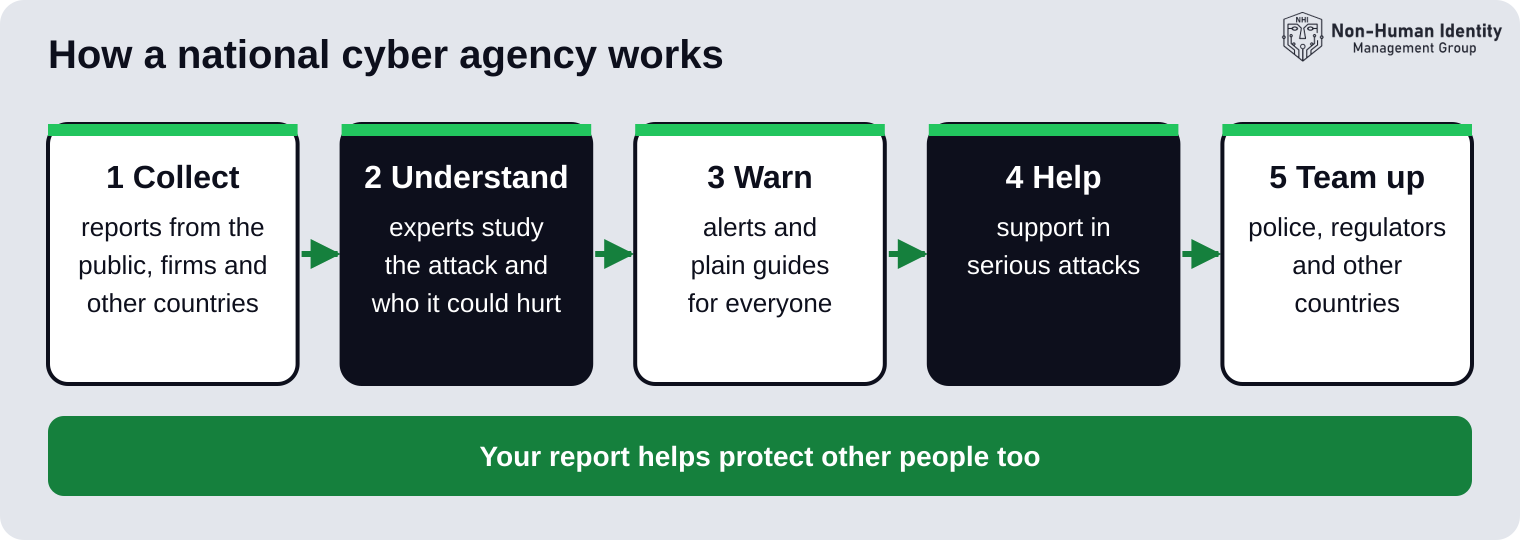
Most national agencies work in a loop like this one.
- Collect. The agency gathers reports from the public, firms and partner countries. For example, the NCSC looks at every suspicious email it is sent and any websites it links to.[6]
- Understand. Experts work out what the attack is and who it could hurt.
- Warn and advise. The agency publishes alerts and plain guides. Some agencies run campaigns for the public, such as Canada's Get Cyber Safe.[4]
- Help in serious cases. For big attacks, the agency's response team supports the victim and other teams. CISA, for example, takes reports of incidents, malware and software weaknesses.[7]
- Work with others. Police handle crime. Regulators check the rules are followed. Agencies in other countries share what they see.
In the EU, each country has its own national team and authority. ENISA supports them, so firms in the EU usually report to their own country, not to ENISA. The EU Cyber Bodies Guide explains who does what.
A worked example
Freya Yeboah runs Cedar Nursery, a fictional plant nursery with eight staff in England.
One Monday an email arrives that looks like it is from her delivery firm. It asks her to "confirm" a card payment. She is not sure, so she asks her nephew, Hugo Novak, who is studying IT.
Hugo thinks of the health service picture. You go to the right place for the right problem. He does not click the link. Instead, they open the NCSC website by typing the address. They find the page on suspicious emails and forward the email to the reporting service it lists.[6]
Freya asks if the NCSC will tell her what it finds. Hugo reads the page again. It says the agency acts on every message but cannot reply with the outcome.[6]
Next, Hugo shows Freya the NCSC advice for small organisations. She learns about Cyber Essentials, a government-backed scheme that sets out basic protections. She decides to work through it with her IT supplier.
They also agree a short plan. If money ever leaves the account, Freya will call the bank first and then report the crime. If the shop's systems are locked, she will call her IT supplier and report the attack.
The email did not cost her anything. The plan means she knows who to call next time.
Myths and mistakes
| What people think | What is true |
|---|---|
| The agency will fix my hacked laptop. | Agencies give advice to all and save hands-on help mainly for serious attacks. Use your own IT support or a trusted repair shop. |
| The agency is the place to get my money back. | Call your bank first, then report the crime to the police or fraud service. |
| A firm in the EU should report attacks to ENISA. | Firms usually report to their own country's team or authority. ENISA supports those national bodies. |
| Agency advice is only for big companies. | Many agencies write guides for homes, sole traders and small firms.[1] |
| An email from "the agency" must be genuine. | Scammers copy government names. Go to the agency's website yourself.[8] |
What can I do this week?
- Find your country's national cyber security agency and save its website address.
- Look up how to report a suspicious email where you live.
- Read one free guide from the agency for homes or small firms.
- Write down who to call first if money goes missing or systems are locked.
Checklist
- I know the name of my national cyber security agency.
- I have its real website address saved, not a link from an email.
- I know how to report a scam email in my country.
- I know to call my bank first if money is taken.
- My business knows where to report a serious attack.
- Someone in my team has read the agency's small business advice.
- I check alerts from the agency when big attacks are in the news.
Common questions
Is a cyber security agency the same as the police?
No. A cyber agency gives advice, warns about threats and helps defend important services. The police investigate crimes and can arrest people. They often work together. If you have lost money, report it to the police or your national fraud service.
Can a small business get help from the NCSC or CISA?
Yes, mainly through free advice. Both agencies publish guides written for small organisations and take reports of attacks. Hands-on help is usually kept for serious incidents. For day-to-day problems, a small firm will normally need its own IT support or a trusted supplier.
Does ENISA help individual people or firms?
Mostly not directly. ENISA supports EU policy, national teams and certification schemes, and shares advice and reports.[3] People and firms in the EU usually go to their own country's agency or response team. The EU Cyber Bodies Guide explains the roles.
What is a national cyber strategy?
It is a government plan for how a country will stay safe online. It sets goals, such as protecting key services, building skills and working with allies. The national agency is one of the teams that puts the plan into action. Plans are usually updated every few years.
Will the agency tell me what happened to my report?
Often not. The NCSC, for example, says it acts on every suspicious email it receives but cannot reply with the result.[6] Your report still helps, because it can lead to harmful websites being taken down for everyone.
Where next?
Ready for the detail? Read the practitioner guide: EU Cyber Bodies Guide. It goes further into the legal basis of each EU body, how national teams and crisis networks link up, and who firms should contact.
Also useful:
- National Cyber Strategies Compared
- Consumer Reporting Routes Map
- Cyber Incident Reporting for Beginners
- NIS2 for Beginners
Related NHI Mgmt Group resources: ENISA Guidance Explained · NCSC 10 Steps and 14 Cloud Security Principles · FBI IC3 Internet Crime Report
Key terms
- National cyber security agency
- A government body that gives advice, warns about threats and helps defend a country online.
- CSIRT
- A team that coordinates the response to serious computer security attacks.
- National CSIRT
- A government-named response team that is a country's main contact for cyber attacks.
- CERT
- Another name for an emergency response team that shares warnings and helps with attacks.
- National cyber strategy
- A government plan that sets out how a country will stay safe online.
- Phishing
- Fake messages or websites that trick people into giving away details, money or access.
- Incident response
- The steps taken to find, contain and recover from a security attack.
Sources and further reading
- What we do. National Cyber Security Centre (NCSC). https://www.ncsc.gov.uk/section/about-ncsc/what-we-do, accessed 28 Nov 2026.
- About CISA. Cybersecurity and Infrastructure Security Agency (CISA). https://www.cisa.gov/about, accessed 28 Nov 2026.
- About ENISA. European Union Agency for Cybersecurity (ENISA). https://www.enisa.europa.eu/about-enisa, accessed 28 Nov 2026.
- About the Cyber Centre. Canadian Centre for Cyber Security. https://www.cyber.gc.ca/en/about-cyber-centre, accessed 28 Nov 2026.
- National Cyber Strategy 2022. Cabinet Office, GOV.UK, 15 December 2021. https://www.gov.uk/government/publications/national-cyber-strategy-2022, accessed 28 Nov 2026.
- Reporting a scam email. National Cyber Security Centre (NCSC). https://www.ncsc.gov.uk/collection/phishing-scams/report-scam-email, accessed 28 Nov 2026.
- Report to CISA. Cybersecurity and Infrastructure Security Agency (CISA). https://www.cisa.gov/report, accessed 28 Nov 2026.
- Internet Crime Complaint Center (IC3). Federal Bureau of Investigation. https://www.ic3.gov/, accessed 28 Nov 2026.