Personal data is any information that relates to a living person who can be identified.
This guide is for students, new IT staff and small business owners who want a clear answer to "is this personal data?". You do not need a legal background. If you keep a customer list, a staff rota or CCTV footage, you already hold personal data.
In short
- Personal data is information about a living person who can be picked out, by name or by other details.
- A person can be identified without a name, for example from an ID number, a location or an IP address.
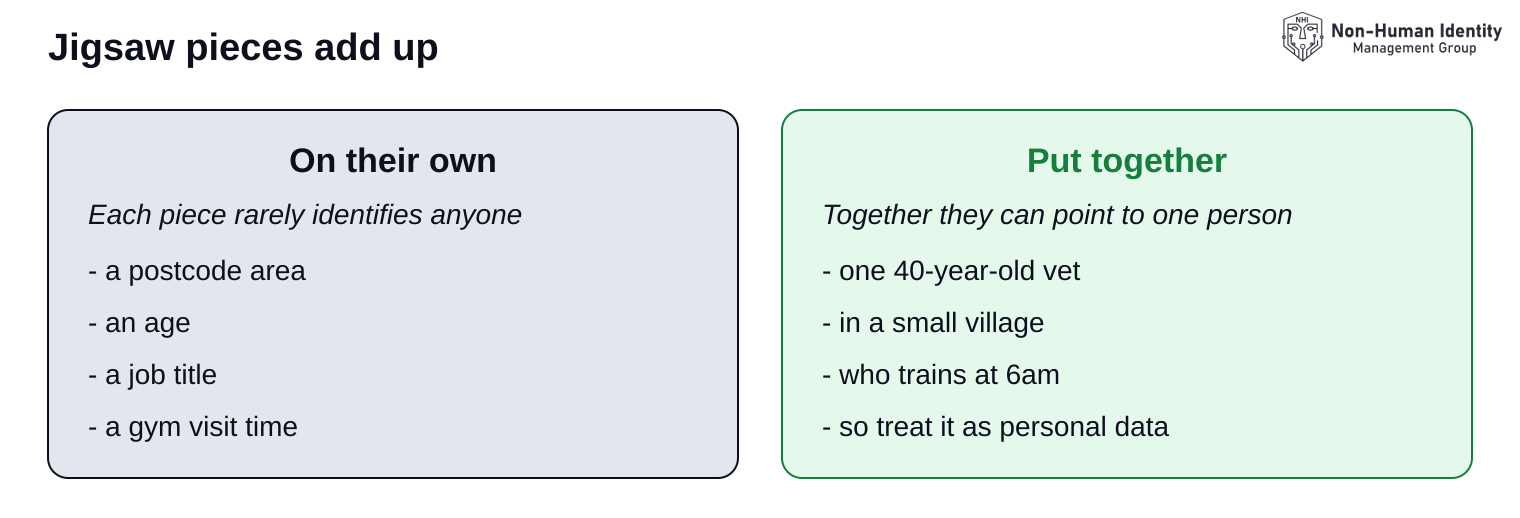
- Details that look harmless on their own can identify someone when they are put together.
- A few kinds, such as health or religion, are extra sensitive and need more care.
What you will learn
- Explain what personal data is in one sentence.
- Spot personal data in everyday files, logs and forms.
- Check whether a set of details could point to one person.
- Ask which details in your work are extra sensitive.
Status: correct as at 28 November 2026, based on guidance from the UK Information Commissioner's Office (ICO) and the European Commission. Laws change; check the official text.
This guide explains the topic in general terms and is not legal advice.
- The person the details are about (data subject)
- the customer, worker or member of the public the information describes.
- A detail that points to someone (identifier)
- anything that helps single out one person, such as a name, number or location.
What is personal data?
Think of jigsaw pieces. One piece rarely shows a whole face, but put a few together and you can see who it is. Personal data works the same way.
The ICO says personal data is information that relates to an identified or identifiable person.[1] In plain words, it has to pass two tests:
- Can you pick the person out? A name does it directly. So can an ID number. Other details may do it once they are combined.
- Is it about them? It has to say something about that person, such as what they bought or where they were.
Common examples include names, home and email addresses, ID card numbers, IP addresses and cookie IDs.[2] An IP address is the number that identifies a device on the internet. A cookie ID is a code a website stores in your browser to recognise it.
Where the comparison stops working: with a jigsaw, you can see when the picture is finished. With data, it is harder to tell when enough pieces have built up to point to one person.
Why does it matter?
Privacy laws protect personal data, so you need to know when you have it. If you do not spot it, you cannot protect it, explain it or delete it on time.
If you run a small business
What could happen: you treat a booking list as "just admin" and email it around without a second thought.
Check this: list the files that hold names, contact details or customer histories.
If you are new to IT work
What could happen: you share a log file with an outside supplier, not realising it holds IP addresses and usernames.
Check this: look for usernames, emails and IP addresses before you share any log or export.
If you are a student
What could happen: a survey for your project collects postcodes, ages and job titles, and together they point to individual people.
Check this: ask whether you need each question, and whether answers could identify someone.
Next: GDPR for Beginners
What does it look like?
Here is a made-up "Is this personal data?" card for a small vet's practice. Each line is something staff handle every day.
Example only. All values are made up.
Is this personal data?
Client name and phone 00000 000000        YES  (1)
Pet's name only: FAKE-Pepper               MAYBE (2)
Wi-Fi log: 192.0.2.0 at 09:14             YES  (3)
[email protected] shared inbox             NO   (4)
Staff rota: "EXAMPLE initials, Tue late"  YES  (5)
Yearly totals: 0000 visits, no names      NO   (6)
- A name and phone number point straight to a person.
- A pet's name alone usually does not, but linked to the client record it can.
- An IP address with a time can often be linked to a person's device.
- A general company email address is not personal data on its own.
- Initials on a small team's rota are enough to tell who is who.
- Totals with no way back to people are not personal data.
Why this is risky: staff tend to protect the obvious lines and forget the rest. Logs, rotas and linked records can identify people too.
The safer way: when in doubt, treat a detail as personal data. Then decide who needs it and how long to keep it.
How does it work?
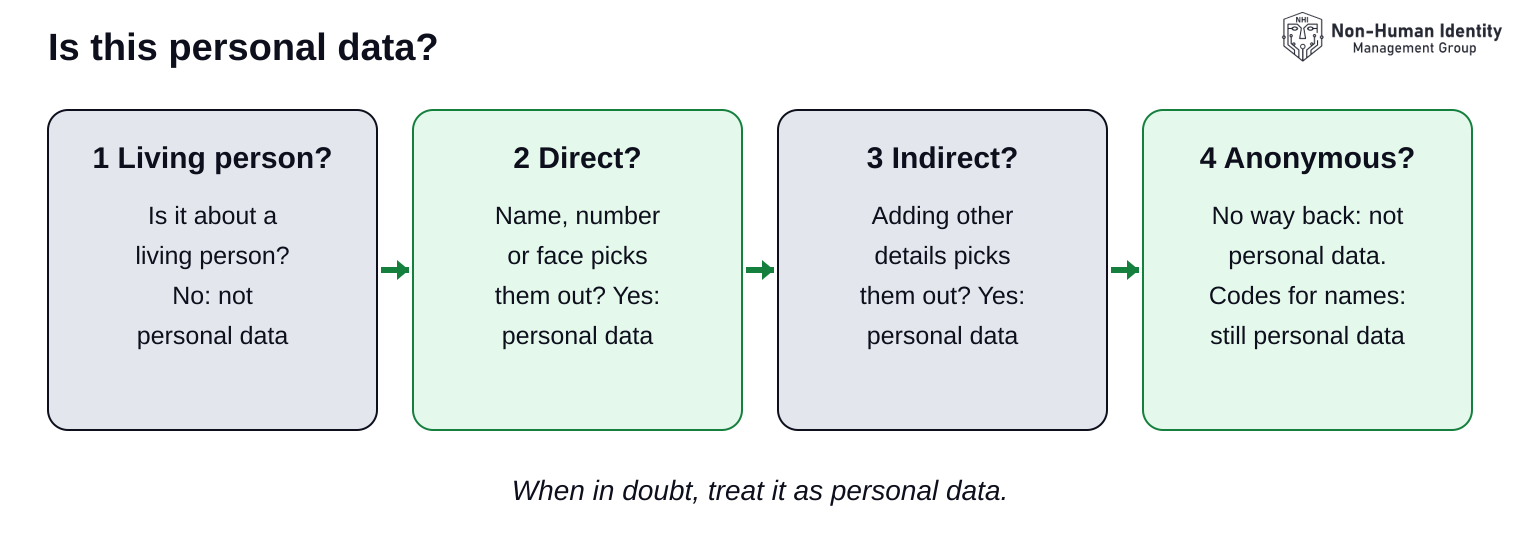
Here is a simple way to decide whether something is personal data.
- Is it about a living person? Information about a company, or about someone who has died, is not personal data under UK law.[1]
- Can you pick them out directly? A name, an ID number or a photo of a face can do this. The ICO notes you do not need to know someone's name for them to be directly identifiable.[1]
- Could you pick them out with other details? If combining the data with other information could identify someone, they may still be identifiable.[1]
- Has the link been hidden or removed? Data with names swapped for codes is called pseudonymised. It is still personal data if it can be linked back. Data that is truly and permanently anonymised is not.[2]
- Is it extra sensitive? Some kinds, such as health, religion, ethnic origin or biometrics used to identify someone, need more care. They are called special category data.[3]
Context matters. The ICO says the same detail can be personal data for one organisation and not for another, depending on what else it holds and why.[1] The rules also apply whatever the format. The European Commission says this covers data on computers, on video and on paper, where paper records are organised, for example in alphabetical order.[2]
A worked example
Vida Castell has just joined Hazel Vets, a made-up practice with two sites, as its first IT assistant. Her manager, Kaia Abara, asks her to send a supplier some data to fix a slow booking system.
Vida opens the export. The first columns hold client names and phone numbers, so she removes them. She is about to send the rest when she pauses.
The file still has pet names, home postcodes, appointment times and the vet each client saw. Vida runs through the questions. In a small town, a postcode with a pet's name and a visit time could point to one household. So it is still personal data.
She also spots a column of notes. Some mention a client's illness when explaining a missed appointment. That is health data, which is extra sensitive.
Vida talks to Kaia. They agree the supplier only needs booking times and system error codes. Vida builds a new export with just those columns and replaces client numbers with codes. She keeps the key to the codes at the practice. She notes that this is pseudonymised data, which still counts as personal data, so it should be shared under the supplier contract.
The supplier fixes the problem with the smaller file. Kaia adds a short step to the practice's checklist: check every export for hidden personal data before it leaves the building.
Myths and mistakes
| What people think | What is true |
|---|---|
| If there is no name, it is not personal data. | ID numbers, locations and online identifiers can identify someone without a name.[1] |
| Swapping names for codes makes data anonymous. | That is pseudonymisation. If the data can still be linked back to a person, it stays personal data.[2] |
| Wrong information is not personal data. | Incorrect details can still be personal data if they relate to someone identifiable.[1] |
| Work email addresses do not count. | A named work email, such as a person's name at a company, can be personal data. A general inbox such as info@ usually is not.[2] |
| Paper files are outside the rules. | Organised paper records, such as a filing system in alphabetical order, are covered too.[2] |
What can I do this week?
- Pick one file and test it. Run the four questions on one spreadsheet, log or export you use often.
- Check before you share. Before sending any export, remove columns the person receiving it does not need.
- Look in the notes. Check free-text boxes for health or other sensitive details.
- Ask who decides. Find out who in your organisation answers privacy questions, so you know where to go.
Checklist
- I can explain personal data in one sentence.
- I know a person can be identified without a name.
- I check logs and exports for IP addresses, usernames and emails.
- I treat combined details as personal data when they could point to one person.
- I know that data with codes instead of names is usually still personal data.
- I know which details are extra sensitive, such as health.
- I remove columns that are not needed before sharing data.
Common questions
Is an IP address personal data?
Often, yes. EU and UK guidance both give IP addresses as an example of what can be personal data.[1][2] It depends on whether the address can be linked to a person. The safe habit is to treat it as personal data.
Is information about my business personal data?
Not on its own. A company registration number is not personal data.[2] But details about a sole trader, a partner or a named director can be, if they are about that person.[1]
What is the difference between personal data and sensitive data?
Sensitive data is a smaller group inside personal data. The law calls it special category data and lists nine kinds, such as health and religion. These need a second legal reason and extra care. Our Special Category Data for Beginners explains more.[3]
Is a photo of someone personal data?
Usually, yes, if the person can be recognised from it, or if it is linked to their name. A photo only becomes biometric data, a more sensitive type, after special processing such as face matching.[3]
Where next?
Ready for the detail? Read the practitioner guide: Special Category Data Guide. It goes further into the higher-risk kinds of personal data, the extra legal conditions they need, and how to find sensitive data you did not know you had.
Also useful:
- Data Privacy for Beginners
- Special Category Data for Beginners
- Anonymisation and Pseudonymisation for Beginners
- Data Classification for Beginners
Related NHI Mgmt Group resources: Anonymisation and Re-identification Risk Guide · Data Masking vs Anonymisation vs Pseudonymisation · UK GDPR for Beginners
Key terms
- Personal data
- Information that can identify a person directly or indirectly, such as a name, account number or location.
- Data subject
- The living person that personal data is about.
- Identifier
- A detail that helps single out one person, such as a name, ID number or IP address.
- Indirect identifier
- A detail, such as a postcode or age, that can identify someone when combined with others.
- Pseudonymised data
- Data where names are replaced by codes, which can still be linked back to people.
- Anonymised data
- Data changed so that people can no longer be identified, with no way back.
- Special category data
- Personal data that needs extra protection, such as health, ethnic origin, religion or biometrics.
Sources and further reading
- What is personal information: a guide. Information Commissioner's Office (ICO). https://ico.org.uk/for-organisations/uk-gdpr-guidance-and-resources/personal-information-what-is-it/what-is-personal-information-a-guide/, accessed 28 Nov 2026.
- What is personal data? European Commission. https://commission.europa.eu/law/law-topic/data-protection/reform/what-personal-data_en, accessed 28 Nov 2026.
- What is special category data? Information Commissioner's Office (ICO). https://ico.org.uk/for-organisations/uk-gdpr-guidance-and-resources/lawful-basis/special-category-data/what-is-special-category-data/, accessed 28 Nov 2026.