The GDPR principles are seven short rules that every use of personal data must follow.
This guide is for students, newcomers and anyone studying for a privacy exam who wants each principle in plain words. It is also for small teams who want a quick test for any new use of data. You do not need a legal background.
In short
- The seven principles are: lawfulness, fairness and transparency; purpose limitation; data minimisation; accuracy; storage limitation; security; and accountability.
- They apply to every use of personal data, from a mailing list to a staff file.
- Most other duties in the GDPR build on them, such as keeping data safe and answering requests.
- Breaking a principle is in the top band of fines, so they are not just good advice.
What you will learn
- Name the seven principles and explain each one in a sentence.
- Spot which principle an everyday mistake breaks.
- Check a new use of data against all seven in a few minutes.
- Explain why accountability means keeping proof, not just doing the right thing.
Status: correct as at 28 November 2026, based on the GDPR text on EUR-Lex and UK regulator guidance. The UK regulator says its principles guidance is under review after the Data (Use and Access) Act.[2] Laws change; check the official text.
This guide explains the topic in general terms and is not legal advice.
- Information about a person (personal data)
- anything that can be linked to a living person, such as a name, email address or customer number.
- Using data (processing)
- anything done with personal data, from collecting and storing it to sharing or deleting it.
- Proving you follow the rules (accountability)
- being responsible for the principles and able to show you meet them.
What are the GDPR principles?
Think of the house rules pinned up in a shared flat. There are only a few, everyone has to follow them, and they cover most daily situations. The GDPR principles work the same way for personal data.
The GDPR is the EU law on personal data. Its principles sit near the start of the law. Six of them describe how data must be handled, and a seventh, accountability, says the organisation must be able to prove it.[1]
The UK has its own version of the law, the UK GDPR, with the same seven principles.[2] Our GDPR for Beginners guide covers the wider law, such as rights and fines.
The principles do not give fixed numbers. They do not say "keep data for two years". Each organisation decides what fits its purpose, then writes down why.
Where the comparison stops working: in a flat, people can see who left the dishes. With data, the people it is about usually cannot see what happens to it. So the seventh rule asks organisations to keep records that prove they follow the other six.
Why does it matter?
Most privacy problems come back to one of the seven rules. Data was kept too long, used for a new purpose, or not kept safe.
Breaking the principles falls in the top band of GDPR fines, the highest level the law allows.[1]
If you are a student or new to privacy work
What could happen: you learn the names but cannot apply them to a real case in an exam or interview.
Check this: for each principle, practise one everyday example of keeping it and one of breaking it.
If you run a small business
What could happen: you keep old customer files for years, and a leak exposes people you no longer serve.
Check this: set a deletion date for each kind of data you hold, and write down why.
If you build apps or websites
What could happen: a form asks for date of birth and phone number that the service never uses.
Check this: for every field, ask what it is for. Remove the ones with no clear answer.
What does it look like?
Here is a made-up check card for a gym that wants to start a new member app.
Example only. All values are made up.
New use: member app for EXAMPLE Gym
Purpose: book classes and show opening times        (1)
Data asked for: name, email, date of birth, weight  (2)
Reason: contract to provide classes; told in notice  (3)
Kept until: no end date set                         (4)
Who can see it: all staff, one shared FAKE-0000   (5)
Owner of this card: not named                        (6)
- A clear, stated purpose supports purpose limitation.
- Weight and date of birth are not needed to book a class. This breaks data minimisation.
- A stated reason, and telling members, supports lawfulness, fairness and transparency.
- No end date breaks storage limitation.
- One shared staff password and access for everyone weaken security. In a real file, this line would name the few staff who need access.
- No named owner and no record makes accountability hard to show.
Why this is risky: the card looks complete, but four of its lines break a principle.
The safer way: drop the extra fields, set an end date, give each person their own access and name an owner.
How does it work?
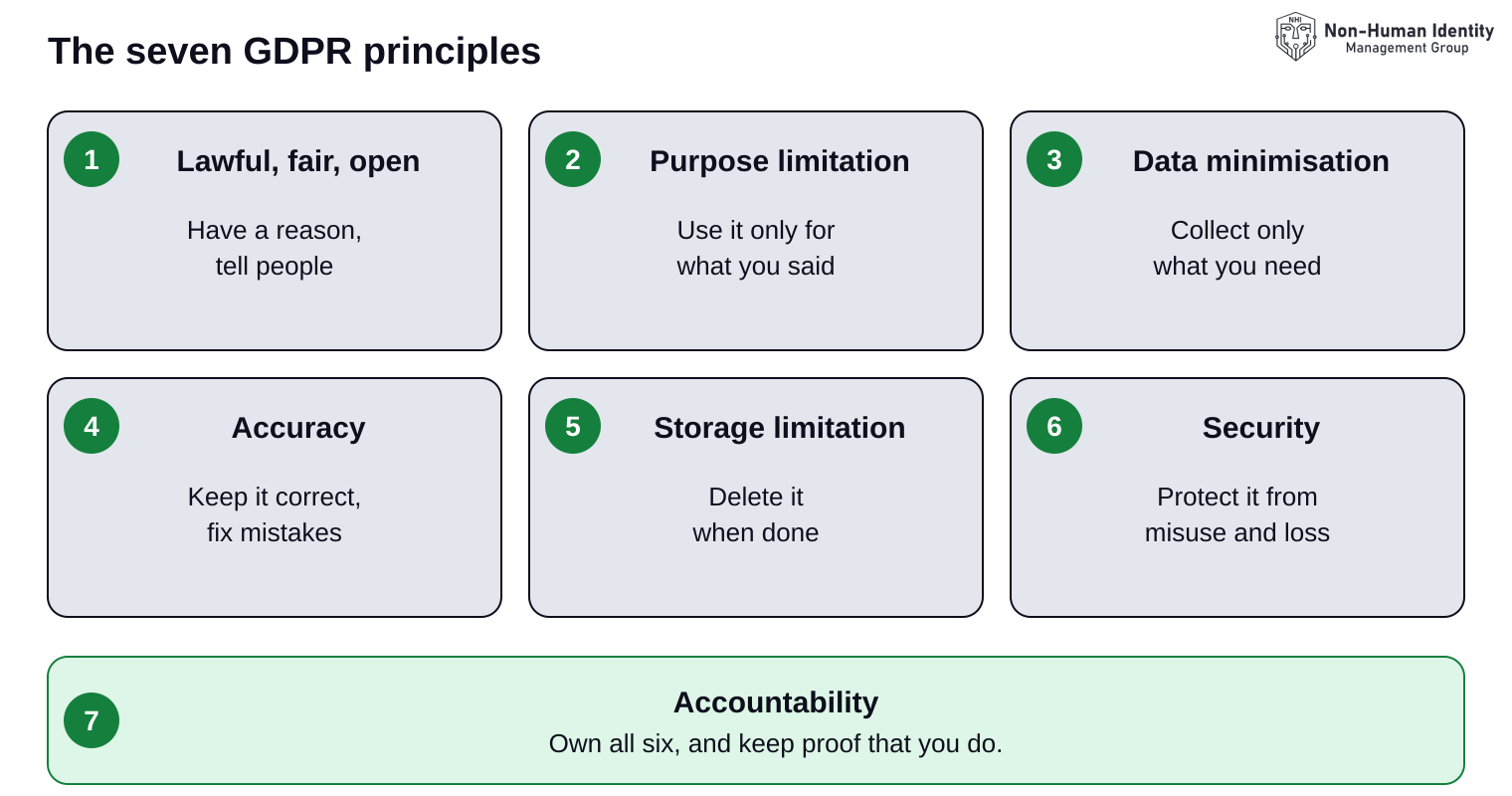
Here are the seven principles in plain words, each with an everyday example.[1][2]
| Principle | In plain words | Everyday example |
|---|---|---|
| Lawfulness, fairness and transparency | Have a legal reason, do not mislead people, and be open about what you do. | A shop tells customers in plain words why it collects their email. |
| Purpose limitation | Collect data for clear purposes, and do not reuse it for something that does not fit. | Phone numbers taken for delivery are not used for sales calls. |
| Data minimisation | Collect only what you need. | A newsletter sign-up asks for an email, not a home address. |
| Accuracy | Keep data correct and up to date, and fix mistakes quickly. | A school updates a parent's phone number as soon as it hears it changed. |
| Storage limitation | Keep data that identifies people only as long as you need it. | Job applications from people not hired are deleted after a set time. |
| Integrity and confidentiality (security) | Protect data against misuse, loss or damage. | Staff files sit in a locked system, not a shared folder. |
| Accountability | Take responsibility, and be able to show you follow the other six. | A charity keeps a short record of what data it holds and why. |
To use them, run any new idea through four quick steps.
- Say why. Write the purpose in one sentence, and the legal reason behind it.
- Trim the list. Cross out any piece of data the purpose does not need.
- Set the limits. Decide how long to keep it, who can see it and how it is protected.
- Write it down. Record what you decided and who owns it, so you can prove it later.
A worked example
Rania Falk runs a small made-up dog-walking business called Paws on Parade. She keeps client details in a spreadsheet and wants to send a holiday offer.
Her helper, Soren Corrigan, suggests emailing every client from the past five years. Rania runs the idea past the seven rules.
First, the reason. Clients gave their email to book walks, not to get offers. Using it for marketing is a new purpose, so she adds a sign-up box for offers on her booking form. She emails only clients who tick it.
Next, the data. The spreadsheet holds door codes for every client, even past ones. Past clients' codes are not needed, so she deletes them. That also helps storage limitation.
Then accuracy. Some vet phone numbers are years old. She asks current clients to confirm them at their next booking.
Security comes next. The spreadsheet sits in a shared folder that Soren and two old helpers can open. Rania removes the old helpers and turns on a second sign-in step for her account.
Finally, accountability. She writes a one-page note: what she holds, why, how long she keeps it and who can see it. She sets a reminder to review it each year.
The offer goes out later than Soren hoped. But Rania can now explain every choice if a client or the regulator asks.
Myths and mistakes
| What people think | What is true |
|---|---|
| The principles are just good advice. | They are rules in the law, and breaking them is in the top band of fines.[1] |
| Security is the only principle that matters for IT teams. | Security is one of seven. Logs and backups also need limits on how much is kept and for how long. |
| The law says exactly how long to keep data. | The principles set no fixed period. You decide what you need and write down why.[2] |
| If we collected data once, we can use it for anything later. | Reuse must not clash with the original purpose. A new purpose needs its own check.[2] |
| Doing the right thing is enough. | Accountability means you must also be able to show it, with records.[1] |
What can I do this week?
- Learn the seven names and say each one aloud with one everyday example.
- Pick one form your team uses and cross out any field with no clear purpose.
- Find one old file of personal data and decide whether you still need it.
- Write a one-page note for one kind of data: why you hold it, how long and who can see it.
Checklist
- I can name all seven principles.
- Each use of personal data has a written purpose and a legal reason.
- People are told in plain words what we do with their data.
- We collect only the data each purpose needs.
- We have a way to correct wrong data quickly.
- Each kind of data has a set time to delete it.
- Only the people who need data can reach it.
- We keep records that show how we follow the principles.
Common questions
Are there six principles or seven?
Seven, though you may see six in some places. The law lists six rules for handling data, then adds accountability as a separate rule. The UK regulator counts all seven together, and most courses and exams do the same.[1][2]
Is consent one of the principles?
No. Consent is one of six legal reasons for using data, which sit under the first principle, lawfulness. Consent has its own tests: a yes must be free, specific, informed and clear, and people can change their mind.
Do the principles apply to small organisations?
Yes. They apply to any organisation that uses personal data under the GDPR, whatever its size. What changes is how much paperwork makes sense. A one-person business may keep a short note, while a large firm is likely to need fuller records.
Are the UK and EU principles the same?
Mostly. The UK kept the same seven principles in its own version of the law. The UK has since changed some detail, such as rules on reusing data for new purposes. Check UK guidance if you work with people in the UK.[2]
Where next?
Ready for the detail? Read the practitioner guide: GDPR Article 5. It goes further into the duties each principle creates for security teams, the evidence regulators expect and real enforcement cases.
Also useful:
- Data Minimisation for Beginners
- Lawful Basis for Processing for Beginners
- Data Retention and Secure Deletion for Beginners
- GDPR Compliance Checklist
Related NHI Mgmt Group resources: GDPR for Beginners · UK GDPR for Beginners · Privacy by Design for Beginners
Key terms
- GDPR
- The EU law that sets rules for how organisations use personal data and gives people rights over it.
- Purpose limitation
- Collecting data for clear purposes and not reusing it in ways that do not fit them.
- Data minimisation
- Collecting and keeping only the personal data a purpose needs.
- Storage limitation
- Keeping data that identifies people no longer than the purpose needs.
- Integrity and confidentiality
- The security principle: protecting personal data against misuse, loss or damage.
- Lawful basis
- The legal reason an organisation has for using personal data, chosen from six in the GDPR.
- Personal data
- Any information that can be linked, directly or indirectly, to a living person.
Sources and further reading
- Regulation (EU) 2016/679 (General Data Protection Regulation), Articles 5 and 83(5). European Parliament and Council, 27 April 2016, EUR-Lex. https://eur-lex.europa.eu/legal-content/EN/TXT/HTML/?uri=CELEX:32016R0679, accessed 28 Nov 2026.
- A guide to the data protection principles. Information Commissioner's Office (UK), purpose limitation page updated 23 March 2026. https://ico.org.uk/for-organisations/uk-gdpr-guidance-and-resources/data-protection-principles/a-guide-to-the-data-protection-principles/, accessed 28 Nov 2026.