A lawful basis is the reason the law accepts for using someone's personal data.
This guide is for small business owners, marketers, students and anyone new to privacy work. If your business keeps names, emails or phone numbers, it needs a reason for each thing it does with them.
In short
- Under the GDPR you need one of six reasons before you use personal data. Since 2026 the UK version adds a seventh.
- No reason is better or safer than another. Pick the one that truly fits what you are doing.
- Consent is only one option, and it means people can say no or change their mind.
- Choose before you start, write it down and tell people in your privacy notice.
What you will learn
- Explain what a lawful basis is in one sentence.
- Name the reasons the law accepts, in plain words.
- Spot when consent is the wrong choice.
- Check that your business has a written reason for each use of data.
Status: correct as at 28 November 2026, based on the GDPR text on EUR-Lex and guidance from the UK data protection regulator. Laws change; check the official text.
This guide explains the topic in general terms and is not legal advice.
- Information about a person (personal data)
- anything that tells you who someone is, such as a name, email address or phone number.
- Your reason (lawful basis)
- one of the set reasons the law accepts for using that information.
- Using data (processing)
- almost anything you do with it: collecting, storing, sending, sharing or deleting it.
What is a lawful basis?
Think of the landing card some countries ask you to fill in. It asks why you are visiting: holiday, work or study. You tick one box, and that choice shapes what you may do while you are there.
A lawful basis works the same way. Before a business uses personal data (information about a person), it picks a reason from a short list in the law. The list is in the GDPR, the European data protection law, and in the UK's own version of it, the UK GDPR.[2]
The reason you pick matters later. It affects what you must tell people, which rights they have and what happens if they object.[1]
Where the comparison stops working: an officer checks your landing card at the border. Nobody checks your lawful basis at the start. You choose it yourself, and you must be able to show your choice if someone asks.
Why does it matter?
Using personal data without a fitting reason breaks the law, even if the data is kept safe. The wrong reason can also leave you stuck later, because switching reasons is usually not allowed.[1]
If you run a small business
What could happen: you ask customers to "consent" to things you would do anyway, then cannot stop when they say no.
Check this: list what you do with customer details and the reason for each.
If you work in marketing
What could happen: a campaign uses data collected for something else, and people complain.
Check this: ask what reason was recorded when the list was built.
If you are new to privacy work
What could happen: you are asked "what is our lawful basis?" and nobody wrote it down.
Check this: find the record of what data is used, why, and on which reason.
Next: UK GDPR for Beginners
What does it look like?
A lawful basis usually lives in a simple record. Here is a made-up one for a small bakery that takes online orders.
Example only. All values are made up.
What we do                  Data used           Our reason
Deliver online orders       name, address       Contract              (1)
Keep sales records          name, amount paid   Legal duty            (2)
Monthly offers newsletter   email               Consent               (3)
Stop repeat card fraud      order history       Legitimate interests  (4)
Reviewed: EXAMPLE-DATE      Owner: FAKE NAME                          (5)
- You cannot deliver a cake without an address. So the contract reason fits.
- Tax rules make the bakery keep sales records, so this is a legal duty.
- Nobody needs offers to get their order. So the bakery asks first and lets people say no later.
- Stopping fraud is a fair reason. Customers would expect it.
- In a real file, this line would contain the date of the last check and the name of the person who looks after it.
Why this is risky: many firms skip the record, or mark every line "consent". If someone then says no, the firm may have to stop things it needs to do, like keep its sales records.
The safer way: one line per use, the reason that genuinely fits, and the same reasons shown in the privacy notice.[1]
How does it work?
The UK regulator, the Information Commissioner's Office (ICO), describes the choice like this.[1]
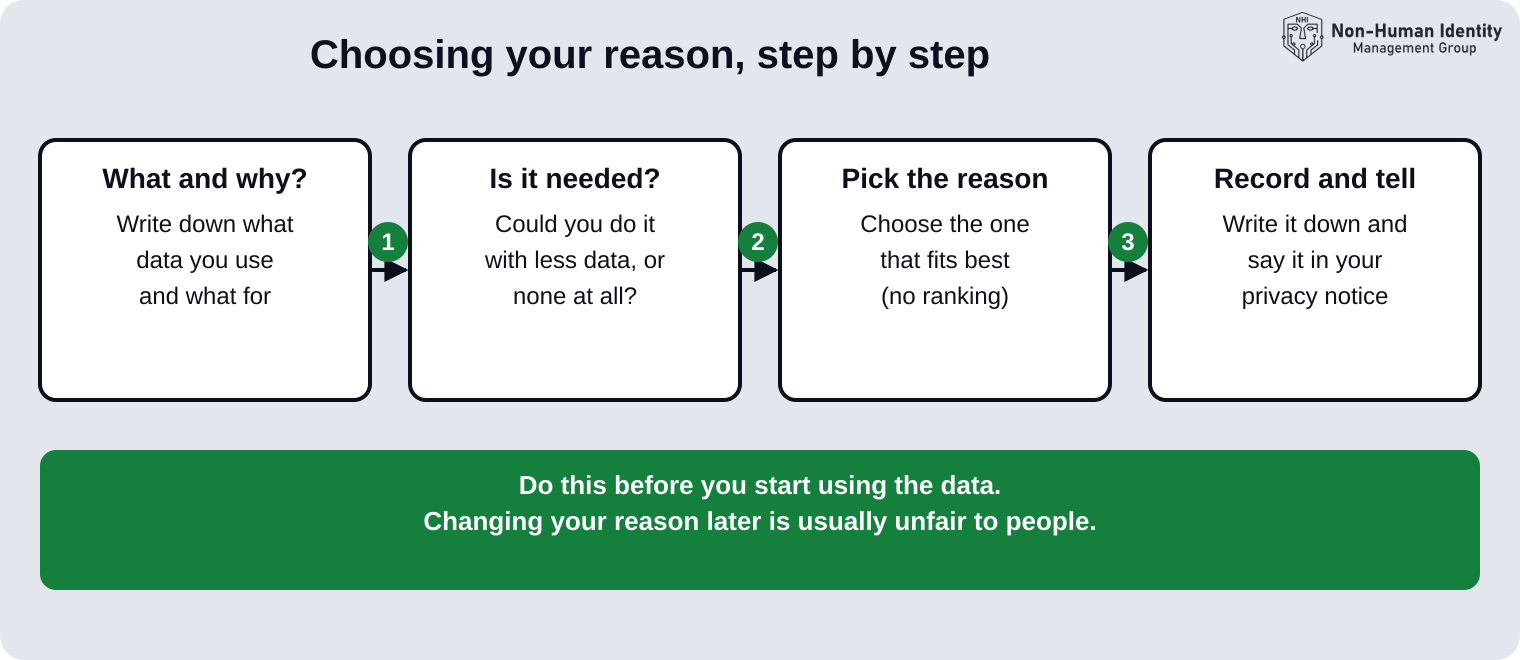
- Say what and why. Write down what data you use and the purpose, one use at a time.
- Check it is needed. If you could reach the same goal with less data, or none, the use is not "necessary".
- Look at the fixed reasons first. A contract, a legal duty, protecting a life and a public task each cover a specific kind of purpose.
- Otherwise, weigh consent against legitimate interests. Think about what people would expect, who benefits and the impact on them.
- Record it and tell people. Note the reason and why it fits, and put it in your privacy notice.
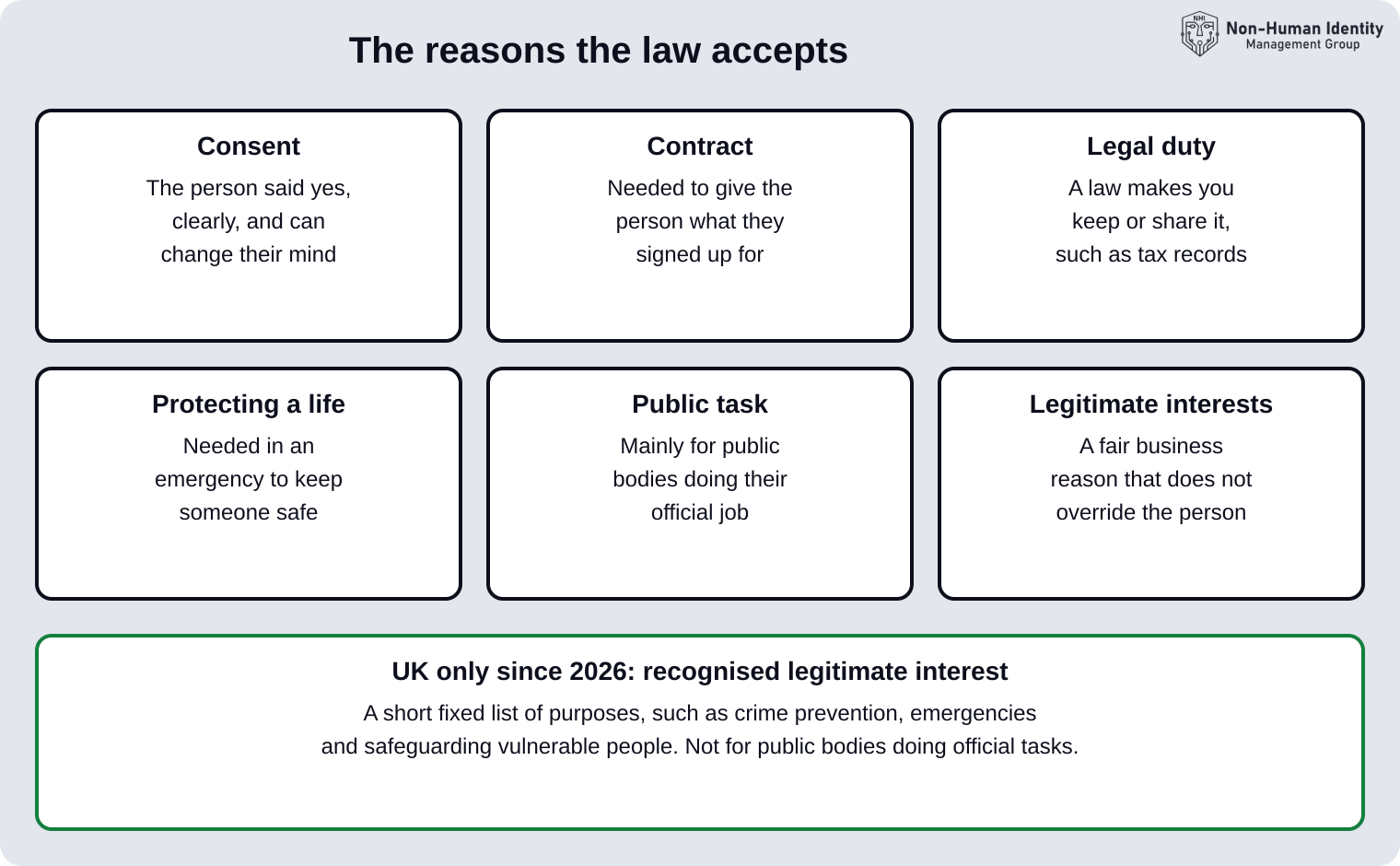
The GDPR lists six reasons.[2] The law does not rank them.[1]
- Consent: the person clearly agreed to a specific use. They may withdraw it at any time, and withdrawing must be as easy as agreeing.[2]
- Contract: the use is needed to give the person what they signed up for, or to do something they asked for before signing.
- Legal duty: a law requires it, such as keeping tax records.
- Protecting a life: the use is needed to protect someone's life, for example in a medical emergency. The law calls this "vital interests".
- Public task: the use is needed for a task in the public interest or an official function, mostly by public bodies.
- Legitimate interests: the use is needed for a fair reason of your own, or of someone else, and does not override the person's interests.
In the UK, a change to the law in 2025 added a seventh reason, called recognised legitimate interest. Most of those changes took effect on 5 February 2026.[4] It covers a short, fixed list of purposes, such as preventing crime, responding to emergencies and protecting vulnerable people.[1]
Legitimate interests needs a three-part check. Is your reason genuine? Is using the data really needed for it? Do the person's interests outweigh yours? A key question is whether a reasonable person would expect the use.[3] Many businesses write this check down in a short document called a legitimate interests assessment.
Some information is extra sensitive, such as health details or religion. The law calls it special category data. For this you need a lawful basis and also a second, separate condition.[1]
A worked example
Odile Tanaka runs a small yoga studio with two part-time teachers. Her bookkeeper, Hugo Iyer, asks her a simple question over coffee. "What is your lawful basis for the class list?"
Odile is not sure. Her sign-up form has one tick box: "I consent to you using my data." Everyone ticks it.
Hugo suggests they think of the landing card. Each use needs its own box, not one box for the whole trip.
So they list what the studio does. Booking classes and taking payment are part of the deal with each member, so that is contract. Keeping payment records for the tax office is a legal duty. The newsletter is optional, so consent fits, with an unsubscribe link in every email.
Then Odile remembers the health question on the form, about injuries. Hugo points out that health details are special category data. She needs a lawful basis and a second condition. She decides to check the ICO's guidance before she uses it again.
They write it all into a one-page record, with a date and Odile's name as owner. Odile then updates her privacy notice to list each reason in plain words.
The single tick box goes. In its place is an optional newsletter box that is not ticked in advance. The whole job takes an afternoon.
Myths and mistakes
| What people think | What is true |
|---|---|
| You always need consent to use personal data. | Consent is one of six reasons. A contract or a legal duty is often a better fit.[2] |
| Consent is the safest choice. | No reason is safer than another. Consent can be withdrawn at any time.[1] |
| If someone withdraws consent, we can switch to legitimate interests. | Usually you cannot. The ICO gives an example where the business had to stop instead.[1] |
| Legitimate interests means we can do what we like. | It needs a genuine reason, a real need and a fair balance with the person's interests.[3] |
| One reason covers everything we do. | Choose a reason for each purpose. Different uses often need different reasons. |
What can I do this week?
- List each thing your business does with personal data, one line per purpose.
- Write the reason next to each line, and one sentence on why it fits.
- Remove any "consent" box that people must tick to get your service.
- Check that your privacy notice names the same reasons.
- Flag any health or other sensitive data for a closer look.
Checklist
- Every use of personal data has a reason, chosen before it started.
- The reasons are written down, with a short note on why each fits.
- Consent is used only where people have a real choice.
- People can withdraw consent as easily as they gave it.
- Legitimate interests uses have a written three-part check.
- Sensitive data has a lawful basis and a second condition.
- The privacy notice tells people each reason in plain words.
- The record has an owner and a review date.
Common questions
How many lawful bases are there?
The EU GDPR has six: consent, contract, legal duty, protecting a life, public task and legitimate interests. Since 2026 the UK version has a seventh, called recognised legitimate interest. It covers a short list of uses, such as stopping crime and helping in emergencies.
Can I use more than one lawful basis?
Yes. Different uses can have different reasons, and one use can sometimes have more than one. The ICO says to find and write down all that apply from the start. Pick each one honestly, because the choice affects people's rights.
Do I need consent to send marketing emails?
Often, yes, but that comes from a separate set of rules on electronic marketing, not only from the lawful basis rules. There is a narrow exception for your own existing customers. See Email Marketing Rules for Beginners.
Can I change my lawful basis later?
Usually not without a good reason, and you can rarely move away from consent. A real change, or a new use you did not plan, can justify a review. If you change, tell people before you do anything new with their data. Then write the change down.
Where do I write my lawful basis down?
There is no set format. A simple table listing each purpose, the data, the reason and why it fits is enough to start. Keep it with your other privacy records, and use the same wording in your privacy notice.
Where next?
Ready for the detail? Read the practitioner guide: Lawful Basis for Processing. It goes further into the test behind each basis, how the choice changes people's rights and how to record the decision for an audit.
Also useful:
- Consent vs Legitimate Interest
- Legitimate Interests Assessment Template
- Privacy Notices for Beginners
- GDPR for Beginners
- Data Protection Impact Assessments for Beginners
Related NHI Mgmt Group resources: UK GDPR for Beginners · Data Privacy for Beginners · Privacy Notice Template
Key terms
- Lawful basis
- One of the set reasons data protection law accepts for using personal data.
- Processing
- Anything done with personal data, from collecting and storing it to sharing or deleting it.
- Consent
- A clear, freely given yes to a specific use of data, which the person can withdraw.
- Legitimate interests
- A lawful basis for a fair reason of your own, where the person's interests do not outweigh it.
- Legitimate interests assessment
- A short written check of purpose, need and balance before relying on legitimate interests.
- Special category data
- Extra sensitive information, such as health or religion, that needs a second condition as well as a lawful basis.
- Privacy notice
- The plain-language statement telling people what you do with their data and why.
Sources and further reading
- A guide to lawful basis. Information Commissioner's Office, last updated 2 April 2026. https://ico.org.uk/for-organisations/uk-gdpr-guidance-and-resources/lawful-basis/a-guide-to-lawful-basis/, accessed 28 Nov 2026.
- Regulation (EU) 2016/679 (General Data Protection Regulation), Articles 6 and 7. EUR-Lex, Publications Office of the European Union. https://eur-lex.europa.eu/legal-content/EN/TXT/HTML/?uri=CELEX:32016R0679, accessed 28 Nov 2026.
- What is the legitimate interests basis? Information Commissioner's Office. https://ico.org.uk/for-organisations/uk-gdpr-guidance-and-resources/lawful-basis/legitimate-interests/what-is-the-legitimate-interests-basis/, accessed 28 Nov 2026.
- Statement on the commencement of the Data (Use and Access) Act. Information Commissioner's Office, 5 February 2026. https://ico.org.uk/about-the-ico/media-centre/news-and-blogs/2026/02/statement-on-the-commencement-of-the-data-use-and-access-act-duaa, accessed 28 Nov 2026.