The FTC Safeguards Rule is a US rule that tells many finance businesses how to protect customer data.
This guide is for owners and staff of small US firms that lend, arrange finance, prepare taxes or give money advice, and for anyone new to the rule. You do not need to be a bank to be covered: a car dealer that arranges loans or a tax preparer can be.
In short
- The Safeguards Rule comes from a US law called the Gramm-Leach-Bliley Act (GLBA), and the Federal Trade Commission (FTC) enforces it.
- It covers many non-bank firms, such as mortgage brokers, payday lenders, tax preparers and car dealers that arrange finance.
- Covered firms need a written security plan, one named person in charge, and set safeguards such as multi-factor sign-in and encryption.
- A breach of unencrypted data about at least 500 people must be reported to the FTC within 30 days of finding it.
What you will learn
- Explain in one sentence what the Safeguards Rule asks for.
- Check whether a small firm is likely to be covered.
- Spot the main pieces of a written security plan.
- Ask the right questions of your IT supplier.
Status: correct as at 28 November 2026, based on the FTC's guidance and the rule text on the US government's official regulations site. Laws change; check the official text.
This guide explains the topic in general terms and is not legal advice.
- Customer money details (customer information)
- records about a customer's finances that are not public, on paper or on a computer.
- Person in charge (Qualified Individual)
- the one person named to run and oversee the firm's security plan.
- Written plan (information security programme)
- a written set of rules and safeguards that protect customer information.
What is the FTC Safeguards Rule?
Think of the fire safety rules for a small shop. You need a written fire plan, a named fire warden, working alarms and regular checks. The Safeguards Rule asks the same kind of thing, but for customer data.
GLBA is a US law about how finance firms treat personal information. It asks them to explain how they share customer data and to keep it safe.[5] The Safeguards Rule is the part about keeping it safe. It asks a covered firm to write a security plan with practical, technical and physical safeguards.[5]
The rule is about what a business does, not what it calls itself. A firm that lends, arranges loans or gives money advice may count as a "financial institution". That can be true even if it would never call itself one.[1]
Where the comparison stops working: a fire warden checks a building you can see. Customer data sits in laptops, email, cloud apps and suppliers' systems, so the first job is finding out where it all is.
Why does it matter?
Small finance firms hold the details criminals want, such as pay, bank details and ID. The rule sets a basic level of care. The FTC may also make breach reports public.[1]
If you run a car dealership
What could happen: finance application forms with income and ID details sit in a shared inbox that every salesperson can open.
Check this: if you arrange finance or lease cars for more than 90 days, the FTC treats you as covered.[4]
If you run a tax or advice firm
What could happen: one staff password is stolen, and with no second sign-in step, a stranger opens every client file.
Check this: turn on multi-factor sign-in for anyone who reaches customer data.
If you look after IT for a small firm
What could happen: you become the named person in charge without knowing it, and the board report never gets written.
Check this: agree in writing who the Qualified Individual is, and who at the firm oversees you.
What does it look like?
Here is a made-up "Am I affected?" checklist that a small firm might fill in before talking to an adviser.
Example only. All values are made up.
Am I affected? Example Motors (fictional), checked 01/01/2000
[x] We arrange car loans for buyers through lenders     (1)
[ ] We lease cars to people for more than 90 days
[x] We keep loan applications and ID copies              (2)
[x] Customer records held: about 900 people              (3)
[ ] We have a written security plan
[ ] We have named a Qualified Individual
- Arranging finance for buyers is the activity that brings a dealer into the rule.
- Loan forms and ID copies are customer information, which the rule protects.
- A firm with fewer than 5,000 consumers' records skips a few parts of the rule, but not the rest.
Why this is risky: the firm is likely covered, but has no written plan and nobody in charge. Every other safeguard tends to slip when no one owns it.
The safer way: name the person in charge first. Then find where customer information lives and write the plan around what you find.
How does it work?
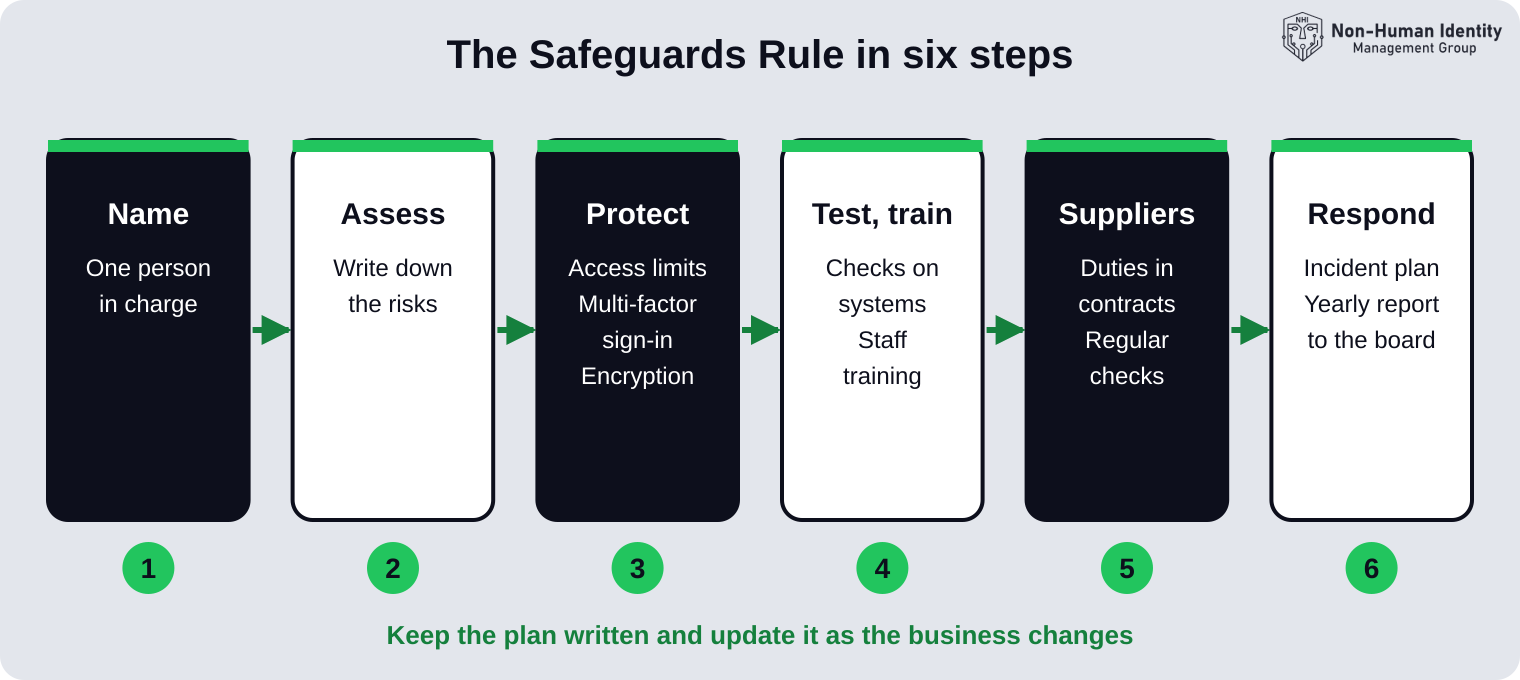
The rule lists what a covered firm's written plan must include.[1] In plain steps:
- Name one person in charge. The Qualified Individual can be on staff or work for a supplier. If you outsource it, your firm stays responsible and a senior employee oversees the supplier.[1]
- Write down the risks. A risk assessment is a written look at what could go wrong with customer information and how badly. It is repeated from time to time.[1]
- Put safeguards in place. Only the right staff can see data, and you know where it is stored. Data is encrypted (scrambled so only the right people can read it). Sign-in needs more than a password. Old data is destroyed safely, changes are controlled and actions are logged.[1]
- Test and train. Either watch systems all the time, or test them. Testing means a yearly penetration test (an approved, hired attack to find weak spots) and a scan for weak spots every six months. Staff get regular security training.[1]
- Watch your suppliers. Choose them with care, put security duties in the contract and check them again from time to time.[1]
- Plan for trouble and report. Keep a written incident response plan. The person in charge reports to the board, or a senior officer, in writing at least once a year.[1]
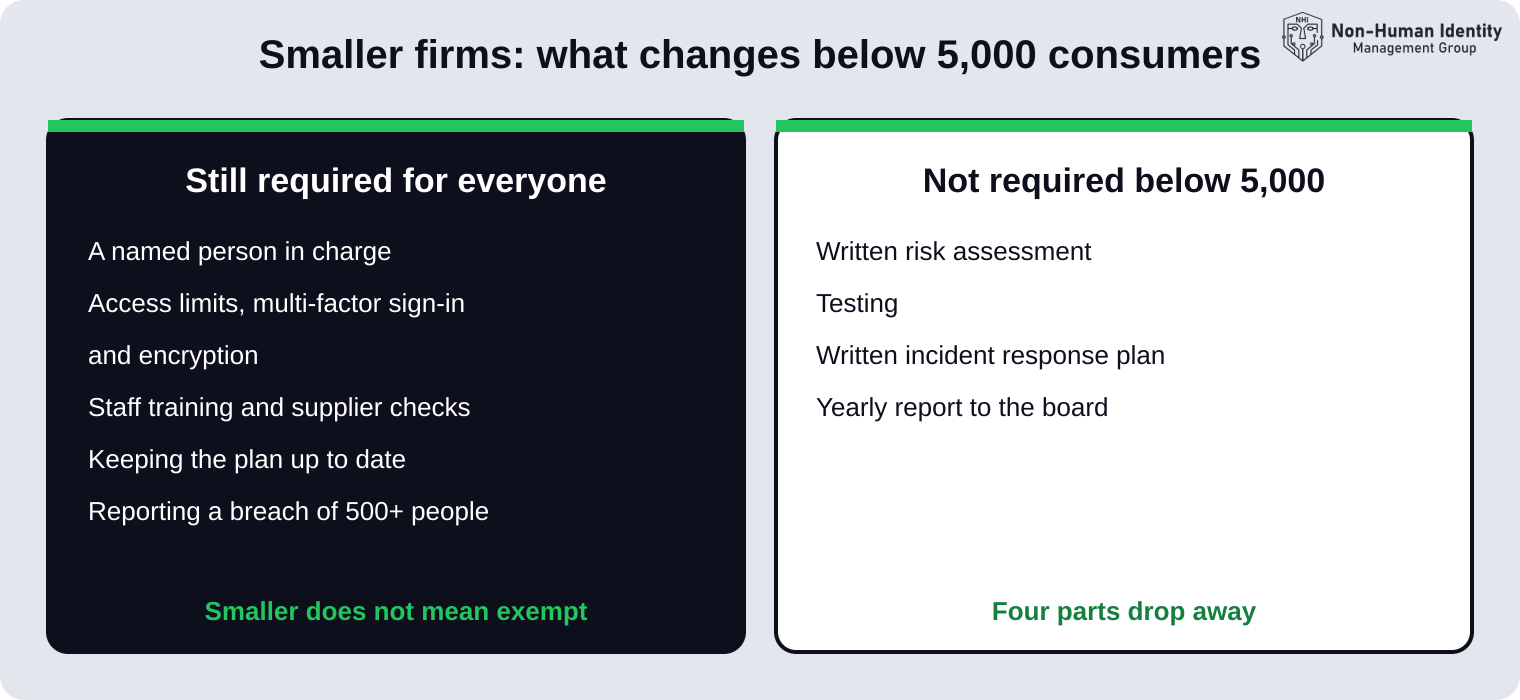
Smaller firms get some relief. If a firm holds customer information about fewer than 5,000 consumers, four parts do not apply.[2] These are the written risk assessment, the testing, the written incident response plan and the yearly board report. Everything else still applies.
Since 13 May 2024, firms must also tell the FTC about some breaches.[2] This applies when unencrypted information about at least 500 consumers is taken without permission. The report goes in through an online form, as soon as possible and no later than 30 days after the firm finds out.[1][3]
A worked example
Yusuf Pereira owns a small, fictional used-car dealership. He arranges loans for about half his buyers through two lenders.
At a trade meeting, someone mentions the Safeguards Rule. Yusuf assumes it is for banks. Later he reads the FTC's guidance for car dealers and sees that arranging finance puts him in scope.
He calls Fen Tanaka, the contractor who looks after his computers. They start with the fire warden idea. Yusuf names Fen as the Qualified Individual, and his office manager oversees her work.
Fen goes looking for customer information. She finds loan applications in a shared inbox, scans of driving licences on the reception computer and old paper files in a back room. She writes these down in a simple list of where data lives.
Next, they make changes. Only the two finance staff can now open the loan folder. Fen turns on multi-factor sign-in for email and the dealer software. The reception computer gets disk encryption, and the old paper files go to a shredding firm.
Yusuf has records on about 2,000 buyers, so a few parts do not apply yet. Even so, Fen writes a one-page plan for what to do after a breach, including the FTC's 30-day report.
The work takes a few weeks of evenings. Yusuf now knows who is in charge, where the data is and what to do if something goes wrong.
Myths and mistakes
| What people think | What is true |
|---|---|
| GLBA is only for banks. | Many non-bank firms are covered, including mortgage brokers, payday lenders, tax preparers and some advisers.[1] |
| We are small, so the rule does not apply. | Below 5,000 consumers, only four parts drop away. The rest still applies.[2] |
| Our IT company handles compliance, so it is their problem. | You can outsource the work, but your firm stays responsible and must oversee the supplier.[1] |
| Only computer files count. | Customer information covers paper and other forms too.[1] |
| We can keep old files just in case. | The rule expects secure disposal, generally no later than two years after the data was last used for the customer, with limited exceptions.[1] |
What can I do this week?
- Read the FTC's plain guide and decide if your firm is likely covered.
- Name the person in charge, in writing, and who oversees them.
- List where customer data lives: inboxes, folders, apps, paper and suppliers.
- Turn on multi-factor sign-in for every account that can reach customer data.
- Write down who calls whom after a breach, including the FTC report.
Checklist
- We have checked whether our activities make us a covered financial institution.
- A Qualified Individual is named in writing.
- We know where customer information is kept, on paper and on computers.
- Access to customer information is limited to staff who need it.
- Multi-factor sign-in protects every account that reaches customer information.
- Customer information is encrypted when stored and when sent, where possible.
- Staff get regular security training.
- Supplier contracts include security duties, and we check suppliers from time to time.
- Old customer records are disposed of securely.
- We know how to report a breach of 500 or more people to the FTC within 30 days.
Common questions
Does the Safeguards Rule apply to banks?
Usually not this rule. The FTC's rule covers financial institutions under its own powers, mostly non-bank firms. Banks and many other regulated firms follow similar safeguards rules from their own regulators. If you are unsure which applies, ask your regulator or a lawyer.
Who can be the Qualified Individual?
An employee, or someone at an affiliate or service provider. The FTC says no set degree or title is needed, only experience that fits your business. If the role is outsourced, your firm stays responsible and a senior employee must oversee the provider.
What counts as a breach I must report?
Unencrypted customer information about at least 500 consumers taken without permission. Encrypted data counts too if the key was also taken. Report to the FTC through its online form as soon as possible, and no later than 30 days after you find out. State laws may add other duties.
Is a car dealer really a financial institution?
It can be. The FTC says dealers that arrange finance for buyers are covered. So are dealers that lease cars for more than 90 days. Records on cash buyers alone are generally not customer information under the rule.
Do I need special software to comply?
No single product makes a firm compliant. The rule asks for a written plan, a named person and set safeguards. Many small firms meet these with features they already pay for, such as multi-factor sign-in and disk encryption, plus clear written steps.
Where next?
Ready for the detail? Read the practitioner guide: GLBA Safeguards Rule Guide. It goes further into each element of the rule, how it differs from the GLBA Privacy Rule, and the evidence and metrics a programme needs.
Also useful:
- Written Information Security Programmes for Beginners
- Cyber Security Compliance for Beginners
- Third Party Risk Management for Beginners
Related NHI Mgmt Group resources: Financial Services Cyber Regulation Map · Financial Services Identity Security Guide · Encryption for Beginners
Key terms
- Gramm-Leach-Bliley Act (GLBA)
- A US law that asks financial institutions to explain how they share customer data and to keep it safe.
- Safeguards Rule
- The FTC rule that sets out how covered firms must protect customer information.
- Qualified Individual
- The one person named to run and oversee a firm's security plan.
- Risk assessment
- A written look at what could go wrong with information and how much harm it could do.
- Multi-factor authentication
- Signing in with two or more kinds of proof, such as a password and a code on your phone.
- Encryption
- Scrambling data so only people with the right key can read it.
- Incident response plan
- A written plan for what to do, and who does it, when something goes wrong.
Sources and further reading
- FTC Safeguards Rule: What Your Business Needs to Know. Federal Trade Commission, first published April 2022. https://www.ftc.gov/business-guidance/resources/ftc-safeguards-rule-what-your-business-needs-know, accessed 28 Nov 2026.
- 16 CFR Part 314, Standards for Safeguarding Customer Information. Electronic Code of Federal Regulations, US Government. https://www.ecfr.gov/current/title-16/chapter-I/subchapter-C/part-314, accessed 28 Nov 2026.
- FTC Amends Safeguards Rule to Require Non-Banking Financial Institutions to Report Data Security Breaches. Federal Trade Commission, 27 October 2023. https://www.ftc.gov/news-events/news/press-releases/2023/10/ftc-amends-safeguards-rule-require-non-banking-financial-institutions-report-data-security-breaches, accessed 28 Nov 2026.
- Automobile Dealers and the FTC's Safeguards Rule: Frequently Asked Questions. Federal Trade Commission staff, 2025. https://www.ftc.gov/system/files/ftc_gov/pdf/2025-GLB-Safeguards-FAQs-for-Auto-dealers.pdf, accessed 28 Nov 2026.
- Gramm-Leach-Bliley Act. Federal Trade Commission business guidance. https://www.ftc.gov/business-guidance/privacy-security/gramm-leach-bliley-act, accessed 28 Nov 2026.