A written information security programme (WISP) is a document saying how a business keeps personal information safe.
This guide is for small business owners, office managers and anyone asked to "write the WISP". You do not need to be technical: most of a WISP is about who is in charge, what you hold and what you do each day, written down.
In short
- A WISP is a written plan that names an owner, lists the personal information you hold and says how you protect it.
- Some laws ask for one, such as a Massachusetts rule and the US FTC rule for many finance and tax firms.
- It should fit your size. A small firm can have a short plan, but each required part still needs to be there.
- A WISP only helps if people follow it, and it is reviewed at least once a year.
What you will learn
- Explain what a WISP is in one sentence.
- Spot the parts a basic WISP usually contains.
- Check whether a law may expect your business to have one.
- Write a first draft and plan its yearly review.
Status: correct as at 28 November 2026, based on the Massachusetts regulation published by the Commonwealth, the US Federal Trade Commission's business guidance and IRS Publication 5708. Laws change; check the official text.
This guide explains the topic in general terms and is not legal advice.
- Written safety plan (WISP)
- a document that says who protects personal information, and how.
- Looking at what could go wrong (risk assessment)
- a written check of the threats to your information and how bad each one would be.
- Person in charge (qualified individual)
- the named person who runs the plan day to day.
What is a written information security programme?
Think of the recipe book in a busy kitchen. It means any cook can make the dish the same safe way, and an inspector can see how the kitchen works.
A WISP is the recipe book for protecting personal information. Personal information here means details like a customer's name with their card number, or staff payroll records. The WISP says who is in charge, what information you hold, where it lives and what steps keep it safe.
Those steps come in three kinds. Administrative steps are rules and training. Technical steps are things like passwords, encryption (scrambling data so only someone with the key can read it) and updates. Physical steps are things like locked cabinets and shredding.[3]
Where the comparison stops working: a recipe stays the same for years. A WISP must change when your business, staff or threats change. And a recipe book on a shelf does not cook anything. A WISP that nobody follows protects nothing.
Why does it matter?
For some businesses, a WISP is a legal duty. In Massachusetts, anyone who holds personal details about people who live there must keep a written plan.[1] A US rule from the FTC (the Federal Trade Commission) asks many money firms for one too. That includes tax preparers and lenders.[2] Even where no law asks, writing it down helps you spot gaps early.
If you own a small business
What could happen: you hold customer or staff records but cannot show a regulator or insurer how you protect them.
Check this: do you have customers or staff in Massachusetts, or do you offer financial or tax services in the US?
If you are the office manager
What could happen: you are asked to "do the WISP" and copy a template that does not match how the office works.
Check this: every line in the plan describes something your office really does.
If you run a tax or accounting practice
What could happen: you assume the rules are only for banks. The IRS says tax professionals count as financial institutions under US law, whatever their size.[3]
Check this: read the free IRS guide on writing a WISP for a tax practice.
What does it look like?
A WISP can be a few pages for a small office. Here is the outline of a made-up one for a small shop.
Example only. All values are made up.
WISP - Example Shop Ltd (version 0.1, draft)
1. Purpose and scope: customer and staff records    (1)
2. Person in charge: A. Example, office manager      (2)
3. What we hold and where: card orders, payroll      (3)
4. Risks we found and what we do about them           (4)
5. Rules: passwords, MFA, locked cabinet, shredding
6. Suppliers who see our data, and their contracts   (5)
7. Training for all staff, including temps
8. If something goes wrong: who to call, what to log  (6)
9. Review date: every year, or after a big change
- Says which information the plan covers.
- Names the person who runs the programme. Here the name is made up.
- A short list of the personal information you hold and where it is kept, on paper and on computers.
- Your risk assessment: what could go wrong and the step you take for each.
- Payroll firms, IT support and cloud apps that can see your records.
- Your incident plan, plus a review once the problem is over.
Why this is risky: a plan copied from the internet can list things your business does not do. If something goes wrong, a plan that does not match reality is hard to defend.
The safer way: start from an official outline, like the one in IRS Publication 5708, and write what you really do.[3] Where you find a gap, write down the fix and a date.
How does it work?
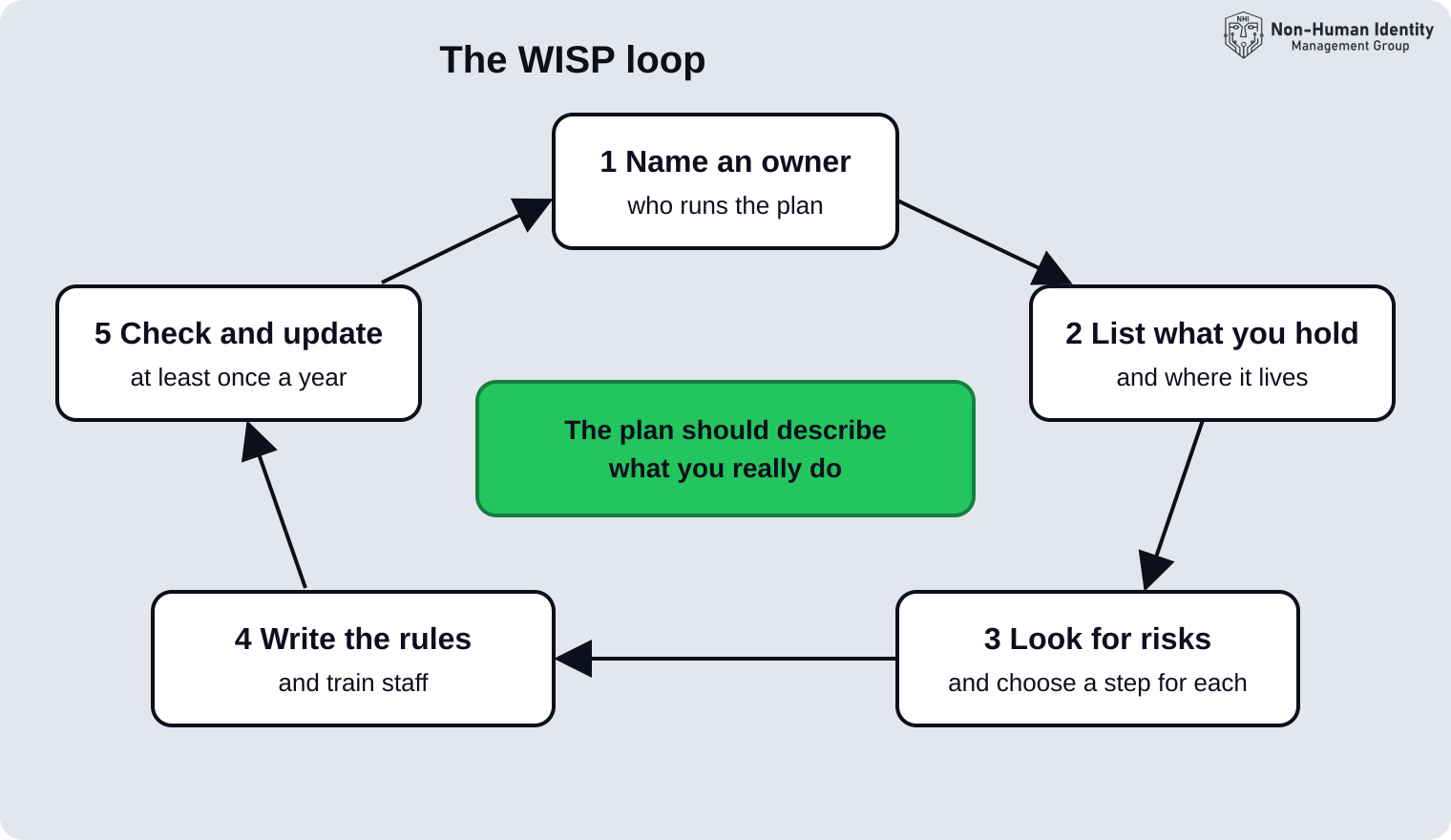
Writing a WISP is a loop, not a one-off task.
- Name an owner. Pick one or more people to run the programme. The Massachusetts rule and the FTC rule both ask for this.[1][2]
- List what you hold. Write down the personal information you keep, where it is and who can see it.
- Look for risks. Ask what could go wrong inside and outside the business, then choose a step for each risk.[2]
- Write the rules and train people. Cover passwords, locked storage, suppliers and what to do if something goes wrong. Add multi-factor authentication, which is a second check at login, such as a code on your phone.
- Check and update. Review the plan at least once a year, or sooner when the business changes.[1]
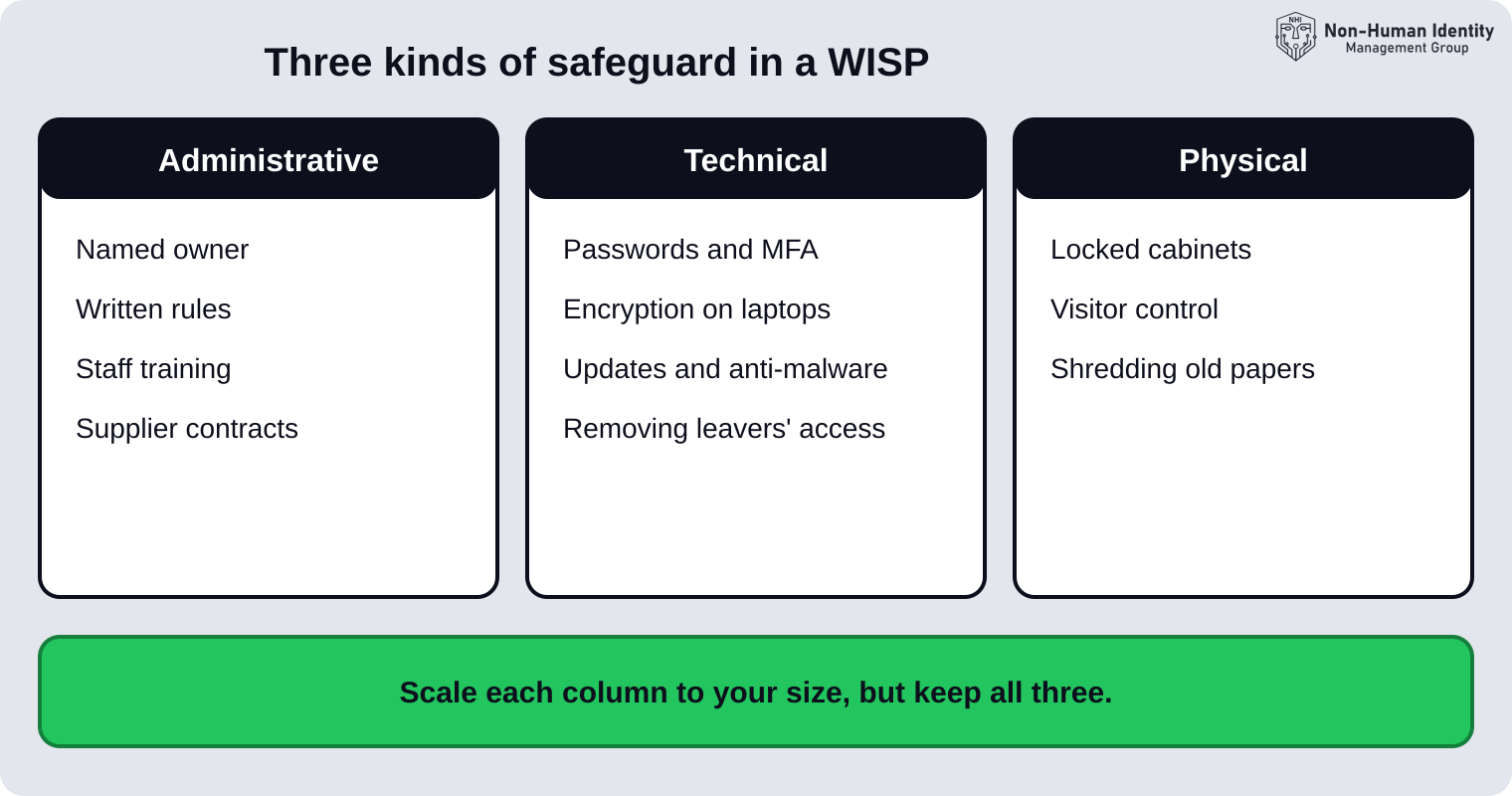
The exact parts depend on the law that applies to you. The Massachusetts rule lists required parts such as staff training and rules for records taken off site. Others include removing leavers' access, supplier contracts and a review after any incident. It also lists computer controls such as encryption on laptops, where technically feasible.[1] The FTC rule adds things such as a written incident response plan and a yearly written report to the board or a senior officer.[2] The FTC says some parts of its rule do not apply to firms holding information on fewer than 5,000 consumers.[2]
A worked example
Kofi Gallardo runs Linden Florist, a fictional flower shop near Boston with six staff. Customers pay by card on the phone, and Kofi keeps payroll records for his team.
His insurer asks a question at renewal: "Do you have a written information security programme?" Kofi does not. He asks his office manager, Vida Vance, to help.
Vida starts with a list. Card details are written on order slips. Payroll sits in a cloud app. Old slips go in a box under the counter.
Next she looks for risks. Anyone at the counter can read the slips. The payroll app has one shared login. A seasonal worker who left in the spring can still log in.
Kofi remembers the recipe book: the plan has to describe what the shop really does. So they make changes first, then write them down. Slips go in a locked drawer and are shredded after 30 days. Each person gets their own payroll login with a code on their phone. The seasonal worker's access is removed.
Vida names herself as the person in charge. She lists the payroll app and the card machine company as suppliers, and checks what their contracts say about security. She writes a one-page incident plan with who to call.
The finished WISP is five pages. Kofi puts the review date in the shop calendar for next November. When the insurer asks again, he can send it.
Myths and mistakes
| What people think | What is true |
|---|---|
| We are too small to need a WISP. | Both rules let the plan fit your size, but they apply to small firms too. The IRS says tax professionals are covered whatever their size.[3] |
| A downloaded template is enough. | A template is a starting point. The plan must describe what your business really does. |
| Once written, it is done. | Review it at least once a year, and when the business changes.[1] |
| A WISP is only about computers. | It also covers paper records, locked storage, staff rules and suppliers.[1] |
| Our IT supplier is responsible, not us. | You can use a supplier, but under the FTC rule the business stays responsible for its programme.[2] |
What can I do this week?
- Check whether you hold personal information about Massachusetts residents or offer financial or tax services in the US.
- Name one person to own the WISP.
- List the personal information you hold and where each kind lives.
- Read the outline in IRS Publication 5708 and use it as your first draft.
- Put a yearly review date in the calendar.
Checklist
- One or more named people run the programme.
- There is a written list of the personal information you hold and where it is.
- A written risk assessment says what could go wrong and what you do about it.
- Rules cover passwords, multi-factor authentication, locked storage and shredding.
- Leavers lose access promptly.
- Suppliers who can see your data have security terms in their contracts.
- All staff, including temporary staff, get training.
- There is a written plan for what to do if something goes wrong.
- The WISP has a review date at least once a year.
Common questions
Is a WISP the same as a security policy?
Not quite. A security policy is usually one set of rules for staff. A WISP is the whole written programme: the owner, the list of information, the risk assessment, the rules, supplier checks, training and the incident plan. Policies are often part of a WISP.
Who has to have a WISP?
Any business covered by a law that asks for one. In Massachusetts, anyone who owns or licenses personal information about residents must keep one. In the US, the FTC rule covers many financial firms, including tax preparers. Other laws may ask for something similar, so check what applies to you.
How long should a WISP be?
As long as it needs to be to describe what you really do. A small office may need only a few pages. Both rules say the programme should fit the size and type of the business, but each required part should still be there.
Do I need a consultant to write one?
Not always. Many small firms write their own from an official outline, such as IRS Publication 5708. A consultant or lawyer can help if your data or legal duties are complex, or if you are unsure which laws apply.
How often should I update my WISP?
At least once a year, and whenever something big changes, such as a new system, a new supplier, a move or an incident. The Massachusetts rule asks for a review at least annually or when business practices change in a material way.
Where next?
Ready for the detail? Read the practitioner guide: Massachusetts 201 CMR 17.00 Guide. It goes further into each required part of the plan, the computer controls, the evidence an assessor will ask for and how the rule is enforced.
Also useful:
- GLBA Safeguards Rule Guide
- GLBA and the FTC Safeguards Rule for Beginners
- Building a Security Programme for Beginners
- US State Cybersecurity Laws Map
Related NHI Mgmt Group resources: Information Security Policy Template · Incident Response Plan Template · Third-Party Risk Management for Beginners
Key terms
- Written information security programme (WISP)
- A document setting out the administrative, technical and physical steps a business uses to protect personal information.
- Risk assessment
- Working out what could go wrong, how likely it is and how much harm it could do.
- Multi-factor authentication
- A login that needs two or more separate checks, such as a password and a code.
- Encryption
- Scrambling data so it cannot be read without the right key.
- Incident response plan
- A written set of steps for handling a security problem, from spotting it to recovery.
- Information security policy
- The top-level document stating how an organisation protects its information.
Sources and further reading
- 201 CMR 17.00: Standards for the Protection of Personal Information of Residents of the Commonwealth. Commonwealth of Massachusetts (unofficial version on Mass.gov; the official text is in the Massachusetts Register). https://www.mass.gov/regulations/201-CMR-1700-standards-for-the-protection-of-personal-information-of-ma-residents, accessed 28 Nov 2026.
- FTC Safeguards Rule: What Your Business Needs to Know. US Federal Trade Commission, December 2024. https://www.ftc.gov/business-guidance/resources/ftc-safeguards-rule-what-your-business-needs-know, accessed 28 Nov 2026.
- Publication 5708: Creating a Written Information Security Plan for your Tax and Accounting Practice (Rev. 8-2024). Internal Revenue Service and the Security Summit. https://www.irs.gov/pub/irs-pdf/p5708.pdf, accessed 28 Nov 2026.