A HIPAA business associate is an outside firm that handles patient information for a US healthcare organisation.
This guide is for people who sell to healthcare, such as software, cloud, IT or billing firms, and for students and new staff. You may be covered by HIPAA even if you never see a patient: what counts is the patient information you handle.
In short
- If your firm creates, receives, keeps or sends patient information for a healthcare customer, you are probably a business associate.
- You and the customer sign a contract called a business associate agreement, or BAA, before patient information is shared.
- Business associates must follow parts of HIPAA themselves and can be held directly responsible.
- If you pass patient information to your own suppliers, they need a BAA with you too.
What you will learn
- Check whether your firm is likely to be a business associate.
- Explain what a BAA is and what it asks of you.
- Spot the suppliers further down the chain who need a BAA.
- Ask the right questions before signing with a healthcare customer.
Status: correct as at 28 November 2026, based on guidance from the US Department of Health and Human Services. Rules change; check the official text.
This guide explains the topic in general terms and is not legal advice.
- Patient information (PHI)
- health details that can identify a person, protected by HIPAA.
- Healthcare customer (covered entity)
- a health plan, a healthcare clearinghouse or a provider such as a clinic.
- Supplier contract (BAA)
- the agreement that sets out what a supplier may do with patient information.
What is a HIPAA business associate?
Think of a removals firm moving a family's filing cabinets. The firm is not the family, but for a while it holds their private papers. So the family wants a written promise about how the papers are handled.
In US healthcare, the "family" is a covered entity, such as a health plan or a clinic. The removals firm is the business associate. HIPAA is the US law that protects patient information. A business associate does work for the covered entity. While doing it, the firm creates, receives, keeps or sends protected health information (PHI).[1]
HHS, the US health department, gives examples. One is a firm that handles claims for a health plan. Another is a cloud service that stores patient records. A third is a note-typing app used by a doctor.[1]
Where the comparison stops working: a removals job ends when the van is empty. A software supplier often holds patient information for years, and copies can sit in backups, logs and other suppliers' systems.
Why does it matter?
Business associates are not just bound by a contract. A US law called the HITECH Act lets HHS act against them directly for some failures. Examples are not following the HIPAA security rules, or not telling the customer about a breach.[2]
If you run a software or app business
What could happen: you win a clinic as a customer and only later learn you are a business associate.
Check this: ask whether your product will hold any patient information before you sign.
Next: HIPAA for Beginners
If you work in sales or contracts
What could happen: a customer sends a BAA and it is signed without anyone checking what it promises.
Check this: route every BAA to your security and legal leads first.
If you are new to IT or security work
What could happen: patient data flows to a tool your firm uses, with no BAA in place.
Check this: list every service that touches patient data, including your own suppliers.
What does it look like?
Here is a made-up "Am I a business associate?" card that a small supplier might fill in.
Example only. All values are made up.
Supplier: Example Notes Ltd (FAKE)   Customer: Example Clinic
Do we create, receive, keep or send patient info for them?  YES  (1)
Is it only for passing data along, like a post service?     NO   (2)
Is the data encrypted and we have no key?                   YES  (3)
Do we pass patient info to our own suppliers?               YES  (4)
Result: likely a business associate. BAA needed with clinic,
and with our hosting firm.
- Handling patient information for a covered entity is the key test.[1]
- A narrow exception covers firms that only transmit data, such as a phone line. It does not cover firms that store it.[3]
- HHS says a cloud service that stores encrypted patient data without the key is still a business associate.[3]
- In a real file, this line would name each of the supplier's own suppliers that handle the data.
Why this is risky: a firm that answers "no" to everything without checking may handle patient data with no BAA. It may still be treated as a business associate.
The safer way: answer each question with your technical team. Then sign BAAs with the customer and your own suppliers before data flows.
How does it work?
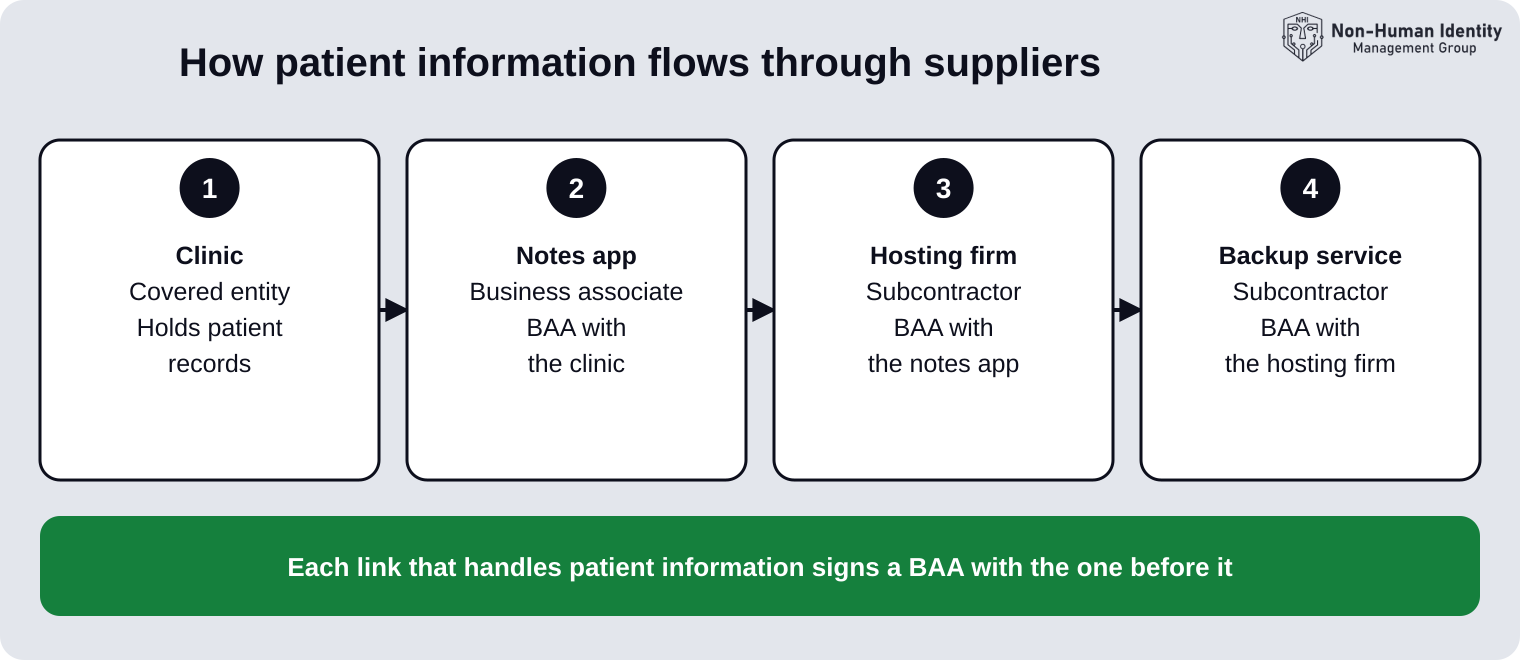
Here is how patient information usually moves from a clinic to its suppliers, and where BAAs fit.
- The clinic picks a supplier. The supplier will handle patient information to do the job.
- They sign a BAA. It says what the supplier may do with the data and that it will not use or share it any other way. It also asks the supplier to report security incidents.[1]
- The supplier protects the data. It follows the parts of HIPAA that apply to it, including the security rules.[2]
- The supplier uses its own suppliers. Before passing them patient data, it signs a BAA with each one. The clinic does not need to sign with them directly.[1]
- Something goes wrong. The supplier tells the clinic about a breach, as the rules require.[2]
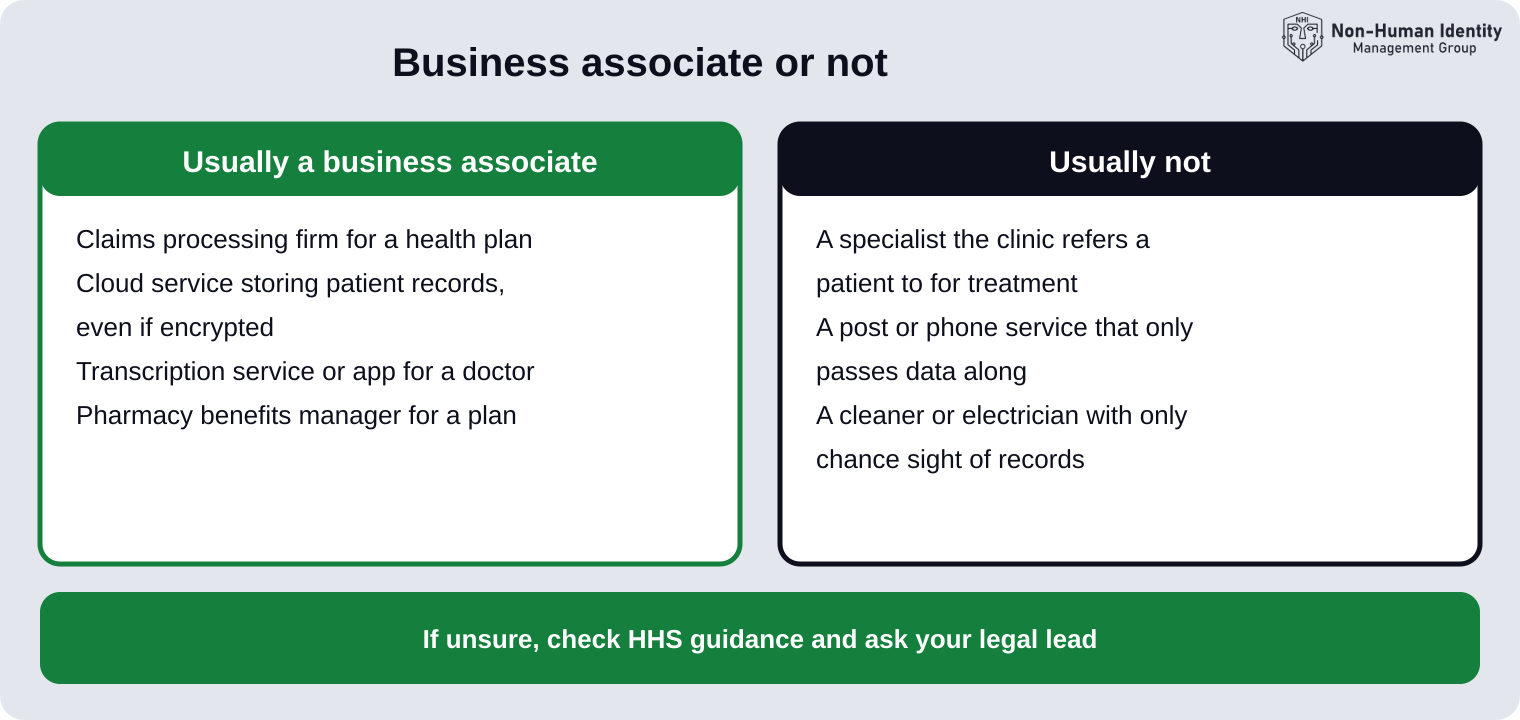
Some suppliers are usually not business associates. A specialist who treats a referred patient is one example. Another is a cleaner whose contact with records is only by chance, with sensible safeguards in place.[1]
A worked example
Gideon Kader runs a small fictional start-up, Quillpath, that makes a voice-notes app for doctors. A doctor speaks, and the app turns it into typed notes.
Jonah Lomax, the practice manager at a family clinic, wants to try it. He emails Gideon: "Before we start, we need you to sign our business associate agreement."
Gideon is surprised. Quillpath never meets patients. Then he thinks of the removals firm. His app will hold the clinic's private papers, the doctors' notes, so the clinic needs his written promise.
He checks HHS guidance and sees a transcription app named as an example of a business associate. He asks his developer where the notes are stored. They sit with a hosting firm, and backups go to a second firm.
So Gideon has three jobs. He reviews the clinic's BAA with a lawyer, then signs it. He checks that the hosting firm offers a BAA, and signs one. He finds the backup firm does not, so he moves backups to a service that does.
He also sets a simple rule for his team. Report any security problem to him the same day. Then Quillpath can tell the clinic, as the BAA requires.
Two weeks later, Jonah's clinic starts using the app. Gideon now asks every new supplier one question first: "Will you touch patient information?"
Myths and mistakes
| What people think | What is true |
|---|---|
| We never see patients, so HIPAA does not apply to us. | What counts is handling patient information for a covered entity, not meeting patients.[1] |
| The data is encrypted, so we are not a business associate. | HHS says a cloud service storing encrypted patient data without the key is still one.[3] |
| Only the clinic gets in trouble if something goes wrong. | Business associates can be held directly responsible for certain failures.[2] |
| Our own suppliers are the clinic's problem. | You need a BAA with each of your suppliers that handles the patient information.[1] |
| We only pass data along, so we are a conduit. | The conduit exception covers transmission only. Storing data takes you out of it.[3] |
What can I do this week?
- List your healthcare customers and ask whether you handle patient information for each.
- Find the signed BAA for each one, or flag where it is missing.
- List your own suppliers that touch that data, and check each has a BAA with you.
- Agree who in your firm tells customers about a security incident, and how fast.
Checklist
- We know which customers make us a business associate.
- A signed BAA is in place with each of them before patient information flows.
- Each of our suppliers that handles the data has signed a BAA with us.
- Staff know to report security incidents quickly, so we can tell the customer.
- Only the people and software accounts that need patient data can reach it.
- We follow the HIPAA security rules for the data we hold.
- We know what happens to the data when a contract ends.
Common questions
Is a cloud storage company a business associate?
Usually, yes, if it stores patient information for a covered entity or a business associate. HHS says this holds even when the data is encrypted and the company has no key. A service that only passes data along may fall under the narrow conduit exception.
What goes in a BAA?
A BAA says what the supplier may and must do with patient information. It says the supplier will not use or share it in other ways. It asks the supplier to protect the data and report security incidents. It also covers the supplier's own suppliers.
Can a clinic be a business associate too?
Yes. HHS says a covered entity can also be a business associate of another one. This happens when it does work for the other that involves patient information. Sharing records for a patient's treatment does not need a BAA.
Does this apply to firms outside the US?
It can. A firm abroad that handles patient information for a US covered entity may be asked to sign a BAA. Other laws, such as data protection laws in Europe, may apply as well. Check with your legal lead.
Where next?
Ready for the detail? Read the practitioner guide: HIPAA Business Associate Agreements Guide. It goes further into the required contract terms clause by clause, subcontractor chains and how HHS enforces against suppliers.
Also useful:
- HIPAA for Beginners
- HIPAA Breach Notification Rule Guide
- Third Party Risk Management for Beginners
- Security Clauses in Supplier Contracts for Beginners
Related NHI Mgmt Group resources: HIPAA Security Rule Guide · Non-Human Identities for Beginners
Key terms
- Business associate
- An outside firm that handles patient information for a covered entity.
- Covered entity
- A health plan, healthcare clearinghouse or healthcare provider that must follow HIPAA.
- Protected health information
- Health information that can identify a person, protected by HIPAA.
- Business associate agreement
- The contract that sets out what a business associate may do with patient information.
- Subcontractor flow-down
- Passing the same duties on to your own suppliers who handle the data.
- Encryption
- Scrambling data so only someone with the right key can read it.
Sources and further reading
- Business Associates. US Department of Health and Human Services, Office for Civil Rights. https://www.hhs.gov/hipaa/for-professionals/privacy/guidance/business-associates/index.html, accessed 28 Nov 2026.
- Direct Liability of Business Associates (fact sheet). US Department of Health and Human Services, 24 May 2019. https://www.hhs.gov/hipaa/for-professionals/privacy/guidance/business-associates/factsheet/index.html, accessed 28 Nov 2026.
- Guidance on HIPAA and Cloud Computing. US Department of Health and Human Services. https://www.hhs.gov/hipaa/for-professionals/special-topics/health-information-technology/cloud-computing/index.html, accessed 28 Nov 2026.