A security clause is part of a supplier contract that says how the supplier must protect your data and systems.
This guide is for small business owners, buyers and procurement staff who sign supplier contracts. You do not need to be a lawyer or a technical expert: you only need to know what to look for and what to ask.
In short
- A contract is your best chance to set security rules for a supplier, and it is easiest before you sign.
- Look for six things: basic security, who else sees your data, breach warnings, checking, leaving and reviews.
- If a supplier handles personal data for you, UK data protection law requires certain terms in the contract.
- Match the clauses to the risk. A cleaner and a payroll firm need different promises.
What you will learn
- Explain what a security clause is and why it matters.
- Spot the six kinds of clause worth checking in a supplier contract.
- Check whether a contract says how fast you will hear about a breach.
- Ask a supplier for missing promises before you sign.
This guide explains the topic in general terms and is not legal advice. For an important contract, ask a qualified adviser.
- Promise in writing (clause)
- one section of a contract that sets out a duty or a right.
- Your supplier's supplier (subcontractor)
- another firm your supplier uses to do part of the work.
- Breach warning (notification)
- a promise to tell you, within a set time, if your data or systems may have been attacked.
What are security clauses in supplier contracts?
Think of hiring a builder. A good written agreement says what they will do, who else they can bring onto the site and what happens if something breaks. You agree it before they start, not after the roof leaks.
Security clauses do the same for suppliers who touch your data or systems. They set out what the supplier must do to keep things safe. They also say what you can ask for, and how you part ways cleanly.
UK guidance from the National Cyber Security Centre suggests building security into contracts. It also suggests asking suppliers to pass the same rules down to firms they use.[1]
Where the comparison stops working: you can see a leaking roof. You often cannot see a supplier's security from the outside. So the contract has to give you ways to ask for evidence and to hear about problems.
Why does it matter?
Once a contract is signed, a supplier has little reason to add promises it did not make. Asking before you sign costs least.
If you run a small business
What could happen: a supplier is hacked, and your contract says nothing about telling you.
Check this: your most important contract has a set time for breach warnings.
If you buy for your organisation
What could happen: you sign the supplier's standard terms, which favour the supplier.
Check this: compare the terms against a short list of clauses you always want.
If you are a small supplier
What could happen: a big customer sends a long contract full of security duties you cannot meet.
Check this: read each duty, and agree changes before you sign rather than promise too much.
What does it look like?
Here is a made-up extract from a supplier contract, with notes on what to check. Real contracts use longer, more formal wording.
Example only. All values are made up.
EXAMPLE Payroll Services Ltd: security terms (extract)
4.1 The Supplier will keep appropriate security measures.  (1)
4.2 The Supplier may use subcontractors.                   (2)
4.3 The Supplier will tell the Customer of any breach.     (3)
4.4 [no clause on checking or evidence]                    (4)
4.5 On exit, the Supplier will return data on request.     (5)
- Vague. Ask what "appropriate" means, or for a list of basics such as two-step login and updates.
- Add that they need your permission, and must pass the same rules on.
- No time limit. Ask for a set time, such as "without undue delay", plus what they will share.
- Missing. Ask for a right to see evidence, such as a certificate or audit report.
- Add that copies are deleted, and that their access to your systems is removed.
Why this is risky: each line sounds fine, but none gives you anything you can check or rely on in a crisis.
The safer way: ask for each promise to say who does what, by when and how you will know.
How does it work?
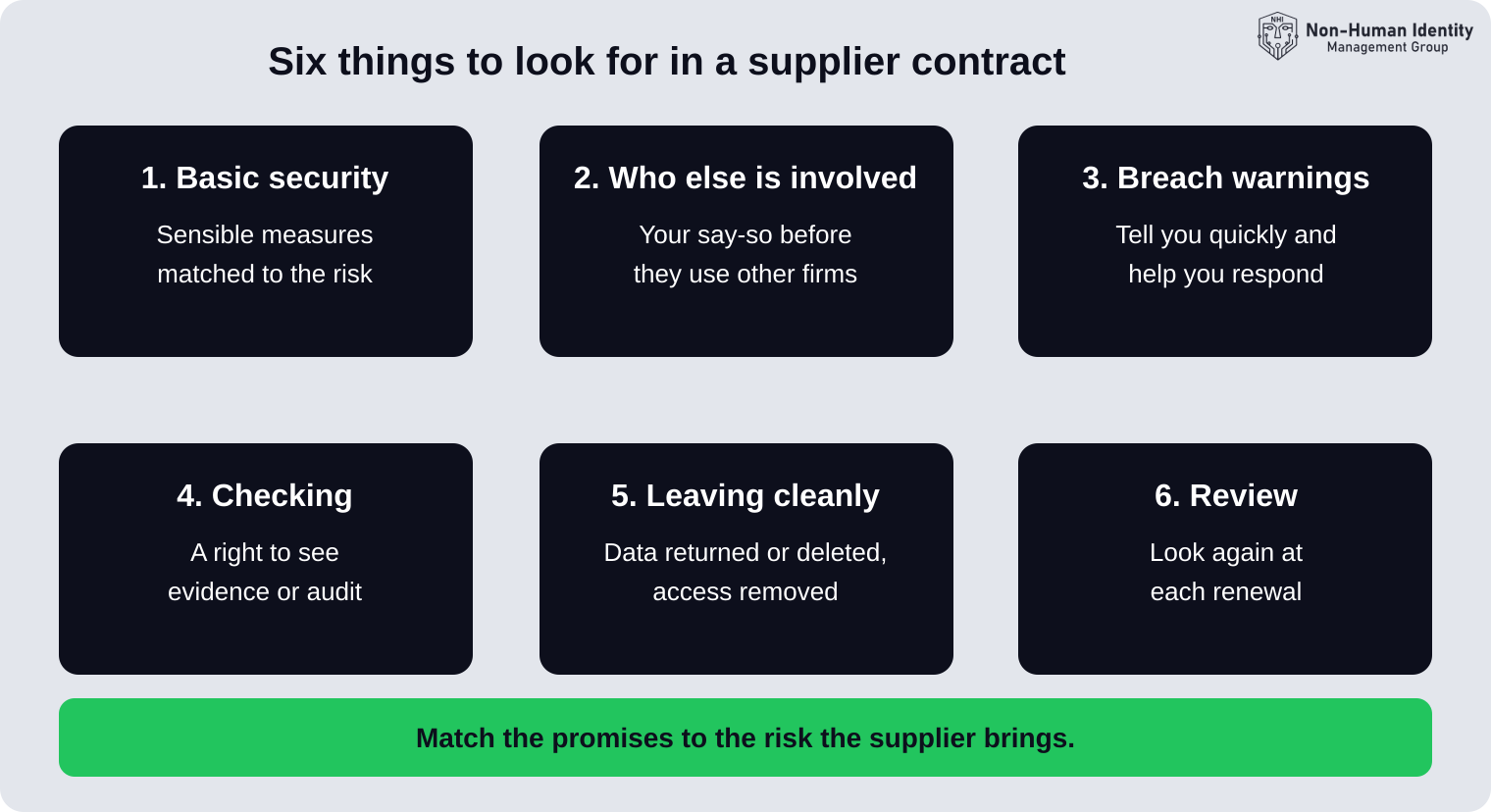
Most supplier contracts with good security cover six areas. You can use them as a checklist when you read one.
- Basic security. The supplier keeps sensible security measures, matched to the risk.[1]
- Who else is involved. The supplier needs your say-so before using other firms, and passes the same rules on to them.[1]
- Breach warnings. The supplier tells you about incidents quickly, and says how it will help you respond.[1]
- Checking. You can ask for evidence, or for an audit, to see that the promises are kept.[2]
- Leaving cleanly. At the end, your data is returned or deleted and the supplier's access to your systems is shut off.[3]
- Review. The terms are looked at again at renewal, as the risks change.[1]
If the supplier handles personal data for you, the law adds its own list. In the UK, a contract with a firm that processes personal data for you must cover set terms.[2] These include security, using other firms, helping you with breaches, deleting or returning data at the end, and audits.
Not every supplier needs every clause. UK guidance says security asks should be fair, in proportion and achievable for the supplier.[1] Save the full set for suppliers that hold sensitive data or can reach your systems.
A worked example
Nadia Ilic runs a fictional accountancy practice with six staff. She is about to move payroll to an online payroll firm. The firm will hold staff names, bank details and salaries.
Dana Lomax, the payroll firm's sales lead, sends the standard contract. Nadia thinks of the builder. She would not let one start work without agreeing what happens if the roof leaks.
She reads the security section with the six areas beside her. The contract promises "appropriate security", which is vague. It allows other firms to be used, with no say for her. It promises to tell her about a breach, but gives no time. There is nothing on checking, and the exit clause only covers returning data.
Nadia emails Dana a short list. She asks for a breach warning without undue delay, with the facts the firm knows. She asks to be told before any new firm handles her data. She asks for a yearly copy of the firm's security certificate. She also asks for data to be deleted at the end, with written confirmation.
Dana agrees to most of it. The firm will not change its standard audit terms, but offers its certificate and a summary report each year. Nadia decides that is enough for the risk.
She files the signed contract with a note of what she asked for and what was agreed. She sets a reminder to look again at renewal.
Myths and mistakes
| What people think | What is true |
|---|---|
| Standard terms cannot be changed. | Many suppliers will agree reasonable changes, especially before you sign. |
| "Appropriate security" covers everything. | It is hard to check. Ask what it means in practice. |
| A contract makes the supplier secure. | A contract sets duties and rights. You still need to check, and plan for problems. |
| Every supplier needs the full set of clauses. | Match the clauses to the risk, so small suppliers are not buried in duties. |
| The contract ends, so access ends. | Only if someone removes it. Ask for data deletion and access removal in writing. |
What can I do this week?
- Pick your most important supplier and find its contract.
- Read the security section with the six areas in Figure 1 beside you.
- Note any area that is missing or vague.
- Write a short list of clauses you want in future contracts.
- Put the contract's renewal date in your calendar, with time to ask for changes.
Checklist
- The contract describes the security the supplier must keep.
- The supplier needs our approval before using other firms with our data.
- The supplier must tell us about a breach within a set time.
- We can ask for evidence, such as a certificate or audit report.
- At the end, data is returned or deleted and access is removed.
- Contracts with firms that handle personal data cover the terms data protection law requires.
- We review security terms at each renewal.
Common questions
Do I need a lawyer to check security clauses?
Not always, but it helps for important or high-risk contracts. You can spot gaps yourself using the six areas on this page. Then ask a qualified adviser to check the wording for contracts with sensitive data, large sums of money or long terms.
What if a supplier refuses to change its terms?
You still have choices. Ask what the supplier can offer instead, such as a certificate or report. Weigh the gap against the risk. You might accept it, limit what data you share or choose another supplier. Write down what you decided and why.
How fast should a supplier tell me about a breach?
Quickly enough for you to act and meet your own duties. If personal data is involved, a supplier handling it for you must tell you without undue delay.[4] Many buyers ask for a set number of hours or days. See Data Breach Notification for Beginners.
What is a right to audit?
A right to audit is a clause that lets you check a supplier's security, or have someone check it for you. Many suppliers offer a certificate or independent report instead of visits. See Right to Audit vs Assurance Reports.
Do these clauses matter for small, cheap suppliers?
Yes, if they hold your data or can reach your systems. A small IT helper with remote access can carry more risk than a large office supplier. Keep the promises simple and in proportion, and focus on breach warnings, access and leaving cleanly.
Where next?
Ready for the detail? Read the practitioner guide: Third-Party Security Contract Clauses Template. It goes further into model wording for each clause, access and credential terms and how to roll the clauses out across suppliers.
Also useful:
- Third Party Risk Management for Beginners
- Supplier Breaches for Beginners
- Vendor Offboarding for Beginners
- UK GDPR for Beginners
Related NHI Mgmt Group resources: Right to Audit vs Assurance Reports · Supplier Cyber Insurance Requirements Guide · NCSC Supply Chain Security Principles Guide
Key terms
- Right to audit
- A contract right to check a supplier's records, controls or security evidence.
- Sub-processor
- Another firm that your supplier uses to handle your data.
- Data processor
- A firm that handles personal data for you, following your instructions.
- Breach notification
- Telling the right people, such as a customer or a regulator, that a breach has happened.
- Service level agreement
- A set of targets for how quickly a supplier must respond to and fix problems.
- Vendor offboarding
- Removing a supplier's access and your data in a controlled way when the work ends.
Sources and further reading
- Supply chain security guidance: Establish control (principles 4 to 7) and principle 9. National Cyber Security Centre (NCSC). https://www.ncsc.gov.uk/collection/supply-chain-security/principles-supply-chain-security/ii-establish-control, accessed 28 Nov 2026.
- What needs to be included in the contract? (UK GDPR Article 28). Information Commissioner's Office (ICO). https://ico.org.uk/for-organisations/uk-gdpr-guidance-and-resources/accountability-and-governance/contracts-and-liabilities-between-controllers-and-processors-multi/what-needs-to-be-included-in-the-contract/, accessed 28 Nov 2026.
- How to assess and gain confidence in your supply chain cyber security: embed cyber security controls throughout the contract's duration. National Cyber Security Centre (NCSC). https://www.ncsc.gov.uk/collection/assess-supply-chain-cyber-security/stage-3-apply-the-approach-to-new-supplier-relationships/step-2-embed-cyber-security-controls-throughout-the-contracts-duration, accessed 28 Nov 2026.
- Personal data breaches: a guide. Information Commissioner's Office (ICO). https://ico.org.uk/for-organisations/report-a-breach/personal-data-breach/personal-data-breaches-a-guide/, accessed 28 Nov 2026.