India's cyber security laws punish computer crime and make many organisations report attacks to CERT-In within six hours.
This guide is for anyone who works with computers in India, or for a firm that serves Indian users, and wants a plain picture of the rules. You do not need to be a lawyer: if your firm runs websites, apps or cloud systems, these rules may already apply to it.
In short
- The main law is the Information Technology Act, 2000, usually called the IT Act. It makes hacking, data theft and online fraud crimes.
- The IT Act also set up CERT-In, India's national team for handling cyber attacks.
- Since 27 June 2022, CERT-In rules say many organisations must report certain attacks within six hours of noticing them.
- The same rules ask firms to keep computer records for 180 days, set their clocks to official time and name a contact person.
What you will learn
- Explain what the IT Act and CERT-In do, in one sentence each.
- Spot the kinds of attack that start the six-hour clock.
- Check whether your firm keeps the records and contact details CERT-In asks for.
- Ask the right questions of your IT team, lawyer or cloud supplier.
Status: correct as at 28 November 2026, based on the IT Act text and the CERT-In Directions of 28 April 2022 with CERT-In's own FAQs. Laws change; check the official text.
This guide explains the topic in general terms and is not legal advice.
- National cyber help team (CERT-In)
- India's government team that collects reports of cyber attacks and helps respond to them.
- Official instructions (Directions)
- rules CERT-In issued in 2022 that organisations must follow.
- Computer records (logs)
- files that note what happened on a system, and when.
What are India's cyber security laws?
Think of the rule that a driver must report a road accident to the police quickly. The rule does not stop crashes. It makes sure the right people hear about them while the details are fresh.
India's cyber security rules work in a similar way. One part says which online acts are crimes. Another part says who must report an attack, how fast, and what records they must keep.
The main law is the Information Technology Act, 2000. It was passed in 2000 and widely updated in 2008.[1] It covers things like breaking into a computer, stealing someone's password and pretending to be someone else online.
The IT Act also names CERT-In, the Indian Computer Emergency Response Team, as the national body for cyber incidents. A cyber incident is any event that harms, or tries to harm, computer systems or data.[1] In 2022, CERT-In used its powers under the Act to issue a set of rules called the Directions.[2]
Where the comparison stops working: a road accident is easy to see. A cyber attack can stay hidden for weeks, so the rules also ask firms to keep records that help spot what happened later.
Why does it matter?
Banks, shops, hospitals and government services in India run on computers and apps, so one attack can affect a great many people.
If you run a business that serves India
What could happen: your firm misses the six-hour report because nobody knew the rule, and later has to explain why to CERT-In.
Check this: ask who in your firm would send a report to CERT-In, and whether they know the deadline.
If you work in IT or support
What could happen: logs are switched off or deleted after a few weeks. When an attack is found, the records CERT-In may ask for are gone.
Check this: find out how long your systems keep their logs. Include the accounts that software uses, such as service accounts and API keys.
If you are a student or new to the field
What could happen: you are asked about Indian rules in an interview or exam and mix up the security law with the privacy law.
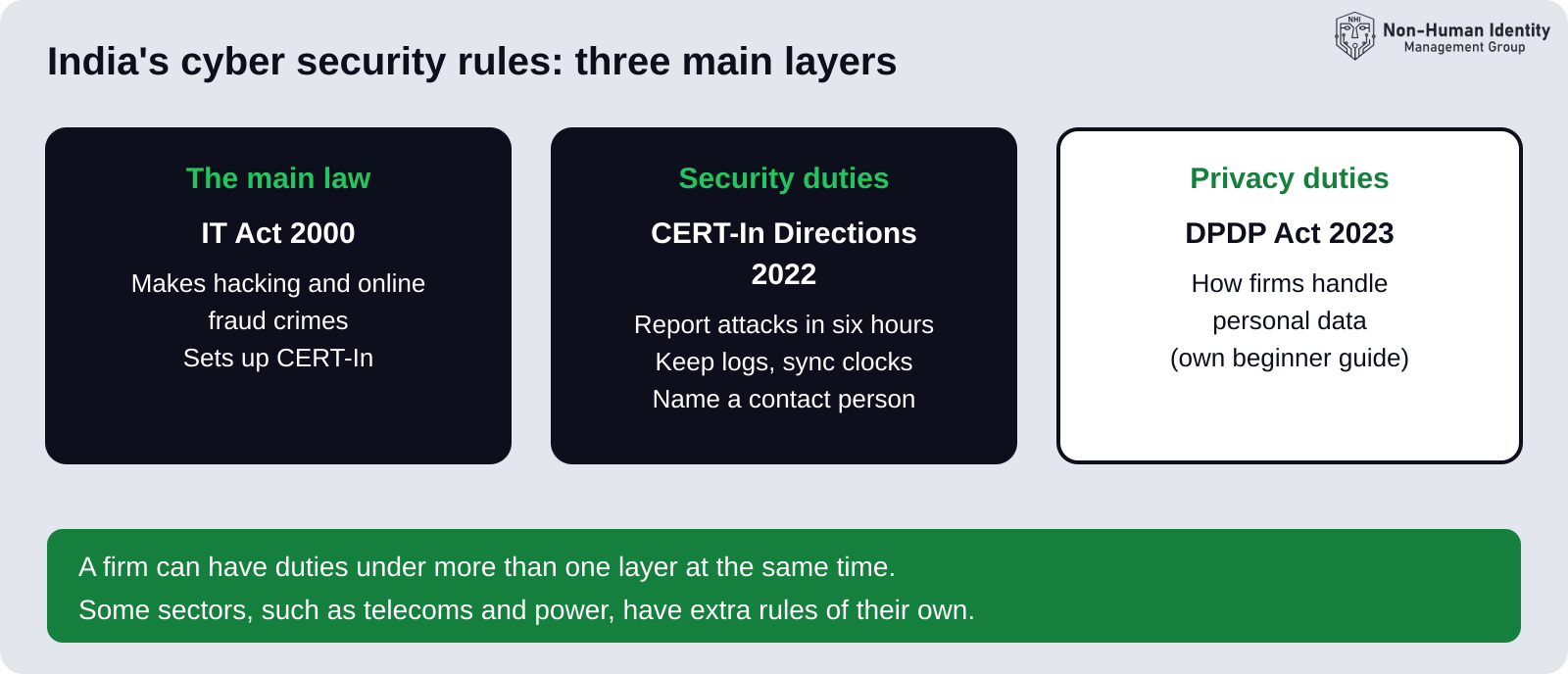
Check this: learn the difference between the IT Act, the CERT-In Directions and the DPDP Act, using Figure 1 below.
What does it look like?
Here is a short "Am I affected?" card for a made-up company. It shows the first questions a firm can ask about the CERT-In rules.
Example only. All values are made up.
AM I AFFECTED? (scenario card)
Company:     EXAMPLE Kart (FAKE), online shop
Users:       customers across India               (1)
Systems:     website, app, cloud servers          (2)
Logs kept:   30 days only                         (3)
Clock source: not checked                         (4)
CERT-In contact named? No                         (5)
Result:      LIKELY covered, with gaps to fix
Next step:   read the Directions, ask a lawyer
- Firms that offer services in India are a main focus of the rules.
- Cloud systems are named in the list of attacks to report.
- The rules ask for logs to be kept for a rolling 180 days.
- System clocks should follow official Indian time servers, or ones that match them.
- Each firm should name a point of contact for CERT-In.
Why this is risky: the firm keeps only 30 days of logs and has no named contact. It may struggle to report on time or to answer CERT-In's questions.
The safer way: fill in the card, fix the gaps it shows and check the answers with someone who knows Indian law.
How does it work?
Here is how the main rules fit together, in general terms. Figure 1 shows the three layers.
- The IT Act sets the crimes. Breaking into a computer, causing damage, using someone else's password and cheating people online can all lead to fines or prison.[1]
- The IT Act sets up CERT-In. CERT-In gathers news of attacks, sends out warnings and helps organise the response.[1]
- CERT-In's Directions add duties. They apply to service providers, online platforms, data centres, companies and government bodies. They have applied since 27 June 2022.[2]
- Report within six hours. Attacks on a list of 20 types must be reported within six hours of noticing them. The list includes ransomware, data leaks, phishing and attacks on cloud systems.[2]
- Keep records and set clocks. Firms keep logs for 180 days and set their system clocks to official time. Correct clocks help investigators put events in the right order.[2]
- Privacy has its own law. How firms handle personal data is covered by the Digital Personal Data Protection Act, 2023, known as the DPDP Act.[4]
The CERT-In Directions in plain words:[2]
| Duty | In plain words |
|---|---|
| Sync clocks | Set system clocks to India's official time servers, or to ones that match them. |
| Report incidents | Tell CERT-In about listed attacks within six hours of noticing them. |
| Name a contact | Give CERT-In a named point of contact and keep the details up to date. |
| Answer requests | Give CERT-In information or help when it asks, in the time it sets. |
| Keep logs | Switch on logs for all systems and keep them safely for a rolling 180 days. |
| Extra records for some firms | Data centres, cloud, VPN and virtual private server providers keep customer records for five years. Crypto firms keep customer and transaction records for five years too. |
A worked example
Chai Basket is a made-up online tea shop in Pune with 40 staff. Its IT manager, Rania Mbeki, reads about the CERT-In six-hour rule on a training course.
She fills in an "Am I affected?" card. The shop serves customers across India and runs on cloud servers, so she decides the rules very likely apply. She shares the card with the founder, Idris Rinaldi, and their lawyer agrees.
Rania finds three gaps. The website logs are kept for only 30 days. Nobody has checked where the servers get their time from. And no one is named as the contact for CERT-In.
She asks the cloud supplier to keep logs for 180 days, including the logs for the shop's service accounts and API keys. These are non-human identities (NHIs): digital identities that let software connect to other systems without a person. She points the server clocks at an official time source. Idris agrees to be the named contact, with Rania as his deputy.
Two months later, a customer emails to say they got a strange message asking for card details, sent in the shop's name. Rania checks and finds a fake copy of the shop's website. That is phishing, which is on the CERT-In list.
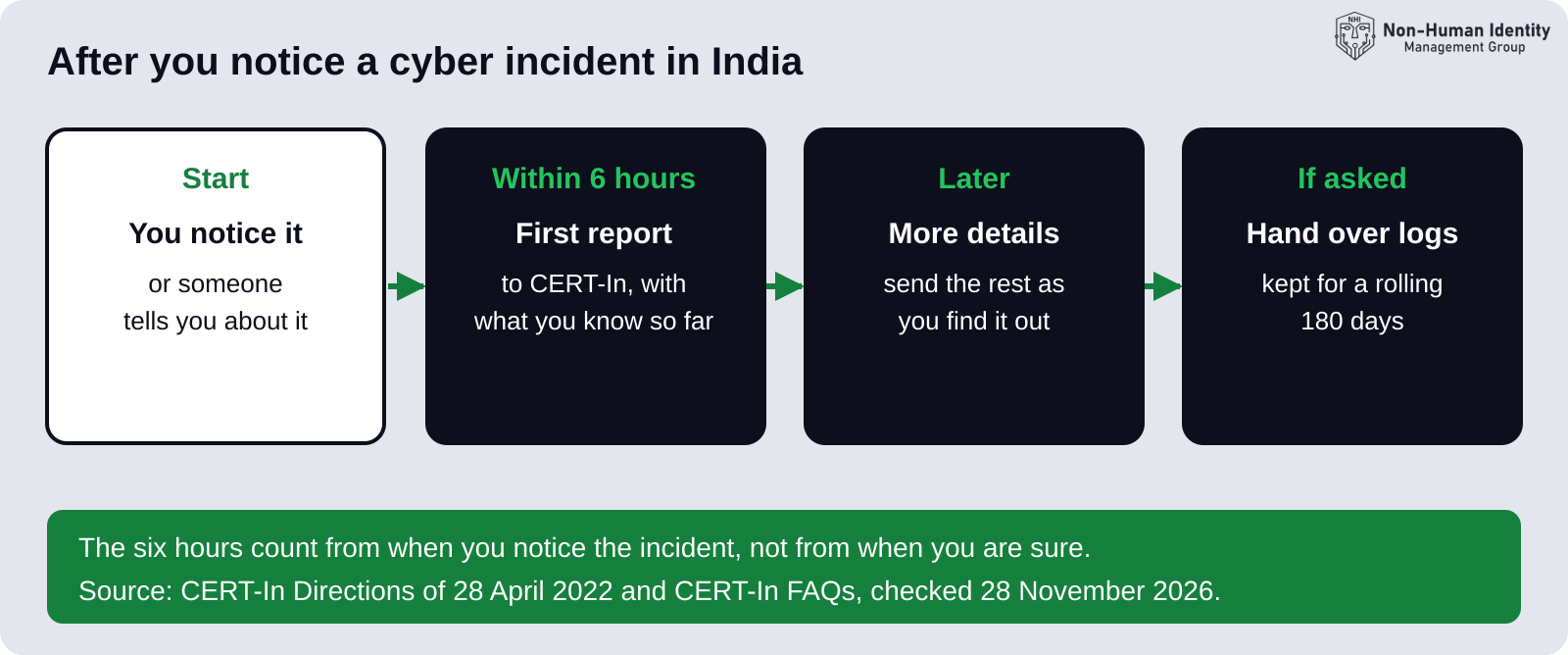
The six-hour clock starts when she notices. Rania sends a short first report with what she knows. She sends more details over the next few days, and the 180 days of logs help show that the real shop was not broken into.
Myths and mistakes
| What people think | What is true |
|---|---|
| We have six hours after we finish investigating. | The six hours run from when you notice the incident or are told about it.[2] |
| We must have every detail before we report. | CERT-In's FAQs say a first report can hold what you know at the time, with the rest sent later.[3] |
| The rules apply to everyone, including me at home. | CERT-In's FAQs say individual citizens are not covered by the Directions.[3] |
| Our logs must sit on servers in India. | The FAQs say logs may also be kept abroad, as long as you can still hand them to CERT-In when asked.[3] |
| The DPDP Act replaced the IT Act. | They are separate laws. The DPDP Act covers personal data, and the IT Act still covers computer crime and CERT-In. |
What can I do this week?
- Fill in an "Am I affected?" card and share it with your legal team.
- Find out how long each key system keeps its logs. Note any that keep less than 180 days.
- Ask who your named contact for CERT-In is, and who covers for them.
- Read the list of 20 incident types. Mark the ones your firm could face.
Checklist
- We know whether the CERT-In Directions are likely to apply to us, with the reasons written down.
- We have a named point of contact for CERT-In, with a deputy.
- Our incident plan says who sends the six-hour report, and how.
- Logs for our key systems, including service accounts and API keys, are kept for 180 days.
- Our system clocks follow an official or matching time source.
- Staff know how to raise a suspected attack quickly, day or night.
- Our cloud and IT suppliers know what records we may need from them.
Common questions
What is the CERT-In six-hour rule?
It is a rule in the CERT-In Directions of April 2022. Covered firms must report certain attacks to CERT-In within six hours. The clock starts when they notice the attack or are told about it. The list has 20 types, from ransomware and phishing to attacks on cloud and AI systems.[2]
Do the CERT-In rules apply to foreign companies?
CERT-In's FAQs say the reporting duty applies to any entity, including firms based outside India that serve Indian users. Some lawyers question how far this reaches. A foreign firm with Indian customers should get its own legal advice.[3]
What happens if a firm does not follow the Directions?
It can face penalties under the IT Act. CERT-In's FAQs say it plans to use this power reasonably, mainly where a firm breaks the rules on purpose. Penalty amounts have changed over time, so check the current text of the Act.[3]
Is hacking a crime in India?
Yes. Under the IT Act, breaking into a computer or damaging it on purpose with dishonest intent can lead to prison and a fine. Using someone else's password, and cheating people by pretending to be someone else online, are also offences.[1]
How is this different from the DPDP Act?
The IT Act and the CERT-In Directions are about computer crime and cyber attacks. The DPDP Act is about how organisations collect and use personal data. A data breach can bring duties under both, so plan for both. See India's DPDP Act for Beginners.[4]
Where next?
Ready for the detail? Read the practitioner guide: CERT-In Directions 2022 Guide. It goes further into the full list of 20 incident types, the record-keeping rules for cloud and VPN providers, and the penalty changes since 2023.
Also useful:
- For the wider law: India IT Act 2000 and SPDI Rules
- India DPDP Act Guide
- Cyber Incident Reporting for Beginners
- Breach Notification Laws by Country Guide
Related NHI Mgmt Group resources: India Telecommunications (Telecom Cyber Security) Rules 2024 · NTP Security Guide · Non-Human Identities for Beginners
Key terms
- CERT
- A computer emergency response team; in India, CERT-In is the national one.
- Incident reporting
- Telling the right body about a cyber attack within the time a rule sets.
- Security incident
- An event that harms, or tries to harm, systems or data.
- Log retention
- How long a firm keeps its computer records before deleting them.
- Network Time Protocol
- The common way computers set their clocks from a trusted time source.
- Identity theft
- Using someone else's password or personal details to pretend to be them.
- Digital Personal Data Protection Act
- India's 2023 law on how organisations handle personal data.
Sources and further reading
- The Information Technology Act, 2000 (No. 21 of 2000), as amended by the Information Technology (Amendment) Act, 2008: sections 43, 66, 66C, 66D and 70B. Copy of the Act text published by PRS Legislative Research. https://prsindia.org/files/bills_acts/bills_parliament/2021/IT%20Act,%202000.pdf, accessed 28 Nov 2026.
- Directions under sub-section (6) of section 70B of the Information Technology Act, 2000 relating to information security practices, procedure, prevention, response and reporting of cyber incidents for Safe and Trusted Internet, No. 20(3)/2022-CERT-In, 28 April 2022, directions (i) to (vii) and Annexure I. Indian Computer Emergency Response Team, Ministry of Electronics and Information Technology. https://www.cert-in.org.in/PDF/CERT-In_Directions_70B_28.04.2022.pdf, accessed 28 Nov 2026.
- Frequently Asked Questions (FAQs) on Cyber Security Directions of 28.04.2022, May 2022. Indian Computer Emergency Response Team. https://www.cert-in.org.in/PDF/FAQs_on_CyberSecurityDirections_May2022.pdf, accessed 28 Nov 2026.
- The Digital Personal Data Protection Act, 2023 (No. 22 of 2023). Ministry of Electronics and Information Technology, Government of India, 11 August 2023. https://www.meity.gov.in/static/uploads/2024/06/2bf1f0e9f04e6fb4f8fef35e82c42aa5.pdf, accessed 28 Nov 2026.