A job scam is a fake job offer designed to take your money or your personal details.
This guide is for anyone looking for work, side income or a work-from-home job. You do not need to be careless to be caught: these offers are made to look like real recruiters and real companies.
In short
- A real employer pays you. If a "job" asks you to pay, to unlock earnings or buy kit, treat it as a scam.
- A common type is the task scam: simple online tasks, small early payouts, then demands for deposits, often in crypto.
- Other warning signs: an offer out of the blue, no interview, high pay for little work, and requests to move money or parcels.
- If you have paid, contact your bank or payment company straight away, then report it.
What you will learn
- Spot the signs that a job offer is fake.
- Explain how a task scam takes money step by step.
- Check a recruiter or company before you share details.
- Know who to call if you have already paid.
- Pay-to-earn job (task scam)
- a fake job where you do simple online tasks, then must pay money to "unlock" your earnings.
- Digital money (cryptocurrency)
- online money such as Bitcoin that is hard to trace and usually cannot be reversed once sent.
What is a job scam?
Think of a fairground game that hands out tokens every time you play. The tokens pile up, but to swap them for a prize you must pay real cash. Then the prize never comes. Many job scams work the same way.
A job scam is an offer of work that is not real. The person behind it wants your money, your personal details, or both. Some ask for a fee for training, equipment or a "starter kit". Some send you a cheque, ask you to bank it and send part of the money on. The cheque later bounces, and you can be left owing the full amount.[1]
A fast-growing kind is the task scam. You are paid, at first, to do small online tasks like rating products. Then you are told to pay in to keep earning.[2]
Where the comparison stops working: a fairground game is honest about being a game. A job scam looks like real work, with a company name, a "trainer" and an app that shows your pay rising.
Why does it matter?
Job scams can take savings, put debt in your name and pull you into moving stolen money. In the US, the FTC says reported job scam losses topped $220 million in the first half of 2024 alone.[2]
If you are looking for work
What could happen: you hand over your bank details and ID for "payroll", and they are used for fraud.
Check this: find the company's own website yourself and contact it there, not through the message.
If you are a student wanting extra income
What could happen: an easy online job asks you to top up your account to reach the next level.
Check this: any request to pay in, in any form, is the moment to stop.
If a "job" asks you to move money or parcels
What could happen: you become a go-between for stolen money or goods, which can lead to trouble with your bank and the police.
Check this: reshipping parcels or passing on payments is not a normal job.[1]
What does it look like?
Here is a made-up message of the kind that starts many task scams.
Example only. All values are made up.
From: +00 0000 000000 (unknown number)            (1)
Hi! I'm Jade from FakeTalent Recruiting. Your CV  (2)
was recommended. Remote part-time role: rate
products in our app, 30 mins a day,
earn 100 to 300 a day!                            (3)
No interview needed, start today.                 (4)
Add our trainer to chat: example.invalid/join     (5)
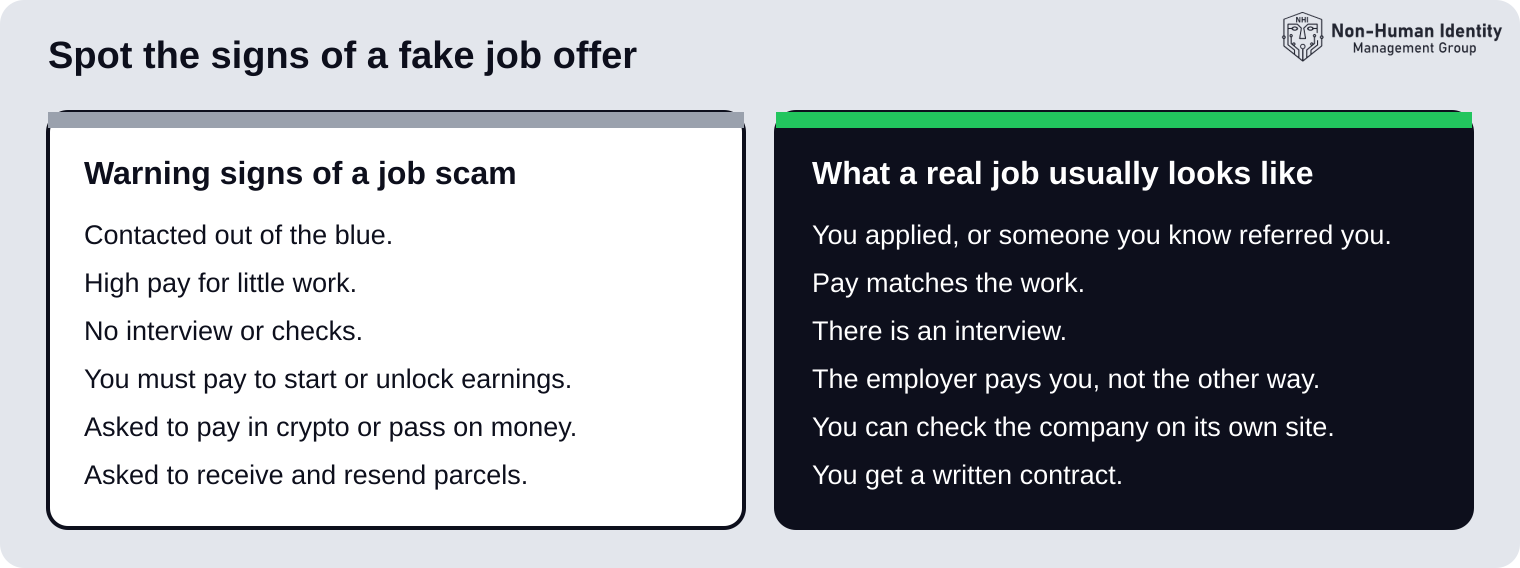
- A message out of the blue from a number you do not know.
- A friendly name and a recruiting firm you never applied to.
- Very high pay for very little work.
- No interview and no checks. Real employers usually want to know who they are hiring.
- A push to move to a chat app or a link. In a real message, this would lead to a "trainer" and a fake earnings app.
Why this is risky: each line is built to make the job feel easy and urgent, so you do not stop to check.
The safer way: do not click the link or reply. Look up the company yourself and ask it directly whether the job is real.
How does it work?
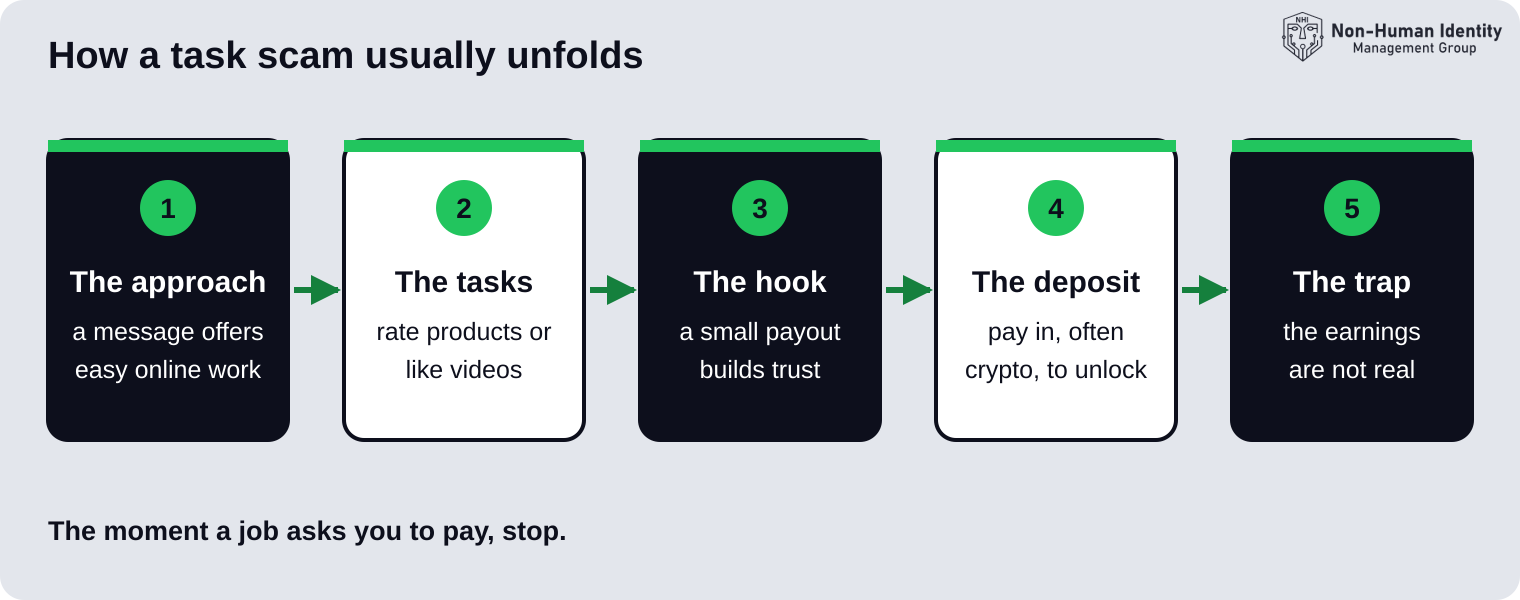
This is a simple view of a task scam so you can spot it. It is not a guide to running one.
- The approach. A text or chat message offers easy online work, with few details.[2] Some scammers pose as staffing or recruiting firms.[3]
- The tasks. You are set simple jobs, such as liking videos or rating product pictures, inside an app that shows your pay rising.[2]
- The hook. A small first payout builds your trust.[2]
- The deposit. You are told to pay in, often in cryptocurrency, to unlock your earnings or reach the next level.[2][3]
- The trap. The earnings on screen are not real, and you cannot take them out. Each new deposit is usually lost.[2][3]
Scammers may also add you to a group chat where other "workers" post their big earnings. These posts are made up to keep you paying.[2]
A worked example
This story is made up to show how it can happen.
Pavel Rasmussen has just finished college in Denver. He is applying for jobs and is keen for some income in the meantime.
One evening a message arrives from a number he does not know. A recruiter called "Jade" says his CV was recommended. The job is rating hotels in an app for half an hour a day. The pay sounds great, and there is no interview.
Pavel signs up. The "trainer" walks him through the tasks, and after two days a small payment lands in his account. He is pleased. He is added to a group chat full of people sharing screenshots of big earnings.
On day four the app says his account is "negative". To clear it and unlock his pay, he must deposit money in cryptocurrency. The trainer says this is normal and he will get it all back.
Pavel pauses. He remembers a line from a careers talk: a real employer pays you, not the other way round. He searches for the recruiting firm's name. He finds no website, only warnings from other job seekers.
He stops replying and blocks the number. He has not sent any money, but he did share his bank details for the first payout. So he calls his bank on the number on his card and tells them what happened. The bank adds extra checks to his account.
Then he reports the scam to the FTC.[1]
What made the difference: Pavel treated the first request to pay as the end of the job, not a step in it.
Myths and mistakes
| What people think | What is true |
|---|---|
| It paid me at first, so it must be real. | Small early payouts are part of the trick. They build trust before the deposit demand.[2] |
| Paying a fee to start a job is normal. | The FTC says honest employers will not ask you to pay to get a job.[1] |
| If I deposit once more, I can take my earnings out. | The earnings on screen are not real. More deposits are usually lost too.[2] |
| Banking a cheque and sending some back is harmless. | The cheque can bounce, and you may owe the bank the full amount.[1] |
| Someone who offers to get my lost money back is helping. | Recovery offers can be a second scam. The FBI warns not to pay them.[3] |
What can I do this week?
- Decide on one rule and stick to it: you never pay to get or keep a job.
- For any offer you did not apply for, look up the company yourself and contact it through its own website.
- Keep your bank details and ID back until you have a written offer you have checked.
- Save your bank's fraud number somewhere you can find it fast.
- Tell friends or family who are job hunting about task scams.
Checklist
- I applied for this job, or someone I know referred me.
- I have found the company's website and contact details myself.
- There was a real interview and a written offer.
- Nobody has asked me to pay, top up, or buy kit.
- Nobody has asked me to pass on money or resend parcels.
- I have not shared my bank login, codes or ID documents before checking.
- I know how to report a job scam where I live.
Common questions
How can I tell if a recruiter is real?
Check them yourself. Find the company's own website, not a link from the message, and contact it to confirm the job and the recruiter's name. Be wary of offers out of the blue, no interview, and moves to private chat apps. A real recruiter will not ask you to pay.
What is a task scam?
A task scam is a fake job where you do simple online tasks, like rating products, in an app that shows your pay growing. After small early payouts, you are told to deposit money, often crypto, to unlock earnings. The earnings are not real.
I have already paid. What should I do?
Contact your bank or the company you used to send the money straight away and ask if the payment can be stopped or reversed. Stop contact with the scammer. Then report it. Be wary of anyone who later offers to recover your money for a fee.
Where do I report a job scam?
In the US, report it to the FTC at ReportFraud.ftc.gov. In England, Wales and Northern Ireland, report it to Report Fraud; in Scotland, contact Police Scotland. Tell your bank too, especially if you shared account details.[1][4]
Why do job scammers want my personal details?
Your name, address, bank details and ID can be used to open accounts or take out credit in your name. The FTC warns that handing these over for fake "payroll" can leave you with an identity theft problem.[1]
Where next?
Ready for the detail? Read the practitioner guide: Job and Task Scams Guide. It goes further into the main scam families, the money mule link, and how organisations can run awareness for staff and job seekers.
Also useful:
- Money Mules for Beginners
- Online Scams for Beginners
- Text Message Scams for Beginners
- Crypto Scams for Beginners
Related NHI Mgmt Group resources: Fake Recruiter Approaches Guide · Identity Theft for Beginners · Social Engineering for Beginners
Key terms
- Job scam
- A fake job offer used to take money or personal details from job seekers.
- Task scam
- A job scam where victims complete simple online tasks and are then told to pay deposits to unlock fake earnings.
- Money mule
- Someone whose bank account is used to receive and pass on money from crime, sometimes without knowing it.
- Advance-fee fraud
- A scam that asks you to pay something up front in return for money or a reward that never arrives.
- Identity theft
- When someone uses your personal details to pretend to be you, often to get money or credit.
- Tricking people into handing over information or money by playing on trust, hope or urgency.
Sources and further reading
- Job Scams. Federal Trade Commission (FTC), Consumer Advice. https://consumer.ftc.gov/articles/job-scams, accessed 28 Nov 2026.
- Paying to get paid: gamified job scams drive record losses (Data Spotlight). Federal Trade Commission (FTC), 12 December 2024. https://www.ftc.gov/news-events/data-visualizations/data-spotlight/2024/12/paying-get-paid-gamified-job-scams-drive-record-losses, accessed 28 Nov 2026.
- Scammers Defraud Individuals via Work-From-Home Scams (Alert I-060424-PSA). Federal Bureau of Investigation, Internet Crime Complaint Center (IC3), 4 June 2024. https://www.ic3.gov/PSA/2024/PSA240604, accessed 28 Nov 2026.
- Report Fraud service goes live. Report Fraud (City of London Police), 4 December 2025. https://www.reportfraud.police.uk/news/report-fraud-service-goes-live/, accessed 28 Nov 2026.