A money mule is someone who moves stolen money through their own bank account for criminals.
This guide is for anyone who has been offered easy money for "receiving a payment", and for friends and family who want to spot the signs. Saying yes once can lead to a criminal record, so it is worth knowing the pattern before anyone asks.
In short
- Criminals pay people to let stolen money pass through their bank accounts. This hides where the money came from.
- Offers often look like easy jobs, friendly favours or a new online friend asking for help.
- Moving the money is a crime, even if you did not know where it came from.
- If you are asked, say no. If you already said yes, stop, tell your bank and report it.
What you will learn
- Explain what a money mule is in one sentence.
- Spot the offers criminals use to draw people in.
- Check what to do if someone asks to use your account.
- Know where to report it and get help.
- Cleaning dirty money (money laundering)
- hiding where stolen money came from so criminals can spend it.
- Middle person (money mule)
- someone whose account is used to pass stolen money along.
What is a money mule?
Imagine a stranger at an airport asks you to carry a bag through security for them. You do not know what is inside. If something illegal is found, you are the one holding it.
A money mule does the same thing with money. Stolen money lands in their bank account. They send it on, or take it out as cash, and often keep a small cut.[1]
Criminals use mules because stolen money is easy to trace. Each extra account makes the trail harder to follow. This hiding of where money came from is called money laundering, and muling is one kind of it.[3]
The money often comes from scams on other people. Think of a pensioner tricked into paying a fake builder, or a shop that paid a fake invoice.[3]
Where the comparison stops working: at the airport you might be asked once. Mule recruiters often come back again and again, and it can be hard to stop once you have started.[4]
Why does it matter?
Many people do not know muling is a crime. In one UK survey, over a third of 16 to 24 year olds did not realise it was illegal.[1]
If you are a student or young adult
What could happen: a "quick job" ends with your account closed and a police interview.
Check this: no real job asks you to receive and pass on money through your own account.
Next: Job Scams for Beginners
If a friend asks to borrow your bank card
What could happen: a "small favour" puts stolen money through your account, with your name on every payment.
Check this: say no, even to friends. Your card, PIN and login are for you alone.
If you met someone online
What could happen: a new partner asks you to receive money for them, and it turns out to be stolen.
Check this: be wary if someone you have never met asks to use your account.
What does it look like?
Example only. All values are made up.
FakeJobs DM from "Payments Team":           (1)
  Work from home! Earn EXAMPLE pay weekly.
  No experience needed.                       (2)
  We send money to your account, you
  forward it to our partner and keep 10%.     (3)
  Just send your card number, PIN and
  online banking login to EXAMPLE-0000.      (4)
  Reply fast, only 3 places left!             (5)
- A message from a stranger, on social media or a chat app.
- Big pay for no skills. That is a common warning sign.
- The "job" is to move money through your account. In a real message, this line is the part that makes it a crime.
- No real employer needs your PIN or banking login.
- Pressure to decide fast, so you do not stop and think.
Why this is risky: the money you would receive is likely stolen from a scam victim. Your name and account are on every payment.
The safer way: do not reply or share any details. Report the message on the platform, and tell your bank if you already shared anything.
How does it work?
This is a simple view so you can spot it. It is not a guide to doing it.
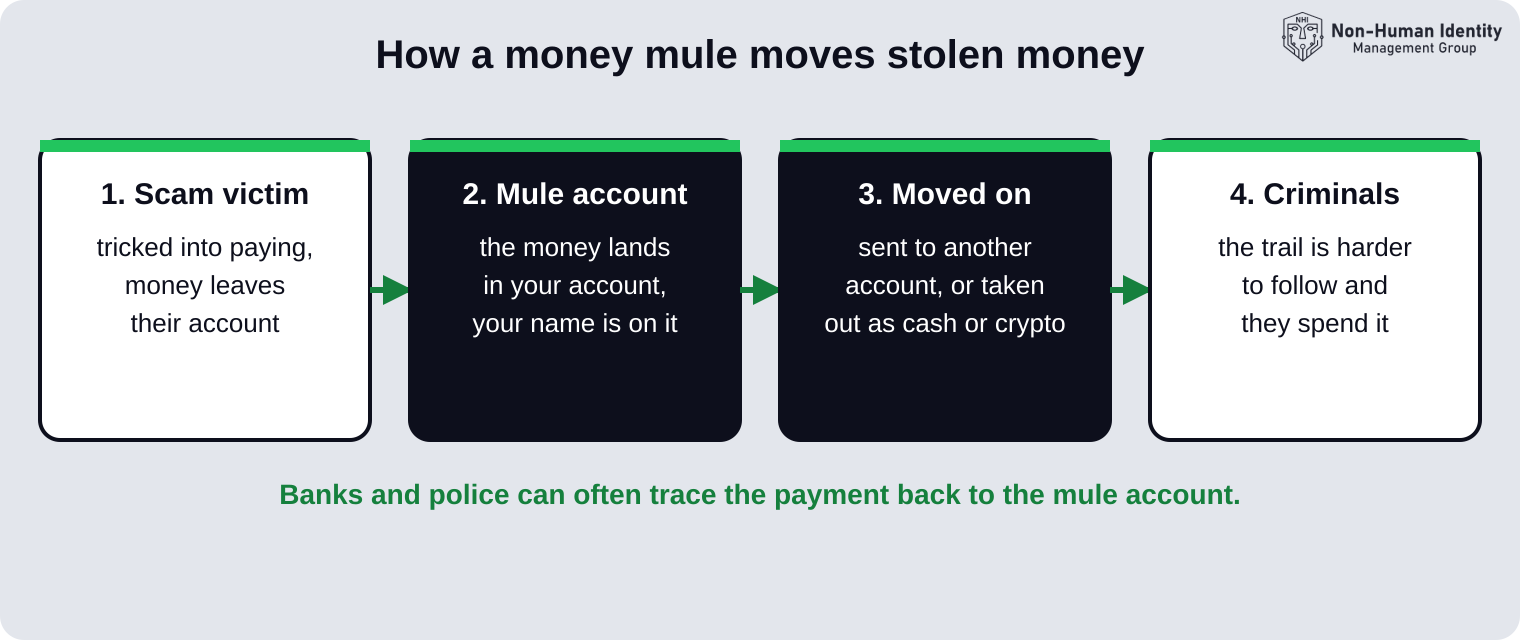
- A scam takes money. Criminals trick someone into paying, or steal from their account.
- A mule is found. Recruiters offer jobs, favours or romance online or in person, often through social media.[1][2]
- Money passes through. The stolen money lands in the mule's account.
- The mule moves it on. They send it to another account, buy crypto, or hand over cash.[1]
- The trail goes cold. The money moves through more accounts. The mule's name stays on the record.
It is common. In 2022, UK banks found over 39,000 accounts behaving like mule accounts.[1]
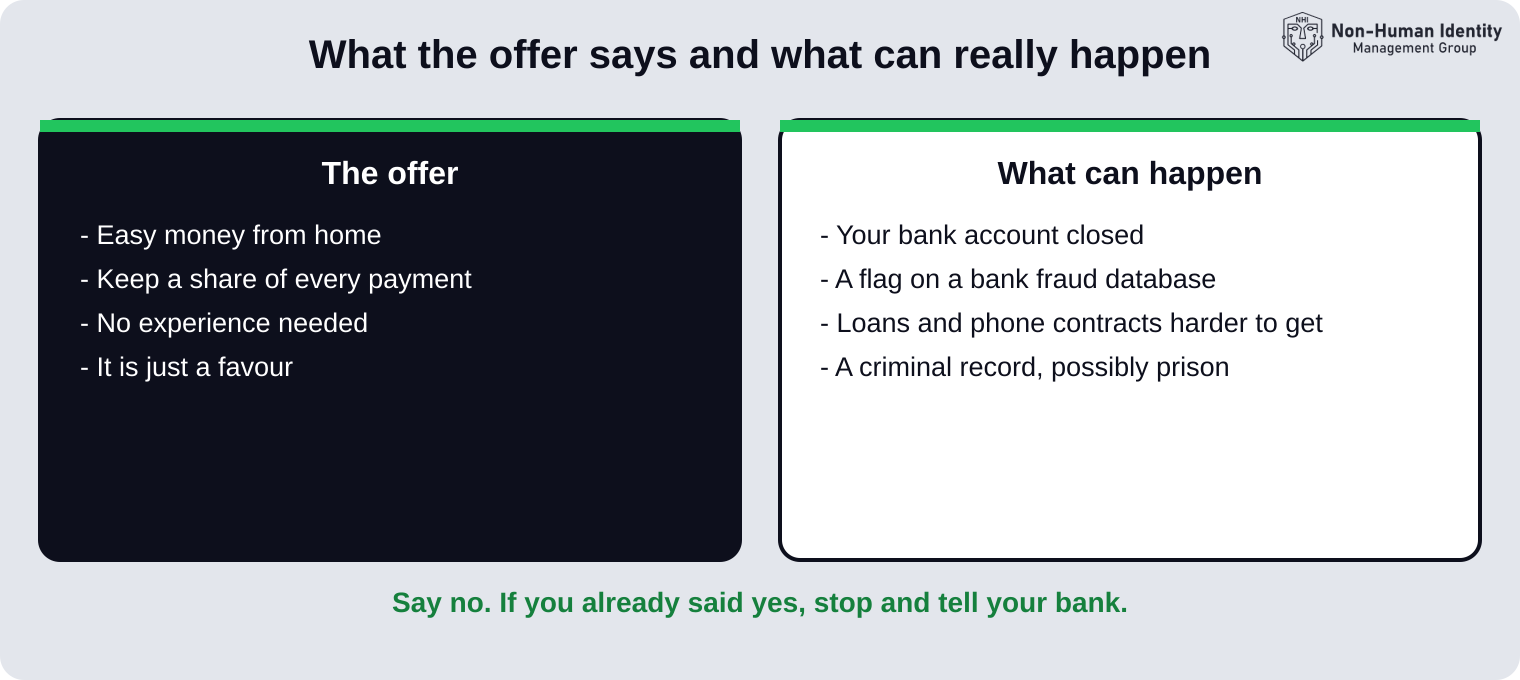
The cost to the mule can be high. In the UK, money laundering can mean up to 14 years in prison. Banks may close your accounts and flag you on a shared database, which can make loans and new accounts hard to get.[1]
A worked example
This story is made up to show how it can happen.
Callum Reid is 19 and studies in Glasgow. Money is tight, so he follows a few "side hustle" accounts on social media.
One day a friendly account sends him a message. It offers a weekly fee to "help process payments" for an online shop. All he needs to do is receive money and send it on. He can keep a share.
It sounds easy. Callum gives his account details. Two days later, a large payment arrives from someone he has never heard of. The account asks him to send most of it to another account straight away.
Something feels wrong. Why would a real shop need a student's bank account? He searches online and finds his bank's page on money mules. It describes his "job" almost word for word.
Callum does not send the money. He calls his bank on the number from its app and explains what happened. The bank freezes the payment and tells him the money came from a scam victim.
The bank asks him to report it. He contacts Police Scotland, because he lives in Scotland. He gives them the messages and the account names. He also changes his online banking password and blocks the account.
Callum was lucky. He stopped before the money moved on, and he told the bank himself. Not everyone who says yes gets that chance.
What made the difference: Callum asked one simple question. Why would a real job need my bank account?
Myths and mistakes
| What people think | What is true |
|---|---|
| If I did not know the money was stolen, I am not in trouble. | Acting as a mule can be punished even if you did not know it was a crime.[2] Telling your bank early helps. |
| It is a real job if they send a contract. | Fake firms send fake contracts. No real job pays you to move money through your own account. |
| Lending my bank card to a friend is just a favour. | If stolen money goes through it, your name is on it. Never share your card, PIN or banking login.[4] |
| Only people who are short of money get asked. | Recruiters target many kinds of people, often through jobs, favours or romance online.[1][2] |
| Once I start, I have to keep going. | You can stop. Tell your bank and the police. Help is there even if you feel scared. |
What can I do this week?
- Learn the warning signs: easy money, "receive and send on", and requests for your card or login.
- Talk to a friend or family member about money muling. Ask if they have seen offers like this.
- Check your bank's app or website for its fraud help page, so you know where to go.
- Keep your card, PIN and passwords to yourself, even with friends.
Checklist
- I know that moving money for someone else can be a crime.
- I would never accept a job that uses my own bank account to pass on money.
- I never share my card, PIN, passcodes or banking login.
- I would never open a bank account in my name for someone else.
- I know to call my bank on the number from its app, card or website if something feels wrong.
- I know where to report it: Report Fraud in England, Wales and Northern Ireland, or Police Scotland in Scotland.
Common questions
What should I do if I already moved money for someone?
Stop now and do not move any more. Call your bank on the number from its app or card and explain. Then report it to the police. Keep the messages as evidence. Acting quickly and being honest is the best way to limit the harm.
Can I really go to prison for being a money mule?
Yes, it is possible. In the UK, money laundering can carry up to 14 years in prison or an unlimited fine. Even without a prison sentence, you could lose your bank account and find credit hard to get.[1]
Where do I report a money mule offer?
In England, Wales or Northern Ireland, use Report Fraud. In Scotland, contact Police Scotland. In the US, report to the FBI's Internet Crime Complaint Center. You can also tell the platform where you saw the offer.[2][5]
Can I report it without giving my name?
Yes. In the UK, the charity Crimestoppers lets you pass on information without giving your name. The UK banks' Don't Be Fooled campaign points to it for anyone worried about themselves or someone close to them.[4]
Is buying crypto or handing over cash for someone also muling?
Yes, it can be. Muling is about moving criminal money, not just bank transfers. UK guidance says mules may move money through crypto or by taking out cash and handing it over.[1]
Where next?
Ready for the detail? Read the practitioner guide: Money Mule Detection Guide. It goes further into mule account types, the signals banks watch for, and how firms report and close mule accounts.
Also useful:
- Job Scams for Beginners
- Online Scams for Beginners
- Romance and Investment Scams for Beginners
- Identity Theft for Beginners
Related NHI Mgmt Group resources: Authorised Push Payment (APP) Fraud Guide · Social Engineering for Beginners
Key terms
- Money mule
- Someone who receives stolen money into their account and moves it on for criminals.
- Money laundering
- Hiding where criminal money came from so it looks like it was earned honestly.
- A scam where someone is tricked into sending money themselves, often to a mule account.
- Tricking people into doing something, rather than breaking technology.
- Romance scam
- A scam where someone fakes a relationship online to get money or help from you.
Sources and further reading
- Money mule and financial exploitation action plan. Home Office, GOV.UK, 1 March 2024 (cites NCA, Cifas Fraudscape 2023 and a Cifas and Opinion Matters survey of August 2022). https://www.gov.uk/government/publications/money-mule-action-plan/money-mule-and-financial-exploitation-action-plan-accessible, accessed 28 Nov 2026.
- Money Mules. Federal Bureau of Investigation (FBI), Scams and Safety. https://www.fbi.gov/how-we-can-help-you/scams-and-safety/common-frauds-and-scams/money-mules, accessed 28 Nov 2026.
- Money Muling. Europol, public awareness and prevention guides. https://www.europol.europa.eu/operations-services-and-innovation/public-awareness-and-prevention-guides/money-muling, accessed 28 Nov 2026.
- Don't Be Fooled: don't become a money mule. UK Finance and Cifas campaign. https://www.dontbefooled.org.uk/, accessed 28 Nov 2026.
- Report Fraud service goes live. Report Fraud (City of London Police), 4 December 2025. https://www.reportfraud.police.uk/news/report-fraud-service-goes-live/, accessed 27 Nov 2026.