Email marketing rules say when a business may send you adverts by email, text or phone.
This guide is for small business owners, marketers and anyone who sends newsletters or offers. If your business emails or texts customers to sell something, these rules apply to you, whatever tool you use.
In short
- In the UK and EU, marketing emails and texts to people generally need their clear yes first.
- One exception, the "soft opt-in", lets you email your own customers about similar products, if they could opt out.
- Every message must say who it is from and give a free, easy way to stop.
- Phone calls have their own rules, including checking "do not call" lists in the UK.
What you will learn
- Explain when you need consent to send a marketing email or text.
- Check whether the soft opt-in covers your customers.
- Spot a message that breaks the rules.
- Ask the right questions before you buy or share a mailing list.
Status: correct as at 28 November 2026, based on guidance from the UK data protection regulator and the EU ePrivacy Directive on EUR-Lex. Laws change; check the official text.
This guide explains the topic in general terms and is not legal advice.
- Adverts sent to you (direct marketing)
- advertising or promotion aimed at a named person, by email, text, call or post.
- A clear yes (consent)
- a person's own active choice to receive your messages, such as ticking an empty box.
- The UK rules (PECR)
- the Privacy and Electronic Communications Regulations, which cover marketing by email, text and phone.
What are email marketing rules?
Think of a shop that offers to post you its catalogue. You fill in a card at the till and tick "yes please". The shop posts catalogues only to people who filled in a card, and stops when someone asks.
Email marketing rules work the same way. In the UK they are called the Privacy and Electronic Communications Regulations, or PECR. Across the EU, the same ideas come from the ePrivacy Directive, which each country puts into its own law.[4] They sit alongside data protection laws such as the GDPR.
The rules cover more than email. Texts, picture messages, voicemail, in-app messages and social media direct messages all count. Banner adverts on websites do not.[2]
Where the comparison stops working: posting a catalogue costs money, so shops are careful who they send to. An email costs almost nothing, so it is easy to send thousands to people who never asked.
Why does it matter?
Unwanted adverts annoy customers. They can also lead to complaints to the regulator. In the UK, the regulator can now fine firms far more for breaking them than it could before 2026.[5]
If you run a small shop or online store
What could happen: you add every buyer to a newsletter without offering a way to say no at checkout.
Check this: your checkout offers a simple opt-out when people give their email.
If you are new to marketing
What could happen: you buy a contact list, and the people on it never agreed to hear from you.
Check this: any consent on a list names your business and the channel you will use.
If you run a charity
What could happen: you email past donors about another group's appeal, which the charity soft opt-in does not cover.
Check this: messages promote only your own charitable purposes.
What does it look like?
Here is a made-up sign-up form and the email that follows it.
Example only. All values are made up.
CHECKOUT  -  EXAMPLE Candle Co
Email: [email protected]
[ ] Email me offers on candles and gifts       (1)
[ ] Text me offers                             (2)

From: EXAMPLE Candle Co  <[email protected]>   (3)
Subject: 20% off winter candles
...
Do not want these emails? Unsubscribe          (4)
- The box starts empty, so ticking it is a clear yes.
- Email and text get separate boxes, because consent is asked per channel.
- The sender's name is shown, not hidden.
- A one-click unsubscribe, with no need to log in.
Why this is risky: many forms tick the box for you, or bundle email, text and calls into one box. A pre-ticked box does not count as consent.[1]
The safer way: empty boxes, one per channel, your business name in the wording, and a record of who said yes and when.[1]
How does it work?
Before a marketing email or text goes out, the UK rules ask a few questions.[1]
- Did they ask for this message? If someone asked for a specific message, such as a brochure, you may send it.[2]
- Is it to a person or a company? The strict rules protect individuals. Sole traders and ordinary partnerships count as individuals. Emails to a company address follow lighter rules, but you must still name yourself and offer an opt-out.
- Did they give clear consent? It must be an active choice, name your business and cover this channel. People can withdraw it at any time.
- If not, does the soft opt-in apply? All five conditions must be met. You got their details yourself. You got them during a sale or talks about a sale. You market only your own similar products. You offered an opt-out at the time. You offer one in every message.
- Every message: say who you are, give a valid contact address and offer a simple, free opt-out. Act on opt-outs promptly.
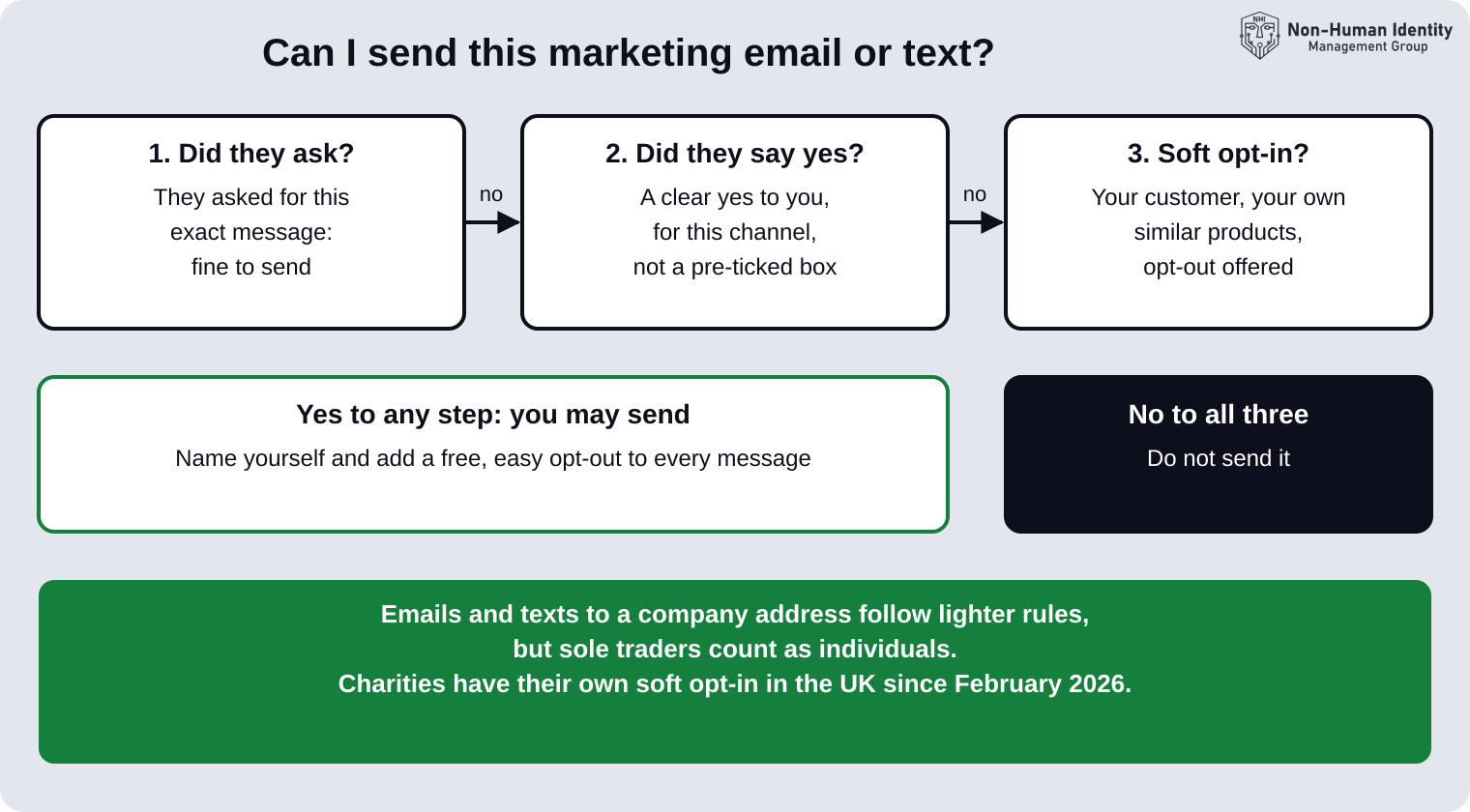
Since 5 February 2026, UK charities have a soft opt-in of their own. It covers people who donated, volunteered or showed interest, for contact details collected on or after that date. The messages must promote only the charity's own purposes.[1]
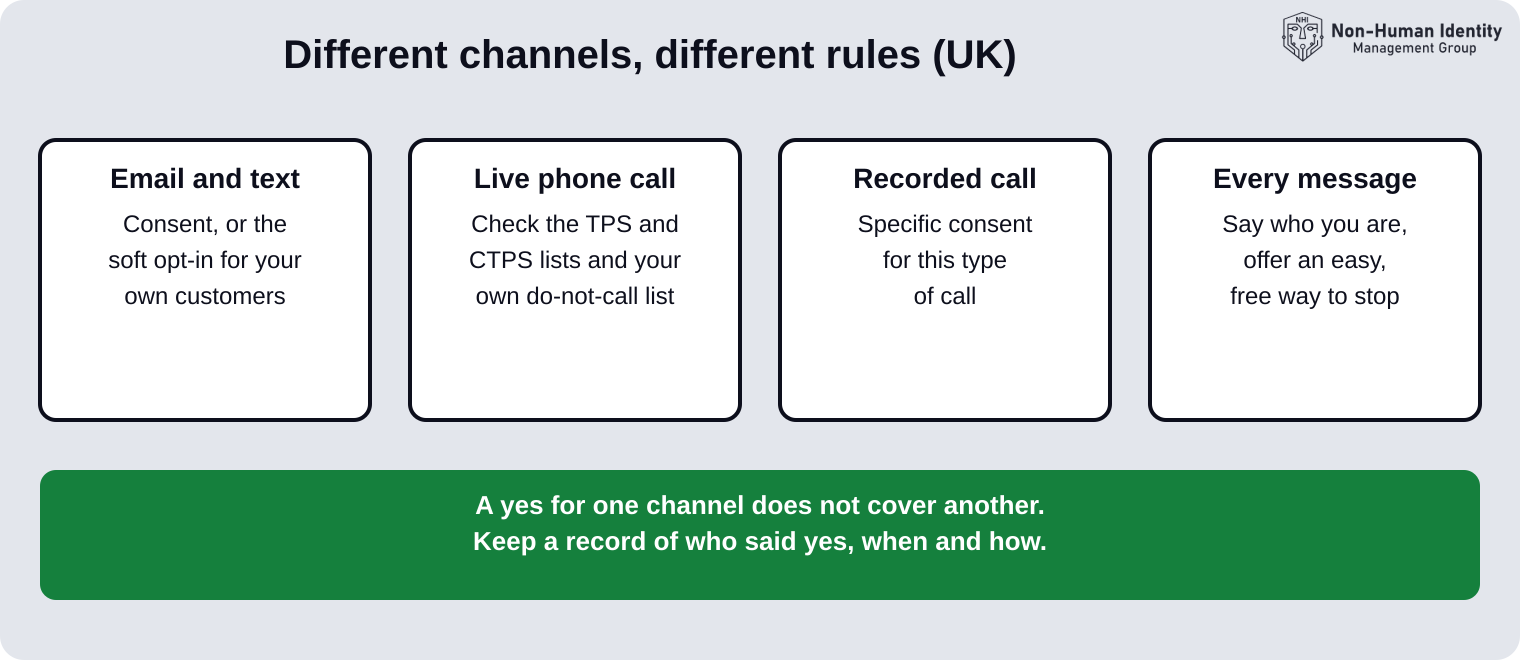
Phone calls work differently in the UK. Live sales calls must not go to numbers on the Telephone Preference Service (TPS) or Corporate TPS lists, unless that person has specifically agreed. Recorded sales calls need specific consent for that type of call.[3]
In the EU, the directive sets the same core ideas. Emails need prior consent, with an exception for existing customers and similar products. Hiding the sender is banned. Each country sets some details itself, so check the local regulator.[4]
A worked example
Juno Yilmaz runs a small online candle shop from her kitchen. Her friend Ivo Ulrich, a freelance marketer, offers to help with a winter sale.
Ivo opens her customer list. It has 900 emails. About 600 came from online orders. The rest came from a craft fair, where people dropped business cards in a bowl to win a prize.
Juno remembers the catalogue card. Who actually asked to hear from her?
For the 600 buyers, Ivo checks the checkout. It had a box saying "Tick here if you do not want offers", which gave people a simple way to say no. They bought candles, and the sale is for candles. So the soft opt-in covers them, as long as each email has an unsubscribe link.
The prize draw is different. Nobody bought anything, and nobody was told about offers. So the soft opt-in does not apply, and there was no clear consent. Ivo sets those 300 aside.
He also spots twelve people who unsubscribed last year but were added back by mistake. He moves them to a "do not contact" list, so they are not emailed again.
The sale email goes to the buyers, with Juno's shop name and a one-click unsubscribe. Next time she runs a prize draw, she adds an optional, empty box asking if people want her emails.
Myths and mistakes
| What people think | What is true |
|---|---|
| A bought list is fine if the seller says it has consent. | Consent must name your business and the channel. The soft opt-in cannot be used for bought lists.[1] |
| A pre-ticked box counts as a yes. | It does not. Consent needs an active choice.[1] |
| Business-to-business email has no rules. | Sole traders count as individuals, and every message must name you and offer an opt-out.[1] |
| Anyone who visited our website can be emailed. | Browsing is not enough for the soft opt-in. It needs a sale or talks about one.[1] |
| A message with a small advert is still a service email. | Adding marketing material makes it direct marketing.[2] |
What can I do this week?
- Check your sign-up and checkout forms for pre-ticked boxes.
- Split your list by where each contact came from.
- Test the unsubscribe link in your latest email.
- Start a "do not contact" list and check it before each send.
- If you make sales calls, check your call list against the TPS and CTPS.
Checklist
- Consent boxes start empty and name our business.
- Each channel (email, text, calls) has its own choice.
- We keep a record of who said yes, when and how.
- Soft opt-in is used only for our own customers and similar products.
- Every message names us and has a free, easy opt-out.
- Opt-outs are acted on promptly and kept on a suppression list.
- We do not use bought lists without consent that names us.
- Call lists are checked against TPS, CTPS and our own list.
Common questions
What is the soft opt-in?
It is a UK exception that lets you email or text your own customers about similar products without asking first. You must have got their details yourself during a sale or talks about one. You must also have offered an opt-out then, and in every message since.
Do I need consent to email business contacts?
Not always. In the UK, emails to company addresses do not need consent or the soft opt-in. But sole traders and some partnerships count as individuals, so they do. Every message must still name you and offer an opt-out.
Is an order confirmation email marketing?
No, not if it only gives order details and promotes nothing. The UK regulator calls this a service message. Add an advert or offer to it, though, and it becomes direct marketing, so the marketing rules apply.
Does PECR apply to texts and app messages?
Yes, texts are covered, and so are in-app messages and social media direct messages. The UK regulator treats them as electronic mail. Banner adverts and social media feed adverts are not covered by these rules, though other rules may apply.
Are the EU rules the same as the UK rules?
Mostly, at heart. Both need prior consent for marketing emails, with an exception for existing customers. But each EU country writes its own law, and the UK has made its own changes since 2025, such as the charity soft opt-in.
Where next?
Ready for the detail? Read the practitioner guide: PECR Guide. It goes further into the 2025 and 2026 changes, cookie rules, breach reporting for telecoms firms and who is liable when others send messages for you.
Also useful:
- Lawful Basis for Processing for Beginners
- Email Deliverability for Beginners
- Business Text Messaging for Beginners
- Cookie Consent Banners for Beginners
- Consent vs Legitimate Interest
Related NHI Mgmt Group resources: UK GDPR for Beginners · Consent Management Guide: Cookies, CMPs and GPC · Privacy Notices for Beginners
Key terms
- PECR
- The UK rules on marketing by email, text and phone, and on cookies.
- Direct marketing
- Advertising or promotion aimed at a particular person.
- Consent
- A clear, active yes to a specific use, which the person can withdraw.
- Soft opt-in
- A UK exception for marketing your own similar products to existing customers who could opt out.
- Unsubscribe mechanism
- The free, simple way in each message for people to stop receiving it.
- Spam
- Unwanted bulk messages, often sent without the person's agreement.
Sources and further reading
- How do we comply with the PECR electronic mail marketing rules? Information Commissioner's Office, 2026. https://ico.org.uk/for-organisations/direct-marketing-and-privacy-and-electronic-communications/guidance-on-direct-marketing-using-electronic-mail/how-do-we-comply-with-the-pecr-electronic-mail-marketing-rules/, accessed 28 Nov 2026.
- Key concepts for direct marketing using electronic mail. Information Commissioner's Office. https://ico.org.uk/for-organisations/direct-marketing-and-privacy-and-electronic-communications/guidance-on-direct-marketing-using-electronic-mail/key-concepts-for-direct-marketing-using-electronic-mail/, accessed 28 Nov 2026.
- Telephone marketing. Guide to PECR, Information Commissioner's Office (page under review after the Data (Use and Access) Act). https://ico.org.uk/for-organisations/direct-marketing-and-privacy-and-electronic-communications/guide-to-pecr/electronic-and-telephone-marketing/telephone-marketing/, accessed 28 Nov 2026.
- Directive 2002/58/EC on privacy and electronic communications (consolidated text, 19 December 2009), Article 13. EUR-Lex, Publications Office of the European Union. https://eur-lex.europa.eu/legal-content/EN/TXT/HTML/?uri=CELEX:02002L0058-20091219, accessed 28 Nov 2026.
- Statement on the commencement of the Data (Use and Access) Act. Information Commissioner's Office, 5 February 2026. https://ico.org.uk/about-the-ico/media-centre/news-and-blogs/2026/02/statement-on-the-commencement-of-the-data-use-and-access-act-duaa, accessed 28 Nov 2026.