Lazarus Group is a name for North Korean state-backed hackers known for spying, destruction and stealing money.
This guide is for anyone who has seen Lazarus in the news after a big crypto theft and wants to know who they are. You do not need to own cryptocurrency to be affected: the group often starts by tricking ordinary staff with fake job offers.
In short
- Lazarus Group is linked by the US government and researchers to North Korea's main intelligence agency.
- The name is often used as an umbrella for several North Korean teams, not one single gang.
- It is linked to the 2014 Sony Pictures attack, an $81 million bank theft in 2016 and the $1.5 billion Bybit theft in 2025.[2][5]
- It often starts with a fake recruiter, a fake job test or a fake app, so checking who you are talking to helps.
What you will learn
- Explain who Lazarus Group is and what it wants.
- Name three well-known attacks linked to the group.
- Spot a fake job offer or "coding test" used as bait.
- Check the simple steps that make your team a harder target.
- Government-backed hackers (state-backed group)
- attackers who work for, or on behalf of, a country's government.
- Digital money (cryptocurrency)
- money that exists only online and is held with secret keys.
- Tricking people (social engineering)
- getting someone to help an attacker by lying to them, not by breaking technology.
What is Lazarus Group?
Think of a heist crew in a film that is secretly working for a government. They plan for months, play fake roles to win trust, and then take the money in one night.
Lazarus Group is often described in a similar way. A free public knowledge base of attacker behaviour calls it a North Korean state-sponsored group. It links the group to North Korea's main foreign spy agency. It also says the group has been active since at least 2009.[1]
The name came from security researchers, not from the hackers.[2] Other companies use other names. Microsoft calls the group Diamond Sleet, and other names include Labyrinth Chollima and ZINC.[3] For how these names work, see Hacker Group Names for Beginners.
Where the comparison stops working: a film crew is one fixed team. "Lazarus" is often used as an umbrella for several North Korean teams that share people, tools and computers. That makes it hard to say which team did which attack.[1]
Why does it matter?
Lazarus is unusual. It is linked to a government, yet it steals money on a huge scale. It often starts by tricking one ordinary person.
If you work in tech and are job hunting
What could happen: a friendly "recruiter" sends a coding test. Running it on your work laptop installs harmful software.
Check this: never run a job test on a work device, and check the recruiter through a separate channel.
If you work at a crypto or finance firm
What could happen: one person's stolen access is used to move company funds. These can be hard to get back.
Check this: make sure large payments need approval from more than one person on separate devices.
If you run a software company
What could happen: the group breaks into your company to reach your customers.
Check this: keep developer access short and check who can change the code customers use.
What does it look like?
Here is a made-up message of the kind the FBI warns about. A fake recruiter builds trust, then sends a test to run.[4]
Example only. All values are made up.
From: Alex (Senior Recruiter, Example Talent FAKE)       (1)
Hi! Loved your profile. We have a remote lead role
paying very well, perfect for your skills.               (2)
Before the interview, please complete our short
coding test. Clone the project from
https://code.example.invalid/test-0000 and run it on
your usual work laptop so we see real speed.             (3)
Please finish within 24 hours.                           (4)
- A recruiter you have never met. The FBI says these personas may use stolen photos.
- Flattery and a job that seems tailored to you.
- In a real message, this line would ask you to run unknown code. That is the trap.
- Time pressure, so you skip the usual checks.
Why this is risky: running unknown code on a work device can hand the attacker your access, passwords and saved sessions.
The safer way: check the recruiter on a separate channel, such as a video call on a different app. Run any test only on a separate machine, never a work device, as the FBI advises.[4]
How does it work?
Here is the broad pattern US government warnings describe. It is a high-level view for defenders, not a how-to.
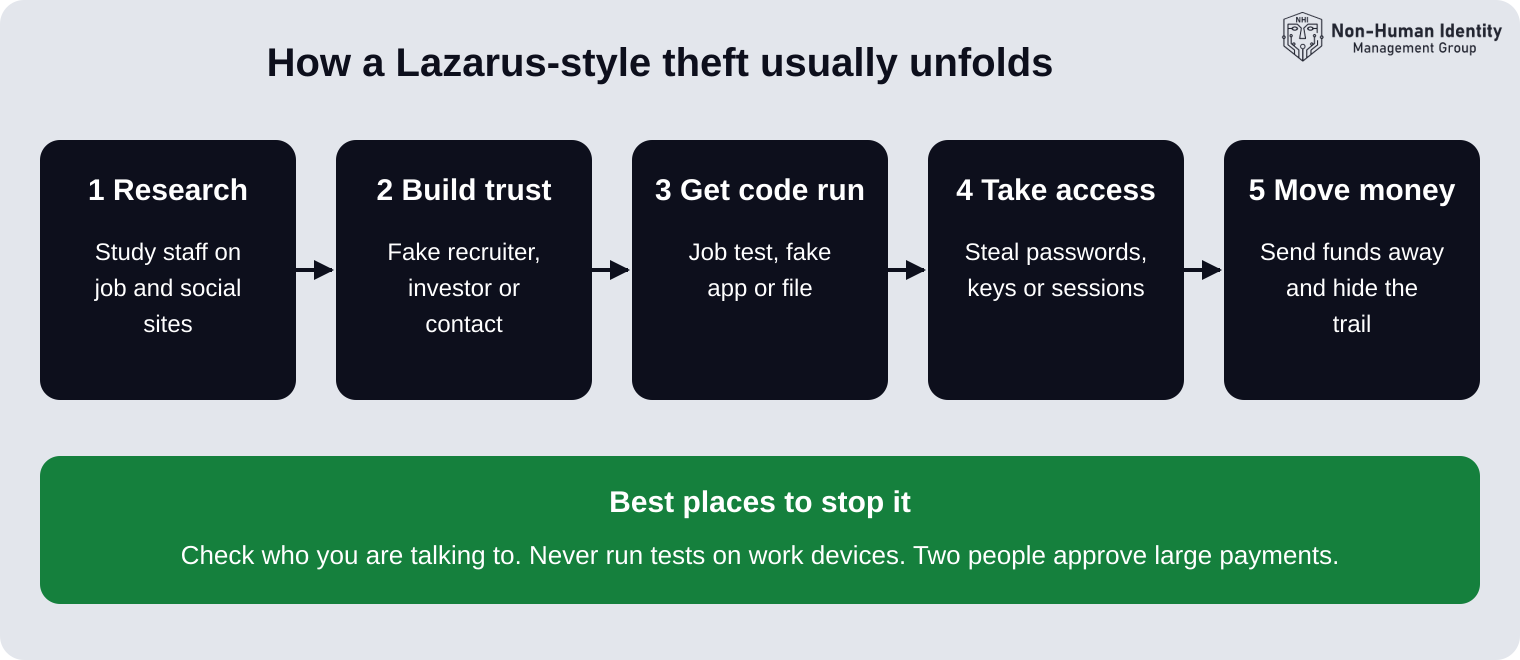
- Research. The group studies staff on job and social sites, often people at crypto and finance firms.[4]
- Build trust. It poses as a recruiter, an investor or a known contact, and chats for days or weeks.[4]
- Get code run. It sends a job test, a fake app or a file. Running it installs harmful software.
- Take access. The software steals passwords, keys or sessions, so the attacker can act as that person.
- Move the money. The group sends funds to its own accounts. It then launders them, which means moving money through many steps to hide where it came from.[5]
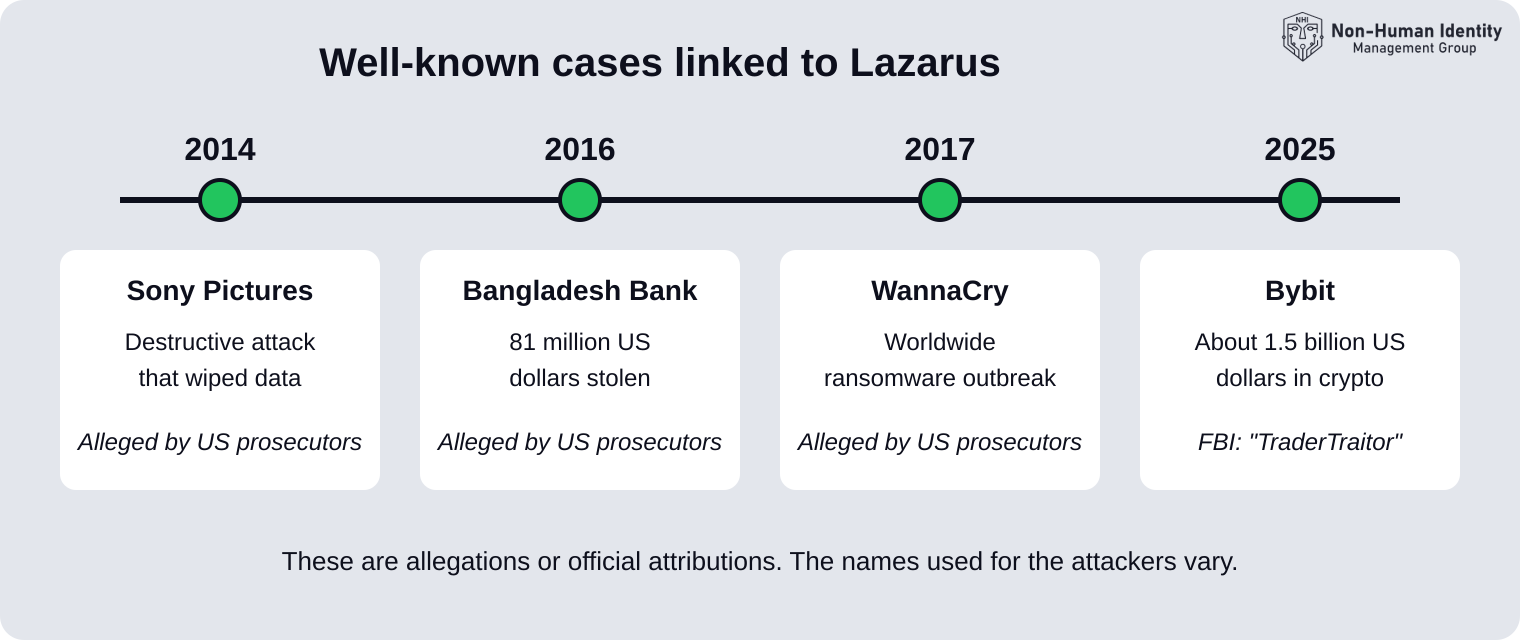
Three well-known cases show the range. US prosecutors allege the group was behind the 2014 attack on Sony Pictures, which destroyed data. They also link it to the theft of $81 million from Bangladesh Bank in 2016.[2] In 2025 the FBI blamed North Korean hackers it calls TraderTraitor for a huge theft. About $1.5 billion in digital money was taken from the exchange Bybit.[5]
A worked example
Bruno Delmar is a developer at Quayside Ledger, a fictional company that builds payment software for small crypto firms. One evening, a recruiter messages him on a job site. She praises his work and offers a remote role with a big salary.
Over two weeks they chat often. She seems to know his projects well. Then she sends a link to a coding test and asks him to run it on his work laptop, "so the speed numbers are fair".
Bruno thinks of the heist crew from a guide he read. The long, friendly build-up and the request to run code feel like a script.
He checks the recruiter's company website. It is only a few weeks old. He asks for a video call on a different app. She keeps finding reasons to delay.
Bruno does not run the test. He tells his security lead, who reports the profile to the job site and shares the warning with the team.
The security lead also checks a few things that same week. Developer access to the live systems now expires each day. Payments over a set amount need two people to approve on separate devices.
No harm was done in the records the team could check. Bruno later reads that a fake job test is a common Lazarus opening move, as the FBI describes.[4]
Myths and mistakes
| What people think | What is true |
|---|---|
| Government hackers only spy. | Lazarus is linked to spying, destruction and large thefts of money.[1] |
| They break in with clever technical tricks. | Many cases start by tricking a person with a fake job, app or contact.[4] |
| Lazarus is one fixed team. | The name is often used as an umbrella for several North Korean teams.[1] |
| Only crypto firms need to care. | Banks, film studios and software firms have also been targets.[2] |
| A job test from a recruiter is safe to run. | Run it only on a separate machine, never on a work device.[4] |
What can I do this week?
- Tell your team never to run job tests or unknown code on work devices.
- Check new contacts through a separate channel, such as a video call on another app.
- Ask who must approve large payments, and make sure it is more than one person.
- Check that developer access to live systems expires and is not shared.
- Keep wallet keys and recovery phrases off devices that are online every day.
Checklist
- Staff know that fake recruiters and job tests are a common trick.
- Unknown code is only run on separate test machines.
- New business contacts are checked through a second channel.
- Large payments need two people to approve, on separate devices.
- Access to live systems is short-lived and reviewed.
- Secret keys for funds are kept off everyday online devices.
- We know how to report a suspicious contact to the FBI or our national authority.
Common questions
Is Lazarus Group really North Korean?
The US government and major security companies link it to North Korea's intelligence services. US prosecutors charged a North Korean programmer in 2018 over attacks linked to the group.[2] Charges are allegations, and the person charged is presumed innocent unless proven guilty.
Why does a government steal money?
North Korea faces strict international sanctions, which limit how it can earn money abroad. Stolen digital money is one way round this. That helps explain why the group puts so much effort into crypto firms and their staff.
Was Lazarus behind WannaCry?
US prosecutors allege so. Their 2018 complaint links WannaCry, the 2017 worldwide ransomware outbreak, to the same group, based on shared code and computers.[2] See Ransomware for Beginners.
What is TraderTraitor?
TraderTraitor is the FBI's name for North Korean hackers it blamed for the Bybit theft.[5] Many reports treat it as part of the wider Lazarus umbrella. Different names often describe teams that overlap.
Can stolen crypto be recovered?
Sometimes some of it can. After the Bybit theft, the FBI asked exchanges and other firms to block transactions linked to the attackers' addresses.[5] Recovery is hard once funds are moved and mixed, so stopping the theft is far better.
Where next?
Ready for the detail? Read the practitioner guide: Lazarus Group Threat Actor Profile. It goes further into the group's aliases, the attack techniques US advisories record and the controls that protect developer access and fund movements.
Also useful:
- North Korea Cyber Operations Guide
- Multisig Wallets for Beginners
- Fake IT Workers for Beginners
- Contagious Interview Threat Actor Profile Guide
- Threat Actors for Beginners
Related NHI Mgmt Group resources: Kimsuky Threat Actor Profile · APT38 Threat Actor Profile Guide · Crypto Wallets and Keys for Beginners
Key terms
- Nation-state actor
- An attacker backed by or working for a government, usually after secrets, influence, money or long-term access.
- Advanced persistent threat (APT)
- A highly skilled attacker that tries to stay hidden for a long time while it steals data or builds access.
- Tricking people into giving access or information, rather than breaking the technology.
- Spear phishing
- A fake message written for one chosen person, using details about them to seem genuine.
- Cryptocurrency
- Digital money recorded on a shared online ledger and controlled with secret keys.
- Money laundering
- Moving stolen money through many steps to hide where it came from.
- Supply chain attack
- An attack on a supplier, used as a way into that supplier's customers.
Sources and further reading
- Lazarus Group (G0032). MITRE ATT&CK, version 20. https://attack.mitre.org/groups/G0032/, accessed 28 Nov 2026.
- North Korean regime-backed programmer charged with conspiracy to conduct multiple cyber attacks and intrusions. US Department of Justice, 6 September 2018. https://www.justice.gov/opa/pr/north-korean-regime-backed-programmer-charged-conspiracy-conduct-multiple-cyber-attacks-and, accessed 28 Nov 2026.
- How Microsoft names threat actors. Microsoft Learn, Microsoft, updated 12 November 2026. https://learn.microsoft.com/en-us/unified-secops/microsoft-threat-actor-naming, accessed 28 Nov 2026.
- North Korea aggressively targeting crypto industry with well-disguised social engineering attacks, Public Service Announcement I-090324-PSA. FBI Internet Crime Complaint Center, 3 September 2024. https://www.ic3.gov/PSA/2024/PSA240903, accessed 28 Nov 2026.
- North Korea responsible for $1.5 billion Bybit hack, Public Service Announcement I-022625-PSA. FBI Internet Crime Complaint Center, 26 February 2025. https://www.ic3.gov/PSA/2025/PSA250226, accessed 28 Nov 2026.