Nation-state hacking is cyber attacks carried out or backed by a government to gain secrets, money or power.
This guide is for anyone who has read about "state-backed hackers" or "cyber warfare" and wondered what it means for them. You do not need to work for a government to be affected: suppliers, councils and ordinary firms can be caught up too.
In short
- Some governments run or back hacking teams, often called APTs (advanced persistent threats).
- They mainly want secrets, money, influence, or a way to cause disruption later in a crisis.
- They are patient: some stay hidden inside networks for years.
- Most still get in through common gaps, so basic defences and national alerts help a lot.
What you will learn
- Explain what an APT is in one sentence.
- Name the main things state-backed hackers want.
- Spot how an ordinary organisation can get caught up.
- Check that your basic defences cover the common ways in.
- Government-backed attacker (nation-state actor)
- a hacking team that works for, or is backed by, a country's government.
- Patient, skilled attacker (APT)
- short for advanced persistent threat: a well-funded group that aims to stay hidden for a long time.
- Spying online (cyber espionage)
- quietly copying secret information from computers.
What is nation-state hacking?
Think of a country's spy service. Its agents are trained, well paid and patient. They may take a job inside a company and do nothing unusual for years, until they are asked to act.
Nation-state hacking is the online version. A government's own staff, or groups it backs, break into computers to collect secrets, make money, shape opinion or prepare to cause disruption. Security teams often call these groups APTs, short for advanced persistent threats.
"Advanced" means they have skill and money. "Persistent" means they keep trying and try to stay inside for a long time. Their aims can include spying, stealing data, and disrupting or destroying systems.[1]
Cyber warfare is the most serious end of this: using cyber attacks to cause damage as part of a conflict between countries.
Where the comparison stops working: a human spy can be in only one place. A state hacking team can work on many organisations at once, from another country, and is rarely caught in person.
Why does it matter?
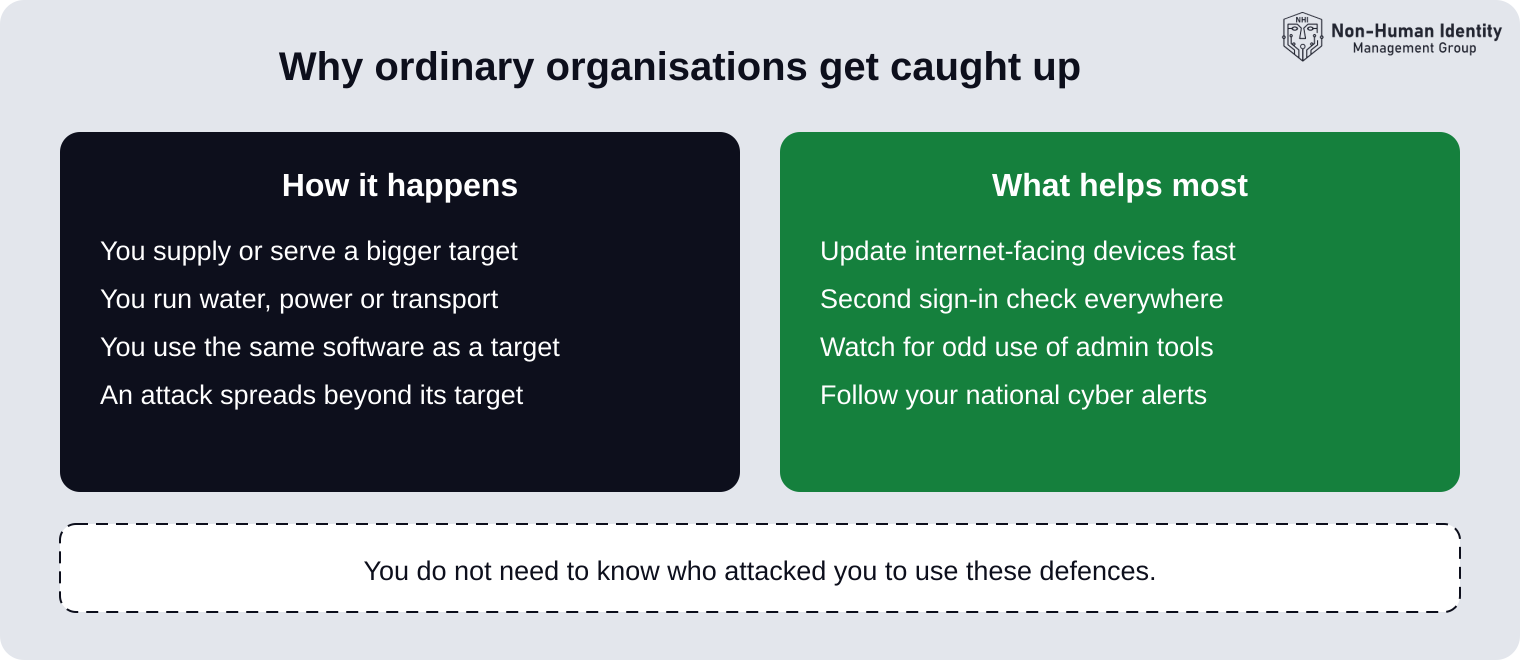
State-backed attacks are not only aimed at governments. They can hit suppliers, local services and firms with useful data or links to bigger targets.
If you are a member of the public
What could happen: the water, power or trains you rely on stop, or your data is taken in a wider breach.
Check this: keep your devices updated and use a second sign-in check on email. This helps against all kinds of attacker.
If you are a student
What could happen: you read scary headlines and think state hackers only use secret tools that nobody can stop.
Check this: read one government alert in full and note how the attackers got in.
If you are a manager
What could happen: your firm is used as a stepping stone to a bigger customer. Or it is hit by an attack aimed at someone else.
Check this: ask if your team reads your national cyber agency's alerts and acts on them.
What does it look like?
Most people meet nation-state hacking through a government alert. Here is a made-up summary card a team might write after reading one.
Example only. All values are made up.
ALERT SUMMARY (Example Ltd, FAKE data)
Who:      State-backed group "EXAMPLE PANDA-0000"         (1)
Wants:    long-term access to energy and water suppliers  (2)
Gets in:  old, unpatched internet-facing devices          (3)
Hides:    uses normal admin tools already on systems      (4)
Do we use the named device?  CHECK by Friday              (5)
- Groups get nicknames. In a real message, this line would show several names used by different companies.
- The goal tells you who is most at risk.
- Many alerts point to old or unpatched equipment rather than secret tools.
- Blending in with normal IT work makes these groups hard to spot.
- The most useful line: a clear action with a date.
Why this is risky: if alerts are filed and forgotten, a known way in stays open.
The safer way: turn each relevant alert into one or two checks with an owner and a deadline.
How does it work?
This is a high-level view for defenders. It does not describe how to attack anything.
- Goal. A government wants something: secrets, money, influence, or the ability to cause disruption later.
- Get in. The group looks for a way in, such as old equipment, stolen passwords or a trusted supplier.
- Stay hidden. It tries to look like normal IT work, sometimes for months or years.
- Act. It copies data, steals money, or in a crisis tries to disrupt or damage systems.
- Defend. Defenders update systems, watch for odd activity, follow alerts and report what they find.
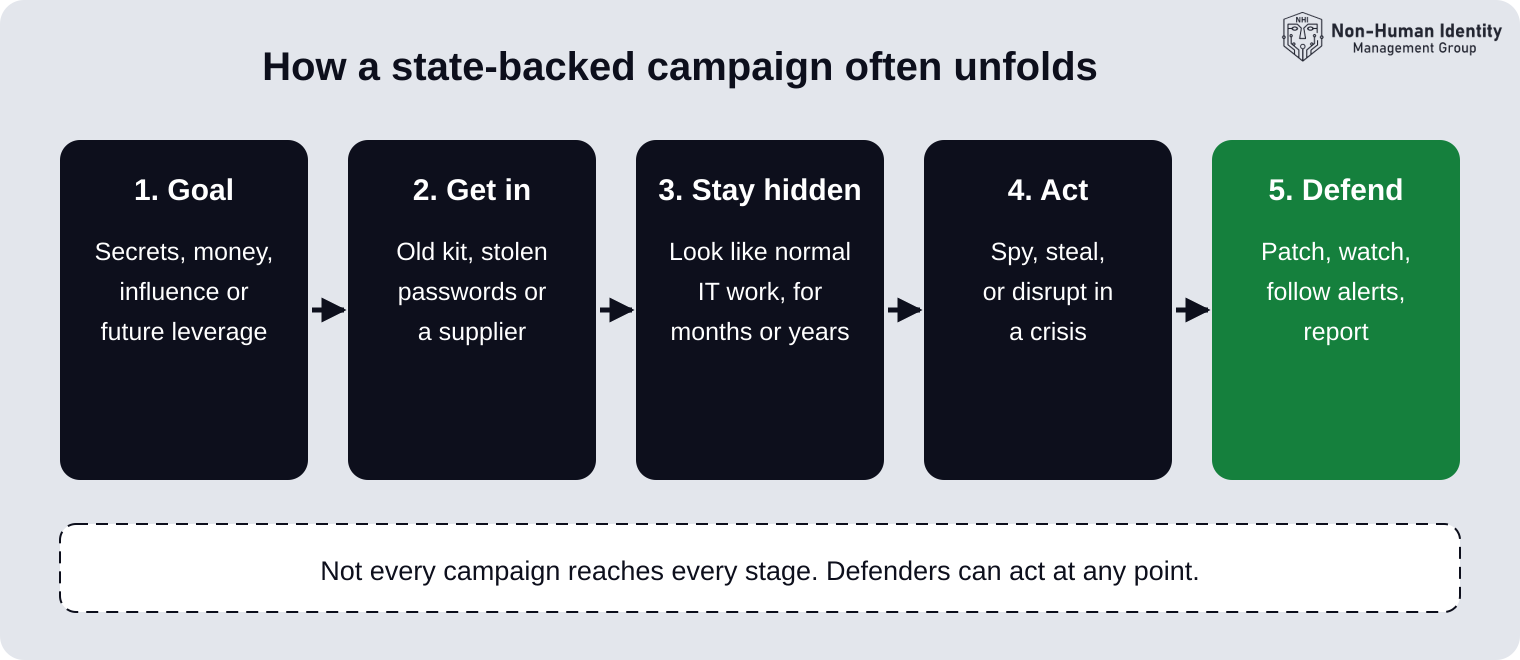
A joint advisory from US agencies and partners shows the "stay hidden" stage. It says a China state-sponsored group called Volt Typhoon got into networks in sectors such as communications, energy, transport and water.[2]
The agencies judged the group was preparing for disruptive attacks in a future crisis or conflict. They saw it keep access to some victims for at least five years.[2] This idea of getting in early and waiting is called pre-positioning. Canada's cyber centre also warns that state actors are very likely targeting critical infrastructure in this way.[4]
Ordinary firms can be hit even when they are not the target. The UK government said the Russian military was responsible for the 2017 NotPetya attack. It was aimed mainly at Ukraine, but it spread and disrupted organisations across Europe, costing hundreds of millions of pounds.[3]
A worked example
Milo Pajari runs IT for Fenwick Valves, a fictional firm of 120 staff that makes parts for water companies. One morning his manager, Zola Falk, forwards a news story. Government agencies have warned that a state-backed group is targeting water suppliers.
"We are not a water company," Zola says. "Does this matter to us?"
Milo thinks of the patient spy who takes a job and waits. A supplier with links into water companies could be a useful place to wait.
He reads the official advisory rather than just the news story. It lists the kinds of internet-facing equipment the group has used to get in. Fenwick uses one of them, a remote access box, and it is two updates behind.
Milo updates the box that afternoon. He checks its sign-in records. There are no unknown sign-ins in the records available to him, but the records only go back 30 days. He asks the supplier to keep them for longer.
He also turns on a second sign-in check for all remote access. He sets an alert for admin tools being used at odd hours.
Zola has one more question: who did it? Milo says that finding out who is behind an attack is a job for national agencies. Fenwick's job is to close the known way in and report anything suspicious.
They sign up to their national cyber agency's alerts and add a monthly ten-minute review to the team diary.
Myths and mistakes
| What people think | What is true |
|---|---|
| Nation-state hackers only go after governments. | They also target suppliers, infrastructure and firms that hold useful data or connect to bigger targets. |
| They always use secret, unstoppable tools. | Government alerts often describe old, unpatched equipment and stolen passwords as the way in. |
| If we are hacked by a state, there is nothing we could have done. | Basic defences such as updates, a second sign-in check and good monitoring make their job harder. |
| We must find out who attacked us. | Working out who is behind an attack is slow and specialist work. Contain, recover and report first. |
| Cyber warfare only happens during a declared war. | Agencies warn that some groups get into networks in peacetime, ready for a future crisis.[2] |
| Small firms cannot be harmed by an attack on another country. | Attacks can spread beyond their target, as NotPetya did across Europe.[3] |
What can I do this week?
- Sign up for your national cyber security agency's alerts.
- List the devices your organisation has that face the internet, and check they are up to date.
- Turn on a second sign-in check for email and remote access.
- Ask which big customers or services you connect to, and how.
- Check how long your sign-in and activity records are kept.
Checklist
- Someone reads national cyber alerts and checks whether they apply to us.
- We know which of our devices face the internet, and who updates them.
- Remote access and email use a second sign-in check.
- We keep sign-in and activity records long enough to look back over several months.
- Odd use of admin tools, such as at night or from new places, raises an alert.
- We know which customers and suppliers our systems connect to.
- Our incident plan says how to report an attack to the national authority.
- We have tested restoring from backups kept separately from our main systems.
Common questions
What does APT stand for?
APT stands for advanced persistent threat. It means a skilled group with lots of money that tries to stay hidden in a network for a long time. The label is mostly used for state-backed groups. Some security firms also use it for very skilled crime groups.
Which countries carry out nation-state hacking?
Many countries have cyber teams. US and Canadian government alerts often name China, Russia, Iran and North Korea as sources of hostile activity.[1][4] The aims differ: spying, disruption, pressure on critics, or money for the state.
Is cyber warfare the same as nation-state hacking?
Not quite. Nation-state hacking covers all the hacking governments do, and much of it is quiet spying. Cyber warfare is the more serious end. It means attacks meant to damage or disrupt, as part of a conflict between countries.
Why do security companies give groups names like Panda or Typhoon?
Each company tracks groups its own way and gives them its own names. That is why one group can have several names. Microsoft, for example, uses weather words: Typhoon points to China and Blizzard to Russia.[5]
What should a small organisation do about nation-state threats?
Focus on the basics that help against most attackers. Keep devices that face the internet updated. Use a second sign-in check, watch for odd activity and follow national alerts. If you see something odd, report it to your national cyber agency rather than digging alone.
Where next?
Ready for the detail? Read the practitioner guide: Cyber Warfare Guide. It goes further into major incidents, the legal and insurance background, and a heightened-threat playbook for organisations.
Also useful:
- Threat Actors for Beginners
- Hacktivism for Beginners
- APT vs Cybercrime vs Hacktivists
- Living Off the Land Attacks for Beginners
- Government Threat Actors Guide
Related NHI Mgmt Group resources: APT29 (Midnight Blizzard) Threat Actor Profile · APT41 Threat Actor Profile · Nation State Cyber Activity Statistics
Key terms
- Nation-state actor
- An attacker backed by or working for a government, usually after secrets, influence or long-term access.
- Advanced persistent threat (APT)
- A highly skilled attacker that tries to stay hidden for a long time while it steals data or builds access.
- Cyber espionage
- Using computers to secretly collect information from governments, firms or people.
- Cyber warfare
- Cyber attacks used to damage or disrupt as part of a conflict between countries.
- Pre-positioning
- Getting into a network early and waiting, ready to act later.
- Critical infrastructure
- Services a country depends on, such as power, water, transport and communications.
- Attribution
- Working out who is responsible for an attack.
Sources and further reading
- Nation-State Cyber Actors. Cybersecurity and Infrastructure Security Agency (CISA). https://www.cisa.gov/topics/cyber-threats-and-advisories/nation-state-cyber-actors, accessed 28 Nov 2026.
- PRC State-Sponsored Actors Compromise and Maintain Persistent Access to U.S. Critical Infrastructure, Cybersecurity Advisory AA24-038A. CISA, NSA, FBI and partners, 7 February 2024, updated 7 March 2024. https://www.cisa.gov/news-events/cybersecurity-advisories/aa24-038a, accessed 28 Nov 2026.
- Foreign Office Minister condemns Russia for NotPetya attacks. UK Government (Foreign and Commonwealth Office and NCSC), 15 February 2018. https://www.gov.uk/government/news/foreign-office-minister-condemns-russia-for-notpetya-attacks, accessed 28 Nov 2026.
- National Cyber Threat Assessment 2025-2026. Canadian Centre for Cyber Security, October 2024. https://www.cyber.gc.ca/en/guidance/national-cyber-threat-assessment-2025-2026, accessed 28 Nov 2026.
- How Microsoft names threat actors. Microsoft Learn, Microsoft. https://learn.microsoft.com/en-us/unified-secops/microsoft-threat-actor-naming, accessed 28 Nov 2026.