NIS2 in Germany is the new BSI Act, which makes many firms register, manage cyber risk and report serious attacks.
This guide is for anyone in a German company who has heard of NIS2 and wants to know what the German version asks for. You do not need to work in IT: managers, office staff and suppliers can all be affected.
In short
- Germany put the EU's NIS2 law into its own law in December 2025, mainly by rewriting the BSI Act.
- It covers many medium-sized and larger firms in listed sectors, from energy and health to food, post and machinery.
- Covered firms must register with the BSI, Germany's federal cyber security office, and report serious attacks within 24 hours.
- Company leaders must put the security steps in place, oversee them and take regular training.
What you will learn
- Explain what the German NIS2 law is in one sentence.
- Check the four questions that decide whether a German firm is likely covered.
- Spot the reporting deadlines after a serious attack.
- Ask your managers whether the firm has registered with the BSI.
Status: correct as at 28 November 2026, based on the German Federal Law Gazette, the BSI Act on gesetze-im-internet.de and the BSI's NIS-2 pages. Laws change; check the official text.
This guide explains the topic in general terms and is not legal advice.
- Federal cyber security office (BSI)
- the German government body that supervises firms under NIS2 and takes their reports.
- Covered firm (entity, or Einrichtung)
- an organisation the law applies to.
- Company leaders (Geschäftsleitung)
- the managing directors or board who run the firm.
What is NIS2 in Germany?
Think of a building safety code. Busy buildings need fire doors and alarms, inspectors check them, and serious fires must be reported. NIS2 does the same for cyber security in the EU.
NIS2 is an EU directive. That means the EU sets the goals and each country writes them into its own law. Germany did this with a law signed on 2 December 2025 and published on 5 December 2025.[1] That was more than a year after the EU deadline.[6]
Most of the rules now sit in the BSI Act, known in German as the BSIG. It is named after the BSI, the Federal Office for Information Security, which supervises the firms it covers.[2] According to a law firm report on the new law, the BSI expects around 29,500 firms to be covered.[6]
Where the comparison stops working: Germany wrote its own local version of the safety code. The goals match the EU law, but the details, names and section numbers are German. So a firm in Germany follows the BSI Act, not the EU text directly.
Why does it matter?
Factories, hospitals, couriers and power firms all run on computers. An attack on one can hit many people.
If you are a managing director
What could happen: the BSI Act says leaders must put the security steps in place and oversee them. If they fail through their own fault, they can be liable to the firm.
Check this: ask when you last had cyber security training, and when the board last saw a security update.
If you run a medium-sized firm
What could happen: your firm is covered but has not registered with the BSI. Missing the registration can lead to a fine.
Check this: try the BSI's online NIS-2 check and write down the answer.
If you work in IT or the office
What could happen: you spot an attack late on a Friday. The first report can be due within 24 hours, so a weekend delay may cost the firm its deadline.
Check this: find out who reports attacks to the BSI, and how to reach them out of hours.
What does it look like?
Here is a short "Am I in scope?" card for a made-up German company. It shows the first questions a firm works through.
Example only. All values are made up.
AM I IN SCOPE? (scenario card, Germany)
Company:     EXAMPLE Pumpen GmbH (FAKE)
What we do:  build industrial pumps             (1)
Staff:       about 140 people                    (2)
Sector list: BSI Act, Annex 2, machinery         (3)
Likely tier: important (wichtige Einrichtung)    (4)
Registered with the BSI? Not yet                 (5)
Next step:   run the BSI online check, ask a lawyer
- Making machinery is one of the listed sectors.
- Firms with 50 or more staff usually pass the size test.
- Annex 2 lists the sectors for the lower tier, called important.
- A firm on the Annex 2 list and above the size test is likely an important entity.
- Covered firms must register within three months of qualifying.
Why this is risky: many mid-sized firms assume NIS2 is only for power and water companies. They may find out late that they should have registered.
The safer way: fill in the card, keep a note of the reasons and check it against the BSI's online tool and legal advice.
How does it work?
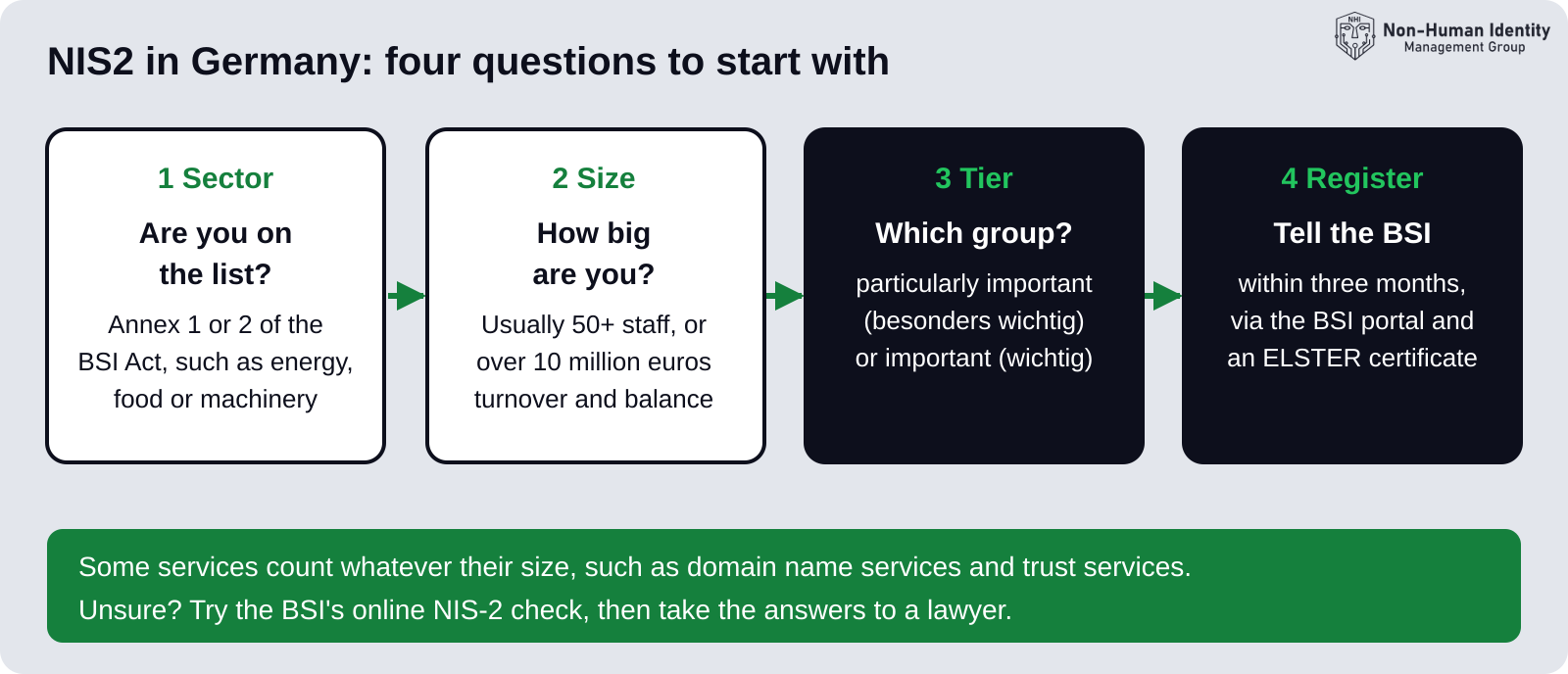
Here is how the German rules apply to a firm, in general terms. Figure 1 shows the first four questions.
- Check your sector. The BSI Act lists sectors in two annexes. The second list covers post and couriers, waste, chemicals, food, several kinds of manufacturing, online platforms and research.[3]
- Check your size. A firm on the list is usually covered with 50 or more staff, or with yearly turnover and balance sheet both above 10 million euros. Some services, such as domain name services, count at any size.[2]
- Find your tier. Larger firms in the most critical sectors are particularly important entities (besonders wichtige Einrichtungen). The rest are important entities (wichtige Einrichtungen).[2]
- Register with the BSI. Covered firms register within three months of qualifying. They use the BSI portal and a company certificate from ELSTER, the German tax office's online service.[4][5]
- Take the security steps and involve leaders. Leaders put the steps in place, oversee them and take regular training.[7]
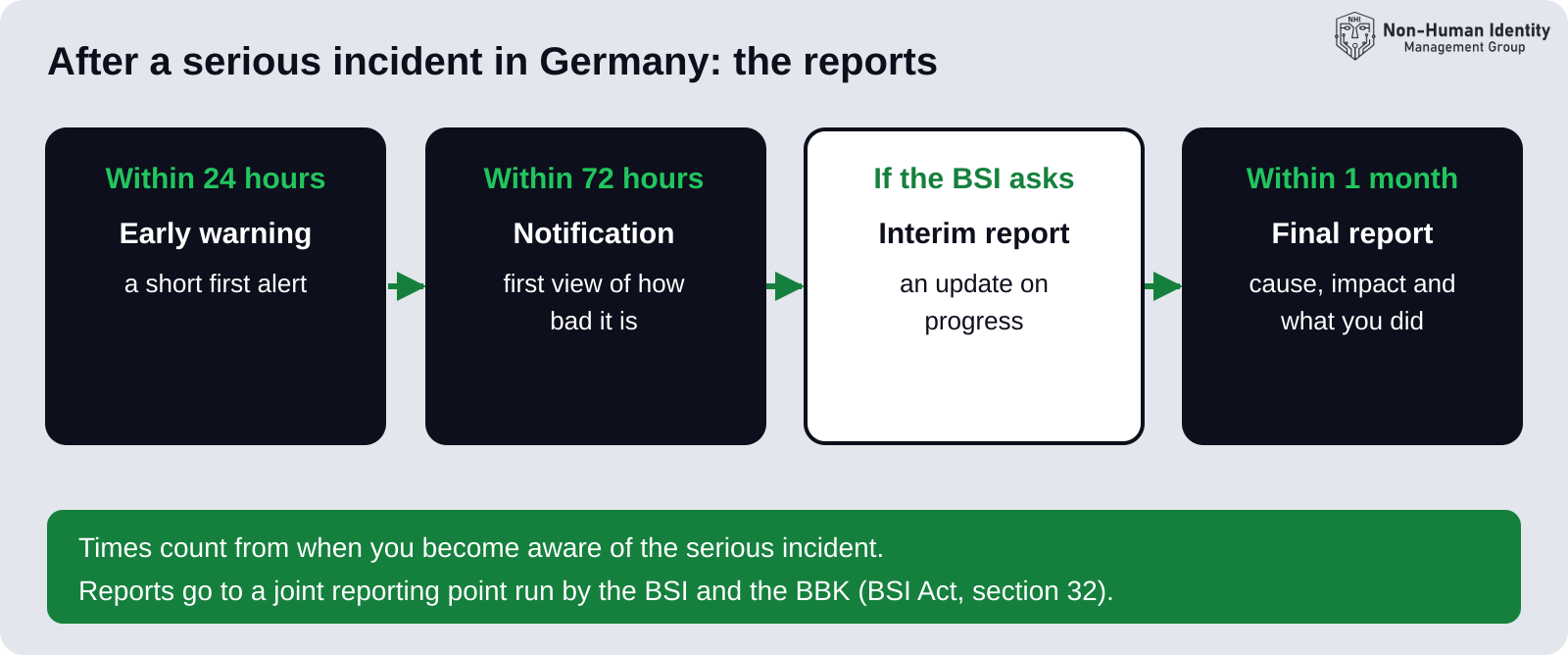
- Report serious attacks. There is an early warning within 24 hours, a notification within 72 hours and a final report within a month.[8]
The two tiers in plain words:[2][9]
| Tier | Who is usually in it | Highest fine for the main duties |
|---|---|---|
| Particularly important (besonders wichtig) | Firms in Annex 1 sectors with 250 or more staff, or above 50 million euros turnover and 43 million euros balance sheet. Also operators of critical installations and some internet services. | 10 million euros, or 2 percent of group turnover for very large groups |
| Important (wichtig) | Other firms in Annex 1 or Annex 2 sectors with 50 or more staff, or above 10 million euros turnover and balance sheet. | 7 million euros, or 1.4 percent of group turnover for very large groups |
For the ten areas of security steps, such as backups, training and strong sign-in, see NIS2 for Beginners. They are the same in Germany. One of them is knowing your accounts, including the accounts software uses, called non-human identities (NHIs).
A worked example
Lindenhof Logistik is a made-up courier firm near Hanover with about 180 staff. Its managing director, Bea Castell, hears at a trade fair that couriers are on the NIS2 list.
She asks her IT lead, Jana Vance, to check. Jana runs the BSI's online NIS-2 check. Post and courier services are on the second list, and the firm is well above 50 staff. So the firm is likely an important entity. A lawyer agrees.
Jana finds that the firm has not registered. She applies for the ELSTER company certificate, then registers in the BSI portal. She sets a reminder to update the details within two weeks if anything changes, such as a new address.
Bea books cyber security training for herself and the other director. She asks for a short security update at every quarterly board meeting.
Jana then compares the firm with the ten security areas. Backups exist, but nobody has tested a restore. The parcel tracking app uses a shared password that has never been changed. Nobody knows who should send the 24-hour early warning.
Jana writes a one-page plan. A named person and a deputy will handle reports to the BSI. The shared password moves into a password manager with an owner. A restore test is booked for next month.
The law did not make Lindenhof safe overnight. But the firm is now registered, its leaders are involved and it knows who to call.
Myths and mistakes
| What people think | What is true |
|---|---|
| NIS2 in Germany is the old KRITIS rules with a new name. | It reaches far more firms. Medium-sized firms in sectors such as food, post and machinery can now be covered.[3] |
| The BSI will tell us if we are covered. | Firms must check for themselves and register within three months of qualifying.[4] |
| Registering is a one-off job. | Changes to your details must reach the BSI within two weeks.[4] |
| Cyber security is just the IT team's job. | Leaders must put the steps in place, oversee them and take regular training.[7] |
| We have 72 hours before we tell anyone. | An early warning is due within 24 hours. The 72-hour deadline is for the fuller notification.[8] |
What can I do this week?
- Run the BSI's online NIS-2 check and save the result.
- Ask whether your firm has registered in the BSI portal, and who holds the ELSTER certificate.
- Find out who sends the 24-hour early warning, and who covers for them.
- Ask when your managing directors last had cyber security training.
Checklist
- We know whether we are likely covered, and in which tier, with the reasons written down.
- We have registered in the BSI portal, or we know why we do not need to.
- Someone owns our registration details and updates them within two weeks of a change.
- Our managing directors have approved the security steps and take regular training.
- Each of the ten security areas has an owner and a status.
- Our incident plan covers the 24-hour, 72-hour and one-month reports.
- We know which accounts our software uses, and who owns each one.
Common questions
When did NIS2 start in Germany?
The German law was signed on 2 December 2025 and published on 5 December 2025. Its rules have applied since early December 2025. The BSI says the deadline to register has already passed, so covered firms that have not registered should do so now.[1][5]
How big are the fines in Germany?
For the main duties, particularly important firms face fines of up to 10 million euros, and important firms up to 7 million euros. Very large groups can face fines based on a share of their worldwide turnover. Failing to register can bring a fine of up to 500,000 euros.[9]
Who do we report a serious attack to?
Reports go to a joint reporting point run by the BSI and the BBK, the federal office for civil protection. The BSI passes them on to other authorities that need to know. Check the BSI's NIS-2 pages for the current way to report.[8]
Can managers be held personally responsible?
Yes, in some cases. Leaders must put the security steps in place and oversee them. If they fail through their own fault, they can be liable to their own firm for the damage. The details depend on company law for the firm's legal form, so take legal advice.[7]
We are part of a big group. Are we covered?
Usually the size test counts the whole group. But the German law lets a firm leave out group figures if its IT systems and processes are fully separate from the group's. Write down your reasoning and check it with a lawyer.[2]
Where next?
Ready for the detail? Read the practitioner guide: Germany NIS2 Implementation Guide. It goes further into the section numbers of the BSI Act, the extra duties for critical installations and how the German rules differ from the EU text.
Also useful:
- NIS2 for Beginners
- Germany KRITIS Rules
- NIS2 Transposition Tracker
- Cyber Incident Reporting for Beginners
Related NHI Mgmt Group resources: NIS2 Directive Guide · NIS2 Readiness Checklist · Germany BSI C5 Guide
Key terms
- NIS2 Directive
- The EU's cyber security law for key services, which Germany put into its BSI Act.
- Essential entity
- A firm in the top NIS2 tier; in Germany it is called particularly important.
- Important entity
- A covered firm in the lower NIS2 tier, with lighter checks but similar duties.
- The national body that checks firms meet their duties; in Germany this is mainly the BSI.
- Significant incident
- An attack or failure serious enough that the law says it must be reported.
- Early warning
- The first short alert about a serious incident, due within 24 hours.
- KRITIS
- Germany's term for critical infrastructure, such as power, water and health services.
Sources and further reading
- Gesetz zur Umsetzung der NIS-2-Richtlinie und zur Regelung wesentlicher Grundzüge des Informationssicherheitsmanagements in der Bundesverwaltung, BGBl. 2025 I Nr. 301: signed 2 December 2025, published 5 December 2025. Bundesgesetzblatt (Federal Law Gazette). https://www.recht.bund.de/bgbl/1/2025/301/VO.html, accessed 28 Nov 2026.
- BSI-Gesetz (BSIG), section 28: particularly important and important entities, size thresholds and group data. Federal Ministry of Justice, gesetze-im-internet.de. https://www.gesetze-im-internet.de/bsig_2025/__28.html, accessed 28 Nov 2026.
- BSI-Gesetz (BSIG), Annex 2: sectors for important entities. Federal Ministry of Justice, gesetze-im-internet.de. https://www.gesetze-im-internet.de/bsig_2025/anlage_2.html, accessed 28 Nov 2026.
- BSI-Gesetz (BSIG), section 33: registration duty, three months, changes within two weeks. Federal Ministry of Justice, gesetze-im-internet.de. https://www.gesetze-im-internet.de/bsig_2025/__33.html, accessed 28 Nov 2026.
- NIS-2-regulierte Unternehmen: registration in the BSI portal with an ELSTER organisation certificate, NIS-2 applicability check, registration deadline passed. Bundesamt für Sicherheit in der Informationstechnik (BSI). https://www.bsi.bund.de/DE/Themen/Regulierte-Wirtschaft/NIS-2-regulierte-Unternehmen/nis-2-regulierte-unternehmen_node.html, accessed 28 Nov 2026.
- Germany Transposes NIS 2 Directive: Increased Cybersecurity Requirements for Businesses. Covington and Burling, Inside Privacy blog (law firm commentary, used for the BSI estimate of about 29,500 firms and the late transposition). https://www.insideprivacy.com/cybersecurity-2/germany-transposes-nis-2-directive-increased-cybersecurity-requirements-for-businesses/, accessed 28 Nov 2026.
- BSI-Gesetz (BSIG), section 38: duties of management, liability and training. Federal Ministry of Justice, gesetze-im-internet.de. https://www.gesetze-im-internet.de/bsig_2025/__38.html, accessed 28 Nov 2026.
- BSI-Gesetz (BSIG), section 32: reporting duties, early warning within 24 hours, notification within 72 hours, interim report, final report within one month, joint BSI and BBK reporting point. Federal Ministry of Justice, gesetze-im-internet.de. https://www.gesetze-im-internet.de/bsig_2025/__32.html, accessed 28 Nov 2026.
- BSI-Gesetz (BSIG), section 65: fines. Federal Ministry of Justice, gesetze-im-internet.de. https://www.gesetze-im-internet.de/bsig_2025/__65.html, accessed 28 Nov 2026.