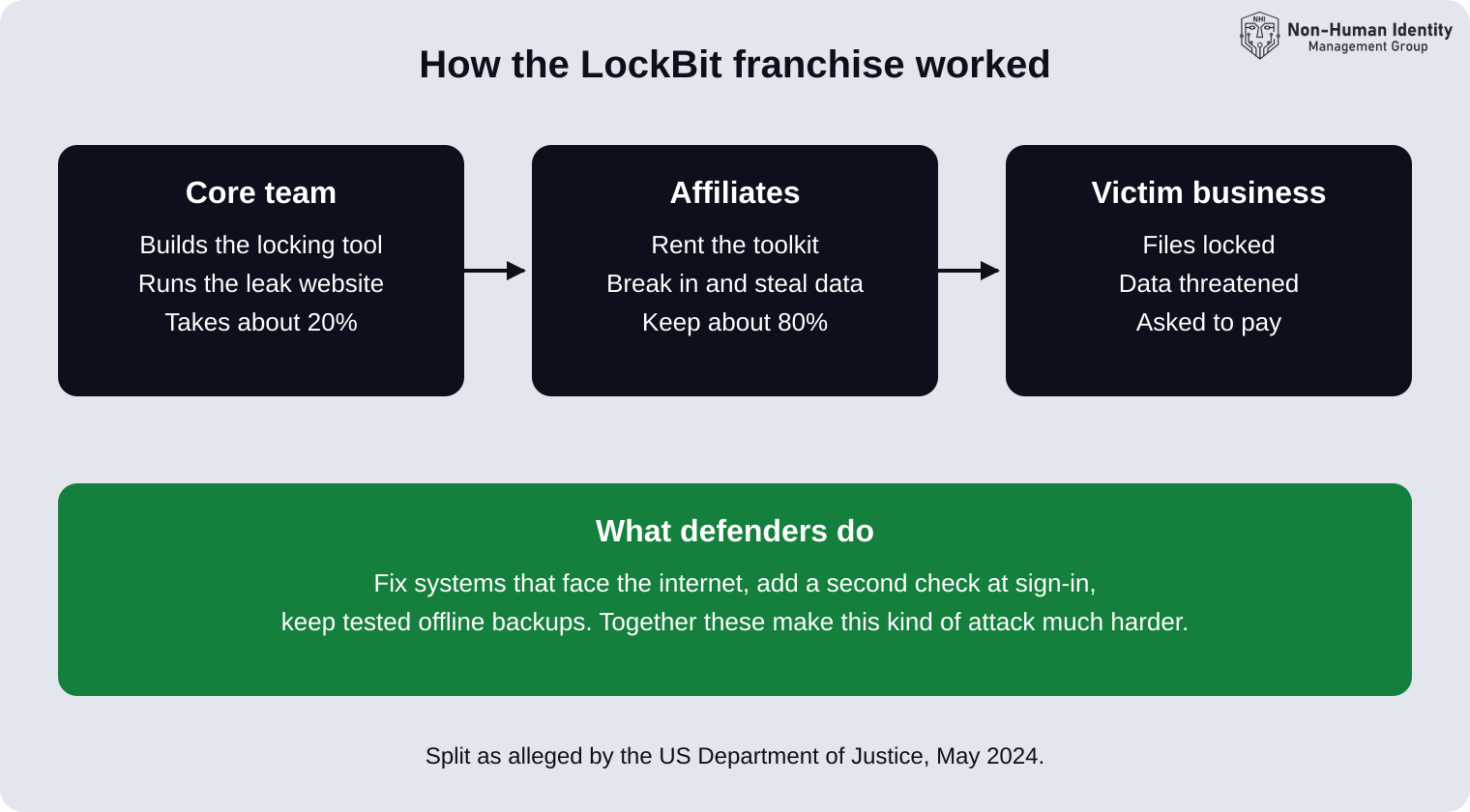
LockBit was a criminal gang that rented out ransomware to other criminals, like a franchise.
This guide is for students, newcomers and anyone who has seen the name in the news. It tells the story in plain words, and shows why the same simple defences still matter for any business.
In short
- LockBit was one of the most active ransomware gangs, with more than 2,000 victims by early 2024.[1]
- A core team built the tools, and partners called affiliates did the break-ins, then shared the money.
- In February 2024, police from several countries seized its systems in Operation Cronos.[1][3]
- Its victims were often hit through ordinary gaps, so updates, a second sign-in check and offline backups still help most.
What you will learn
- Explain how a ransomware franchise works, in one sentence.
- Spot why paying a gang to delete data is a poor bet.
- Explain what Operation Cronos did, and what it did not do.
- Check the three basics that make this kind of attack harder.
- File-locking software (ransomware)
- harmful software that scrambles files and demands payment to unlock them.
- Franchise partner (affiliate)
- a criminal who rents the gang's tools and carries out the attack.
- Shaming website (leak site)
- a website where a gang lists victims and threatens to publish their data.
What is LockBit?
Think of a fast-food franchise. Head office supplies the recipe, the brand and the signs. Local owners run the shops and send part of the takings back.
LockBit worked like a criminal version of that. A small core team built the ransomware, which is software that locks files until a ransom is paid. Other criminals, called affiliates, rented it and used it on victims. This set-up is called ransomware as a service.[2]
US prosecutors allege that the core team usually took 20% of each ransom and the affiliate kept 80%.[2] The gang also ran a leak site, a website that named victims and threatened to publish their stolen files.
Where the comparison stops working: a real franchise sells food to willing customers. LockBit's "customers" were victims, and every sale was a crime that hurt a business, a school or a hospital.
Why does it matter?
LockBit shows how ransomware became a business. Because anyone could rent the tools, attacks spread to firms of every size, not just big ones.
If you run a small business
What could happen: an affiliate finds an old remote access account and locks your files over a weekend.
Check this: ask whether every remote sign-in needs a second check, such as a code on a phone.
Next: Ransomware for Beginners
If you are studying cyber security
What could happen: you read about a gang's name and miss the lesson about how it worked.
Check this: learn the business model, because many other gangs copy it.
If you manage a team or budget
What could happen: you are asked to pay so that stolen data is "deleted".
Check this: agree now who decides, and who gives legal advice, before any attack.
What does it look like?
Here is a made-up listing of the kind that gangs like LockBit posted on their leak sites.
Example only. All values are made up.
NEW VICTIM                                  (1)
Company: Example Widgets Ltd (FAKE)
Files taken: 0000 GB, staff and customer   (2)
Time left: 09 days 23 hours                (3)
Pay to delete: EXAMPLE amount              (4)
- The gang names the business in public to shame it.
- In a real message, this line would claim what data was stolen. The claim may be true, partly true or false.
- A countdown, to push the victim to pay fast.
- An offer to delete the data for money.
Why this is risky: paying does not prove the data is gone. US prosecutors say seized LockBit systems held copies of data from victims who had paid and been told it would be deleted.[2]
The safer way: report the attack, get expert and legal help, and restore from clean backups. UK guidance says law enforcement does not encourage paying.[4]
How does it work?
Every attack was different, because each affiliate worked in its own way, but the business ran in a similar loop.
- Build. The core team made the locking software and ran the websites.[2]
- Recruit. Affiliates signed up to use the tools in return for most of each ransom.[2]
- Break in. An affiliate got into a victim's network. UK guidance says ransomware is more and more often run by attackers who first get in through remote access.[4]
- Steal and lock. The affiliate copied files out, then locked the computers it could reach.
- Demand. A ransom note appeared, and the victim could be listed on the leak site.
- Split. If the victim paid, the money was shared between the affiliate and the core team.[2]
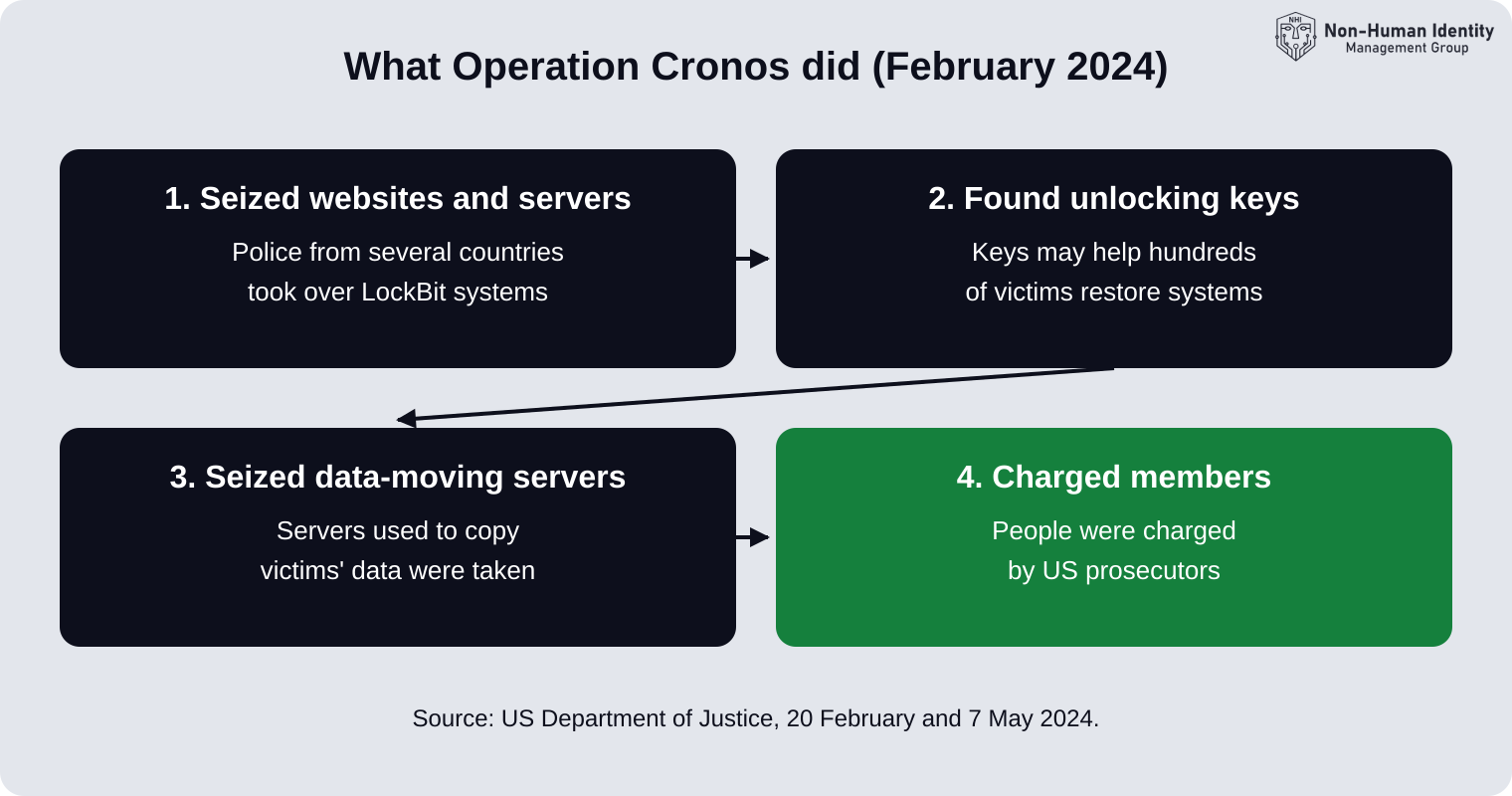
In February 2024, an international police effort called Operation Cronos struck back. The UK's National Crime Agency led it, with help from Europol and Eurojust.[3] Police seized LockBit's websites and the servers that ran it. They also took servers used to copy victims' data, and found keys to help unlock files.[1]
A takedown hurts a gang, but it does not end ransomware. The US Department of Justice noted that LockBit was not the first ransomware it had helped take apart.[1] Other gangs use the same model, so the defences below still matter.
A worked example
Cyrus Haddad runs Elmbrook Accounts, a fictional firm with twelve staff. The firm uses an outside IT helper, Reza Marlow.
One Monday, staff cannot open any client files. A note on each screen says the files are locked and data has been taken. It names a leak site and gives a deadline.
Cyrus thinks of the franchise picture. The note carries a big brand name, but the person behind it is likely an affiliate, a local operator using rented tools.
Reza unplugs the affected computers from the network, but does not wipe them. He reports the attack and asks whether a free unlocking key exists. Police later said Operation Cronos found keys that may help some victims.[1]
Next, Reza checks the backups. The copy on the office server is locked too. But a weekly copy kept offline is safe, so the firm can restore most files.
Reza finds the way in. An old remote access account, set up for a past supplier, had a simple password and no second check. He closes it.
The note offers to delete the stolen data for a fee. Cyrus takes legal advice. He learns that paying does not prove the data is gone.[2] The firm does not pay. It tells affected clients and takes advice on whether to tell the data regulator.
Afterwards, every remote account needs a second check. Updates are applied each month, and Reza tests a restore every quarter.
Myths and mistakes
| What people think | What is true |
|---|---|
| LockBit was one hacker. | It was a core team plus many affiliates who rented its tools.[2] |
| The takedown means ransomware is over. | Other gangs use the same model. A takedown slows crime down, but the basics still matter. |
| Paying makes the gang delete the data. | Seized LockBit systems held data from victims who had paid.[2] |
| Gangs like this only go after big companies. | LockBit had more than 2,000 victims. Affiliates often hit whoever had an open door.[1] |
| A note with a famous name proves who did it. | The note shows which tools were used. Only investigators can say who carried out the attack. |
What can I do this week?
- Turn on a second check at sign-in for email and any remote access.
- Ask when updates were last applied to systems that face the internet.
- Check that one backup copy is kept offline, and ask when it was last restored as a test.
- Remove remote accounts that belong to old suppliers or staff.
- Write down who to call, and who decides, if a ransom note appears.
Checklist
- Every remote sign-in uses a second check.
- Systems that face the internet get security updates promptly.
- Old and unused accounts are removed.
- At least one backup is kept offline and restores are tested.
- Staff know to unplug, not wipe, a computer that shows a ransom note.
- There is a written plan naming who to call and who decides on payment questions.
Common questions
Is LockBit still active?
Operation Cronos seized its systems in February 2024 and badly damaged it. Takedowns rarely end a criminal brand completely, and other gangs copy the same model. For a business, the safer view is that the threat goes on, whatever name it uses.
What does ransomware as a service mean?
It means a gang rents out its ransomware to other criminals. The renters, called affiliates, do the break-ins. The gang supplies the tools and websites and takes a share of each ransom. LockBit's alleged split was 20% to the core team and 80% to the affiliate.[2]
Can victims get their files back for free?
Some may. After Operation Cronos, US officials said police had found keys that may help hundreds of victims restore systems.[1] Victims should report the attack and ask the police whether a key exists, before thinking about any payment.
Were the people behind LockBit caught?
Some have been charged. In May 2024, US prosecutors charged a man they say ran LockBit, and said he took a share of each ransom.[2] Charges are allegations, and people are presumed innocent unless a court finds them guilty.
Why do gangs like this succeed against small firms?
They often find simple gaps. UK guidance points to remote access as a common way in, and stresses updates and a second check at sign-in.[4] Small firms may not have anyone checking these, so a weak spot can stay open for months.
Where next?
Ready for the detail? Read the practitioner guide: LockBit Threat Actor Profile. It goes further into LockBit's versions, the attack techniques reported by government advisories and what defenders should detect and harden.
Also useful:
- Ransomware-as-a-Service Business Model Guide
- Ransomware for Beginners
- Threat Actors for Beginners
- Scattered Spider for Beginners
- Backup Security for Beginners
Related NHI Mgmt Group resources: Ransomware Groups Guide · Cybercrime Ecosystem Guide · Ransomware Response and Recovery Guide
Key terms
- Ransomware
- Harmful software that blocks access to files or systems and then demands payment.
- Ransomware as a service
- A criminal model where a gang rents its ransomware and leak site to other criminals.
- Affiliate model
- A deal where a core gang supplies the tools and partners carry out attacks for a share of the money.
- Double extortion
- Locking files and also threatening to publish stolen data.
- Multi-factor authentication
- Signing in with two or more separate checks, such as a password and a phone code.
- Immutable backup
- A backup copy that cannot be changed or deleted for a set time.
Sources and further reading
- U.S. and U.K. Disrupt LockBit Ransomware Variant. US Department of Justice, 20 February 2024. https://www.justice.gov/opa/pr/us-and-uk-disrupt-lockbit-ransomware-variant, accessed 28 Nov 2026.
- U.S. Charges Russian National for Developing and Operating LockBit Ransomware. US Department of Justice, 7 May 2024. https://www.justice.gov/opa/pr/us-charges-russian-national-developing-and-operating-lockbit-ransomware, accessed 28 Nov 2026.
- Law enforcement disrupt world's biggest ransomware operation. Europol, February 2024. https://www.europol.europa.eu/media-press/newsroom/news/law-enforcement-disrupt-worlds-biggest-ransomware-operation, accessed 28 Nov 2026.
- Mitigating malware and ransomware attacks. National Cyber Security Centre (NCSC). https://www.ncsc.gov.uk/guidance/mitigating-malware-and-ransomware-attacks, accessed 28 Nov 2026.