Special category data is the most private kind of personal data, such as health, religion or biometrics.
This guide is for students, new IT staff and small business owners who want to know which details need extra care. You do not need a legal background. If you keep sick notes, allergy lists or a fingerprint clock-in system, this topic already applies to you.
In short
- UK and EU law lists nine kinds of personal data that need extra protection, including health, ethnic origin, religion and sexual orientation.
- Misuse of these details can lead to unfair treatment or real harm, so the rules are stricter.
- An organisation needs a normal lawful reason and also a second, specific condition before it uses them.
- Collect as little as you can, limit who can see it, and check the risk before you start.
What you will learn
- Explain what special category data is, with everyday examples.
- Spot sensitive details hiding in ordinary forms and files.
- Check the two questions to answer before using this data.
- Ask who can see the sensitive records in your organisation.
Status: correct as at 28 November 2026, based on the UK Information Commissioner's Office (ICO) guidance on special category data. Laws change; check the official text.
This guide explains the topic in general terms and is not legal advice.
- Details about a person (personal data)
- anything that can be linked to a living person, on its own or with other facts.
- Extra-private details (special category data)
- a short list of personal data types that the law protects more strongly.
- Body measurements used to recognise you (biometric data)
- things like a face scan or fingerprint, processed by a system to identify a person.
What is special category data?
Think of a home with a locked medicine cabinet. Most things sit on open shelves, but some are locked away because they could hurt someone if misused. Special category data is the locked cabinet of personal data.
All personal data needs care. But the law picks out nine kinds that carry more risk.[1] In plain words, they are details that reveal:
- racial or ethnic origin
- political opinions
- religious or philosophical beliefs
- trade union membership
- genetic information, such as DNA results
- biometric information, when it is used to identify someone
- health, including mental health
- sex life
- sexual orientation
The ICO says these details need extra protection because using them can create big risks to people's rights and freedoms.[1] A leaked postcode is a problem. A leaked diagnosis can change how someone is treated at work or in their community.
Where the comparison stops working: a locked cabinet is easy to see. Sensitive details often hide in ordinary places, such as a note in a booking system or a guess made by software.
Why does it matter?
These details can expose people to unfair treatment, embarrassment or worse. Organisations that handle them carelessly can face complaints and action by a regulator.
If you run a small business
What could happen: staff sick notes sit in a shared folder that every employee can open.
Check this: list where health or other sensitive details are kept, and who can open each place.
Next: UK GDPR for Beginners
If you are new to IT work
What could happen: a new fingerprint clock-in system goes live before anyone checks the rules for biometrics.
Check this: ask whether a risk check was done before the system was bought.
Next: Biometrics for Beginners
If you are a student or job seeker
What could happen: a form asks for your religion or health with no reason given.
Check this: look for a privacy notice that says why they need it, and whether answering is optional.
What does it look like?
Here is a made-up booking record from a small dog-grooming salon. Look for the details that fall into the locked cabinet.
Example only. All values are made up.
Example Grooming Co: customer record
Name:        Sam Example
Phone:       00000 000000
Dog:         FAKE-Biscuit, terrier
Notes:       Owner uses a wheelchair, needs ramp  (1)
Notes:       Owner pays with union discount card  (2)
Staff note:  "Seems anxious, maybe depressed"     (3)
Entry scan:  face-match ID EXAMPLE-0000           (4)
- A note about a disability is health data, even when it is written to be helpful.
- A union discount reveals trade union membership.
- A guess about mental health can still count as health data, if it is used to judge or treat someone differently.
- A face scan used to recognise a person is biometric data used for identification.
Why this is risky: every staff member who opens the booking screen sees all of it. Most of them only need the name, phone number and dog.
The safer way: record only what the job needs, such as "use the ramp entrance". Drop the guesses and the union detail. Keep any face-scan system off unless you have checked the rules first.
How does it work?
For ordinary personal data, an organisation needs one lawful reason, such as a contract. For special category data, it needs two things.[2]
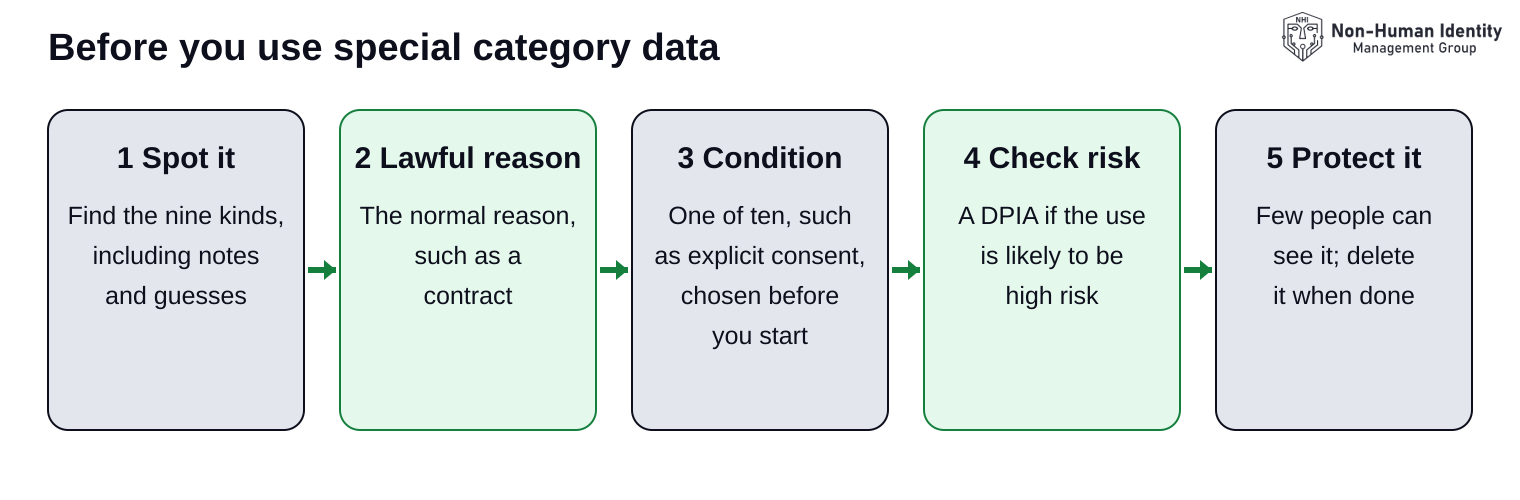
- Spot it. Find where the nine kinds of data appear, including notes, free-text boxes and guesses made by software.
- Pick a normal lawful reason. This is the same choice as for any personal data, such as a contract or a legal duty.
- Pick a second, specific condition. UK law lists ten conditions. Examples include the person's explicit consent and duties under employment law. You must choose it before you start, and be able to show which one you use.[2]
- Check the risk. A written risk check, called a data protection impact assessment (DPIA), is required when the use is likely to be high risk. Sensitive data makes that more likely.[2]
- Write down the rules. Some conditions also need a short written policy that explains how you handle the data.[2]
- Protect it. Limit who can see it, keep it separate where you can, and delete it when the purpose ends.
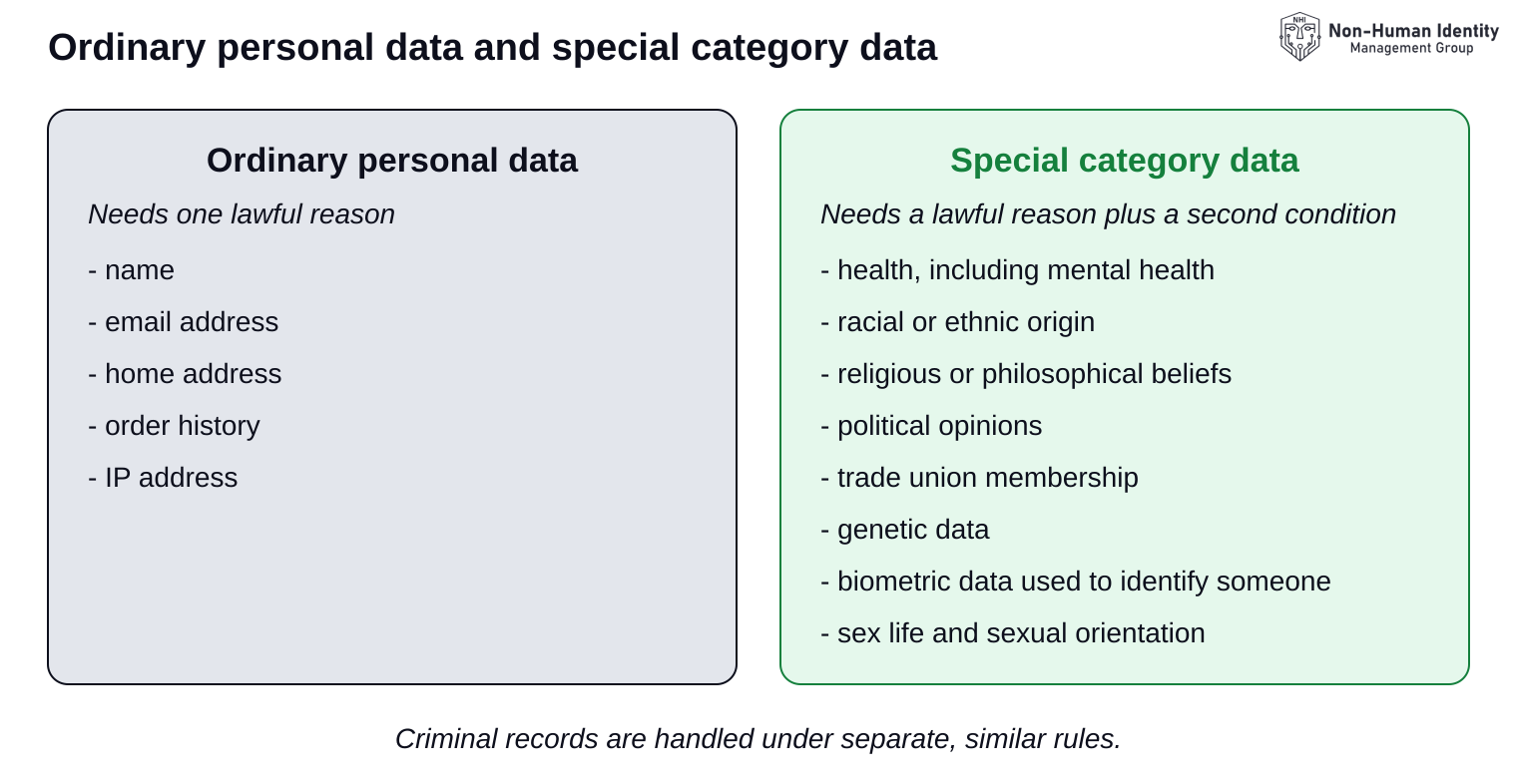
Two details trip people up. First, a photo is not automatically biometric data. The ICO says it becomes biometric data only after specific technical processing, such as face matching.[1] Second, a guess can count. If a system is meant to infer something sensitive, or people are treated differently because of it, the ICO treats it as special category data. This applies even if the guess is wrong.[1]
Criminal records are not on the list of nine. They have their own, similar safeguards under separate rules.[1]
A worked example
Bea Ulrich manages Wren Pharmacy, a small made-up chemist with eight staff. The pharmacy plans a new loyalty app. The supplier offers a feature that suggests health products based on what each customer buys.
Bea asks her colleague Ivo Strand, who looks after the shop's IT, to help her check it. They start by spotting the data. The app would hold names and emails. But buying patterns for some products could point to a health condition. The suggestion feature is designed to guess exactly that.
Ivo reads the ICO guidance. A guess that is meant to reveal something about health counts as health data.[1] So the feature would need a second condition as well as a normal lawful reason.
Bea asks the supplier what the feature needs and who can see it. The answers are vague. Staff at the supplier could see each customer's full history.
They decide to switch the suggestion feature off. The app launches with points and offers only, based on how much people spend. Bea writes a short note explaining the decision. She asks the pharmacy's data protection adviser to review it.
Ivo also finds an old spreadsheet of customers' allergy notes on the shared drive. He moves it into the pharmacy system, where only the pharmacists can open it.
The pharmacy still holds health data for its prescriptions. But it no longer collects more than it needs, and fewer people can see it.
Myths and mistakes
| What people think | What is true |
|---|---|
| Consent is the only way to use sensitive data. | Explicit consent is one of ten conditions. Others cover things like employment duties. You should first ask whether you can give people a real choice.[2] |
| Every photo of a person is biometric data. | A photo becomes biometric data after specific technical processing, such as face matching.[1] |
| A guess about someone's health is not real data. | An inference meant to reveal health, or used to treat people differently, can count, whether or not it is correct.[1] |
| Criminal records are special category data. | They are a separate type with their own, similar safeguards.[1] |
| Free-text notes are harmless. | Notes boxes are a common place for health and other sensitive details to build up unseen. |
What can I do this week?
- Search your notes. Look through one notes field or form for health, religion or similar details.
- Check who can open sick notes. Make sure staff health records sit in a folder only a few named people can open.
- Remove one question. Drop any sensitive question on a form that you do not truly need.
- Ask about new tools. Before buying anything that scans faces or fingerprints, ask for a risk check first.
Checklist
- I can name at least five of the nine kinds of special category data.
- We know where sensitive details are kept, including notes and free-text boxes.
- Each use has a normal lawful reason and a second, specific condition.
- We considered a DPIA before starting any high-risk use.
- Only the people who need sensitive records can open them.
- Our forms do not ask for sensitive details we do not need.
- Face or fingerprint systems were checked against the rules before going live.
- Sensitive records are deleted when the purpose ends.
Common questions
Is "sensitive data" the same as special category data?
Mostly, yes. Many people say sensitive data, while UK and EU law uses the term special category data for its fixed list of nine types. Other details, such as bank numbers, can be sensitive too. They need good security but follow the ordinary rules.
Do I need explicit consent to keep a staff sick note?
Not always. Employers often rely on a condition linked to employment law duties instead. Explicit consent is one of ten conditions, and the right one depends on the purpose. Check with your adviser or the ICO guidance before you decide.[2]
Is a fingerprint door lock special category data?
It can be. If the system uses fingerprints to recognise who each person is, the ICO treats that as biometric data used for identification.[1] That brings the stricter rules, and a risk check is a sensible first step.
Does this apply outside the UK?
The same nine types appear in the EU GDPR, and many other countries protect similar details. The names and conditions differ. If your customers or staff are elsewhere, check the local law or ask an adviser who knows it.
Where next?
Ready for the detail? Read the practitioner guide: Special Category Data Guide. It goes further into each of the ten conditions, the written policy some of them need, and the security controls that fit the level of harm.
Also useful:
- Personal Data for Beginners
- Data Protection Impact Assessments for Beginners
- Biometrics for Beginners
- Data Classification for Beginners
Related NHI Mgmt Group resources: Biometric Data in the Workplace · Explicit vs Implied Consent · Health Data Privacy Beyond HIPAA Guide (My Health My Data)
Key terms
- Special category data
- Personal data that needs extra protection, such as health, ethnic origin, religion or biometrics.
- Personal data
- Information that can identify a person directly or indirectly, such as a name, account number or location.
- Biometric data
- Measurements of a person's body or behaviour, such as a face or fingerprint, processed to identify them.
- Health data
- Information about a person's physical or mental health, including care they receive.
- Explicit consent
- A clear, specific yes from a person, given in words or writing, for a stated use of their data.
- Criminal offence data
- Information about criminal allegations, proceedings or convictions, handled under its own rules.
- Data protection impact assessment
- A written check of the risks a use of personal data creates, and how to reduce them.
Sources and further reading
- What is special category data? Information Commissioner's Office (ICO). https://ico.org.uk/for-organisations/uk-gdpr-guidance-and-resources/lawful-basis/special-category-data/what-is-special-category-data/, accessed 28 Nov 2026.
- Special category data (UK GDPR Article 9). Information Commissioner's Office (ICO). https://ico.org.uk/for-organisations/uk-gdpr-guidance-and-resources/lawful-basis/a-guide-to-lawful-basis/special-category-data/, accessed 28 Nov 2026.