Purple teaming is when security testers and defenders work side by side to find and fix gaps in detection.
This guide is for students, new security analysts and managers who want to know what the colours mean and how a session runs. It matters to the business because it shows whether the alarms you pay for actually go off.
In short
- The red team plays the attacker. The blue team defends. Purple is the two working together in the open.
- The red team tries one known attack step at a time, and the blue team checks if it was seen.
- Gaps are fixed on the spot or soon after, then the step is tried again.
- The result is a list of what your defences can and cannot spot, with owners for each fix.
What you will learn
- Explain what red, blue and purple teams do.
- Describe how a purple team session runs, step by step.
- Spot the difference between purple teaming and a secret red team test.
- Check what a good session should leave behind.
- Attack side (red team)
- people who act like real attackers, with permission, to test defences.
- Defence side (blue team)
- people who watch for attacks and respond to them.
- Alarm rule (detection)
- a rule in a security tool that raises an alert when something suspicious happens.
What is purple teaming?
Think of a football training session. The forwards try a move, the defenders try to stop it, and the coach stops play to ask "what did you see?". Then they run the move again until the defence reads it.
Purple teaming works the same way. A red team acts like an attacker, with permission. A blue team watches for attacks and responds. Mix red and blue and you get purple: both sides in the same room, sharing what they see.
In a normal red team test, the attackers work in secret and report at the end. In purple teaming, nothing is hidden. The aim is not to win. It is to find out which attack steps the defences spot, and to improve the ones they miss.
Where the comparison stops working: a training match uses your own players. A purple team usually copies the habits of real attacker groups, taken from public reports, so the practice matches threats your organisation may face.[2]
Why does it matter?
Many organisations buy security tools but never check that the alarms work against real attack steps. Purple teaming tests this directly. European Central Bank guidance for bank testing says it helps teams learn attacker methods and find improvements across people, processes and technology.[1]
If you are studying cyber security
What could happen: you think security is either attack or defence, and miss the jobs that join the two.
Check this: learn how one attack step shows up in the records a defender reads.
If you are a new security analyst
What could happen: you trust an alarm rule that has never been tested, and it stays silent in a real attack.
Check this: ask when each of your key alarm rules was last tested with a safe attack step.
If you manage a security team
What could happen: a test report lists problems, but nobody owns the fixes and the same gaps appear next year.
Check this: make sure every gap found has a named owner and a date to test it again.
What does it look like?
Many teams keep a simple record of each test during a session. Here is a made-up one.
Example only. All values are made up.
Purple team session EXAMPLE-01, test laptop LAB-0000
Step  What the red team tried         Seen?  Alert?  Fix
1     Fake invoice email opened         yes    yes     none needed   (1)
2     New admin account created         yes    no      new rule      (2)
3     Files copied to a test server     no     no      add logging   (3)
4     Step 2 run again after the fix    yes    yes     done          (4)
- The defences saw the step and raised an alert. Good news, recorded so it can be re-checked later.
- The activity was in the records, but no rule raised an alert. This is a common kind of gap.
- The step left no trace at all, because that activity was not being recorded.
- After the new rule was added, the step was tried again. This time it raised an alert.
Why this is risky: without a session like this, steps 2 and 3 could happen in a real attack and nobody would be told.
The safer way: run sessions on a regular basis, write down every result, and test each fix again before calling it done.
How does it work?
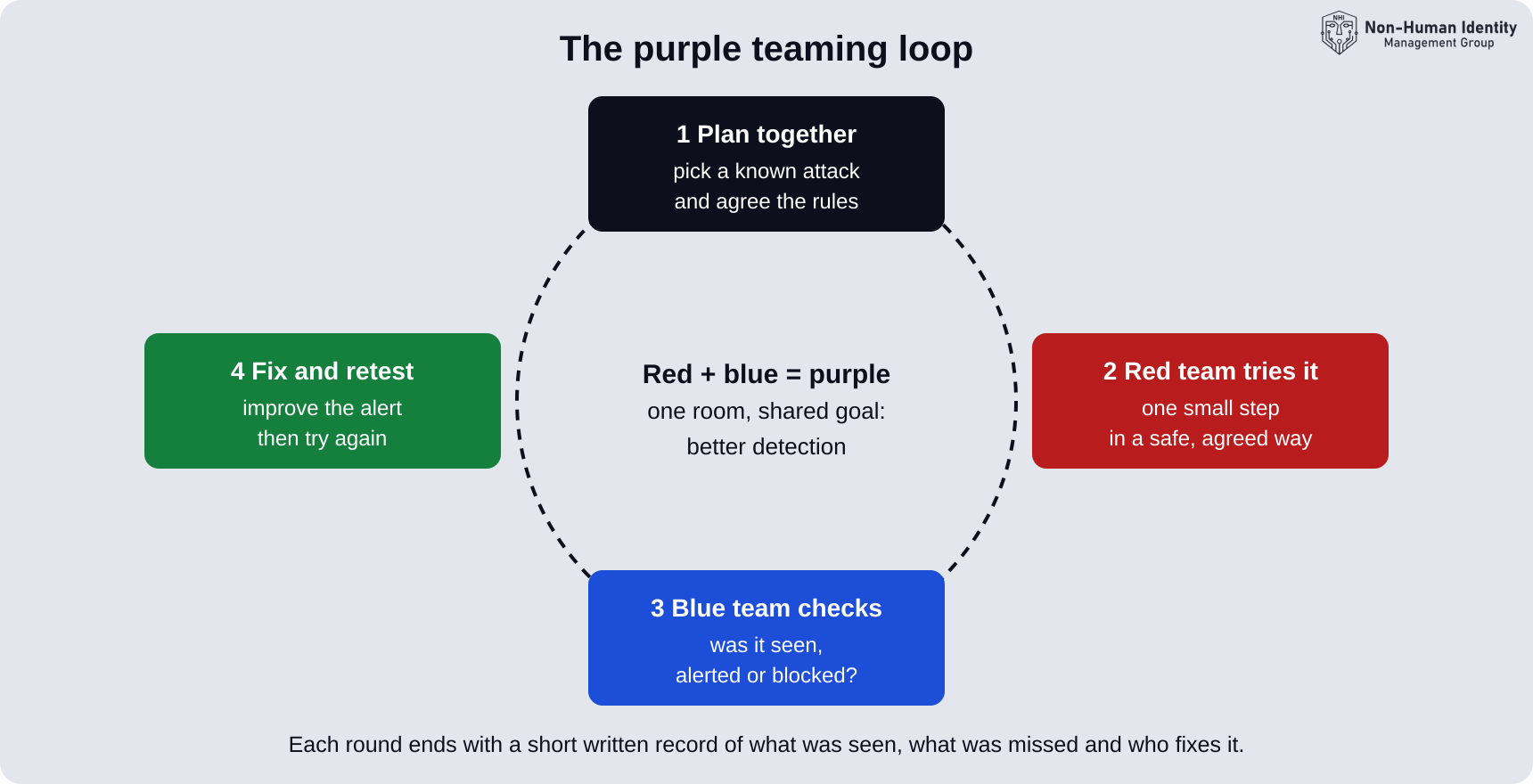
A typical session follows these steps.
- Plan together. Both teams pick an attacker or attack to copy, often from public reports. They agree the rules, the systems in scope and who can stop the test. Written permission comes first.
- Try one step. The red team runs one small, safe attack step on an agreed system.
- Check together. The blue team looks for it. Was it recorded? Did an alarm go off? Was it blocked?
- Fix. If something was missed, the team adds the missing records or improves the alarm rule.
- Test again. The red team runs the same step again to prove the fix works.
- Write it up. The team records what was seen, what was missed and who owns each fix.
Teams do not have to invent attacks. MITRE, a US not-for-profit organisation, publishes adversary emulation plans. These describe how known attacker groups work, so teams can copy their behaviour and test defences against it.[2] MITRE's Center for Threat-Informed Defense also publishes small, automated plans for common threats. They are aimed partly at organisations without their own red team.[3]
Purple teaming can also follow a bigger, secret red team test. The European Central Bank's guidance for bank testing includes a purple team stage after the test. There, both teams walk back through the attack together and try "what if" variations.[1]
A worked example
Darius Corrigan runs IT for a fictional regional insurer with 150 staff. Last year a supplier's secret red team test found problems, but most were never fixed. This year he books a two-day purple team session instead.
Hana Tanaka, a tester from the security firm, plays the red team. Sana Pajari, the insurer's security analyst, leads the blue team. Before they start, Darius signs a written plan. It lists the test laptops and servers, and says either side can pause the test at any time.
They choose to copy a criminal group that public reports say targets insurers with fake invoice emails.
Hana opens a harmless fake invoice on a test laptop. Sana's screen shows an alert almost at once. Good start.
Next, Hana creates a new admin account on a test server. Sana searches the records and finds it, but no alarm went off. Like a coach stopping play, they pause and talk it through. Sana writes a rule that alerts on new admin accounts. Hana creates another test account. This time the alert fires.
Then Hana copies a folder of dummy files to a test server outside the network. Sana finds nothing. The firewall was not recording that kind of traffic. Fixing it needs a change request, so they note it with an owner and a date.
At the end of day two, they have tested twelve steps. Seven were spotted, three were fixed on the spot and two have owners. Darius books a short follow-up in a month to retest those two.
Myths and mistakes
| What people think | What is true |
|---|---|
| Purple team is a third team you have to hire. | It is usually a way of working. Your existing red and blue people work together. |
| Purple teaming replaces red team tests. | They do different jobs. A secret test checks the real response. Purple teaming improves detection step by step. |
| The aim is for the red team to win. | The aim is learning. A missed step is a useful finding, not a failure. |
| A good session means every step was caught. | Finding gaps is the point. What matters is that each gap is fixed and tested again. |
| You need a big budget to start. | Publicly available attack plans let small teams test common steps, with care and permission.[3] |
What can I do this week?
- List the five attack steps you most want your alarms to catch.
- Ask when each matching alarm rule was last tested.
- Read one public attacker profile and note the steps it describes.
- Agree who would sign the written permission for a test.
Checklist
- Written permission and a clear scope exist before any test starts.
- Both teams agree the goal: better detection, not winning.
- Tests copy real attacker behaviour from trusted public sources.
- Every step is recorded as seen or missed, alerted or not.
- Each gap has an owner and a date.
- Every fix is tested again before it is marked done.
- Sessions are repeated, so old fixes are checked again over time.
Common questions
What is the difference between red, blue and purple teams?
The red team plays the attacker. The blue team defends and responds. Purple is the two working together openly, so the defenders learn from each attack step as it happens. See Red Team vs Blue Team vs Purple Team for a side-by-side view.
Is purple teaming a job title?
Sometimes, but usually it is a way of working. Some organisations have a dedicated purple team person or group. More often, testers and analysts who already exist run joint sessions. The skills come from both sides: attack techniques and reading security records.
How is purple teaming different from breach and attack simulation?
Breach and attack simulation is software that runs safe attack steps automatically and often. Purple teaming is people working together, with discussion and fixes along the way. Many teams use both. See BAS vs Purple Teaming.
Is it safe to run attacks on our own systems?
It can be, with care. We suggest written permission, an agreed list of systems, test accounts and a clear way to stop. Start on test machines. Use harmless versions of attack steps, and never use real customer data.
How often should we run a purple team session?
Regularly enough to keep up with change. New systems, new staff and new attacker habits can all break alarm rules that used to work. Many teams run short sessions often, rather than one large test a year.
Where next?
Ready for the detail? Read the practitioner guide: Purple Teaming Guide. It goes further into engagement models, building a test case library from attacker emulation plans, tracking detection gaps and measuring results.
Also useful:
- Red Teaming for Beginners
- Breach and Attack Simulation for Beginners
- Detection Engineering for Beginners
- MITRE ATT&CK for Beginners
- Red Team vs Blue Team vs Purple Team
Related NHI Mgmt Group resources: BAS vs Purple Teaming · Red Teamer for Beginners · Security Operations Centres for Beginners
Key terms
- Purple teaming
- Attack and defence teams working together openly to test and improve detection and response.
- Red team
- People who act like real attackers, with permission, to test defences.
- Blue team
- The people who detect, respond to and recover from attacks.
- Adversary emulation
- Copying how a known attacker group works, to test whether defences cope.
- Detection rule
- A rule in a security tool that raises an alert when a set pattern appears.
- Detection engineering
- Designing, testing and maintaining the rules that spot attacks.
- Breach and attack simulation
- Software that runs safe, attack-like tests often, to check that defences still work.
Sources and further reading
- TIBER-EU Purple Teaming Guidance. European Central Bank, January 2025. https://www.ecb.europa.eu/pub/pdf/annex/ecb.tiber_eu_purple_best_practices_2025.en.pdf, accessed 28 Nov 2026.
- Adversary Emulation Plans. MITRE ATT&CK, The MITRE Corporation. https://attack.mitre.org/resources/adversary-emulation-plans/, accessed 28 Nov 2026.
- Micro Emulation Plans. Center for Threat-Informed Defense, MITRE. https://ctid.mitre.org/projects/micro-emulation-plans/, accessed 28 Nov 2026.