Singapore's PDPA is the law that sets how organisations collect, use, share and look after personal data.
This guide is for people who run or work in a Singapore business, and for students new to the topic. If your business keeps customer, member or patient details, the law is likely to apply to you, even if you are small.
In short
- The PDPA covers private organisations that handle personal data in Singapore. Public agencies have separate rules.
- It sets a list of duties, such as getting consent, keeping data safe and letting people see their data.
- Some data breaches must be reported to the regulator within three calendar days of deciding they are serious enough.
- The regulator can fine an organisation up to S$1 million, or 10% of its Singapore turnover for larger firms.[3]
What you will learn
- Explain what the PDPA is and who it covers.
- Name the main duties in plain words.
- Check when a data breach must be reported.
- Ask the right questions about your own organisation.
Status: correct as at 28 November 2026, based on guidance from Singapore's Personal Data Protection Commission (PDPC). Laws change; check the official text.
This guide explains the topic in general terms and is not legal advice.
- Details about a person (personal data)
- information about someone who can be identified from it, true or not.
- The regulator (PDPC)
- the Personal Data Protection Commission, which enforces the PDPA.
- A helper firm (data intermediary)
- an organisation that handles personal data for another organisation.
What is the PDPA?
Think of a left-luggage desk at a station. You hand over your bag. The desk should use it only as agreed, keep it safe, let you check on it and tell you if it goes missing.
The PDPA, or Personal Data Protection Act 2012, sets similar rules for personal data. It governs how data about people is collected, used, shared and cared for in Singapore.[1] Personal data means data, true or not, about a person who can be identified from it.[2]
The law mainly covers private organisations, including small firms. Some things are left out. People acting in a personal or home capacity are not covered. Nor are employees acting for their employer, because the employer is responsible. Public agencies are also left out. Business contact details, like a work email or job title, are generally excluded too.[2]
Where the comparison stops working: a left-luggage desk holds one bag you can see. An organisation may hold copies of your data in many systems and suppliers, and you cannot look inside them. So the law also asks organisations to be open about what they do.
Why does it matter?
The PDPC can order an organisation to fix problems, and it can impose fines.[3] Beyond fines, a breach can cost you the trust of customers who handed you their details.
If you run a small business in Singapore
What could happen: a customer list is left open online and you do not know what you must do next.
Check this: make sure someone is named to look after data protection in your firm.
If you provide services to other firms
What could happen: you hold a client's customer data and have a breach, but do not tell the client.
Check this: agree in writing how you will tell clients about a breach.
If you are a student or new to privacy work
What could happen: you mix up the PDPA with Europe's GDPR and give the wrong advice.
Check this: compare the two laws side by side before assuming they match.
What does it look like?
Here is a made-up "Am I affected?" checklist. It is a quick first check, not a legal test.
Example only. All values are made up.
Am I affected by the PDPA? (Example Tuition Pte Ltd, fictional)
[x] We are a private organisation, not a public agency   (1)
[x] We collect names, phone numbers and school results     (2)
[x] We keep the data on a cloud booking system            (3)
[ ] We have named a data protection officer               (4)
[ ] We know what to do if the data leaks                  (5)
- Private organisations are the main group the law covers.
- Names, phone numbers and results about pupils are personal data.
- The cloud firm is likely to be a data intermediary, handling data on your behalf. You stay responsible.
- An empty box here is a gap. The PDPC's own guide treats the officer role as mandatory.[5]
- An empty box here means the firm needs a simple breach plan.
Why this is risky: many small firms tick the first three boxes without noticing they have duties. The gaps show up only when something goes wrong.
The safer way: name a data protection officer and write down what data you hold and why. Agree the steps for a breach before you need them.
How does it work?
The PDPC groups the law into a set of duties it calls obligations.[4] In plain words, an organisation should:
- Ask and explain. Get consent to collect, use or share personal data, unless an exception applies. Tell people why you want it (the consent, notification and purpose limitation obligations).
- Use it as you said you would. Use data only for the purposes you explained, and keep it accurate (the purpose limitation and accuracy obligations).
- Keep it safe. Put reasonable security in place to protect it (the protection obligation).
- Do not keep it longer than needed. Delete data you no longer need, and take care before sending it overseas (the retention and transfer limitation obligations).
- Let people check it. Let people ask to see their data and correct mistakes.
- Be ready for breaches and be accountable. Assess breaches, report serious ones and have policies and an officer in place.
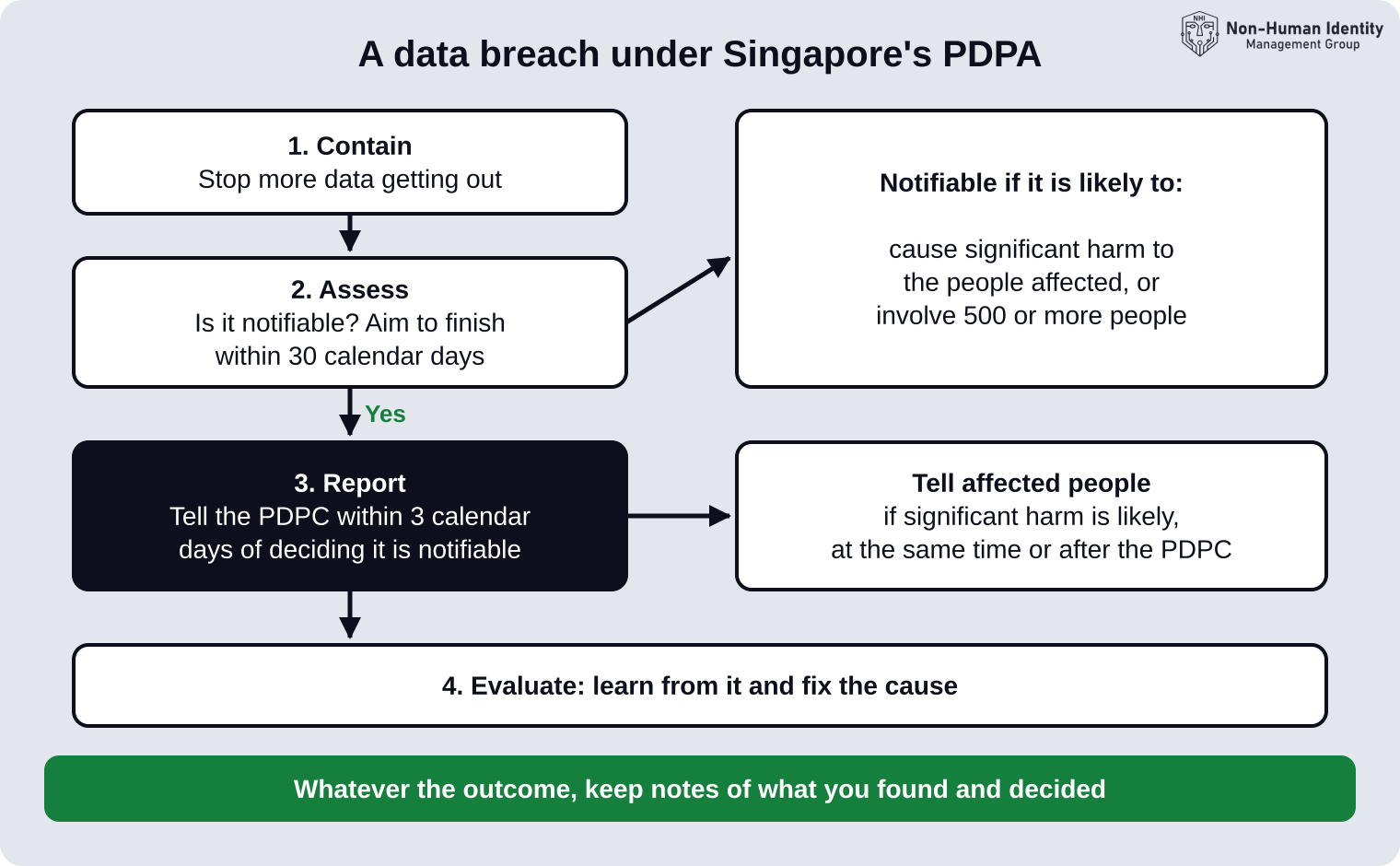
A data breach means personal data has been accessed, collected, used, shared, copied, changed or disposed of without permission.[6] The PDPC's guide sets out four steps, known as C.A.R.E.: contain, assess, report and evaluate.[6]
A breach must be reported if it is likely to cause significant harm to the people affected, or if it involves 500 or more people. The PDPC expects the assessment to be done quickly, within 30 calendar days. Once a breach is judged notifiable, the PDPC must be told as soon as practicable, and no later than three calendar days. Affected people are told at the same time or after.[6] Reports go through the PDPC's online form.[7]
Fines can reach S$1 million. For firms with more than S$10 million annual turnover in Singapore, the cap is 10% of that turnover if that is higher.[3]
A helper firm that handles data for you, such as a cloud or IT supplier, must tell you about a breach it finds. You then do the assessment.[6]
A worked example
Reza Ueda runs a small tuition centre in Singapore, a fictional firm with 300 pupils. His IT helper is Bruno Jensen, who works part time.
One Monday, Bruno spots that a shared folder of pupil records has been open to anyone with the link for two weeks. It holds names, parents' phone numbers and exam results.
Reza thinks of the left-luggage desk. Before anything else, the bags need to stop going missing. So Bruno closes the link first. That is the contain step.
Next they assess. The folder covers 300 pupils, which is under 500. They look at what was in it. There are no ID numbers, passwords or bank details. The access records show the link was opened twice, both times by staff.
Reza uses the PDPC's guidance to think about harm. He decides, and writes down why, that significant harm is unlikely. So this breach does not need to be reported.
He still notes the dates, what was exposed and what they decided. Then they evaluate. Bruno changes the folder settings so links only work for staff. Reza names himself as data protection officer and adds his business contact details to the website.
If the folder had held 600 pupils, Reza would have had three calendar days from his decision to tell the PDPC.
Myths and mistakes
| What people think | What is true |
|---|---|
| The PDPA only applies to big companies. | It covers private organisations of any size that handle personal data in Singapore. |
| The three days start when the breach happens. | They start once you decide the breach is notifiable. But you must assess quickly, so do not wait.[6] |
| Our cloud supplier is responsible if it leaks. | The supplier must tell you, but you stay responsible for assessing and reporting. |
| Every breach must be reported. | Only notifiable ones: likely significant harm, or 500 or more people. Keep notes on the others. |
| The PDPA is the same as GDPR. | They share ideas, but the rules, clocks and fines differ. |
What can I do this week?
- Name a data protection officer and publish their business contact details.
- List the personal data you hold, where it is and why you keep it.
- Check that your suppliers have agreed to tell you about breaches.
- Write a one-page breach plan that follows contain, assess, report and evaluate.
- Delete personal data you no longer need.
Checklist
- We know which personal data we hold and why.
- People are told why we collect their data, and we have consent or a valid exception.
- A data protection officer is named and can be contacted.
- We have reasonable security for the data we hold.
- We delete data that is no longer needed.
- We can answer requests to see or correct data.
- We have a breach plan with the three-day clock written into it.
- Suppliers that handle data for us have agreed to tell us about breaches.
Common questions
Does the PDPA apply to government agencies?
Not for the most part. The PDPC says public agencies are excluded from the main data protection rules, and they follow separate public sector rules. If you work with a public agency, check your contract and the PDPC guidance.
Is a work email address personal data under the PDPA?
Usually it is treated as business contact information, which is generally excluded from the main rules. That covers details like a work email, job title and office phone. If a person gave the details only for personal reasons, the exclusion does not apply.
When must I report a data breach to the PDPC?
When it is likely to cause significant harm to the people affected, or involves 500 or more people. Once you decide it is notifiable, tell the PDPC as soon as practicable and within three calendar days. Use the PDPC's online form.
Do I need a data protection officer?
Yes. The PDPC's guidance treats the role as mandatory for organisations. It can be an existing staff member, a small team or an outsourced service. People should be able to find the officer's business contact details.
How big can a PDPA fine be?
Up to S$1 million. For firms with more than S$10 million annual turnover in Singapore, the cap is 10% of that turnover if it is higher.[3] The PDPC can also give directions, such as telling a firm to stop using data or to destroy it.
Where next?
Ready for the detail? Read the practitioner guide: Singapore PDPA Guide. It goes further into each obligation, the consent exceptions, overseas transfers and what recent PDPC decisions mean for security teams.
Also useful:
- Data Protection Laws Around the World for Beginners
- Southeast Asia Data Protection Laws for Beginners
- Data Breach Notification for Beginners
- Data Protection Officer for Beginners
- Singapore PDPC Advisory Guidelines on Personal Data in Generative AI Guide
Related NHI Mgmt Group resources: Singapore Cybersecurity Act Guide · Data Breach Notification Checklist · Cyber and Privacy Regulator Directory
Key terms
- PDPA
- Singapore's Personal Data Protection Act 2012, the main law on personal data held by private organisations.
- Personal data
- Data, true or not, about a person who can be identified from it.
- PDPC
- The Personal Data Protection Commission, which enforces the PDPA.
- Data intermediary
- An organisation that handles personal data on behalf of another organisation.
- Data protection officer
- The person named to help an organisation meet its data protection duties.
- Data breach notification
- Telling the regulator and affected people about a serious data breach.
Sources and further reading
- Personal Data Protection Act overview. Personal Data Protection Commission Singapore. https://www.pdpc.gov.sg/overview-of-pdpa/the-legislation/personal-data-protection-act, accessed 28 Nov 2026.
- Advisory Guidelines on Key Concepts in the PDPA, chapters 3 to 9 (revised 9 October 2019). Personal Data Protection Commission Singapore. https://www.pdpc.gov.sg/-/media/Files/PDPC/PDF-Files/Advisory-Guidelines/AG-on-Key-Concepts/Chapter-3to9-9-Oct-2019.pdf, accessed 28 Nov 2026.
- Advisory Guidelines on Enforcement of Data Protection Provisions (1 October 2022), paragraph 27.1 and sections on directions. Personal Data Protection Commission Singapore. https://www.pdpc.gov.sg/-/media/Files/PDPC/PDF-Files/Advisory-Guidelines/Advisory-Guidelines-on-Enforcement-of-DP-Provisions_1oct2022.pdf, accessed 28 Nov 2026.
- Advisory Guidelines on Key Concepts in the Personal Data Protection Act (chapter list of obligations). Personal Data Protection Commission Singapore. https://pdpc.gov.sg/Guidelines-and-Consultation/2020/03/Advisory-Guidelines-on-Key-Concepts-in-the-Personal-Data-Protection-Act, accessed 28 Nov 2026.
- Guide to Developing a Data Protection Management Programme. Personal Data Protection Commission Singapore, 15 July 2019. https://www.pdpc.gov.sg/-/media/Files/PDPC/PDF-Files/Other-Guides/DPMP/Guide-to-Developing-a-Data-Protection-Management-Programme-15-July-2019.pdf, accessed 28 Nov 2026.
- Guide on Managing and Notifying Data Breaches under the PDPA. Personal Data Protection Commission Singapore, 15 March 2021. https://www.pdpc.gov.sg/-/media/Files/PDPC/PDF-Files/Other-Guides/Guide-on-Managing-and-Notifying-Data-Breaches-under-the-PDPA-15-Mar-2021.pdf, accessed 28 Nov 2026.
- Report your organisation's data breach. Personal Data Protection Commission Singapore. https://www.pdpc.gov.sg/report-data-breach, accessed 28 Nov 2026.