Synthetic data is made-up data, created by a computer to copy the patterns of real data.
This guide is for students, newcomers and anyone at work who has been told "it's fine, it's only synthetic data". You do not need to be a data scientist to ask good questions about it, and those questions can protect the people in the original data.
In short
- Synthetic data is made by a computer model that has learned from real data.
- It is useful for testing, training and sharing, because it holds fewer real details.
- It is not private by default: it can still give away facts about real people, especially unusual ones.
- Models trained again and again on made-up data can get worse, a problem called model collapse.
What you will learn
- Explain what synthetic data is in one sentence.
- Spot when synthetic data may still reveal real people.
- Explain model collapse in plain words.
- Ask the right questions before you share or use a synthetic dataset.
Status: correct as at 28 November 2026, based on the ICO's synthetic data guidance, which the ICO says is under review. Laws change; check the official text.
This guide explains the topic in general terms and is not legal advice.
- Made-up data (synthetic data)
- records created by a computer model to look like real ones.
- Data a model learns from (training data)
- the examples an AI model studies to learn patterns.
- Working out who someone is (re-identification)
- linking data that looks anonymous back to a real person.
What is synthetic data?
Think of a street built on a film set. From the front it looks like a real street, with shops, doors and signs. Nobody lives there, but it was built by studying real streets.
Synthetic data works the same way. A computer model studies a real dataset, such as patient records or bank payments. It then makes new records that follow the same patterns. The UK privacy regulator, the ICO, calls it "artificial" data made by computer methods.[1]
People use it to test software without real customer records. They also use it to train AI when real data is scarce, and to share data with researchers. Some sets change only a few columns. Others are made up completely.[1]
Where the comparison stops working: a film set is built by hand and copies no one in particular. A synthetic data model can copy too closely, so a made-up record may end up very like a real person.
Why does it matter?
People often treat synthetic data as safe by default. It may not be. The ICO says it can still count as personal data if facts about real people can be worked out from it.[1]
If you are a student or new to data work
What could happen: you share a "safe" made-up file online, and it still points to a real person.
Check this: ask how the data was made and whether anyone tested it for privacy.
If you manage a team that shares data
What could happen: a supplier gets made-up customer data that still shows real details.
Check this: treat made-up data as possibly personal until someone checks it.
If you build or buy AI tools
What could happen: a model trained mostly on made-up data slowly loses rare but important cases.
Check this: ask how much of the training data is real and how fresh it is.
What does it look like?
Here is a made-up example. It shows a few rows from a clinic list, and the new rows a model made from it.
Example only. All values are made up.
ORIGINAL (FAKE) clinic list
Age  Town           Condition
34   Exampletown    asthma
41   Exampletown    asthma
102  Smallvillage   rare condition X       (1)

SYNTHETIC rows made from it
Age  Town           Condition
36   Exampletown    asthma                 (2)
39   Exampletown    asthma
101  Smallvillage   rare condition X       (3)
- In a real file, this line would describe one unusual patient: very old, in a tiny village, with a rare condition.
- Common rows come out mixed and slightly changed. These are hard to link to anyone.
- The unusual row comes out almost the same. Anyone who knows the village could guess who it is.
Why this is risky: records that stand out are the easiest to link back to a person. These are called outliers. The ICO names them as a key risk. It suggests removing them or adding protection.[1]
The safer way: remove or blur rare records. Use a method that adds measured "noise", such as differential privacy. Then test the result before you share it. Expect a trade-off, because more protection usually makes the data less useful.[1]
How does it work?
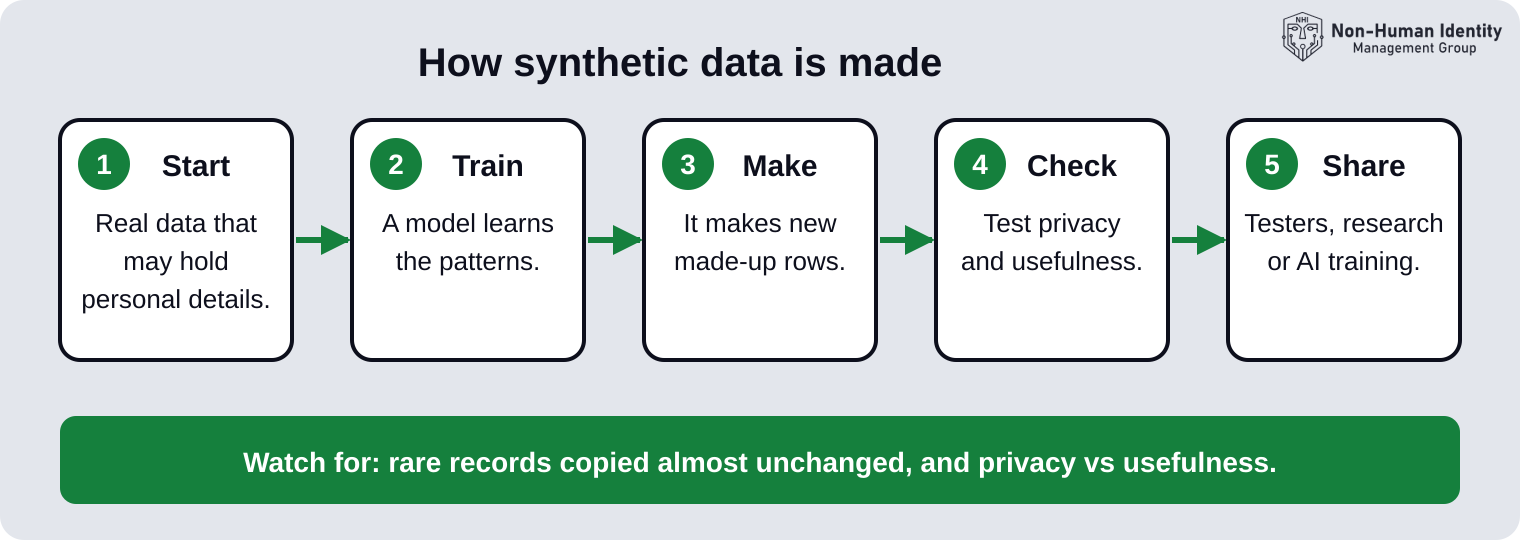
US government guidance lists publishing synthetic data, made from real records, as one way to share data more safely.[4] Here is the usual pipeline, from real data to a synthetic copy.
- Start with real data. Someone gathers a real dataset, which may hold personal details.
- Train a model. A computer model studies the data and learns its patterns, such as which ages go with which conditions.
- Generate new rows. The model makes new records that follow those patterns.
- Check privacy and usefulness. People test whether real people can be found, and whether results still match the real data.
- Share or use. The synthetic data goes to testers, researchers or an AI training job.
Research backs up the caution. A 2022 study tested several ways of making synthetic data. It found the privacy gain was highly variable and the loss of usefulness hard to predict.[2] In other words, "synthetic" is a method, not a promise.
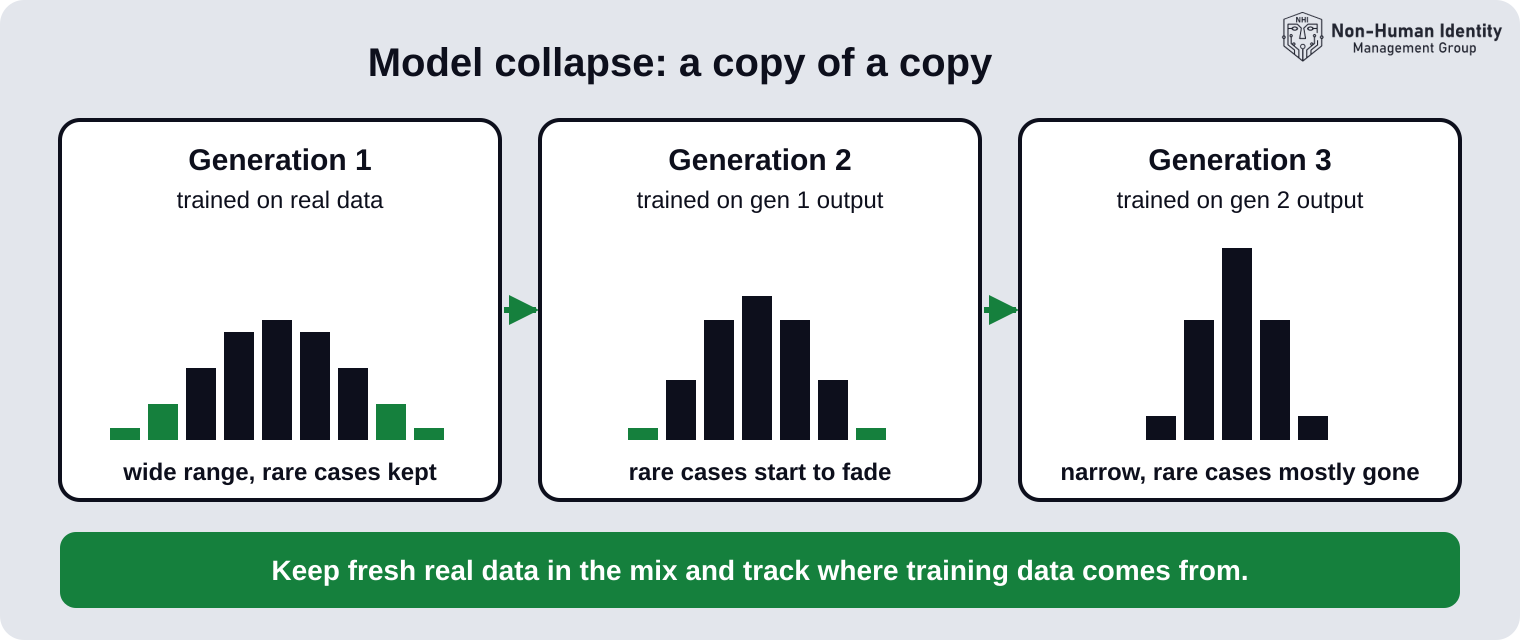
A second problem shows up when AI models learn from made-up data again and again. Think of a message passed along a line of people: each retelling drops a few odd details. Researchers found that models trained on content made by other models lose the rare parts of the original data. They called this model collapse.[3]
A worked example
Hal Iyer is a data analyst at a fictional small housing charity. A university student, Wanda Yilmaz, asks for data on tenants for her project about repairs.
Hal cannot share the real tenant list. His manager suggests making a synthetic copy with a free tool. "It's all made up, so it's safe," she says.
Hal thinks of the film set street. It looks real because it was built from real streets. So he looks more closely at what the tool produced.
Most rows look fine. But one row stands out: a tenant aged 98, in the charity's only house in a small village, with a rare repair type. The real list has one person who matches that almost exactly.
Hal removes rare records like that one before making the data again. He also groups exact ages into bands, such as 30 to 39. He then compares a few results with the real data. The patterns Wanda needs, such as how long repairs take, still hold up.
He writes a short note for Wanda. It explains how the data was made, what was removed and what it should not be used for. He also asks the charity's data protection lead to review it before sharing.
Wanda gets useful data for her project. The charity does not hand over a file that points to a real tenant.
Myths and mistakes
| What people think | What is true |
|---|---|
| Synthetic data is always anonymous. | It depends on how it was made. Facts about real people can sometimes be worked out from it.[1] |
| If no row matches a real person exactly, it is safe. | A near match can be enough, especially for unusual people. |
| Synthetic data is as useful as the real thing. | Protection usually costs some usefulness. Test results against the real data where you can.[2] |
| We can keep training AI on made-up data with no harm. | Training again and again on generated data can make models lose rare cases.[3] Keep real data in the mix. |
| Synthetic data removes bias. | Bias in the real data can carry into the synthetic copy. Check for it.[1] |
What can I do this week?
- Find out where your team already uses synthetic data, and for what.
- Ask how each synthetic dataset was made and whether it was tested for privacy.
- Look for rare or unusual records in any synthetic file before you share it.
- Add a short note to each dataset saying how it was made and what it is for.
Checklist
- We know which real data each synthetic dataset was made from.
- Rare or unusual records are removed or blurred before generating.
- Someone has tested whether real people can be found in the result.
- We check that the synthetic data still gives useful answers.
- Synthetic data is treated as possibly personal until it has been checked.
- Each dataset has a note on how it was made and what it should not be used for.
- AI training plans keep fresh real data in the mix and record where data came from.
Common questions
Is synthetic data personal data?
Sometimes. The UK regulator says it depends on whether facts about the real people behind it can be worked out from the synthetic data.[1] Making it also uses real data, which may be personal. Check with your data protection lead before you share it.
How is synthetic data different from anonymised data?
Anonymised data is real data with identifying details removed or changed. Synthetic data is new, made-up data that copies the patterns of real data. Both aim to protect people, and both can fail if done badly. See Anonymisation and Pseudonymisation for Beginners.
What is model collapse?
Model collapse is when AI models trained on made-up output from other models get worse over time. Each round tends to lose the rare and unusual parts of the original data.[3] Keeping fresh real data in training helps reduce it.
Is synthetic data the same as a deepfake?
No. Both are made by computers, but they serve different aims. Synthetic data is usually tables of made-up records used for testing, research or training. A deepfake is fake video, images or audio made to look like a real person. See Deepfakes and AI Fraud for Beginners.
Can differential privacy make synthetic data safe?
It can make it much safer. Differential privacy adds measured random changes so single people are harder to spot. The ICO suggests it as one option for synthetic data.[1] The trade-off is that more protection usually makes the data less useful.
Where next?
Ready for the detail? Read the practitioner guide: Synthetic Data Risk Guide. It goes further into privacy attack testing, governance for training data and what data protection law expects.
Also useful:
- Differential Privacy vs Synthetic Data
- Anonymisation and Re-identification Risk Guide
- Privacy-Enhancing Technologies for Beginners
- Anonymisation and Pseudonymisation for Beginners
- Data Poisoning for Beginners
Related NHI Mgmt Group resources: Differential Privacy Guide · AI Training Data Governance Policy Template · AI and Privacy for Beginners
Key terms
- Synthetic data
- Made-up data, created by a computer model to copy the patterns of real data.
- Training data
- The examples an AI model studies to learn patterns.
- Re-identification
- Linking data that looks anonymous back to a real person.
- Personal data
- Information that can identify a person directly or indirectly.
- Differential privacy
- A method that adds measured noise so single people are harder to pick out.
- Membership inference
- An attack that tries to tell whether a person's record was used to train a model.
- Model collapse
- When AI models trained on made-up output from other models lose rare details and get worse over time.
Sources and further reading
- Synthetic data. Privacy-enhancing technologies guidance, Information Commissioner's Office (ICO). https://ico.org.uk/for-organisations/uk-gdpr-guidance-and-resources/data-sharing/privacy-enhancing-technologies/what-pets-are-there/synthetic-data/, accessed 28 Nov 2026. The ICO notes this guidance is under review after the Data (Use and Access) Act.
- Stadler, T., Oprisanu, B. and Troncoso, C. Synthetic Data: Anonymisation Groundhog Day. 31st USENIX Security Symposium, 2022. https://www.usenix.org/conference/usenixsecurity22/presentation/stadler, accessed 28 Nov 2026.
- Shumailov, I. et al. The Curse of Recursion: Training on Generated Data Makes Models Forget. arXiv:2305.17493, v3, 14 April 2024. https://arxiv.org/abs/2305.17493, accessed 28 Nov 2026.
- De-Identifying Government Datasets: Techniques and Governance. NIST Special Publication 800-188, National Institute of Standards and Technology, September 2023. https://csrc.nist.gov/pubs/sp/800/188/final, accessed 28 Nov 2026.