A compliance manager makes sure an organisation knows the rules it must follow, and follows them.
This guide is for career changers, graduates and anyone wondering what a compliance manager does all day. You do not need a law degree or a technical background to read it. If your employer handles personal data, money or health records, someone is responsible for meeting the rules, and that is often a compliance manager.
Status: correct as at 28 November 2026, based on official regulator and standards body guidance cited below. Rules change; check the official text.
In short
- A compliance manager keeps a list of the laws, contracts and standards that apply, and makes sure each one has an owner.
- The job includes writing policies, training staff, checking that rules are followed and looking into possible breaches.
- They are often the person who signs off reports and talks to regulators when something goes wrong.
- People come in from audit, legal, risk, finance and operations jobs. Clear writing and good judgement matter more than coding.
What you will learn
- Explain what a compliance manager does in one sentence.
- Spot how the role differs from a GRC analyst or an auditor.
- Describe what happens when a possible breach is reported.
- Check which of your skills the job already uses.
- A rule you must meet (obligation)
- a duty that comes from a law, a contract or a standard the organisation has signed up to.
- Official rule enforcer (regulator)
- a public body that checks organisations follow a law and can act if they do not.
- Formal approval (sign-off)
- a named person confirming that a report or decision is correct and complete.
What is a compliance manager?
Think of the secretary of a sports club. They know the league's rulebook. They make sure players are registered and forms go in on time. When the league asks a question, they answer it.
A compliance manager plays that part for an organisation. Its rulebook is the laws, contracts and standards it must meet. The manager keeps track of them. They turn them into clear house rules and check that teams follow them.
A US government careers guide puts it simply. Compliance staff make sure people and firms meet the law and the rules set by regulators. They keep up with new laws, write policies and train staff. They also run checks and look into possible breaches of the rules.[1]
In cyber security, the rules often cover personal data, safeguards and how fast to report an attack. Some compliance managers cover many topics. Others focus on one area, such as data protection.[1]
Where the comparison stops working: a club secretary deals with one league. A compliance manager may answer to several regulators, many contracts and the laws of more than one country.
Why does it matter?
Missing a rule can lead to fines, lost customers and damaged trust. A compliance manager helps leaders see which rules apply, who owns each one and where the gaps are.
If you work in audit or finance
What could happen: you already check controls and records, but assume compliance needs a law degree.
Check this: read three compliance manager adverts and mark the tasks you already do.
If you run a small business
What could happen: a data breach happens and nobody knows whether, or how fast, it must be reported.
Check this: name one person who decides on reporting, and write down your regulator's reporting page.
Next: UK GDPR for Beginners
If you are a GRC analyst
What could happen: you want to step up but are unsure what changes when you own the outcome.
Check this: ask your compliance manager which decisions they sign off and which regulators they deal with.
What does it look like?
Many compliance managers keep an obligations register, a list of the rules that apply and who looks after each one. Here is a made-up entry.
Example only. All values are made up.
OBLIGATION 0000-EXAMPLE
Rule:      Report serious personal data breaches     (1)
Source:    Data protection law (EXAMPLE)              (2)
Deadline:  72 hours where feasible                    (3)
Owner:     (blank)                                    (4)
Policy:    Breach procedure v0.0 (FAKE)               (5)
Last test: never                                      (6)
- The duty, in plain words.
- Where the duty comes from. In a real file, this line would contain the law's full name.
- How long the organisation has to act.
- No owner, so nobody is clearly in charge of meeting the deadline.
- The internal rule that explains what staff should do.
- The procedure has never been practised.
Why this is risky: the rule is known, but nobody owns it and nobody has tested it. When a breach happens, time runs out while people work out who should decide.
The safer way: give each obligation a named owner. Practise the procedure with a short drill, and record the result.
How does it work?
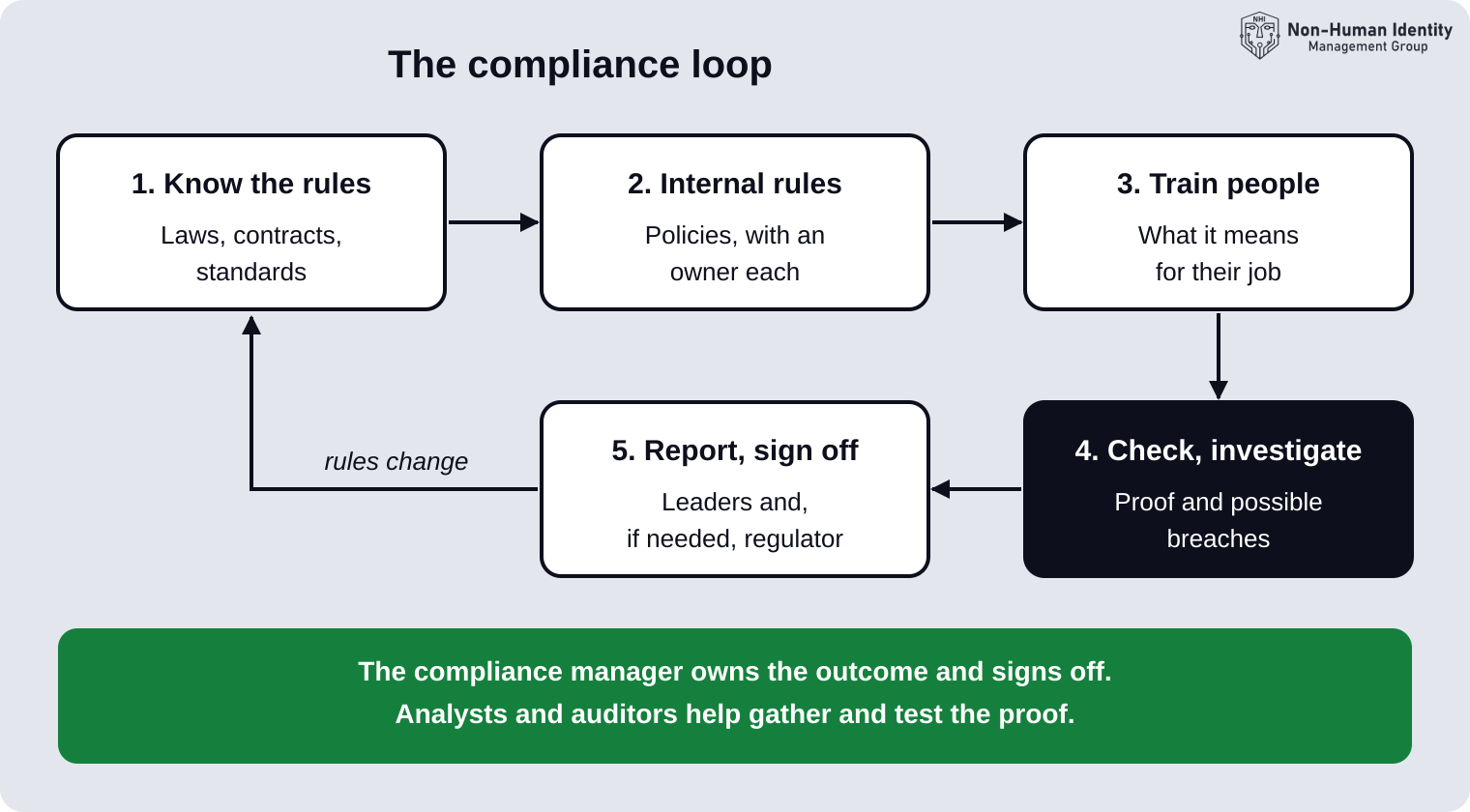
The details differ by sector, but compliance work often follows this loop.
- Know the rules. The manager tracks which laws, contracts and standards apply, and watches for changes.[1]
- Turn them into internal rules. They write policies and procedures that staff can follow, and give each one an owner.
- Train people. Staff learn what the rules mean for their own work.
- Check and investigate. The manager runs checks, collects proof and looks into possible breaches of the rules.[1]
- Report and sign off. They report to leaders, sign off key documents and, when needed, contact the regulator.
Some rules come with a clock. Take the UK as an example. A firm must tell the data protection regulator about a personal data breach if it is likely to put people at risk. The report should go in as soon as possible and, where feasible, within 72 hours.[2] Deciding whether a breach meets that bar, and making sure the report goes in, is often part of the compliance manager's job. This page explains the topic in general terms and is not legal advice.
How it differs from nearby jobs
A GRC analyst keeps risk lists up to date and gathers proof. An auditor checks the work from an independent position. The compliance manager owns the obligations, makes the call on difficult cases and signs off. In many firms, a data protection officer advises on personal data in particular.
Skills and tools
- Reading rules carefully. Turning long legal or contract text into clear duties.
- Clear writing. Policies, reports and emails that busy people understand.
- Judgement. Deciding what matters most and when to escalate.
- Organisation. Registers, deadlines and records, often in spreadsheets or compliance software.
- Working with people. Persuading teams without being the "rules police".
- Basic security knowledge. Enough to understand what safeguards do and ask good questions.
Routes in
Many compliance managers start as analysts or officers and step up. Common earlier jobs include audit, legal support, risk, finance and operations. In the US, entry-level compliance jobs typically ask for a degree, and most people learn the specific rules on the job. Experience in an industry, in audit or in law can help.[1]
A worked example
Gideon Yeboah is the compliance manager at Larch Tutors, a fictional firm that runs online language courses for adults. He moved into the role from internal audit two years ago.
On Tuesday afternoon, a staff member tells him she emailed a spreadsheet of learner names and addresses to the wrong customer. Gideon starts a clock on his notepad.
He thinks of the club secretary. The rulebook says when the league must be told, and the secretary makes sure it happens. He opens the breach procedure he wrote last year.
First, he asks Celia Falk, the IT lead, to contact the customer and request that the email is deleted. The customer confirms by evening. Gideon writes down every step and the time.
Next, he weighs the risk with the data protection lead. The file holds names and home addresses for 40 learners, but no payment or health details. They agree there is some risk to the people involved, so the firm will report.
On Wednesday morning, well inside 72 hours, Gideon signs off the report and sends it to the regulator. He also approves a short, honest email to the learners affected.
On Friday, he looks at why it happened. The email program filled in the wrong address automatically. Gideon asks IT to add a warning for files sent outside the firm, and adds the case to his report for the directors.
Next month he runs a 30-minute drill so the whole team knows the procedure.
Myths and mistakes
| What people think | What is true |
|---|---|
| You must be a lawyer. | Many compliance managers come from audit, risk, finance or operations. Legal knowledge helps, and much of it is learned on the job.[1] |
| Compliance means being secure. | Meeting the rules is a minimum. An organisation can tick every box and still be attacked. |
| Wait for all the facts before reporting a breach. | The UK regulator says to report within the time limit even without every detail, and add more later.[2] |
| Writing a policy is the end of the job. | A policy only helps if people know it, follow it and someone checks. |
| Compliance managers just say no. | Good ones help teams find a way to do what they need within the rules. |
What can I do this week?
- Read three compliance manager adverts and list the tasks they share.
- Find your country's data protection regulator and read its page on reporting breaches.
- Read our Cyber Security Compliance for Beginners guide.
- Ask someone in compliance or audit which rules take up most of their week.
Checklist
- I can explain what a compliance manager does in one sentence.
- I know what an obligation, a regulator and a sign-off are.
- I can explain how the role differs from a GRC analyst and an auditor.
- I know that some rules, such as breach reporting, come with a deadline.
- I can point to times I wrote clearly or kept careful records.
- I have checked official sources for pay, not just job boards.
- I have a plan for one first learning step.
Common questions
Is a compliance manager the same as a GRC analyst?
No, though they work closely together. A GRC analyst usually gathers proof and keeps risk lists up to date. A compliance manager owns the rules the organisation must meet, decides on hard cases and signs off reports. Many compliance managers started as analysts and stepped up.
Do I need a technical background?
Not to start. Many compliance managers come from audit, legal, finance or operations. In cyber security roles, you do need to learn what common safeguards do, so you can ask the right questions. Short courses and time with IT teams build that knowledge.
How much does a compliance manager earn?
Pay depends on country, sector and experience, so we do not quote a figure here. Use official sources. In the US, see the government's job outlook page for compliance officers.[1] In the UK, see the National Careers Service.[3]
Is compliance a good first job in security?
It can be, especially for people with audit, legal or office experience. Entry routes are usually as a compliance analyst or officer, not straight into a manager role. The work shows you how a whole organisation handles rules and risk, which helps in many later jobs.
Where can a compliance manager job lead?
Several places. Compliance managers often move into head of compliance, risk management, privacy or wider security leadership roles. Some specialise in one sector, such as finance or health. See Cyber Legal, Policy and Compliance Officer Career Guide.
Where next?
Ready for the detail? Read the practitioner guide: Regulations and Frameworks Guide. It goes further into the laws and frameworks compliance teams work with, incident reporting clocks in different countries and how one set of controls can be mapped to many rules.
Also useful:
- Cyber Legal, Policy and Compliance Officer Career Guide
- Governance, Risk and Compliance for Beginners
- Data Protection Officer for Beginners
- Security Auditor for Beginners
- GDPR for Beginners
Related NHI Mgmt Group resources: Cybersecurity Careers Guide · Career Change into Cyber Security Guide · NHI Governance for Beginners
Key terms
- Compliance
- Meeting the rules, laws, contracts and standards an organisation has agreed to follow.
- Regulatory compliance
- Meeting the rules set by laws and the public bodies that enforce them.
- Compliance obligation
- A specific duty the organisation must meet, such as reporting a breach on time.
- Security policy
- A written rule that says how staff and systems must handle security.
- Incident reporting
- Telling the right people, and sometimes a regulator, that a security incident has happened.
- Audit evidence
- Records that show a safeguard or rule is in place and working.
- Gap analysis
- Comparing what the rules ask for with what is in place today, to find what is missing.
Sources and further reading
- Compliance Officers, Occupational Outlook Handbook. US Bureau of Labor Statistics, last modified 29 October 2026. https://www.bls.gov/ooh/business-and-financial/compliance-officers.htm, accessed 28 Nov 2026.
- Report a personal data breach (guidance page). Information Commissioner's Office (UK). https://ico.org.uk/for-organisations/report-a-breach/personal-data-breach/, accessed 28 Nov 2026.
- Explore careers. National Careers Service (England). https://nationalcareers.service.gov.uk/explore-careers, accessed 28 Nov 2026.