A platform engineer builds the shared tools other developers use to build, test and run their software.
This guide is for students, career changers and anyone new to IT who keeps seeing "platform engineer" in job adverts. You do not need to write code to follow it. If your company makes its own apps, a platform team may sit behind how fast and how safely they ship.
In short
- A platform engineer builds an internal "platform": a set of shared tools and ready-made routes that developers use instead of setting everything up themselves.
- Good platforms are self-service. A developer can ask for something, like a database, and get it without waiting for another team.
- Security is part of the job: safe settings, secret handling and checks are built into the ready-made routes.
- People often come in from system administration, software development, cloud or site reliability work.
What you will learn
- Explain what a platform engineer does in one sentence.
- Spot the difference between a platform engineer and a developer.
- Check which of your current skills the job already uses.
- Ask good questions about a platform job before you apply.
- Shared toolkit (internal platform)
- the set of tools and services a company builds once so every development team can use them.
- Ready-made route (golden path)
- a tested, documented way to do a common job, such as launching a new web app.
- Help yourself (self-service)
- getting what you need through a form or command, without raising a request with another team.
What is a platform engineer?
Think of the team that builds a town's roads. They lay well-signed routes with safe junctions and lighting. Drivers still choose where to go, but the easy road is also the safe one.
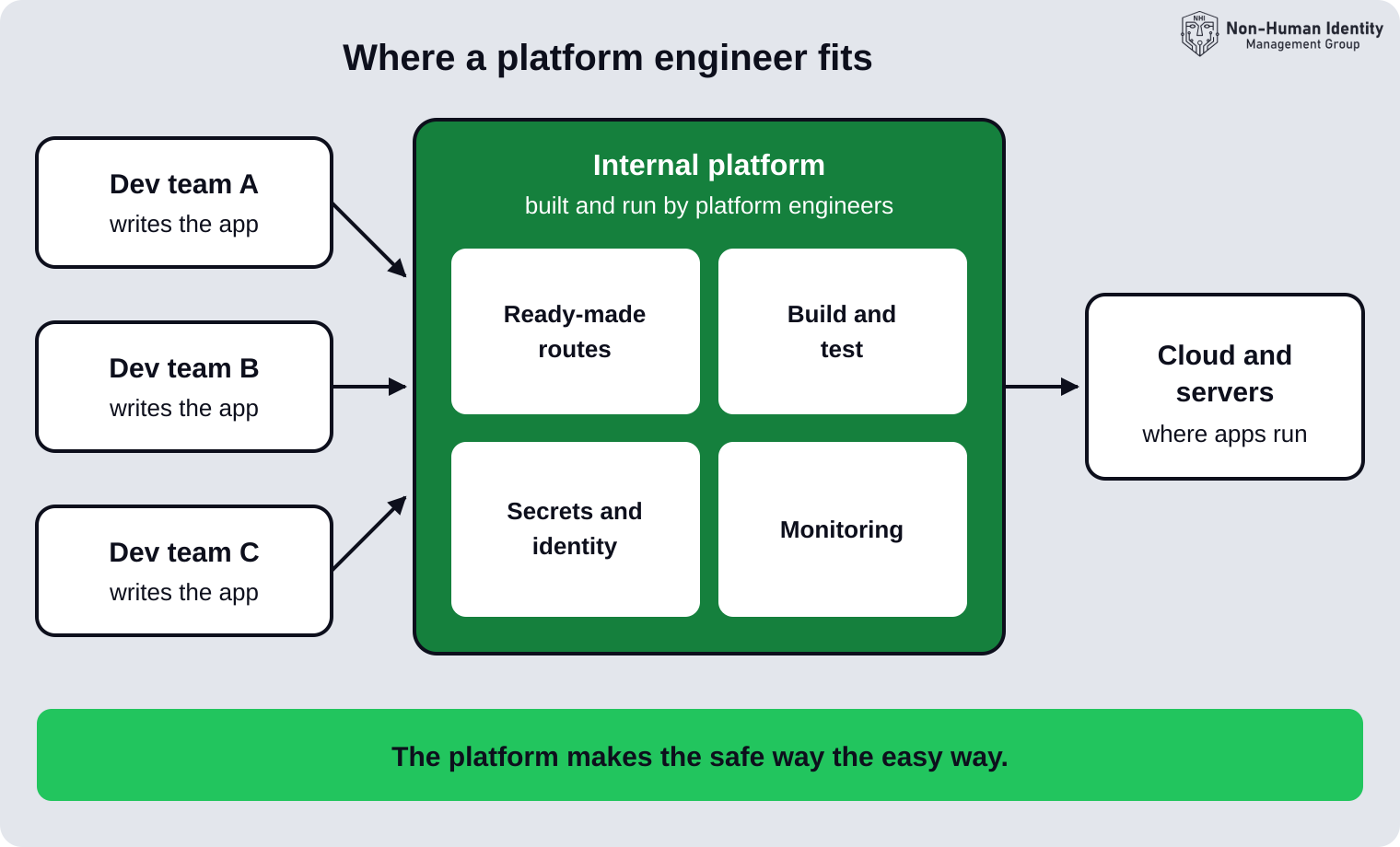
A platform engineer does this for software teams. Developers write the apps. The platform engineer builds the roads those apps travel on: the tools to build, test, launch and watch them.
An industry group for cloud software, the CNCF, describes a platform as a set of shared tools shaped around what its users need.[1] Here the users are the company's own developers.
Where the comparison stops working: drivers cannot change a road. Developers can ask the platform team for new features, and a good team treats them like customers.
Why does it matter?
Without a platform, each team sets up its own tools and settings. Some do it well and some do not. A good platform makes the safe way the easy way for everyone.
If you are a student or new to IT
What could happen: you think every tech job is writing apps, and miss a role about building tools for other builders.
Check this: read three platform engineer job adverts and note what the "customers" of the role are.
If you work as a developer
What could happen: you spend days setting up servers and secrets for each new project, and each one ends up a bit different.
Check this: ask whether your company has a ready-made template for new projects.
If you manage a technology team
What could happen: security settings differ from team to team, so a mistake in one goes unnoticed.
Check this: ask how many different ways your teams use to launch software.
What does it look like?
Much of the work turns into simple forms or files that developers fill in. Here is a made-up request a developer might send to a platform, with notes on what the platform adds behind the scenes.
Example only. All values are made up.
# new-app request (EXAMPLE, FAKE)
app_name: booking-demo-example
team: example-team
template: web-app-golden-path       (1)
needs_database: yes                 (2)
db_password: FAKE-0000-EXAMPLE      (3)
public_web_address: demo.example.com (4)
- The ready-made route. It brings tested settings for building, scanning and launching.
- The platform creates the database and passes the connection details to the app.
- A password typed into the form. In a real file, this line would contain a secret that anyone reading the file could copy.
- The platform can request and renew the web certificate for this address.
Why this is risky: line 3 puts a secret in a plain file. Files get copied, shared and saved in history.
The safer way: the platform creates the password itself and keeps it in a vault, a locked store for secrets. The app collects it when it runs, and nobody types it.
How does it work?
Every company is different, but platform work tends to follow this loop.
- Listen. The team asks developers what slows them down, like any product team would.[1]
- Build the roads. They create ready-made routes for common jobs, for example building, scanning, testing and launching a web app.[1]
- Bake in safety. Safe settings, secret handling and automatic checks are part of each route, so teams get them by default.
- Offer self-service. Developers ask for what they need through a web page, a command or a short file.[1]
- Watch and improve. The team runs the platform, fixes what breaks and measures whether developers use it.
Many platforms run on Kubernetes, open-source software that manages programs packed into containers, which are small self-contained bundles.[3] You do not need it on day one, but it shows up in a lot of adverts.
The CNCF lists the kinds of things a platform can offer. They include web portals, templates, build and test tools, monitoring, identity and secrets, and security.[1]
Platforms also hold a lot of power. They create the non-human identities (NHIs) that apps use, such as service accounts and keys. An NHI is an identity used by software, a machine or a service, not a person. So the platform team's own access needs careful limits.
Skills and tools
You do not need all of these on day one. Many platform engineers learn them on the job.
- Linux and the command line. Most servers and containers run on Linux.
- Cloud services. How the big cloud providers offer servers, storage and networks.
- Automation. Writing scripts and setting up build pipelines, the automatic steps that test and launch code.
- Infrastructure as code. Describing servers and networks in files, so they can be built the same way each time.
- Security basics. Handling secrets, giving each tool only the access it needs and adding checks to the roads.
- Listening to users. Treating developers as customers and building what they will use.
A worked example
This story is made up to show what the job can look like.
Talia Nakamura is a platform engineer at Larch Studio, a fictional company that makes design software. Before this, she was a system administrator at a college.
On Monday, she reads the platform's feedback board. Three teams say new projects take a week to set up. Talia thinks of the road crew. If drivers keep building their own roads, the main road is missing something.
She spends Tuesday talking to two of the teams. Each one set up its database by hand, and one kept a password in a settings file.
On Wednesday and Thursday, she adds a database option to the web app template. The platform now creates the database and stores the password in the vault. The app collects it when it runs.
On Friday, a developer tries the new route. Their project is ready in under an hour, with scanning and monitoring switched on. Talia asks the team with the password in a file to move to the new route. Then she checks that the old password has been changed.
She ends the week by updating the platform's guide and noting how many projects use the template.
What made the difference: Talia fixed the road, not just one car, so every new project gets the safer setup.
Myths and mistakes
| What people think | What is true |
|---|---|
| Platform engineering is just a new name for IT operations. | It overlaps, but the focus is building self-service tools that developers choose to use, run like a product.[1] |
| The platform team should force everyone to use it. | Top-down orders tend to cause pushback. A platform that solves real problems gets used.[1] |
| Security is someone else's job. | Safe defaults in the ready-made routes are one of the most useful things a platform team can build. |
| You need to know Kubernetes before you apply. | It helps, but many adverts for junior roles ask for Linux, scripting and cloud basics first. |
| Bigger platforms are better. | The CNCF suggests keeping the platform as thin as is reasonable, using managed services where they fit.[1] |
What can I do this week?
- Read three platform engineer job adverts and list the tools they mention most.
- Read the CNCF Platforms white paper introduction.
- Set up a free Linux virtual machine and try ten basic commands.
- Read our CI/CD Pipeline Identities for Beginners guide.
- Ask a developer what slows them down when they start a new project.
Checklist
- I can explain what an internal platform is in one sentence.
- I know what a golden path or ready-made route is.
- I can explain why self-service matters.
- I know why secrets should not sit in plain files.
- I can explain how a platform engineer differs from a developer.
- I have looked at real job adverts for the role.
- I have checked official sources for pay, not just job boards.
- I have chosen one first learning step.
Common questions
What is the difference between a platform engineer and a DevOps engineer?
They overlap a lot. DevOps is a way of working where building and running software are shared. Platform engineering turns that into a team that builds shared tools for everyone. Some job titles use the two names for very similar work.
Is a platform engineer the same as a site reliability engineer?
Not quite. A site reliability engineer focuses on keeping live services up and fast. A platform engineer focuses on the tools developers use to build and launch. In small companies one person may do both. See Site Reliability Engineer for Beginners.
Do I need to be a strong coder?
You need to be comfortable with scripts and config files, and able to read code. You do not need to build large apps. Many platform engineers start in system administration and learn scripting as they go.
How much does a platform engineer earn?
Pay varies a lot by country, sector and experience, so we do not quote a figure here. Use official career sources for your country, such as the National Careers Service in England, and compare several real job adverts.[4]
How do you know if a platform is working well?
Mainly by asking whether developers use it and find it helpful. The CNCF's maturity model looks at investment, adoption, interfaces, operations and measurement, and moves from early to optimising stages.[2]
Where next?
Ready for the detail? Read the practitioner guide: Platform Engineering Security. It goes further into policy as code, workload identity, platform team privilege and how to measure a platform's security.
Also useful:
- Cloud Engineer for Beginners
- DevSecOps Engineer Career Guide
- CI/CD Pipeline Security for Beginners
- PKI Engineer for Beginners
Related NHI Mgmt Group resources: Cybersecurity Careers Guide · IT to Cyber Security Career Guide · Non-Human Identities for Beginners
Key terms
- Internal developer platform
- The shared tools and services a company builds so its developers can build, launch and run software themselves.
- Golden path
- A tested, documented route for a common job, such as launching a web app, with safe settings already in place.
- CI/CD pipeline
- The automatic steps that build, test and release code each time it changes.
- Infrastructure as code
- Describing servers and networks in files, so they can be built the same way every time.
- Workload identity
- The identity a running app or service uses to prove who it is to other systems.
- Least privilege
- Giving each person or program only the access it needs for its job.
Sources and further reading
- CNCF Platforms White Paper. Cloud Native Computing Foundation, TAG App Delivery. https://tag-app-delivery.cncf.io/whitepapers/platforms/, accessed 28 Nov 2026.
- Platform Engineering Maturity Model, v1.0. Cloud Native Computing Foundation, TAG App Delivery. https://tag-app-delivery.cncf.io/whitepapers/platform-eng-maturity-model/, accessed 28 Nov 2026.
- Overview (What is Kubernetes?). Kubernetes documentation. https://kubernetes.io/docs/concepts/overview/, accessed 28 Nov 2026.
- Explore careers. National Careers Service (England). https://nationalcareers.service.gov.uk/explore-careers, accessed 28 Nov 2026.