A PKI engineer runs the system that gives computers digital certificates, so they can prove who they are.
This guide is for students, career changers and anyone new to IT who wants to know what this behind-the-scenes job involves. You do not need to understand the maths. If you have ever seen a padlock next to a web address, a PKI engineer's kind of work helped put it there.
In short
- A digital certificate is an ID document for a website, server or app. PKI is the system that issues and checks them.
- A PKI engineer sets up that system, keeps a list of every certificate, renews them before they run out and cancels ones that are no longer safe.
- The job is getting busier: public website certificates are allowed to last fewer days each year, so renewal has to be automatic.
- People often come in from system administration, networking or security work. Curiosity and careful record keeping matter more than maths.
What you will learn
- Explain what a PKI engineer does in one sentence.
- Spot the everyday tasks that fill a PKI engineer's week.
- Check which of your current skills the job already uses.
- Ask good questions about a PKI job before you apply.
- ID document for a computer (digital certificate)
- a signed file that says which website, server or app it belongs to and when it runs out.
- The certificate issuer (certificate authority)
- the trusted service that checks a request and signs the certificate.
- The whole system (PKI)
- short for public key infrastructure: the people, rules and software that issue, track and cancel certificates.
What is a PKI engineer?
Think of a vehicle licensing office. It checks who you are, issues a document with an expiry date and keeps a record of it. It also cancels documents that should no longer be used.
A PKI engineer runs that kind of office for computers. Websites, servers, apps and devices use a digital certificate, a kind of ID document, to prove who they are. The engineer builds and runs the system that hands these out. It is called public key infrastructure (PKI).
Certificates are one kind of non-human identity (NHI). That is an identity used by software, a machine or a service, not a person. Big firms can have thousands, so keeping track is a real job.
Where the comparison stops working: a licensing office deals with people who come in. A PKI engineer's "customers" are mostly programs. Much of the work is making the asking, checking and renewing happen on their own.
Why does it matter?
When a certificate runs out without anyone noticing, the website or service that relies on it may go offline. Good PKI work keeps things running quietly. It is also a steady specialist path for people who like detail.
If you are a student or new to IT
What could happen: you skip PKI because it sounds like advanced maths, and miss a role that values careful, practical people.
Check this: open a website in your browser, click the padlock and read who issued its certificate and when it expires.
If you work as a system administrator
What could happen: you already renew certificates by hand now and then, without seeing that it could become a career.
Check this: list the certificates you looked after last year, and note how you knew each was about to run out.
If you manage an IT team
What could happen: nobody owns certificates, so one runs out and a customer site goes offline on a Saturday.
Check this: ask who owns your certificate list and how renewals are tracked.
What does it look like?
Much of the job is keeping a full list of certificates, called an inventory. Here is a made-up part of the kind of report an engineer reads each day.
Example only. All values are made up.
CERTIFICATE REPORT  (EXAMPLE, FAKE DATA)
Name                     Owner      Expires     Renewal
shop.example.com         Web team   in 9 days   manual   (1)
api.example.invalid      Platform   in 41 days  auto     (2)
printer-07.example.lan   (blank)    expired     none     (3)
old-test.example.invalid IT         in 300 days manual   (4)
- Close to expiry and renewed by hand. In a real file, this line would name a public website at risk of going offline.
- Renewed on its own. This is what the engineer wants for most.
- No owner, and it has run out. Someone must find the device and its owner.
- A long-lived one for an old test system. It may not be needed now.
Why this is risky: hand renewals and blank owners are where certificates get forgotten. A forgotten one can take a site offline. Unused ones are clutter that could be misused.
The safer way: each certificate has a named owner. Most renew on their own. Unused ones are cancelled.
How does it work?
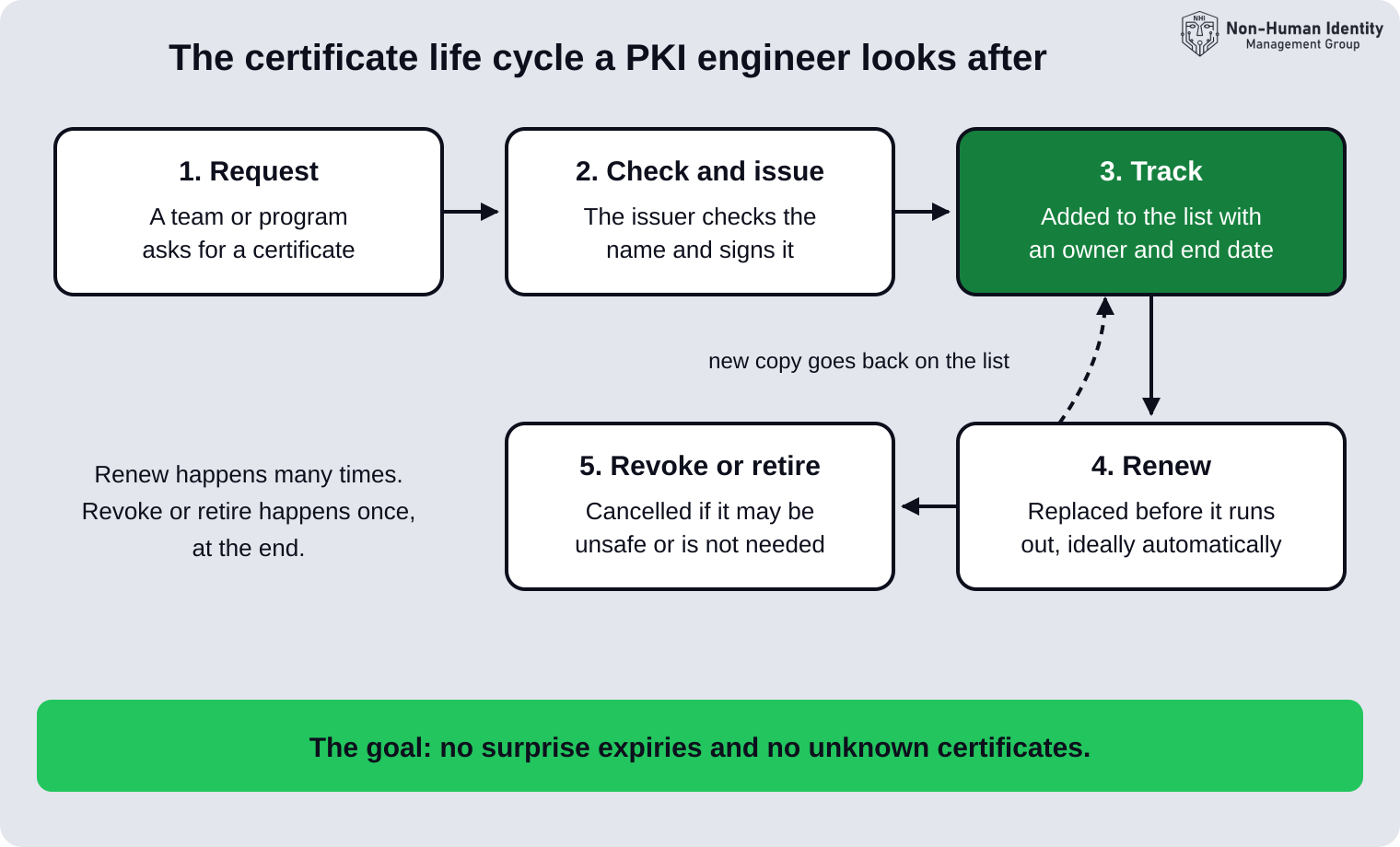
Every organisation is different, but the work usually follows the life of a certificate from start to finish.
- Design and run the issuer. The engineer sets up the organisation's own certificate authority for internal systems, and chooses which outside providers to use for public websites.
- Issue. A team asks for a certificate. The system checks they control the name they asked for, then signs the certificate. A standard protocol called ACME lets software ask for, prove and collect certificates on its own.[3]
- Track. Every certificate goes on the inventory with an owner and an expiry date.
- Renew. Before a certificate runs out, a new one replaces it, ideally with no person involved.
- Cancel. If a certificate's secret key may have leaked, or the system is retired, the engineer revokes it, which means marking it as no longer trusted.
Change is coming fast. The industry group of certificate issuers and browser makers, the CA/Browser Forum, voted in 2025 to shorten how long public website certificates may last.[2] The limit was 398 days. It fell to 200 days for certificates issued from 15 March 2026. It falls to 100 days from 15 March 2027, then to 47 days from 15 March 2029.[1]
At 47 days, renewing by hand becomes hard to keep up with. That is why automation and accurate inventories are now a big part of the job. A US government guide on certificate management describes a formal, organisation-wide programme for this, with automation to help avoid and recover from certificate problems.[4]
Skills and tools
You do not need all of these on day one. Many PKI engineers learn them on the job after starting in system administration or networking.
- How certificates work. What is inside a certificate, who signed it and how a computer decides to trust it.
- Certificate authority software. Running the organisation's own issuer for internal systems.
- Automation and scripting. Writing small scripts and using tools that request and renew certificates without a person.
- Inventory and records. Keeping a reliable list of every certificate, its owner and its expiry date.
- Protecting keys. Keeping the issuer's most important secret keys locked down, often in special tamper-resistant hardware.
- Clear communication. Explaining to other teams, in plain words, what they need to change and by when.
A worked example
This story is made up to show what the job can look like.
Quinn Bergmann is a PKI engineer at Fern Kitchens, a fictional kitchen retailer with shops, a website and a warehouse. Before this, Quinn spent three years on the IT help desk.
Monday starts with the certificate report. The shop website's certificate runs out in nine days, and it is still renewed by hand. Quinn thinks of the licensing office. A document that nobody renews is a document that lapses.
Quinn renews it, then spends the afternoon with the web team. Together they switch the site to automatic renewal, so the next one happens on its own.
On Tuesday, the report shows an expired certificate on a device with no owner. Quinn checks the network records. It is a label printer in the warehouse. The warehouse manager agrees to own it, and Quinn sets it up for automatic renewal too.
On Wednesday, a developer posts a private key in a team chat by mistake. Quinn revokes the matching certificate, issues a new one and helps the developer delete the message.
On Friday, Quinn writes a short note for the IT manager. It shows how many certificates now renew automatically, how many still need work and the dates when public certificate lifetimes get shorter.
What made the difference: Quinn treated the list as the job. Most problems that week were found in the report before they caused an outage.
Myths and mistakes
| What people think | What is true |
|---|---|
| You need a maths degree to work in PKI. | The maths sits inside tested software. The daily job is mostly systems, automation, records and talking to teams. |
| Certificates are a one-off job. | Every certificate has an expiry date, and public ones are getting shorter, so the work keeps coming back. |
| PKI is only about websites. | Certificates are also used by servers talking to each other, devices, Wi-Fi and signed software. |
| Deleting a leaked key is enough. | Copies may exist elsewhere. Revoke the certificate and issue a new one. |
| It is a lonely, back-room job. | A lot of the time goes on helping other teams switch to automatic renewal. |
What can I do this week?
- Click the padlock on three websites and note who issued each certificate and when it expires.
- Read our Public Key Infrastructure for Beginners guide.
- Read three PKI engineer job adverts and list the tasks they share.
- Look up how a free certificate service automates renewal, and write two lines on what it does.
- Ask someone in your IT team how certificates are tracked where you work.
Checklist
- I can explain what a digital certificate is in one sentence.
- I know what a certificate authority does.
- I can name the stages of a certificate's life.
- I know why public certificate lifetimes are getting shorter.
- I can explain why automatic renewal matters.
- I have looked at real job adverts for the role.
- I have checked official sources for pay, not just job boards.
- I have chosen one first learning step.
Common questions
Do I need to be good at maths to become a PKI engineer?
No, not for most roles. The maths is built into tested software. Day to day, you need to know how certificates work and how computers decide to trust them. You also run systems, write small scripts and keep good records. Cryptographer roles are a different job.
What is the difference between a PKI engineer and a cryptographer?
A PKI engineer runs the system that issues and looks after certificates. A cryptographer studies or designs the maths underneath. Some people move between the two, but most PKI work is hands-on. See Cryptographer for Beginners for the other role.
How do people get into PKI work?
Often sideways. Many start in IT support, system administration or networking, look after a few certificates, and grow into the role. Building a small test certificate authority at home and learning a scripting language are common first steps.
How much does a PKI engineer earn?
Pay varies a lot by country, sector and experience, so we do not quote a figure here. Use official career sources for your country, such as the National Careers Service in England, and compare several real job adverts.[5]
Will automation replace PKI engineers?
Automation changes the job more than it removes it. Someone still has to design the system, link it to each team, find unknown certificates and fix problems. Shorter lifetimes make that work more important.
Where next?
Ready for the detail? Read the practitioner guide: Machine Identity, PKI and Certificate Lifecycle Guide. It goes further into certificate lifecycle management programmes, monitoring and metrics, and preparing for post-quantum cryptography.
Also useful:
- Cryptographer and PKI Engineer Career Guide
- Enterprise PKI Design and CA Hierarchy Guide
- NHI Specialist for Beginners
- Mutual TLS for Beginners
Related NHI Mgmt Group resources: Cybersecurity Careers Guide · IT to Cyber Security Career Guide · Non-Human Identities for Beginners
Key terms
- Digital certificate (X.509 certificate)
- A signed file that ties a name, such as a website address, to a public key and has an expiry date.
- An issuer an organisation runs itself, to give certificates to its own internal systems.
- Private key
- The secret half of a key pair. Whoever holds it can act as the certificate's owner, so it must be protected.
- Certificate lifecycle management
- Looking after certificates from request to issue, renewal and retirement.
- Short-lived certificate
- A certificate that expires after a short time, so it is renewed often, usually by automation.
- Machine identity
- The digital identity of a machine, device or workload, such as a server or app.
Sources and further reading
- Baseline Requirements for the Issuance and Management of Publicly-Trusted TLS Server Certificates, version 2.3.1 (maximum validity period table). CA/Browser Forum, GitHub repository cabforum/servercert. https://github.com/cabforum/servercert/blob/main/docs/BR.md, accessed 28 Nov 2026.
- Ballot SC081v3: Introduce Schedule of Reducing Validity and Data Reuse Periods. CA/Browser Forum, voting ended 11 April 2025 (passed). https://cabforum.org/2025/04/11/ballot-sc081v3-introduce-schedule-of-reducing-validity-and-data-reuse-periods/, accessed 28 Nov 2026.
- RFC 8555: Automatic Certificate Management Environment (ACME). IETF, March 2019. https://www.rfc-editor.org/rfc/rfc8555, accessed 28 Nov 2026.
- NIST SP 1800-16: Securing Web Transactions: TLS Server Certificate Management. National Institute of Standards and Technology, June 2020. https://csrc.nist.gov/pubs/sp/1800/16/final, accessed 28 Nov 2026.
- Explore careers. National Careers Service (England). https://nationalcareers.service.gov.uk/explore-careers, accessed 28 Nov 2026.