A cloud engineer builds and runs the systems an organisation rents from online cloud providers.
This guide is for students, career changers and anyone who keeps seeing "cloud engineer" in job adverts and wants to know what the job is. You do not need to know how to code to read it. If your workplace uses online apps, file storage or websites, a cloud engineer probably keeps some of that running.
In short
- A cloud engineer sets up, changes and looks after computers, storage and networks rented from providers such as Amazon, Google or Microsoft.
- The job is mostly building and running things: keeping services up, fast and affordable. Safe settings are part of every task.
- Much of the work is written as text files that describe what to build, so changes can be checked and repeated.
- People come in from IT support, systems or network jobs, software work, apprenticeships and degrees, usually after hands-on practice with one provider.
What you will learn
- Explain what a cloud engineer does in one sentence.
- Describe a normal week in the job.
- Spot how a cloud engineer differs from a cloud security engineer.
- Choose a first step if you want to work towards the role.
- Rented computing (the cloud)
- computers, storage and software you use over the internet from a provider, instead of owning them.
- Building from a written plan (infrastructure as code)
- describing servers and settings in text files, so a tool can build them the same way each time.
- Program accounts (non-human identities)
- the accounts and keys that apps and scripts use to connect to other systems.
What is a cloud engineer?
Think of the stage crew at a theatre. They do not own the building, and they are not the actors. They build the set, run the lights and sound, and fix things fast when something breaks mid-show.
A cloud engineer is the stage crew for an organisation's online systems. The building is rented from a cloud provider. The engineer builds what the organisation needs inside it: servers, storage, networks and databases. Then they keep it running.
The cloud is a way to get computing power over the network, on demand, from a shared pool. It can be set up and released quickly, with little effort from the provider.[1] The provider runs the data centres. The customer still decides how its own systems are set up, who can use them and what data goes in.[2]
Google's entry-level cloud certificate describes the job in a similar way. The engineer deploys and secures apps and systems, watches how they run and keeps them working well.[3]
Where the comparison stops working: a stage set is built once for a show. Cloud systems change every day, and engineers can build a whole new "set" quickly by running a file.
Why does it matter?
Many organisations now run their key systems in the cloud. Someone has to build them well, keep them running and stop the bill from growing out of control. That someone is often a cloud engineer.
If you work in IT support
What could happen: you already reset passwords and set up laptops, but do not see a path into cloud work.
Check this: list the online services you already help run, such as email or shared files. That is cloud experience.
If you are a student
What could happen: you try to learn three cloud providers at once and finish none of them.
Check this: pick one provider and learn its basics first. The ideas carry across to the others.
If you are interested in security
What could happen: you assume cloud engineering is "just building" and miss how much safety work it includes.
Check this: compare a cloud engineer advert with a cloud security engineer advert and mark the shared tasks.
What does it look like?
A lot of cloud engineering happens in short text files that describe what to build. Here is a made-up, simplified example. It is not working code.
Example only. All values are made up.
# plan for a delivery tracking website (EXAMPLE)
server "tracking-web":
  size: small                       (1)
  copies: 2                         (2)
storage "parcel-photos":
  open_to_internet: yes             (3)
app_key: FAKE-KEY-0000-EXAMPLE      (4)
owner: (blank)                      (5)
- How big the rented server is. Bigger costs more.
- Two copies, so the site stays up if one fails.
- Photos anyone online could open.
- A secret key typed straight into the file. In a real file, this line would contain a working key for another service.
- No named owner, so nobody is sure who looks after it.
Why this is risky: the file builds the same mistakes every time it runs. Anyone who can read it can also copy the key.
The safer way: keep storage private unless there is a clear reason. Fetch keys from a locked store when the app runs. Name an owner for every system.
How does it work?
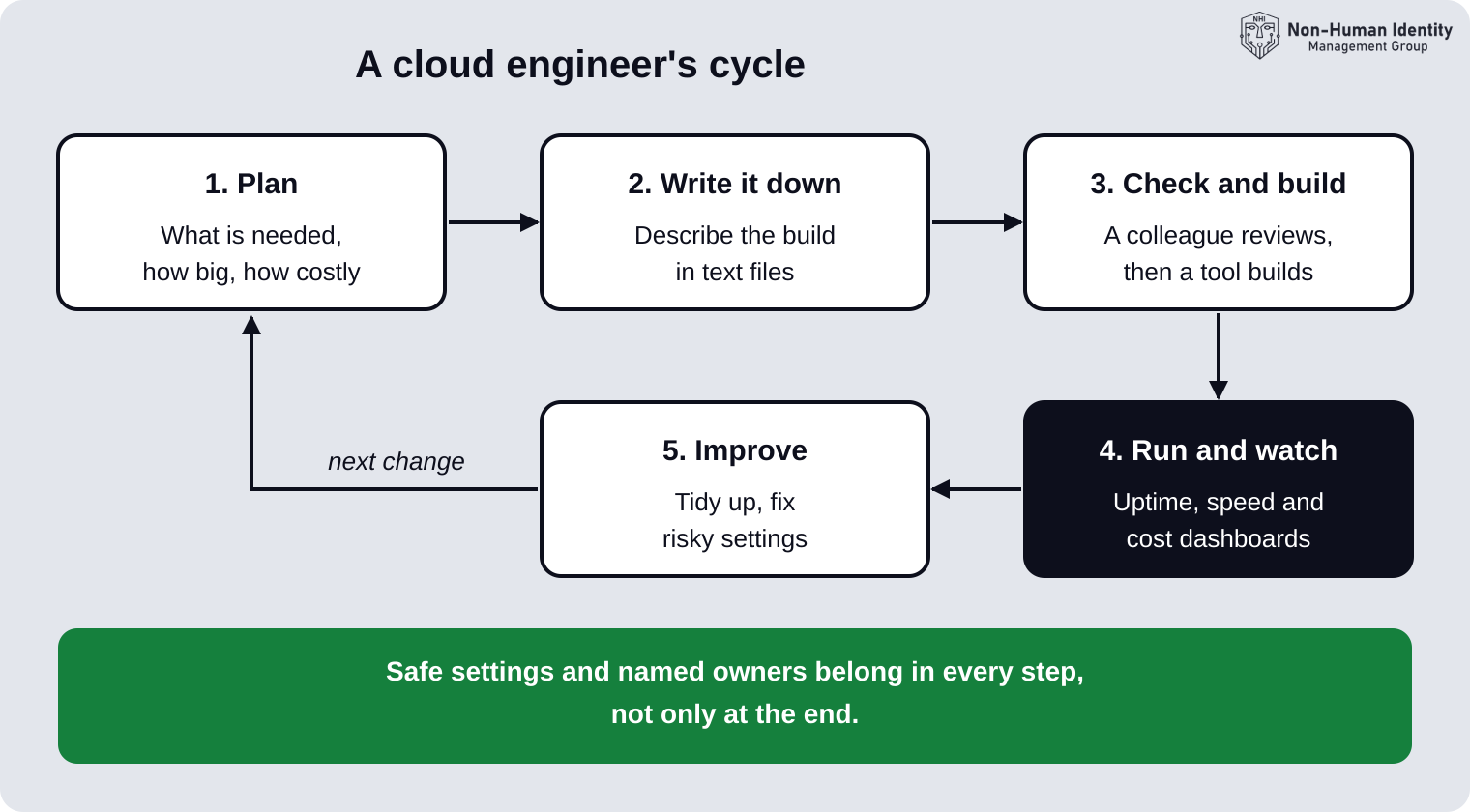
Every team works a little differently, but a lot of cloud work follows this cycle.
- Plan. The engineer agrees with the team what is needed, such as a new website, and how big, fast and costly it should be.
- Write it down. They describe the servers, storage and settings in text files. This is called infrastructure as code. One popular tool reads those files and works out the steps to build what they describe.[4]
- Check and build. A colleague reviews the change. A tool shows what will be created, then builds it.[4]
- Run and watch. Dashboards show whether systems are up, how fast they are and what they cost. Alerts wake someone when things break.
- Improve. The engineer tidies up unused systems, fixes risky settings and makes the next build smoother.
Cloud providers publish guidance on what "well built" means. Amazon's version names six areas to balance: smooth running, security, reliability, speed, cost and sustainability.[5] A cloud engineer juggles all six. A cloud security engineer focuses mainly on one of them.
One part of the job deserves extra care. Apps and scripts need their own accounts and keys to talk to each other. These are non-human identities (NHIs). Cloud engineers create many of them every week, so giving each one only the access it needs, and a named owner, matters a lot.
Skills and tools
- One cloud provider in depth. Its main services for servers, storage, networks and access.
- Basic networking and Linux. How computers find and talk to each other, and how to work at a command line.
- Infrastructure as code. Writing and reviewing the text files that describe a build.
- Some scripting. Small programs that automate repeated jobs.
- Monitoring and cost tracking. Reading dashboards and spotting what is slow, broken or wasteful.
- Clear communication. Explaining trade-offs to people who are not engineers.
Routes in
There is no single route. Many people start in IT support, systems administration or network jobs and move across. Others come from software roles, apprenticeships or computing degrees. Provider certificates can help show your skills. Google, for example, suggests about six months of hands-on use before its entry-level cloud engineer exam.[3]
A worked example
Yara Okafor is a junior cloud engineer at Juniper Couriers, a fictional parcel firm. She moved across from the IT support desk eight months ago.
On Monday, the sales team asks for a page where customers can see photos of delivered parcels. Yara writes a short plan: one small website, two copies for safety and a place to store photos.
She drafts the build file and asks a senior engineer to review it. He spots two problems. The photo storage is open to the whole internet, and a key for the map service is typed into the file.
Yara thinks of the stage crew. A good crew does not leave the backstage door open during the show. She changes the storage so only the website can read the photos. She moves the map key into the company's locked store, so the website fetches it when it runs.
She also adds her team's name as owner of the new program account. The account gets access to the photo store and nothing else.
On Wednesday, the tool shows what it will build, and the change goes live. On Thursday, her cost dashboard shows an old test server still running from a project that ended in spring. She checks with its owner, then switches it off.
On Friday, Yara writes a short note for the team on what she built and why the storage is private. Next month she plans to study for her first cloud certificate.
Myths and mistakes
| What people think | What is true |
|---|---|
| The cloud provider keeps everything safe. | The provider looks after its buildings and hardware. The customer still owns its settings, access and data.[2] |
| You need a computing degree. | Many cloud engineers come from support, systems or network jobs and learn on the job. |
| Cloud engineers just click buttons in a web page. | Much of the work is written as text files that can be reviewed and rerun.[4] |
| Security is someone else's job. | Safe settings are part of every build. Security teams help, but the engineer makes the change. |
| Learn every provider before applying. | Depth in one provider is usually worth more than a little of three. |
What can I do this week?
- Read three cloud engineer job adverts and list the tasks they share.
- Open a free trial account with one provider and follow its beginner tutorial.
- Read our Cloud Computing for Beginners guide.
- Ask someone in your IT team which cloud services your workplace uses and who looks after them.
Checklist
- I can explain what a cloud engineer does in one sentence.
- I know which parts the provider looks after and which the customer looks after.
- I understand what infrastructure as code means.
- I can name the difference between a cloud engineer and a cloud security engineer.
- I have picked one cloud provider to learn first.
- I know that apps and scripts need their own accounts, each with an owner.
- I have checked official sources for pay, not just job boards.
Common questions
Is a cloud engineer the same as a cloud security engineer?
No, but they overlap. A cloud engineer builds and runs cloud systems. They balance speed, cost, reliability and safety. A cloud security engineer focuses on protecting those systems, setting rules and checking settings. Many people do cloud engineering first and then move into the security role.
Do cloud engineers need to code?
Some, yes. Most write infrastructure as code files and small scripts to automate tasks. That is usually simpler than building full apps. You can start with the basics and grow your skills on the job, as many engineers who moved from IT support have done.
Which cloud provider should I learn first?
Pick the one used most where you want to work. Look at local job adverts and see which provider they name most often. The core ideas, such as servers, storage, networks and access rules, carry across, so switching later is easier than starting from zero.
How much does a cloud engineer earn?
Pay varies by country, sector and experience, so we do not quote a figure. Use official sources. In the US, the government's job outlook pages cover related computer roles, such as network architects, whose work includes cloud systems.[6] In the UK, see the National Careers Service.[7]
Where can a cloud engineer job lead?
Several directions. Many move into senior cloud, platform or cloud security roles. Some go on to design whole systems as an architect. The work teaches how modern systems fit together, which helps in most technical careers. See Platform Engineer for Beginners.
Where next?
Ready for the detail? Read the practitioner guide: Cloud Security Engineer Career Guide. It goes further into the security side of cloud work, the tools and provider settings employers test, certifications and how people move from cloud engineering into security.
Also useful:
- Cloud Security Engineer for Beginners
- Shared Responsibility Model for Beginners
- Infrastructure as Code Security for Beginners
- Cloud Workload Identities for Beginners
- Site Reliability Engineer for Beginners
Related NHI Mgmt Group resources: Cybersecurity Careers Guide · IT to Cyber Security Career Guide · Non-Human Identities for Beginners
Key terms
- Cloud computing
- Using computers, storage and software over the internet from a provider, on demand.
- The split of security duties between the cloud provider and the customer.
- Infrastructure as code
- Describing servers and settings in text files so a tool can build them the same way each time.
- Misconfiguration
- A setting left in an unsafe or wrong state, such as storage open to anyone online.
- Service account
- An account used by an app or script, not a person, to connect to other systems.
- Least privilege
- Giving each person or program only the access it needs for its job.
- Uptime
- The share of time a system is working and available to use.
Sources and further reading
- The NIST Definition of Cloud Computing (SP 800-145). US National Institute of Standards and Technology, September 2011. https://csrc.nist.gov/pubs/sp/800/145/final, accessed 28 Nov 2026.
- Shared Responsibility Model. Amazon Web Services. https://aws.amazon.com/compliance/shared-responsibility-model/, accessed 28 Nov 2026.
- Associate Cloud Engineer certification. Google Cloud. https://cloud.google.com/learn/certification/cloud-engineer, accessed 28 Nov 2026.
- What is Terraform? HashiCorp Developer documentation. https://developer.hashicorp.com/terraform/intro, accessed 28 Nov 2026.
- The pillars of the framework, AWS Well-Architected Framework. Amazon Web Services documentation. https://docs.aws.amazon.com/wellarchitected/latest/framework/the-pillars-of-the-framework.html, accessed 28 Nov 2026.
- Computer Network Architects, Occupational Outlook Handbook. US Bureau of Labor Statistics, last modified 27 August 2026. https://www.bls.gov/ooh/computer-and-information-technology/computer-network-architects.htm, accessed 28 Nov 2026.
- Explore careers. National Careers Service (England). https://nationalcareers.service.gov.uk/explore-careers, accessed 28 Nov 2026.