The Privacy Act 1988 is Australia's main law on how organisations collect, use, share and protect personal information.
This guide is for anyone in Australia, or doing business there, who wants to know what the law asks in plain words. You do not need a legal background. If your organisation keeps names, emails or customer records, this law may already apply to you.
In short
- The Act sets 13 rules, called the Australian Privacy Principles. They cover collecting, using, sharing, storing and correcting personal details.[1]
- It covers government agencies and most businesses with yearly turnover above A$3 million. Some smaller ones are covered anyway, such as health service providers.[3]
- A data breach likely to cause serious harm must be reported to the people affected and to the privacy regulator, the OAIC.[4]
- Since 10 June 2025, people can also go to court over a serious invasion of their privacy.[6]
What you will learn
- Explain what the Privacy Act is and who it covers.
- Spot which of the 13 principles matter most to your work.
- Check what to do if personal details are lost or seen by the wrong people.
- Ask the right questions about your own data as a customer.
Status: correct as at 28 November 2026, based on official pages from the Office of the Australian Information Commissioner (OAIC). Laws change; check the official text.
This guide explains the topic in general terms and is not legal advice.
- Personal details (personal information)
- information or an opinion about a person who can be identified, such as a name, address or photo.
- Privacy rules (Australian Privacy Principles)
- the 13 rules in the Act that say how personal details must be handled.
- Privacy regulator (OAIC)
- the Office of the Australian Information Commissioner, which oversees the Act.
What is the Australia Privacy Act?
Think of borrowing a book from a library. You borrow it for a reason. You keep it safe, and you do not lend it to strangers. When you are done, you hand it back.
The Privacy Act asks organisations to treat your personal details in a similar way. They should collect them for a clear reason. They should use them for that reason, keep them safe and get rid of them when they are no longer needed.[2]
The rules apply to personal information. That is information, or an opinion, that could identify you. Examples are your name, phone number, photo, IP address (the number that identifies a device online) and phone location data.[5] Some details, such as health, religion or a criminal record, are called sensitive information. They get extra protection.[5]
Where the comparison stops working: a library book is one copy. Personal details can be copied many times, so a business may not know every place they have gone.
Why does it matter?
Breaking a privacy principle counts as an interference with a person's privacy. It can lead to action by the regulator and to penalties.[1]
If you are a customer
What could happen: a shop holds wrong details about you, or will not say what it holds.
Check this: you can ask to see your details, and ask for wrong ones to be fixed.
If you run a small business
What could happen: you assume the Act does not apply, but your type of business is covered anyway.
Check this: go through the OAIC's small business checklist once a year.
If you are new to IT work
What could happen: a customer list is left in a shared folder that anyone can open.
Check this: keep personal details only where access is limited, and delete old copies.
If you write privacy policies or forms
What could happen: a sign-up form collects details with no clear reason given.
Check this: say who you are, why you collect each detail and who you share it with.
What does it look like?
Here is a made-up "Am I affected?" check. A business might fill it in. Use it to start a talk with your adviser.
Example only. All values are made up.
Business: Example Tutoring Pty Ltd (example.com)
Yearly turnover: A$0,000,000 (FAKE)
1. Turnover above A$3 million in any year since 2002?  [ ] yes [x] no  (1)
2. A health service provider?                          [ ] yes [x] no  (2)
3. Sell or trade personal details?                     [ ] yes [x] no  (3)
4. A contractor to the Australian Government?          [x] yes         (4)
Result: the Privacy Act applies. Read the 13 principles.
- Turnover is the first test. The OAIC checklist asks about every year since 2002.
- Health service providers are covered whatever their size.
- Businesses that trade in personal details are covered too, in most cases.
- In a real file, this line would name the government contract that brings the business in.
Why this is risky: a business that answers only the turnover question may wrongly decide the law does not apply.
The safer way: answer every question on the OAIC checklist, keep the result, and check it again each year.[3]
How does it work?
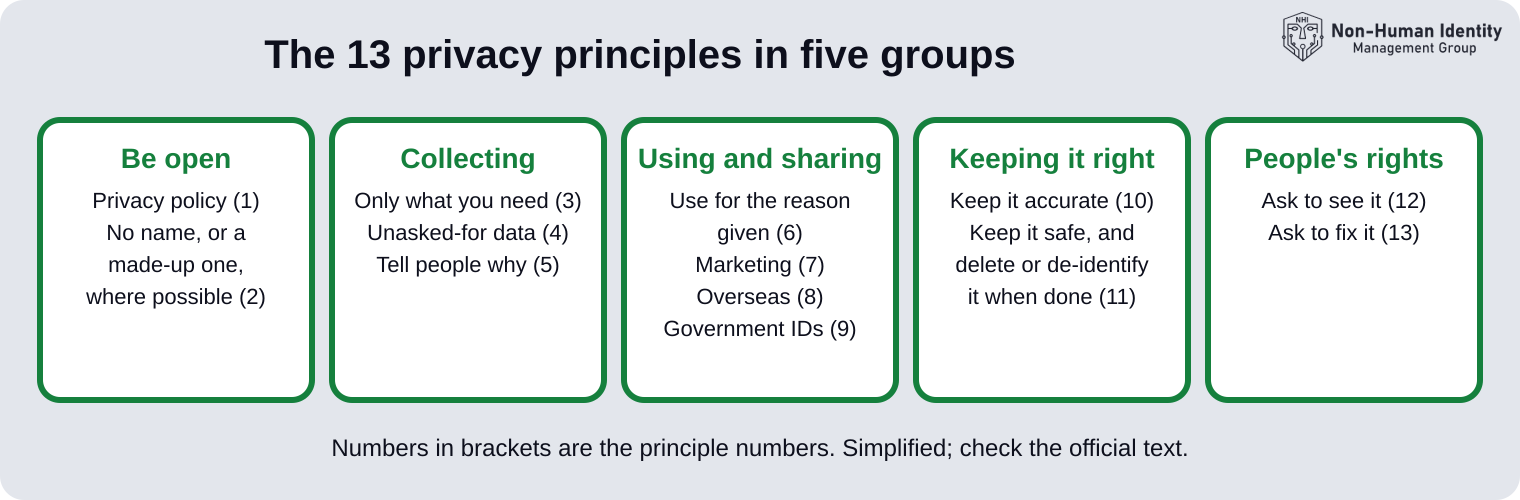
The 13 principles follow personal details through their life with an organisation.[2]
- Be open. Have a clear, free privacy policy. It says what you hold, why, how people can see or fix it, how to complain and whether data goes overseas.
- Collect with care. When you collect details, tell people who you are, why you want them and who you usually share them with.
- Use them for the reason given. In general, do not use details for a different purpose without consent, unless an exception applies. Direct marketing, meaning messages that try to sell, has its own rule.
- Keep them safe. Protect details from misuse, loss and access by the wrong people. When you no longer need them, destroy them or remove what identifies the person.
- Let people see and fix them. People can ask for their details and ask for wrong ones to be corrected.
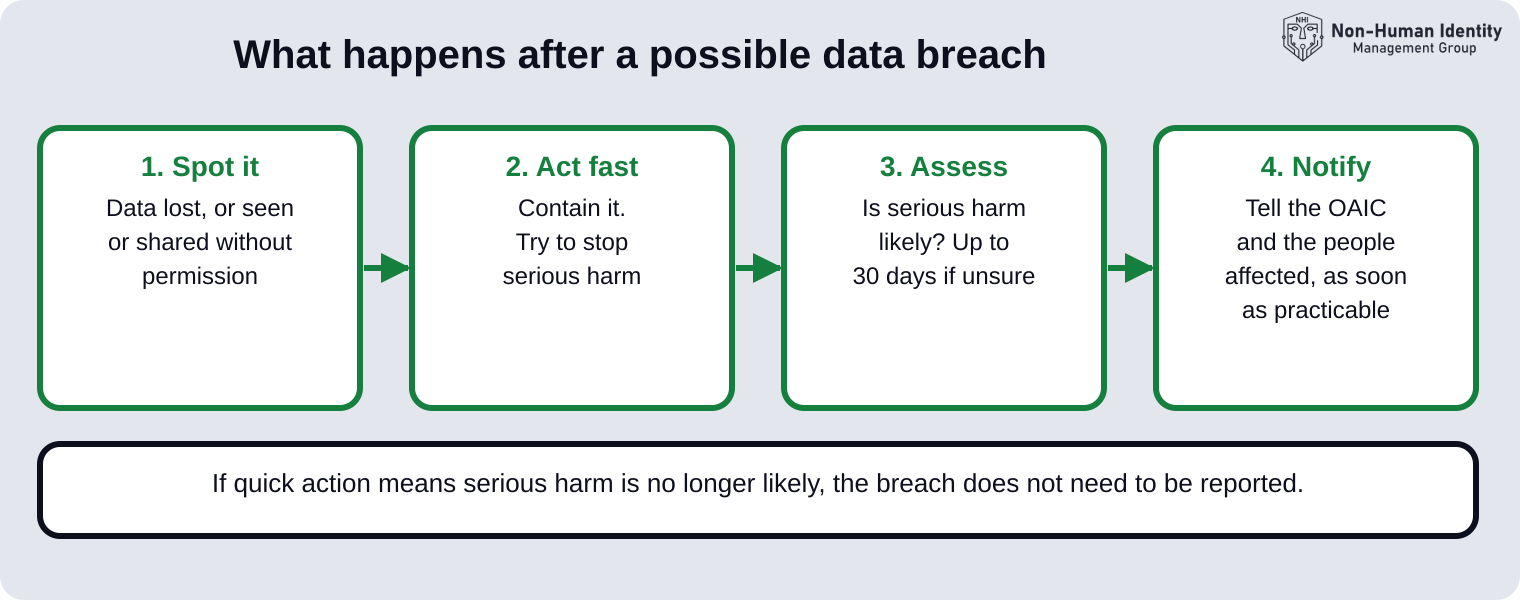
The Act also has a data breach scheme, called the Notifiable Data Breaches scheme. It has applied to breaches since 22 February 2018.[4] A breach must be reported when three things are true. Personal details were lost, or seen or shared without permission. Serious harm to someone is likely. And quick action has not removed that likelihood.[4]
If a business only suspects a breach, it must check quickly. It must take all reasonable steps to finish within 30 days. Then it tells the OAIC and the people affected, as soon as practicable.[4]
A worked example
Lina Engel runs a made-up tutoring business in Adelaide called Wattle Lane Tutoring. Her turnover is well under A$3 million.[3] But the business tutors students for a government programme, under a government contract.
Last year, Lina went through the OAIC small business checklist. She found that a business providing services under a Commonwealth contract can be covered, whatever its size.[3] So she treats the Act as applying to Wattle Lane.
One Thursday, a tutor emails a spreadsheet of student names and school reports to the wrong parent. Lina acts fast. She calls the parent, who agrees to delete the email and confirms in writing that it is gone.
Next, Lina writes down what happened and when. She asks whether serious harm is still likely. The file went to one person, who deleted it quickly and confirmed this. She decides that serious harm is not likely, and she notes her reasons.[4]
She knows that if the facts change, she may need to look again. If the file turned up somewhere else, she would tell the OAIC and the families.
Afterwards, Lina makes two changes. Student reports now go through the booking system, not by email. And staff now check the address before sending any file with personal details.
Myths and mistakes
| What people think | What is true |
|---|---|
| Small businesses are never covered. | Most with turnover of A$3 million or less are not, but some are covered anyway, such as health service providers.[3] |
| Every data breach must be reported. | Only those likely to cause serious harm, where quick action has not removed that risk.[4] |
| Personal information means only names and addresses. | It also covers things like photos, IP addresses and phone location data.[5] |
| Once we have your data, we can use it for anything. | In general, details may be used only for the reason they were collected, unless consent or an exception applies.[2] |
| Keeping data for as long as possible is the safe choice. | Details no longer needed should be destroyed or de-identified, unless the law says to keep them.[2] |
What can I do this week?
- Run the OAIC small business checklist, even if you think you are too small.
- Read your privacy policy as a customer would. Does it say what you hold, why, and how to complain?
- List where personal details live, such as email, spreadsheets, apps and paper files.
- Delete one old copy of personal details you no longer need.
- Write down who decides whether a breach must be reported, and name a backup.
Checklist
- We know whether the Privacy Act applies to us, and why.
- Our privacy policy is up to date and free to read.
- Our forms say why we collect each detail.
- Personal details are stored where only the right people can open them.
- We delete or de-identify details we no longer need.
- We can answer a request to see or correct someone's details.
- We know the three tests for a breach that must be reported.
- One named person owns breach decisions, with a backup.
Common questions
How do I make a privacy complaint?
Complain to the organisation first. If it does not reply within 30 days, or you are unhappy with the answer, you can complain to the OAIC. Some complaints, such as those about banks or phone companies, may first go to an industry complaints scheme.[7]
Can I see the details a business holds about me?
Yes, in most cases. Under the principles you can ask for access. A business must reply within a reasonable time. It may charge a fee for giving access, but the fee must not be excessive, and asking is free. A refusal must come with reasons in writing.[2]
Can a business send my details overseas?
It can, but it must take reasonable steps to make sure the overseas receiver will not break the principles. There are exceptions. Its privacy policy should say whether your details are likely to go overseas.[2]
What is the new privacy right to sue?
It is a statutory tort, a right to go to court, which started on 10 June 2025. A person can claim for a serious invasion of privacy, such as misuse of information about them. The courts handle these claims, not the OAIC.[6]
Does the Act cover information about people who have died?
No. The OAIC says the Privacy Act does not cover the personal information of people who have died. The Act protects the details of living people who can be identified, such as customers, staff and patients.[5]
Where next?
Ready for the detail? Read the practitioner guide: Australia Notifiable Data Breaches Scheme Guide. It goes further into the three-part breach test, how to run the 30-day assessment and what the statement to the OAIC must contain.
Also useful:
- Australian Cyber Security Laws for Beginners
- Australia Privacy Act Reforms Guide
- Data Breach Notification for Beginners
- Personal Data for Beginners
Related NHI Mgmt Group resources: Australian Privacy and Cyber Rules Guide · Data Protection Laws Worldwide for Beginners · Privacy Notices for Beginners
Key terms
- Privacy Act 1988
- Australia's main law on how organisations handle personal information.
- Australian Privacy Principles
- The 13 rules in the Act on collecting, using, sharing, protecting and correcting personal information.
- Personal information
- Information or an opinion about a person who is identified or can reasonably be identified.
- Sensitive information
- Personal information such as health, religion or criminal record, which gets extra protection.
- Notifiable Data Breaches scheme
- The part of the Act that says when a data breach must be reported to the people affected and the OAIC.
- Privacy policy
- A public document that explains how an organisation handles personal information.
- Statutory tort
- A right to sue set out in law; in Australia, one now covers serious invasions of privacy.
Sources and further reading
- Australian Privacy Principles. Office of the Australian Information Commissioner (OAIC). https://www.oaic.gov.au/privacy/australian-privacy-principles, accessed 28 Nov 2026.
- Read the Australian Privacy Principles. OAIC. https://www.oaic.gov.au/privacy/australian-privacy-principles/read-the-australian-privacy-principles, accessed 28 Nov 2026.
- Small business. OAIC. https://www.oaic.gov.au/privacy/privacy-for-organisations/small-business, accessed 28 Nov 2026.
- Data breach preparation and response, Part 4: Notifiable Data Breach (NDB) Scheme. OAIC. https://www.oaic.gov.au/privacy/guidance-and-advice/data-breach-preparation-and-response/part-4-notifiable-data-breach-ndb-scheme, accessed 28 Nov 2026.
- What is personal information? OAIC. https://www.oaic.gov.au/privacy/your-privacy-rights/your-personal-information/what-is-personal-information, accessed 28 Nov 2026.
- Statutory tort for serious invasions of privacy. OAIC. https://www.oaic.gov.au/privacy/your-privacy-rights/more-privacy-rights/statutory-tort-for-serious-invasions-of-privacy, accessed 28 Nov 2026.
- Lodge a privacy complaint with us. OAIC. https://www.oaic.gov.au/privacy/privacy-complaints/lodge-a-privacy-complaint-with-us, accessed 28 Nov 2026.