Australia has several laws that set cyber security duties for businesses, especially around protecting data and reporting incidents.
This guide is for anyone in Australia, or doing business there, who wants a plain map of the main rules. You do not need a legal or technical background. If your business holds customer details or pays a ransom after an attack, some of these rules may apply to you.
In short
- There is no single cyber law. The main rules sit in the Privacy Act, the critical infrastructure law (SOCI Act) and the Cyber Security Act 2024.
- The Privacy Act covers most businesses with yearly turnover above A$3 million, plus some smaller ones such as health providers. Certain data breaches must be reported.[1]
- The SOCI Act covers critical infrastructure in 11 sectors. Serious cyber incidents must be reported within 12 or 72 hours.
- Since 30 May 2025, businesses with turnover of A$3 million or more must report a ransom payment within 72 hours.[5]
What you will learn
- Explain which main Australian laws deal with cyber security.
- Check which of them might apply to your organisation.
- Spot the reporting clocks that start after an incident.
- Ask the right first questions of your adviser or regulator.
Status: correct as at 28 November 2026, based on official pages from the Department of Home Affairs, the Cyber and Infrastructure Security Centre, the Australian Signals Directorate and the Office of the Australian Information Commissioner. Laws change; check the official text.
This guide explains the topic in general terms and is not legal advice.
- Essential services (critical infrastructure)
- services such as power, water, banking and health that the country relies on.
- Must-report breach (notifiable data breach)
- a data breach likely to cause serious harm, which must be reported.
- Ransom payment report
- a short report to government after a business pays criminals who are holding its systems or data hostage.
What are Australian cyber security laws?
Think of the rules for running a café. Food safety, fire safety and staff pay each have their own law. Each has its own inspector, too.
Cyber rules in Australia work in a similar way. There is no single cyber law. A few main laws each cover a different job.
- The Privacy Act 1988 is about personal details. It says when a data breach must be reported.
- The SOCI Act is short for the Security of Critical Infrastructure Act 2018. It covers firms that run essential services.
- The Cyber Security Act 2024 adds newer rules. One is reporting ransom payments. Another sets basic security for smart devices.
Where the comparison stops working: a café owner usually knows which inspector to call. One cyber attack can touch more than one law, so you may need to report to more than one place.
Why does it matter?
After a cyber attack, some reports have short deadlines. If you know the rules first, you save time when it counts.
If you run a small business
What could happen: you think privacy law does not apply because you are small. But your type of business is covered anyway.
Check this: read the regulator's list of small firms that are always covered.
If you work for an essential service
What could happen: staff spot a serious attack late on a Friday. Nobody knows a 12-hour clock has started.
Check this: ask who owns incident reports, and where the steps are written down.
If you lead a medium or large business
What could happen: under pressure, the business pays a ransom and forgets the 72-hour report.
Check this: add the ransom payment report to your incident plan, with a named owner.
Next: Ransomware for Beginners
If you make or sell smart devices
What could happen: a product uses the same default password on every unit. It may not meet the new rules.
Check this: make sure each product has its own password and says how long it gets updates.
What does it look like?
Here is a made-up "Am I affected?" check that a business might fill in. Use it as a starting point for a talk with your adviser.
Example only. All values are made up.
Business: Example Clinic Pty Ltd (example.com)
Yearly turnover last financial year: A$0,000,000 (FAKE)
1. Turnover above A$3 million?             [ ] yes  [x] no   (1)
2. A health provider, or another covered type? [x] yes      (2)
3. Run a critical infrastructure asset?    [ ] yes  [x] no   (3)
4. Make or sell consumer smart devices?    [ ] yes  [x] no   (4)
Result: Privacy Act applies. Check the data breach scheme.
- Turnover affects both the Privacy Act and the ransom payment report.
- Some smaller businesses are covered by the Privacy Act anyway, such as health providers.
- If yes, the SOCI Act rules may apply. In a real file, this line would name the asset and sector.
- If yes, the smart device security rules may apply to new products.
Why this is risky: a business that answers only the turnover question might wrongly decide that no rules apply.
The safer way: answer every question, keep the result with your incident plan, and check it each year.
How does it work?
Each law covers a different group. Each one asks for different things.
- Privacy Act and data breaches. The Act covers most firms with yearly turnover above A$3 million. It also covers some smaller ones, such as health providers.[1] Some breaches are likely to cause serious harm to a person. For those, the firm must tell the people affected. It must also tell the privacy regulator, called the OAIC.[2]
- SOCI Act and essential services. The Act covers 11 sectors, such as energy, water, health, banking and transport. Owners may need to register their assets and report attacks. Some must also keep a written risk plan.[3]
- SOCI attack reports. A critical attack with a big impact must be reported within 12 hours. Other attacks that must be reported have 72 hours. The clock starts when you find out.[4]
- Ransom payment reports. This rule started on 30 May 2025. Firms with yearly turnover of A$3 million or more must report a ransom payment within 72 hours. Critical infrastructure owners must report too. The rule applies only when a payment is made.[5]
- Other parts of the Cyber Security Act 2024. It sets basic security rules for home smart devices. It limits how facts you share with government in an attack can be used. It also sets up a review board that looks at major attacks without blame.[6]
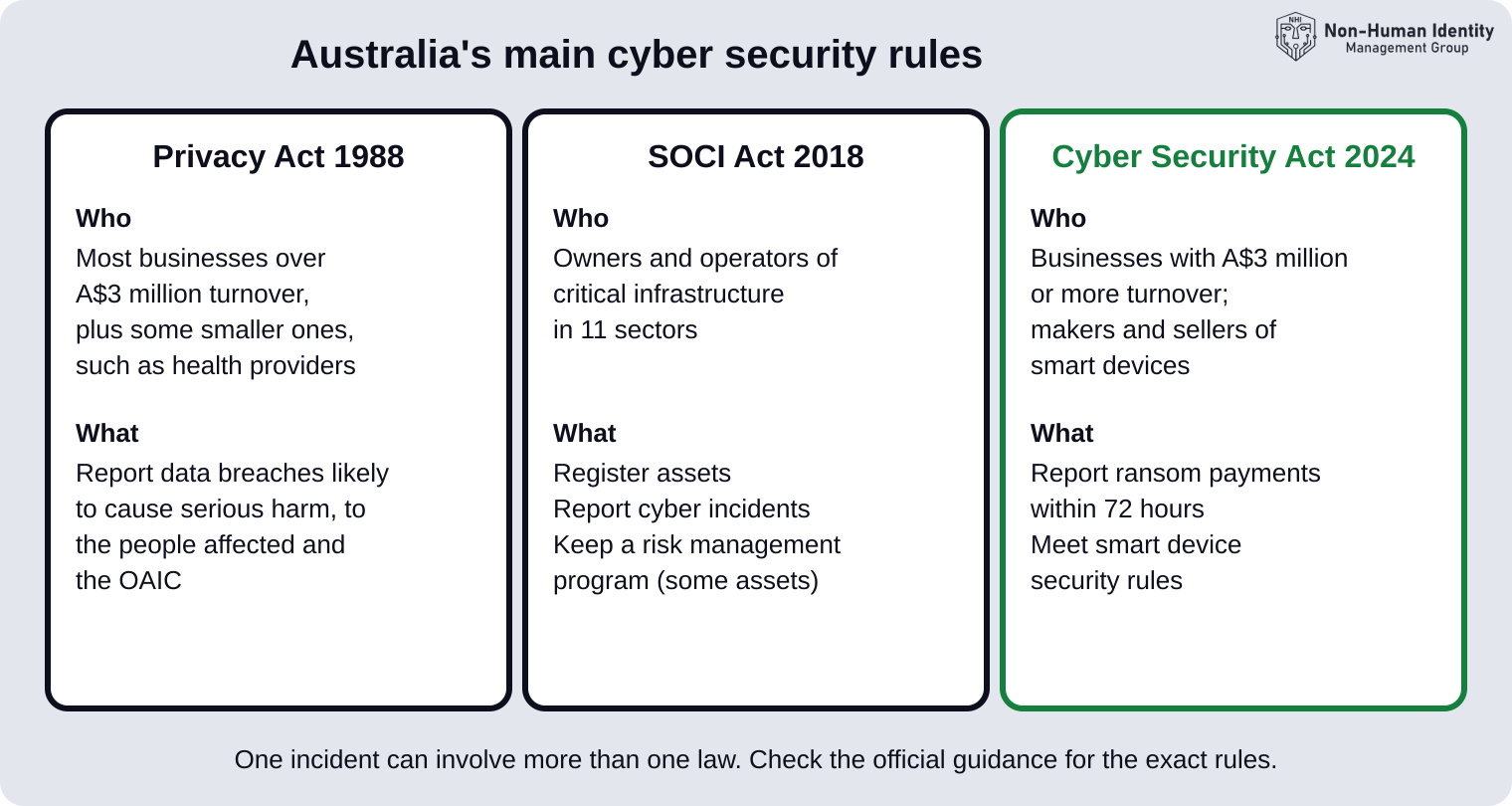
The smart device rules apply to most home devices made on or after 4 March 2026. Devices may not share one default password. Makers must publish a way to report security flaws. They must also say how long the device will get updates.[7]
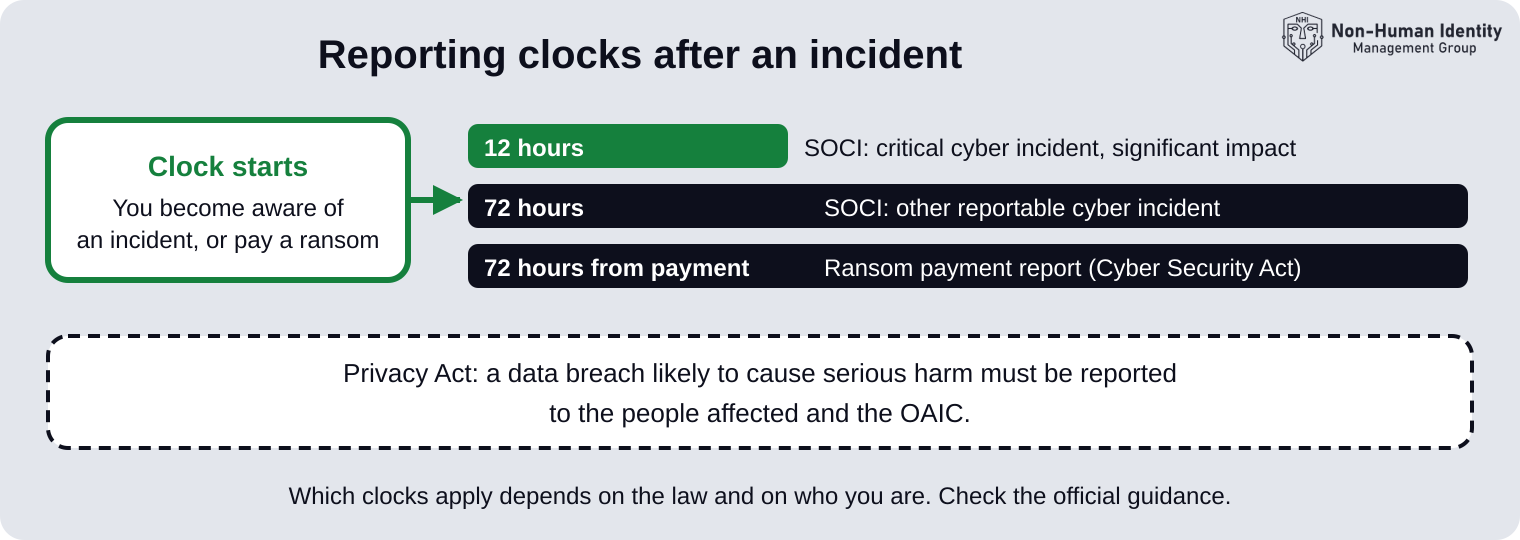
A worked example
Reza Abara runs a made-up physiotherapy clinic in Perth called Saltbush Physio. It has eight staff and a yearly turnover of about A$2 million.[1]
One Monday, staff find that the booking system is locked. A message demands payment to unlock it. It also claims that patient records have been copied.
Reza calls the clinic's IT supplier, who isolates the affected computers. Then Reza goes through the "Am I affected?" check he wrote last year.
The clinic is below the A$3 million line. But it is a health service provider, so the Privacy Act applies anyway.[1] Patient records are sensitive, so a leak is likely to cause serious harm. Reza starts the data breach steps: he plans to tell the affected patients and the OAIC.
He also checks the ransom payment rule. The clinic is below the turnover line, and it does not plan to pay. The clinic is also not a critical infrastructure asset, so the SOCI reporting clocks do not apply.
The supplier restores the booking system from a backup kept offline. Reza sends the notices and records each decision with the date and time.
Afterwards, he adds two items to the clinic's plan. One is a contact list for the OAIC and the clinic's insurer. The other is a yearly check of whether the clinic has grown past A$3 million.[5]
Myths and mistakes
| What people think | What is true |
|---|---|
| Small businesses are never covered by the Privacy Act. | Most with turnover of A$3 million or less are not, but some types are covered anyway, such as health providers.[1] |
| Australia has one cyber security law. | Several laws share the job, including the Privacy Act, the SOCI Act and the Cyber Security Act 2024. |
| You must report every ransom demand. | The ransom report applies when a payment is made by or for a business in scope. A demand that goes unpaid does not trigger it.[5] |
| SOCI only matters to power and water companies. | It covers 11 sectors, including health, food and grocery, higher education and data storage.[3] |
| Sharing details with government during an incident will be used against you. | The Cyber Security Act 2024 limits how information shared voluntarily during an incident can be used.[6] |
What can I do this week?
- Fill in an "Am I affected?" check like the sample above. Keep it with your incident plan.
- Write down who you would report to. Start with the OAIC. Add the government cyber reporting page if you are in scope.
- Name one person who makes reporting decisions after an attack. Name a backup too.
- Check your turnover against the A$3 million line once a year.[1]
- Ask your IT supplier how fast they would tell you about an attack.
Checklist
- We know whether the Privacy Act applies to us, and why.
- We know what counts as a data breach likely to cause serious harm.
- We know whether we run a critical infrastructure asset under the SOCI Act.
- If we are in scope, our plan includes the 12-hour and 72-hour SOCI reporting clocks.
- Our plan includes the 72-hour ransom payment report, if we are in scope.
- One named person owns reporting decisions, with a backup.
- We review our "Am I affected?" check every year.
Common questions
Do I have to report every data breach?
No. If the Privacy Act covers you, you report a breach that is likely to cause serious harm to someone. A lost laptop, a hacked database or details sent to the wrong person can all be breaches. You tell the people affected and the OAIC.[2]
Who do I report a ransom payment to?
You use a form on the website of the Australian Signals Directorate, the government's cyber agency. The Department of Home Affairs runs the scheme. You only need to report what you know, or can find out with a reasonable search.[5][8]
Does the SOCI Act apply to my business?
Probably not, if you are a small firm. It covers owners and operators of certain critical assets in 11 sectors. If you run or supply an essential service, read the official guidance or ask an adviser to be sure.[3]
What if a business does not report a ransom payment?
It can face a fine, called a civil penalty. The government said it would focus on teaching firms about the rule until the end of 2025. From 1 January 2026, it said it would check more actively.[5]
Is the Essential Eight one of these laws?
No. The Essential Eight is a set of eight security steps from the Australian Signals Directorate. It is advice, not one of the laws on this page. Many firms still use it as a good place to start.
Where next?
Ready for the detail? Read the practitioner guide: Australia SOCI Act Guide. It goes further into the asset classes, the risk management program rules and how the SOCI duties map to security frameworks.
Also useful:
- Australia Cyber Security Act 2024 Guide
- Australia Notifiable Data Breaches Scheme Guide
- Essential Eight for Beginners
- Incident Response for Beginners
Related NHI Mgmt Group resources: Australian Privacy and Cyber Rules Guide · Ransomware Payments and Sanctions Guide · APAC Cybersecurity Laws Compared · Critical Infrastructure Regulation Map
Key terms
- Privacy Act 1988
- Australia's main law on how organisations handle personal information.
- Notifiable Data Breaches Scheme
- The part of the Privacy Act that says when a data breach must be reported to the people affected and the OAIC.
- Critical infrastructure
- Essential services, such as power, water, health and banking, that a country relies on.
- Critical Infrastructure Risk Management Program
- A written plan, required for some SOCI assets, for finding and reducing risks to the asset.
- Ransomware Payment Reporting
- A legal duty to tell government when a business in scope pays a ransom.
- Cyber Incident Reporting
- Telling a government body about a cyber attack or security problem, often within a set time.
- Essential Eight
- A set of eight security measures recommended by the Australian Signals Directorate.
Sources and further reading
- Small business. Office of the Australian Information Commissioner (OAIC). https://www.oaic.gov.au/privacy/privacy-for-organisations/small-business, accessed 28 Nov 2026.
- About the Notifiable Data Breaches scheme. OAIC. https://www.oaic.gov.au/privacy/notifiable-data-breaches/about-the-notifiable-data-breaches-scheme, accessed 28 Nov 2026.
- Security of Critical Infrastructure Act 2018. Cyber and Infrastructure Security Centre (CISC), Department of Home Affairs. https://www.cisc.gov.au/legislation-regulation-and-compliance/soci-act-2018, accessed 28 Nov 2026.
- Mandatory cyber incident reporting: guidance for responsible entities. CISC, April 2025. https://www.cisc.gov.au/resources-subsite/Documents/mcir-guidance.pdf, accessed 28 Nov 2026.
- Factsheet: Ransomware payment reporting. Department of Home Affairs. https://www.homeaffairs.gov.au/cyber-security-subsite/files/factsheet-ransomware-payment-reporting.pdf, accessed 28 Nov 2026.
- Cyber Security Act 2024. Department of Home Affairs. https://www.homeaffairs.gov.au/about-us/our-portfolios/cyber-security/cyber-security-act, accessed 28 Nov 2026.
- Security standards for smart devices. Department of Home Affairs. https://www.homeaffairs.gov.au/about-us/our-portfolios/cyber-security/security-standards-for-smart-devices, accessed 28 Nov 2026.
- Ransomware payment and cyber extortion payment reporting. Australian Signals Directorate (ASD). https://www.cyber.gov.au/ransomware-payment-and-cyber-extortion-payment-reporting, accessed 28 Nov 2026.