A chargeback is when a customer's bank takes back a card payment after the customer disputes it.
This guide is for small online shop owners and anyone new to taking card payments. You do not need a finance background. If you sell anything online and accept cards, a chargeback can take money out of your account weeks after the sale.
In short
- A customer can ask their card provider to reverse a payment, for example for fraud or goods that never arrived.
- The money, plus a fee, is usually taken from the shop straight away, and the customer's bank decides who wins.
- Card fraud is the most common reason, and those disputes are hard to win because the claim is often true.
- Clear shop names, clear policies, tracked delivery and fast replies to customers help avoid many chargebacks.
What you will learn
- Explain what a chargeback is and who decides it.
- Spot the common reasons customers dispute payments.
- Check what evidence your shop keeps for each order.
- Ask your payment provider how disputes reach you and how fast you must reply.
- Payment dispute (chargeback)
- a card payment reversed by the customer's bank after the customer questions it.
- Customer's bank (card issuer)
- the bank or firm that gave the customer their card, and decides the dispute.
- Name on the statement (statement descriptor)
- the shop name that appears on the customer's card statement.
What is a chargeback?
Think of a video review in football. A goal is scored, then someone questions it. The goal comes off the scoreboard while the referee looks at the evidence, and the referee's call is what counts.
A chargeback works the same way. A customer pays, then contacts the bank that gave them their card to question the payment.[1] The money is usually taken back from the shop while the case runs. The shop can send evidence, and the customer's bank makes the final decision.[1]
A refund is different. With a refund, the shop chooses to give money back. With a chargeback, the customer goes to their bank instead, and the shop has no choice about the money leaving its account.
Where the comparison stops working: a football review takes minutes. A chargeback can take two to three months from start to finish, and the shop usually pays a fee even if it wins.[1]
Why does it matter?
Each chargeback can cost the sale, the goods and a fee. Card fraud is the most common reason customers dispute payments.[2] A shop with too many disputes can put its payment account at risk. It may also be placed in a card brand monitoring programme.[4]
If you run a small online shop
What could happen: a criminal pays with a stolen card, you send the goods, and weeks later the real cardholder disputes it.
Check this: ask your payment provider which fraud checks are switched on for your shop.
If you answer customer emails
What could happen: a customer who cannot reach you about a late parcel goes to their bank instead.
Check this: make your contact details easy to find, and reply to delivery questions quickly.
If you are new to payments work
What could happen: a dispute notice sits unread in an inbox, and the deadline passes.
Check this: find out where dispute alerts arrive and who must act on them.
What does it look like?
Here is a made-up dispute notice, of the kind a payment provider might send a small shop.
Example only. All values are made up.
New dispute on payment EXAMPLE-PAY-0000
Amount disputed:   £64.00                      (1)
Dispute fee:       £0.00 (example)             (2)
Reason:            Product not received        (3)
Card ending:       0000
Respond by:        00 Month 0000               (4)
Status:            Needs response
- The amount the customer's bank has taken back, often the full price.
- In a real message, this line would contain the fee your provider charges for each dispute.
- The reason the customer gave. The evidence you need depends on it.
- The deadline. If you miss it, you are likely to lose the case.
Why this is risky: the money has already left the shop's account. If nobody sees the notice before the deadline, the shop loses by default.
The safer way: the shop sends dispute alerts to a shared inbox someone checks daily. For "not received", it sends the delivery tracking record as screenshots, because banks may not follow links.[4]
How does it work?
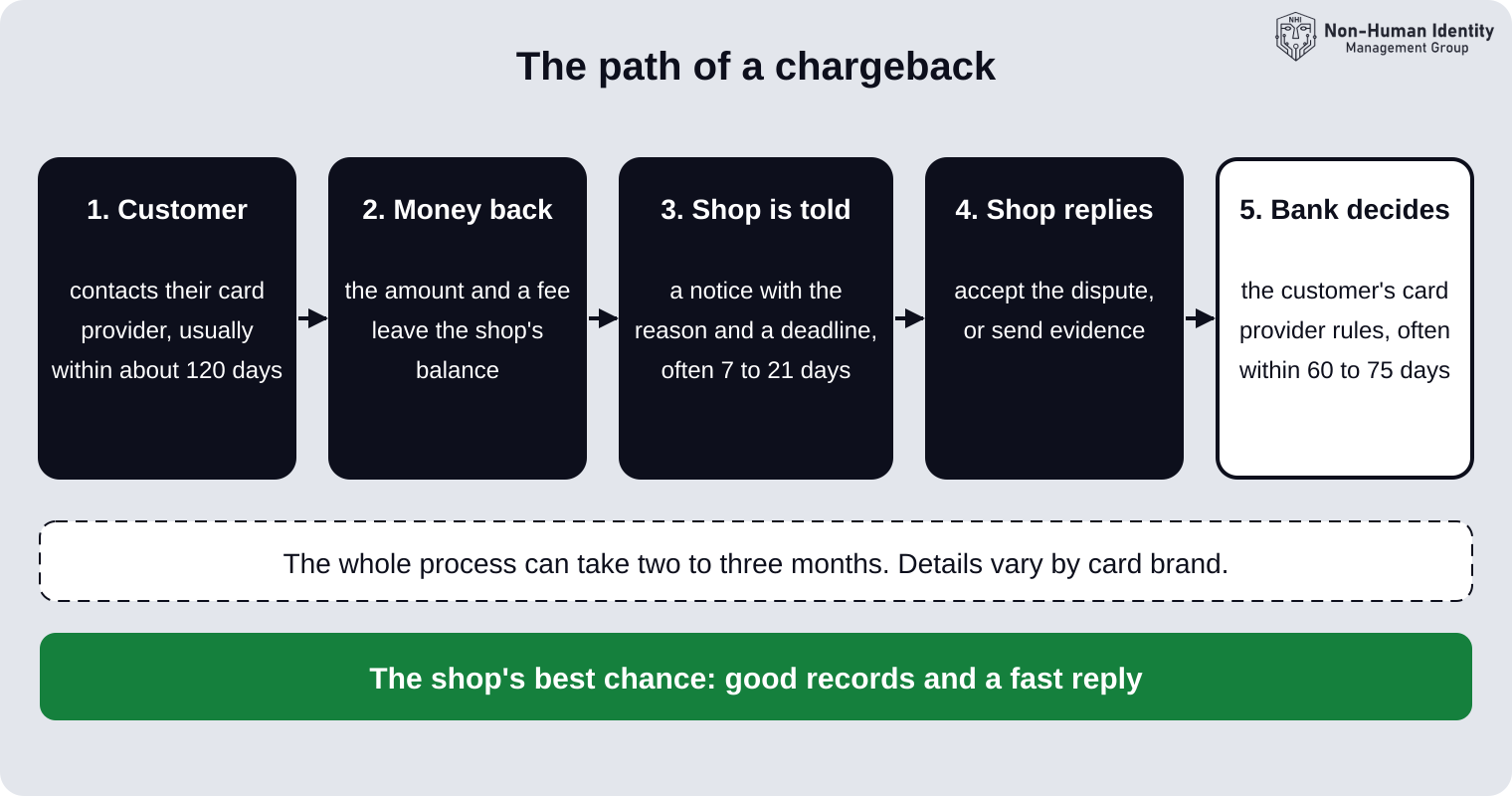
Here is the usual path of a card dispute. Exact rules vary between card brands and providers.
- The customer disputes. They contact their card provider, usually within about 120 days of paying. Some card rules allow longer.[1]
- The money is taken back. The shop's payment provider takes the disputed amount, plus a dispute fee, from the shop's balance.[1]
- The shop is told. The provider sends a notice with the reason and a deadline. Replies are usually due within 7 to 21 days.[1]
- The shop decides. It can accept the dispute, or send evidence such as receipts, tracking records and messages with the customer.[1]
- The bank rules. The customer's card provider reviews the evidence, usually within 60 to 75 days. If the shop wins, the money comes back.[1]
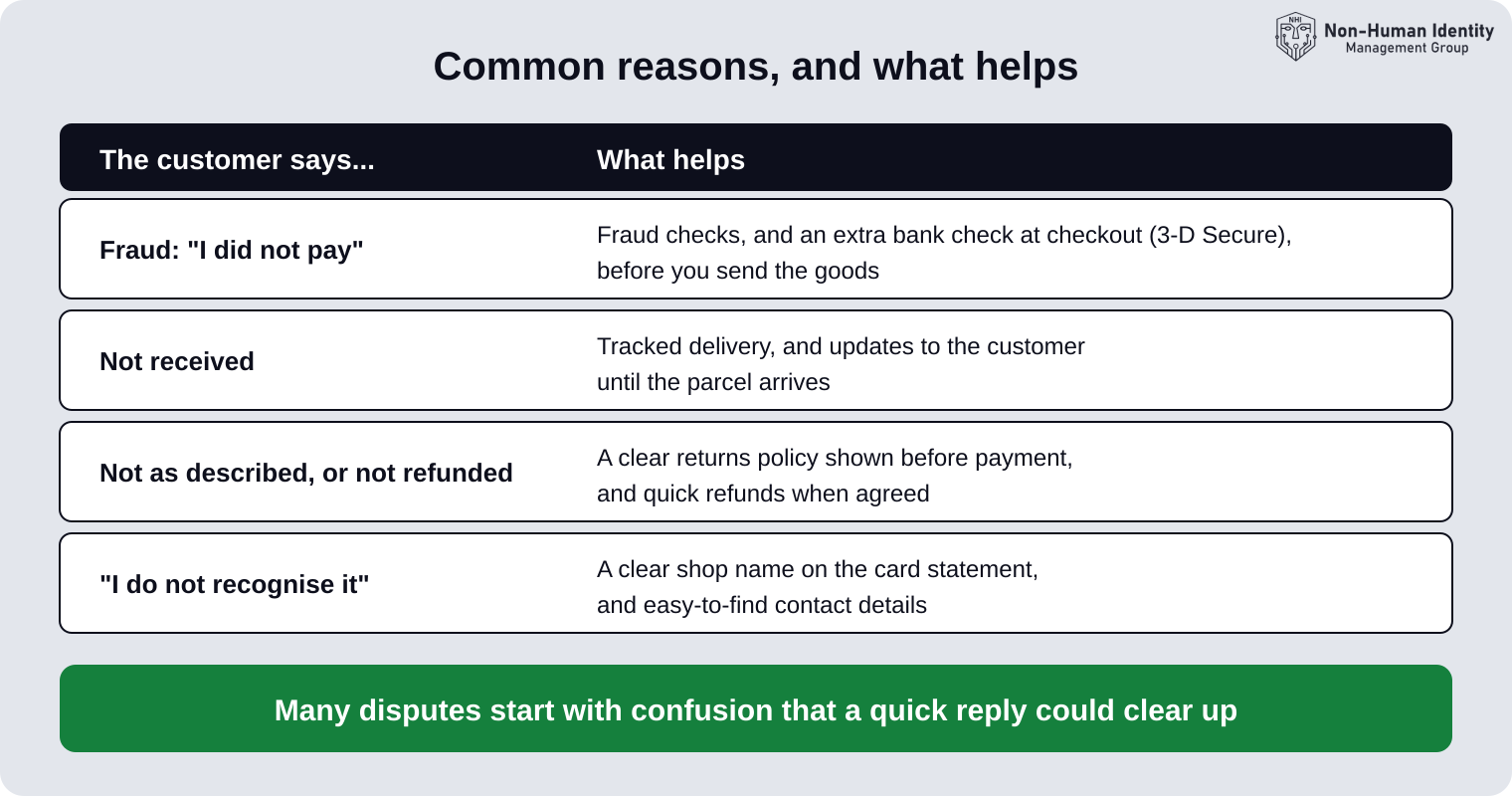
Most disputes fall into a few groups. Stripe's list includes fraud, product not received, product unacceptable, duplicate charges, cancelled subscriptions, refunds not processed and payments the customer does not recognise.[2]
Sometimes a real customer disputes a purchase they did make, to get money back and keep the goods. This is called friendly fraud. Good records of the order, the delivery and past purchases help a shop show the payment was genuine.[4]
A worked example
Elif Kader runs the online shop for Slate Vets, a fictional vet practice that sells pet food and supplies.
One morning she gets a dispute notice. A customer, Nils Brandt, says his order of dog food never arrived. The money and a fee have already gone from the shop's balance. She has two weeks to reply.
Elif thinks of the football review. Shouting at the referee will not help. Clear evidence might. So she gathers it.
The courier's tracking shows the parcel was delivered to Nils's address, with a photo of the doorstep. She takes screenshots, because banks may not follow links.[4] She adds the order email and the shop's delivery policy.
Before sending it, she emails Nils. He replies that a neighbour had taken the parcel in, and he had not checked. He apologises and says he will withdraw the dispute.
Elif still sends her evidence before the deadline. Her provider's guide says a shop should still respond, even if the customer says they have withdrawn.[1] Six weeks later, the money comes back.
She makes two changes. Delivery emails now include a photo link and a contact button. And the shop's name on card statements now reads "SLATE VETS SHOP", so customers recognise it.[3]
Myths and mistakes
| What people think | What to do instead |
|---|---|
| I can just refund the customer once a dispute opens. | Many providers block refunds while a dispute is open.[1] Reply through the dispute process. |
| If the customer says sorry, the case closes itself. | Send your evidence anyway, before the deadline.[1] |
| My payment provider decides who wins. | The customer's card provider decides.[1] Your job is to send clear evidence on time. |
| Every dispute is worth fighting. | If the payment really was fraud, accepting it is often the sensible choice.[2] |
| A link to the tracking page is enough. | Send screenshots. Banks may not follow links.[4] |
What can I do this week?
- Check the name your shop shows on card statements, and make it easy to recognise.
- Put your returns and refund policy where customers see it before they pay.
- Find out where dispute alerts arrive, and name one person to act on them.
- Use tracked delivery for orders worth more than a small amount.
- Ask your payment provider which fraud checks you have switched on.
Checklist
- Your shop name on card statements matches what customers know you as.
- Contact details are easy to find on your site and in order emails.
- Refund and returns policies are shown in full before payment.
- Orders keep receipts, delivery tracking and customer messages together.
- Dispute alerts go to someone who checks them daily.
- Each dispute gets a reply, or a decision to accept, before the deadline.
- Fraud checks are on, and risky orders are reviewed before sending goods.
- You know your dispute fee and your current number of disputes.
Common questions
Is a chargeback the same as a refund?
No. A refund is the shop choosing to give money back. A chargeback is the customer's bank taking the money back after the customer complains to it. Chargebacks usually add a fee for the shop and count against its record with its payment provider.
Who decides a chargeback?
The bank or firm that issued the customer's card. Your payment provider passes on the case and your evidence, but it does not choose the result. Stripe, for example, says the outcome is at the sole discretion of the card issuer.[1]
How long does a customer have to dispute a payment?
Often about 120 days from the payment, but card rules allow longer in some cases. For things paid in advance, such as tickets or trips, the clock may start on the event date instead.[1]
Can extra card checks at checkout help?
Yes, often. An extra check by the customer's bank at checkout, called 3-D Secure, may protect the shop from most fraud disputes on those payments.[4] It adds a step for customers, so many shops use it on riskier orders.
What if I am the customer?
Contact the shop first, as many problems are fixed quickly that way. If that fails, your card provider can explain your options. Our Safe Online Shopping for Beginners page covers how card payments can protect shoppers.
Where next?
Ready for the detail? Read the practitioner guide: Chargeback Management and Dispute Guide. It goes further into reason codes and the evidence each one needs, early warning tools, and dispute rate limits set by card brands.
Also useful:
- Online Shop Security for Beginners
- Payment Fraud for Beginners
- EMV 3-D Secure Guide
- Refund and Returns Fraud Guide
Related NHI Mgmt Group resources: Ecommerce Fraud and Chargeback Protection · Ecommerce Store Security Checklist · Small Business Cyber Security for Beginners
Key terms
- Chargeback
- A card payment reversed by the cardholder's bank after the cardholder disputes it.
- Card issuer
- The bank or firm that gives a customer their card and approves or declines their payments.
- Friendly fraud
- When a real cardholder disputes a genuine purchase to get the money back and keep the goods.
- 3-D Secure (3DS)
- An extra check by the customer's bank during an online card payment.
- Fraud
- Deliberate deception used to get money or goods unfairly.
- Card testing
- Criminals trying many stolen card details with small payments to see which still work.
Sources and further reading
- How disputes work. Stripe Documentation, Stripe. https://docs.stripe.com/disputes/how-disputes-work, accessed 28 Nov 2026.
- Dispute reason code categories. Stripe Documentation, Stripe. https://docs.stripe.com/disputes/categories, accessed 28 Nov 2026.
- Dispute resolution (merchant guidance). Visa. https://www.visa.com/en-us/support/business/dispute-resolution, accessed 28 Nov 2026.
- Best practices for preventing fraud. Stripe Documentation, Stripe. https://docs.stripe.com/disputes/prevention/best-practices, accessed 28 Nov 2026.