Cobalt Strike is paid software that security testers use to act like real attackers inside a network.
This guide is for students, newcomers to security and anyone who keeps seeing the name in breach news. You do not need to be technical: if your organisation could be hit by ransomware, it helps to know why this tool shows up in so many reports, and what it means when an alert names it.
This is an independent guide from NHI Mgmt Group, based on Fortra's public product information and public reports as of November 2026. It is not sponsored or reviewed by Fortra.
In short
- Cobalt Strike is a legitimate product sold to security teams for realistic attack practice.
- Criminals have used unlicensed, cracked copies of it to control hacked computers and prepare ransomware attacks.
- It belongs to a family of tools called command and control (C2) frameworks. Free ones such as Havoc and Sliver are also misused.
- Defenders spot these tools with device monitoring, email filtering and blocks on known control servers.
What you will learn
- Explain what Cobalt Strike and other C2 frameworks are for.
- Explain why the same tool appears in both security tests and real attacks.
- Spot the key details in an alert that names one of these tools.
- Ask whether an alert comes from an approved test or a real attack.
- Remote control link (command and control, or C2)
- the channel an attacker or tester uses to send orders to a computer they have got into.
- Check-in program (beacon)
- a small program on the device that calls home for its next orders.
- Practice attack team (red team)
- people hired to attack an organisation, with permission, to test its defences.
What is Cobalt Strike?
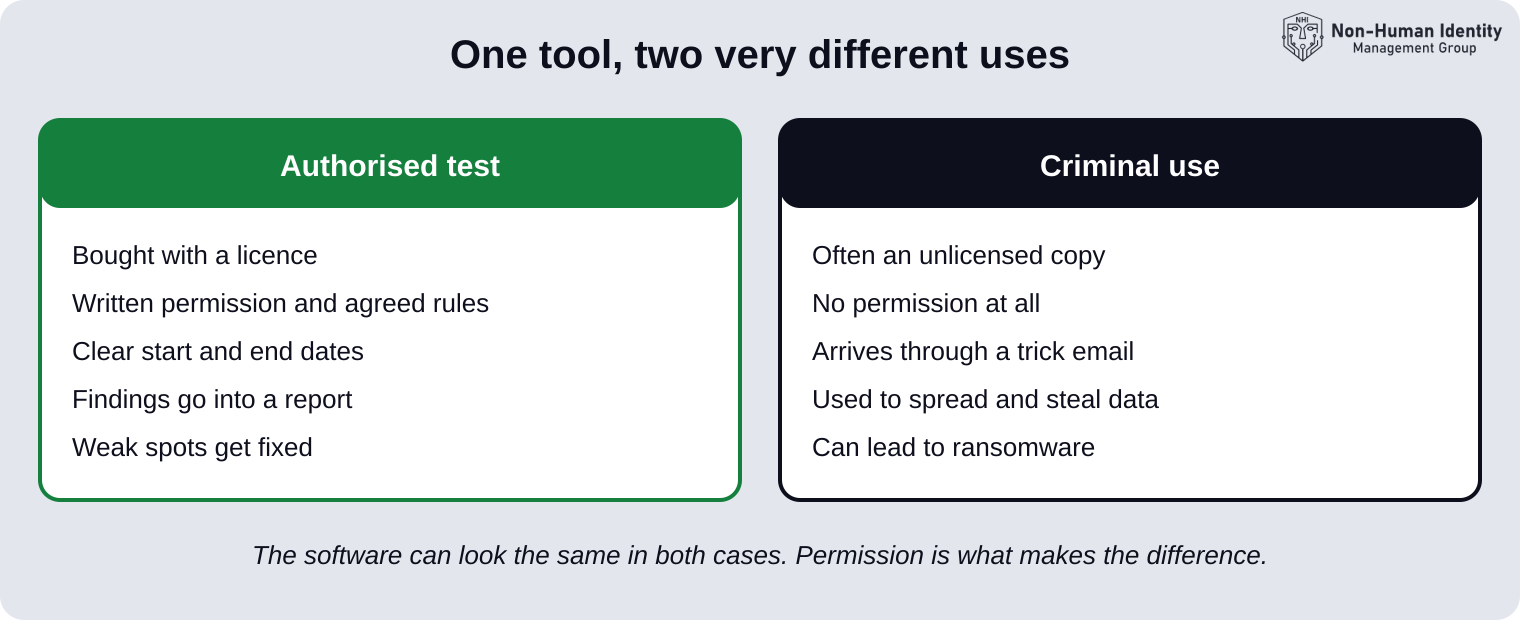
Think of a kit a security firm buys to stage a realistic robbery drill at a bank, with radios, fake badges and a plan. Used with permission, it shows the bank where its guards are weak. Stolen, the same kit helps real robbers.
Cobalt Strike works the same way. Its maker, Fortra, describes it as a tool for security professionals running attack simulations and red team work. A red team is a group hired to attack an organisation, with permission, to test how well it spots and stops intruders.[1]
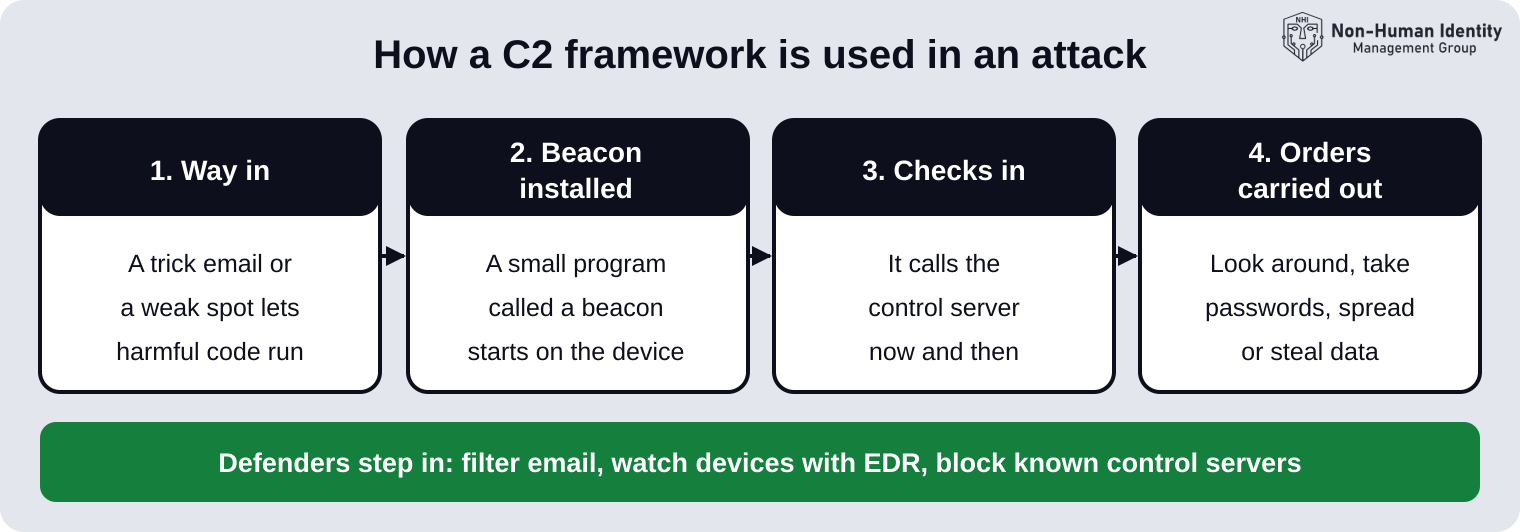
The tool helps testers copy what attackers do after they get in. A small program, called a beacon, runs on a computer and checks in with a control server from time to time. The tester then sends it orders.[2] This remote control link is called command and control, or C2.
Tools built around a C2 link are called C2 frameworks. Cobalt Strike is the best-known paid one. Free, open-source ones also exist, such as Havoc and Sliver. Both are described as C2 frameworks for testers, and both have also been used by attackers.[6][7]
Where the comparison stops working: a stolen drill kit is one physical box. Software can be copied many times, so one leaked copy can end up with many criminal groups.
Why does it matter?
Criminals have used illegal versions of Cobalt Strike to launch ransomware and steal data. The UK's National Crime Agency says these versions have lowered the barrier to entry into cybercrime.[3] When an alert names one of these tools, it can be an early warning of something much worse.
If you are new to a security team
What could happen: an alert names a C2 framework, and you assume it is "only a test".
Check this: confirm with the named test contact before you close any such alert.
If you manage an organisation
What could happen: a beacon goes unnoticed, and ransomware follows days later.
Check this: ask whether your devices have monitoring that can spot these tools, and who reads its alerts.
If you are thinking of hiring testers
What could happen: your own security team mistakes the approved test for a real attack, or the other way round.
Check this: agree in writing who is told, when the test runs and how to check it is really them.
What does it look like?
Most people meet these tools as an alert from a security product that watches devices. Here is a made-up alert.
Example only. All values are made up.
ALERT  High   Possible C2 framework beacon
Device:     FIN-LAPTOP-0000                        (1)
Program:    EXAMPLE-invoice-viewer.exe             (2)
Calls out:  updates.example.invalid, about every 60 seconds (3)
Matched:    known framework pattern FAKE-RULE-0000 (4)
Status:     device not yet isolated                (5)
- The device where the tool was seen. In a real message, this line would contain the computer's name.
- The program that started it, here posing as an invoice viewer.
- A regular check-in with an outside server, a common sign of a beacon.
- The security product matched a pattern it links to this kind of tool.
- Nobody has cut the device off yet.
Why this is risky: while the beacon keeps checking in, whoever controls it can keep sending orders.
The safer way: check at once whether an approved test is running. If not, treat it as a real attack and isolate the device.
How does it work?
These steps describe what defenders need to know, not how to use the tool.
- A way in. The attacker or tester first gets code to run on a device. National Crime Agency reporting describes trick emails with harmful links or files as one common route.[3]
- The beacon starts. A small program runs on the device and checks in with a control server, often at varied times.[2]
- Orders arrive. Through the beacon, the operator can look around, take screenshots and try to collect passwords.[2]
- It spreads. The operator may move to other computers, which is called lateral movement. In criminal attacks, this can end in data theft or ransomware.[3]
- Defenders step in. Security tools look for known patterns of these frameworks. Google, for example, published detection rules aimed at cracked, older versions of Cobalt Strike, while leaving the current licensed version to paying customers.[4]
Police also act. In June 2024, a UK-led operation flagged 690 addresses linked to illegal copies of Cobalt Strike. By the end of that week, 593 were taken down.[3] Europol coordinated the action, and Fortra worked with the authorities.[5]
A worked example
Leila Gallardo runs IT for Bright Meadow Housing, a housing charity with 200 staff. This year the board agreed to hire a red team to test the charity's defences. Jana Ulrich leads the testing firm.
Before the test, Leila and Jana sign a written agreement. It sets the dates, the systems in scope and the rules. It names two people at the charity who know about the test. It also gives a code word, so Leila can check that any activity really comes from Jana's team.
On day three, the charity's device monitoring raises a high alert. It says a finance laptop is running a possible C2 beacon, checking in with an outside server. The analyst on duty does not know about the test. She follows the process and isolates the laptop.
Then she calls Leila. Leila phones Jana on the number in the agreement and asks for the code word. Jana gives it and confirms the laptop and server are part of the test. Leila records the check, and the test carries on.
At the end, Jana's report shows that a trick email got the beacon onto the laptop. It also shows the monitoring caught it within an hour. Leila takes two lessons from it. The alert would have looked the same in a real attack. And the analyst was right to act first and check second.
The charity adds more staff training on trick emails and keeps the "isolate, then verify" rule.
Myths and mistakes
| What people think | What is true |
|---|---|
| Cobalt Strike is a virus. | It is a paid product made for security testing. Criminals misuse unlicensed copies of it.[5] |
| If an alert names a testing tool, it must be a test. | The same tools appear in real attacks. Check with the named test contact before closing the alert. |
| Free tools are less of a worry. | Free C2 frameworks such as Havoc and Sliver have also been used by attackers.[6][7] |
| Blocking one control server ends the attack. | The attacker may have other servers or other footholds. The device still needs checking and cleaning. |
| Testers can start whenever they like. | Proper tests have written permission, agreed rules and named contacts. |
What can I do this week?
- Find out whether your organisation's devices have monitoring that can spot C2 tools.
- Ask who reads high alerts, including at night and at weekends.
- Check that your response plan says to isolate first and verify second.
- If a test is planned, make sure there is a named contact and a way to verify the testers.
Checklist
- Every work device has security monitoring turned on.
- Someone is named to act on high alerts at any hour.
- Our plan says how to cut off a device quickly.
- Any red team or penetration test has written permission and agreed rules.
- The test agreement names contacts and a way to check it is really them.
- Email filtering is in place to catch trick emails.
- Passwords used on a device are changed if a beacon is confirmed on it.
Common questions
Is Cobalt Strike illegal?
No. It is a legal product sold to security professionals for authorised testing. Using any copy to get into systems without permission is a crime in many countries. Police action has focused on illegal, unlicensed copies used by criminals.
Why do criminals use a testing tool?
Because it does what they need. It was built to copy real attackers, so it can control hacked computers, look around and spread. Illegal copies give criminals these powers without building their own tools, which the National Crime Agency says lowers the barrier to cybercrime.
What is a beacon?
A beacon is a small program on a hacked or tested device that checks in with a control server for orders. Its regular calls to the same outside address are one of the signs that security tools look for.
What are Havoc and Sliver?
They are free, open-source C2 frameworks. Like Cobalt Strike, they were made for security testing, and like it, they have been used in real attacks. Defenders often look for all of them, not just the best-known one.
What should I do if an alert names one of these tools?
Follow your organisation's process and tell the security lead at once. Usually the device is cut off from the network first. Then someone checks whether an approved test is running. If not, it is handled as a real attack.
Where next?
Ready for the detail? Read the practitioner guide: Cobalt Strike Abuse Detection Guide. It goes further into the techniques criminals use with it, detection sources and the groups linked to its misuse.
Also useful:
- Sliver, Havoc and Brute Ratel C2 Frameworks Detection Guide
- Beaconing and C2 Detection Guide
- Penetration Testing for Beginners
- Ransomware for Beginners
Related NHI Mgmt Group resources: Lateral Movement for Beginners, Malware for Beginners and Phishing for Beginners.
Key terms
- Cobalt Strike
- A paid attack simulation tool used by security teams, and misused by attackers through unlicensed copies.
- Command and control channel
- The link used to send orders to a compromised computer and get results back.
- Beacon
- A regular check-in from a program on a device to its control server, asking for orders.
- Post-exploitation framework
- A toolkit used after someone first gets in, to look around, take passwords and spread.
- Red teaming
- An approved, realistic attack exercise that tests whether an organisation can spot and respond to intruders.
- Lateral movement
- Moving from the first hacked computer to others in the same network.
Sources and further reading
- Cobalt Strike product page. Fortra. https://www.fortra.com/products/cobalt-strike, accessed 28 Nov 2026.
- Cobalt Strike (S0154). MITRE ATT&CK. https://attack.mitre.org/software/S0154/, accessed 28 Nov 2026.
- National Crime Agency leads international operation to degrade illegal versions of Cobalt Strike. National Crime Agency (NCA), 3 July 2024. https://www.nationalcrimeagency.gov.uk/news/national-crime-agency-leads-international-operation-to-degrade-illegal-versions-of-cobalt-strike, accessed 28 Nov 2026.
- Making Cobalt Strike harder for threat actors to abuse. Google Cloud blog, 17 November 2022. https://cloud.google.com/blog/products/identity-security/making-cobalt-strike-harder-for-threat-actors-to-abuse, accessed 28 Nov 2026.
- Europol coordinates global action against criminal abuse of Cobalt Strike. Europol press release, republished by Fortra, 3 July 2024. https://www.fortra.com/resources/press-releases/europol-coordinates-global-action-against-criminal-abuse-cobalt-strike, accessed 28 Nov 2026.
- Havoc (S1229). MITRE ATT&CK. https://attack.mitre.org/software/S1229/, accessed 28 Nov 2026.
- Sliver (S0633). MITRE ATT&CK. https://attack.mitre.org/software/S0633/, accessed 28 Nov 2026.