The cost of a cyber attack is all the money, time and trade a business loses because of it.
This guide is for small business owners, managers and anyone new to the topic. You do not need to work in IT to pay the bill: if your business takes orders, pays suppliers or keeps customer details on a computer, an attack can cost you money.
In short
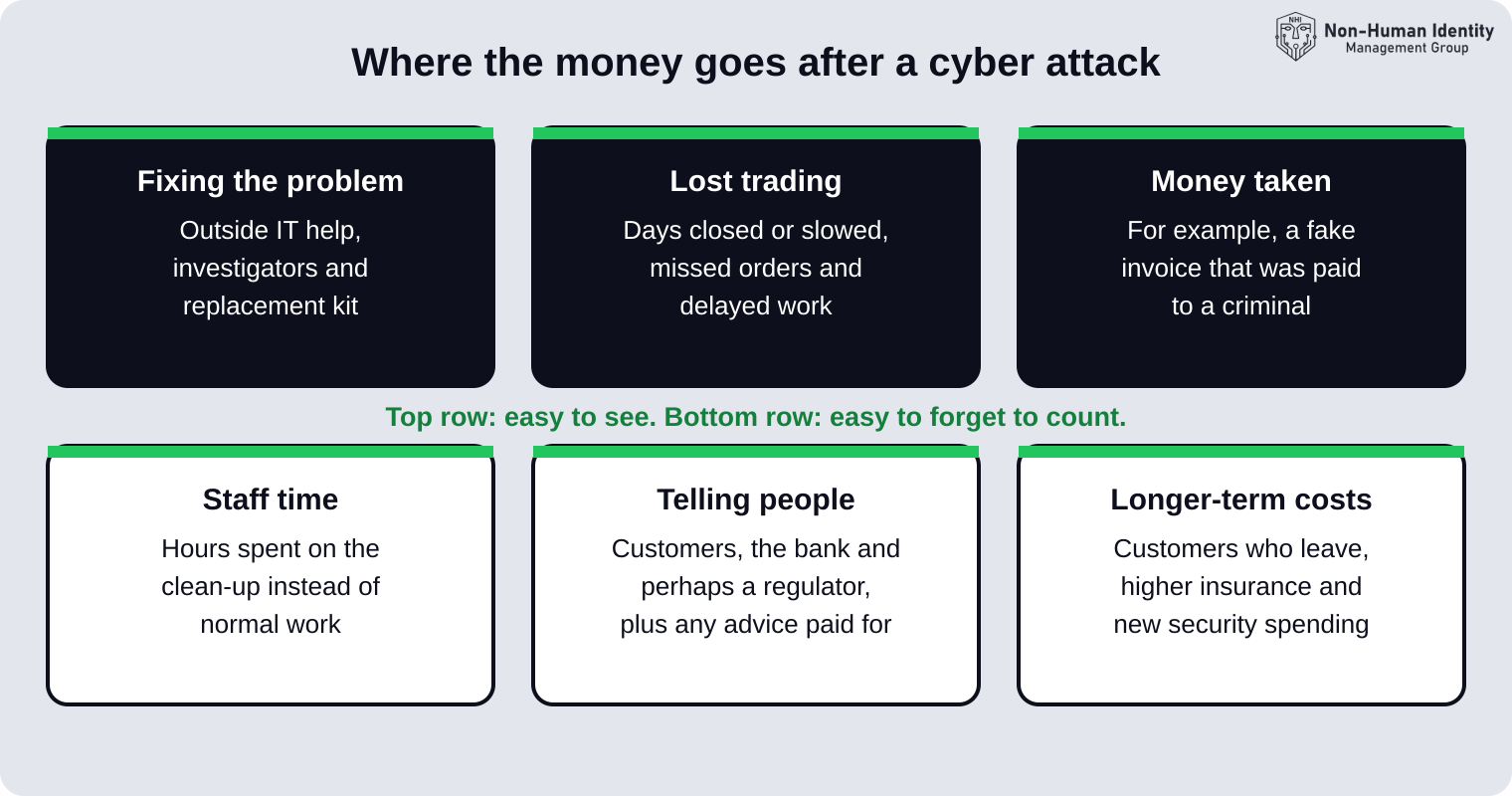
- The cost of an attack is more than the IT repair bill. Lost trading, staff time and lost customers often add more.
- Many costs arrive weeks or months later, so they are easy to forget to count.
- In a large UK government survey, the average cost of the worst breach was modest for most firms, but some losses are far larger.
- Good backups, a short response plan and checks on payment changes can lower the cost when something goes wrong.
What you will learn
- Explain what makes up the cost of a cyber attack.
- Spot the hidden costs that people forget to count.
- Check how long your business could cope without its computers.
- Ask the right questions about backups, insurance and response plans.
- Time when you cannot work (downtime)
- the hours or days when systems are down and normal work stops.
- Clean-up after an attack (recovery)
- getting systems, data and trading back to normal.
- Fake payment request (invoice fraud)
- a message that tricks a business into paying a criminal's bank account.
What is the cost of a cyber attack?
Think of a car crash. The repair bill from the garage is the part everyone sees. But you also pay for a hire car, lose time off work and may face a higher insurance price next year.
A cyber attack works the same way. A cyber attack is any attempt by criminals to break into, damage or misuse your computers, accounts or data. The first bill is often for IT help. Then come the days when you cannot trade, the hours your staff spend on the clean-up, and the customers who go elsewhere.
So the true cost is the total of all of these, not just the money paid to fix the computers.
Where the comparison stops working: after a car crash, you know the moment it happened. A cyber attack can go unnoticed for some time, and costs can keep growing before anyone spots it.
Why does it matter?
Attacks are common. In the UK government's 2025 survey, 43% of businesses said they had a cyber security breach or attack in the previous 12 months.[1] Knowing what an attack can cost helps you decide what is worth protecting first.
If you own a small business
What could happen: you pay a fake invoice, or your till and booking system are down on your busiest day.
Check this: how many days could you trade with no computers at all?
If you look after the money
What could happen: a supplier's "new bank details" email turns out to be fake, and the money is hard to get back.
Check this: do you phone a known number before changing any payment details?
If you are new to IT or security work
What could happen: you are asked "what would an attack cost us?" and only count the repair bill.
Check this: list lost trading, staff time and longer-term costs too.
What does it look like?
Here is a made-up tally a small business might keep after an attack.
Example only. All values are made up.
INCIDENT COST TALLY   Firm: EXAMPLE Trading Ltd   Ref: FAKE-0000
Outside IT help (2 days)                 £0,000   (1)
Shop closed (1 day of lost sales)        £0,000   (2)
Staff overtime on clean-up               £0,000   (3)
Fake invoice paid, not recovered         £0,000   (4)
Advice on telling customers              £0,000   (5)
New laptop to replace a wiped one        £0,000
Still to come: insurance renewal         unknown  (6)
TOTAL SO FAR                             £0,000
- The bill most people think of first.
- Sales lost while the business could not trade.
- Hours spent on the clean-up instead of normal work.
- Money sent to a criminal. In a real file, this line would contain the amount and the date it was paid.
- Help with what to tell customers and, where needed, a regulator.
- Some costs only show up months later.
Why this is risky: if you only count the IT bill, you may decide security is not worth the spend. The other lines can be larger.
The safer way: keep one running list from the first day, including staff time and lost trading, and update it as new costs appear.
How does it work?
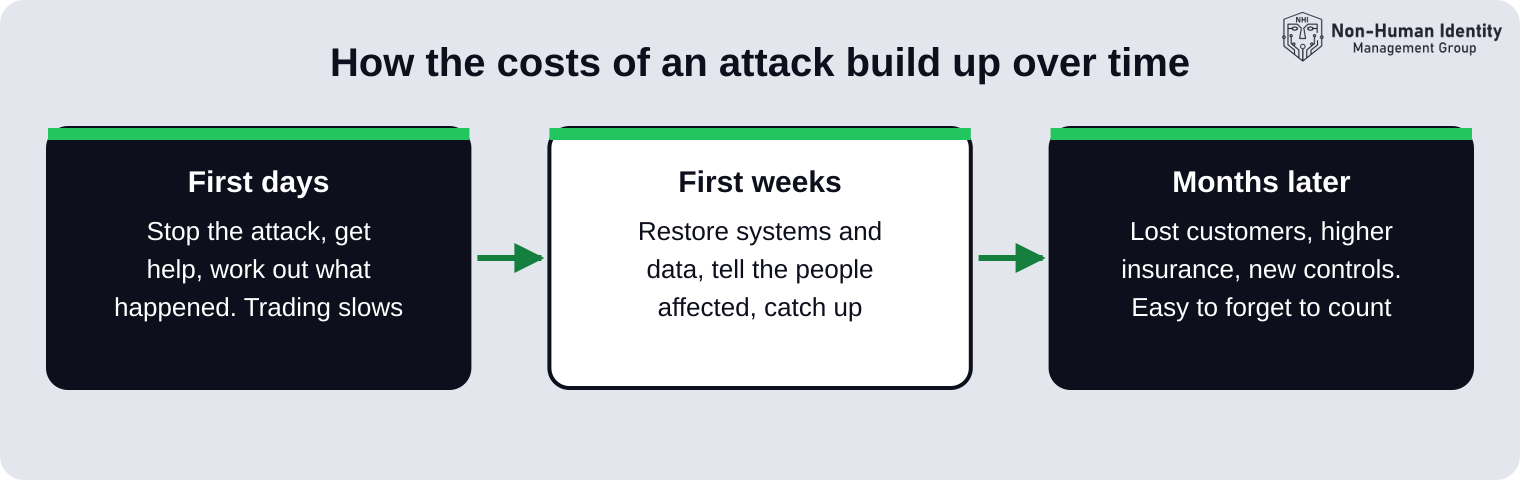
Costs build up in stages. Here is the usual pattern.
- The attack happens. For example, a criminal tricks someone into paying a fake invoice, or locks files so the business cannot use them. Locking files and asking for payment is called ransomware.
- Work slows or stops. Staff cannot reach orders, emails or the till. Every hour of this downtime can mean lost sales.
- You pay for help. This may be your IT supplier, an investigator who finds out what happened, or new equipment.
- You tell the people affected. Customers, your bank, your insurer and, if personal data was involved, perhaps a regulator. Advice on this may cost money too.
- The long tail follows. Some customers may leave. Insurance may cost more at renewal. You may need to spend on new security.
How big is the bill? It varies a lot. In the UK survey, the average cost of the single most disruptive breach was £1,600 per business. Leaving out businesses that reported no cost, it was £3,550.[1] The survey notes these are firms' own estimates and may understate the full cost.[1]
Large data breaches cost far more. IBM's 2026 study of breaches at larger organisations puts the global average at 4.99 million US dollars.[2] Averages hide a wide spread, so treat any single number with care.
A worked example
This story is made up to show how it can happen.
Farah Delmar runs Slate Laundry, a laundry service with eight staff. One Monday she gets an email that looks like it is from her detergent supplier. It says the supplier has a new bank account. Farah updates the details and pays the next invoice.
Two weeks later, the real supplier calls. They have not been paid. The email was fake, sent by a criminal who had broken into the supplier's mailbox. This kind of trick is called invoice fraud.
Farah calls her bank straight away. Some of the money may come back, but the bank cannot promise it. She still owes the real supplier.
Her IT helper, Jonah Ueda, checks her own email account to be safe. He finds no sign of a break-in in the records available to him. Even so, he turns on a second login step for every staff account. This costs her a morning of his time.
Farah starts a cost tally. It has the lost payment, Jonah's time, her own hours on the phone and a late fee from the supplier. She is surprised to see the IT work is the smallest line.
She makes one change that costs nothing. From now on, any request to change bank details is checked by phoning the supplier on a number she already has.
What made the difference: Farah counted every cost, not just the IT bill. That showed her the cheapest fix was a simple phone check.
Myths and mistakes
| What people think | What is true |
|---|---|
| We are too small to be worth attacking. | In the UK survey, 43% of all businesses reported a breach or attack, not only large ones.[1] |
| The cost is whatever the IT company charges. | Lost trading, staff time and lost customers can add more than the repair bill. |
| Once the computers work, the cost has stopped. | Some costs, like higher insurance or lost customers, arrive months later. |
| The big figures in the news tell us what we would lose. | Those averages often come from large organisations. Work out your own likely cost instead. |
| Insurance will pay for everything. | Policies have limits and conditions. Read what yours covers before you need it. |
What can I do this week?
- Write down how much a day without computers would cost you in lost sales.
- Check that your important data is backed up and that a backup has been restored at least once as a test.
- Agree a rule: any change to bank details is checked by phone on a number you already have.
- Write a one-page plan of who to call if something goes wrong.
- Read the free small business guide from the UK's National Cyber Security Centre.[3]
Checklist
- We know roughly what a day of downtime would cost us.
- Our important data is backed up, and we have tested a restore.
- Bank detail changes are always checked by phone.
- Every account has a second login step where it is offered.
- We have a short list of who to call after an attack.
- We know what our insurance does and does not cover.
- We would start a cost tally on the first day of an incident.
Common questions
How much does a cyber attack cost a small business?
It varies widely. A UK government survey put the average cost of a firm's worst breach at £1,600.[1] Leaving out firms with no cost, it was £3,550. Some attacks cost far more, especially when trading stops for days.
What is the biggest hidden cost?
For many small firms it is lost trading and staff time. While systems are down, orders and sales are lost, and staff spend hours on the clean-up. These costs rarely appear on any invoice, so they are easy to miss.
Does cyber insurance cover the cost of an attack?
It can cover some of it, such as expert help and lost income, depending on the policy. Each policy has its own limits and conditions. Check what yours includes, and what it expects you to have in place, before anything happens.
What is the cheapest way to lower the cost?
Simple habits help most. Keep tested backups, check payment changes by phone, turn on a second login step and know who to call. These steps can shorten downtime and stop some fraud before money leaves the account.
Where next?
Ready for the detail? Read the practitioner guide: Cost of a Cyber Incident Statistics. It goes further into the main cost studies, how their methods differ and how to choose the right figure for a business case.
Also useful:
- Business Continuity and Disaster Recovery for Beginners
- Ransomware for Beginners
- Incident Cost Tracking Template
Related NHI Mgmt Group resources: IBM Cost of a Data Breach Report · Cyber Insurance Guide · Backup Security for Beginners
Key terms
- Downtime
- The time when systems are not working and normal business stops or slows.
- Business email compromise
- A scam where criminals use a real or faked business email account to trick people into paying money or sharing data.
- Ransomware
- Harmful software or an attack that blocks access to systems or data and then demands payment.
- Incident response
- The planned steps a business takes to find, contain and recover from a security problem.
- Business impact analysis
- A simple study of which activities matter most and what it costs when they stop.
- Business continuity
- Planning so the most important work can carry on, or restart quickly, after a disruption.
Sources and further reading
- Cyber security breaches survey 2025. UK Department for Science, Innovation and Technology and Home Office, official statistics, 10 April 2025. https://www.gov.uk/government/statistics/cyber-security-breaches-survey-2025/cyber-security-breaches-survey-2025, accessed 28 Nov 2026.
- Cost of a Data Breach Report 2026. IBM, 2026. https://www.ibm.com/reports/data-breach, accessed 28 Nov 2026.
- Small Business Guide. UK National Cyber Security Centre. https://www.ncsc.gov.uk/collection/small-business-guide, accessed 28 Nov 2026.