Cyber attack attribution is deciding who is most likely behind an attack, and how sure we are.
This guide is for students, newcomers and anyone who reads headlines like "Russia blamed for hack" and wonders how anyone knows. You do not need a technical job to use it: knowing how blame is worked out helps you read the news with a clear head.
In short
- Attribution is a judgement built from many clues, not a single piece of proof.
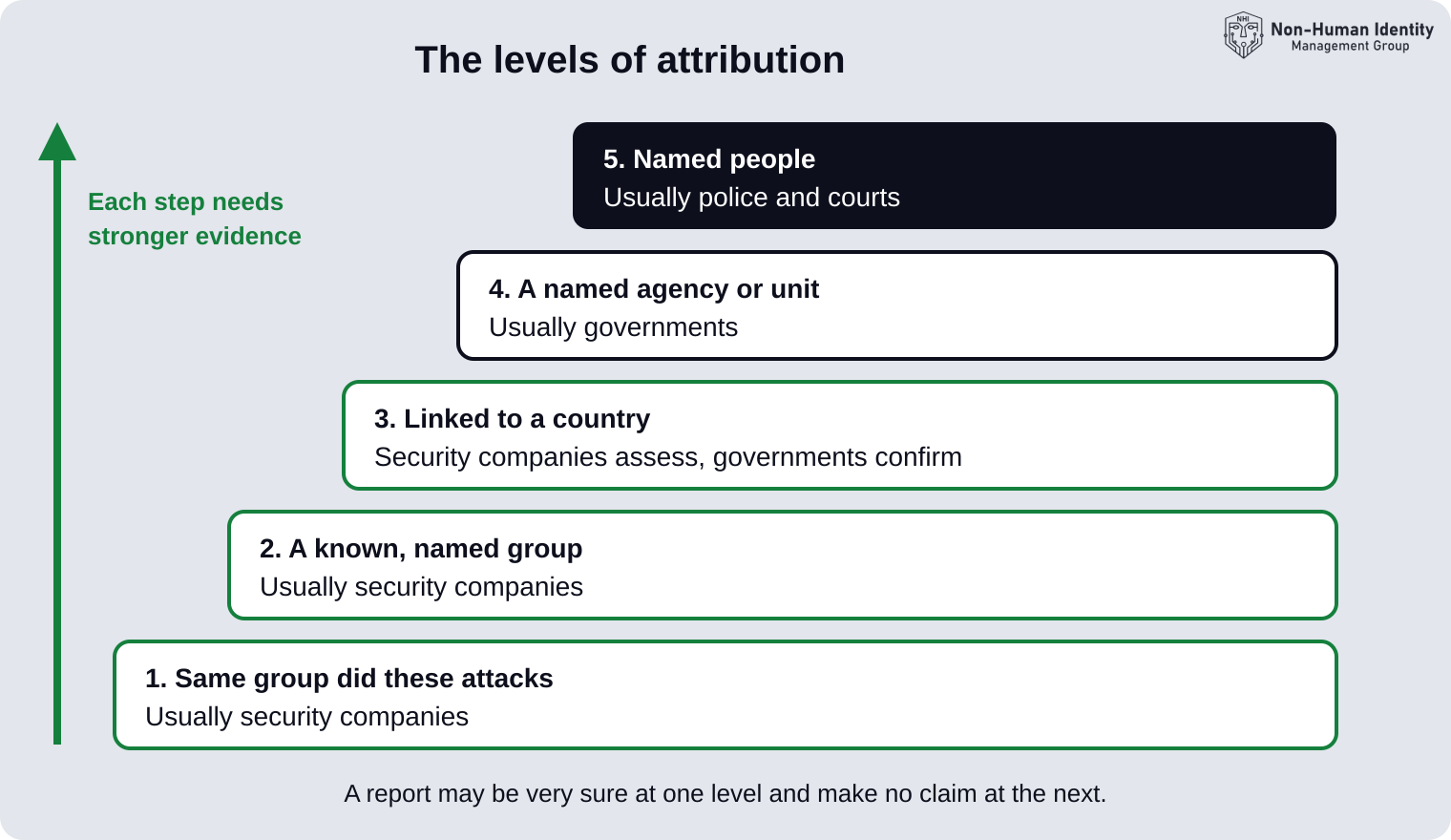
- There are levels: "the same group did these attacks" is a much smaller claim than "this government did it".
- Experts use careful words such as "likely" and "high confidence" to show how sure they are.
- Attackers sometimes plant false clues, so one clue on its own is weak evidence.
What you will learn
- Explain what attribution means in one sentence.
- Spot which level of blame a news story is really claiming.
- Read confidence words like "almost certainly" and "moderate confidence".
- Ask whether a claim comes from a government or a security company.
- Working out who did it (attribution)
- the judgement of who is most likely behind an attack.
- How sure we are (confidence)
- how strong the evidence and reasoning behind a judgement are.
- Planted clue (false flag)
- evidence left on purpose to make someone else look guilty.
What is cyber attack attribution?
Think of a detective after a burglary. There is no signed confession. There are footprints, a type of tool mark and a pattern that matches earlier break-ins.
The detective puts the clues together and names the most likely suspect. A good detective also says how sure they are.
Cyber attack attribution works the same way. Experts gather clues from an attack, such as the tools used, the websites the attackers controlled and the times they were active. Then they compare those clues with earlier attacks.
Where the comparison stops working: a detective can often arrest a suspect and test the evidence in court. With cyber attacks, the people behind them may live in another country and are rarely questioned. So most attributions stay as judgements, with a stated level of confidence.
Why does it matter?
Blame for a cyber attack can lead to sanctions, court cases and news stories. If you misread how firm the blame is, you may worry about the wrong thing or trust a weak claim.
If you read the news
What could happen: a headline says a country "did it", but the report only says the attack was "likely" linked to a group.
Check this: find the exact words in the original report, not just the headline.
If you are a student or new to security
What could happen: you repeat a security company's guess as fact in an essay or interview.
Check this: say who made the claim and how sure they said they were.
If your organisation is attacked
What could happen: the team spends days arguing about who did it while the attackers are still inside.
Check this: fix the problem first. A name is useful later, for reporting and planning.
What does it look like?
Here is a made-up "attribution note" of the kind an analyst might write. Every name and value is invented.
Example only. All values are made up.
ATTRIBUTION NOTE: CASE-0000 (FAKE)
Claim level:  Same group as earlier attacks       (1)
Group:        EXAMPLE-GROUP-0000 (FAKE)
Clues:        Same control website, example.invalid  (2)
              Same custom tool, FAKE-TOOL-0000
              Active during the same working hours
Confidence:   Moderate                            (3)
Country link: Not assessed                        (4)
Made by:      Our team, 01 Jan 0000               (5)
- The level of claim. Here it is only "same group", not a country.
- In a real file, this line would contain the website address the attackers used.
- How sure the team is. It depends on how many clues match and how strong they are.
- The team did not guess a country. Its clues do not point to one.
- Who made the judgement and when, so readers can weigh it.
Why this is risky: without the claim level and confidence lines, a reader may treat a careful guess as a proven fact.
The safer way: every attribution states the level, the confidence, the main clues and who made it.
How does it work?
Here is the usual path from clues to a name.
- Collect clues. Experts gather evidence from the attack. Mandiant, a security company, sorts clues into three layers. The first is technical items, such as harmful software (malware) and web addresses. The second is behaviour, such as tools and targets. The third is motive, such as goals and likely sponsors.[1]
- Group the activity. Attacks that share clues are put into one cluster. Mandiant gives a new cluster a holding name, "UNC" plus a number, while it is unsure.[1] Microsoft uses "Storm" plus four digits in the same way.[2]
- Link to a known group. Over time, a cluster may match a group already being tracked. Mandiant says moving a cluster to a full group name typically takes years of work and thousands of pieces of evidence.[1]
- Decide on a country or agency. This bigger step often needs secret sources, such as spy agency reports, that only governments hold. So governments usually make these claims.
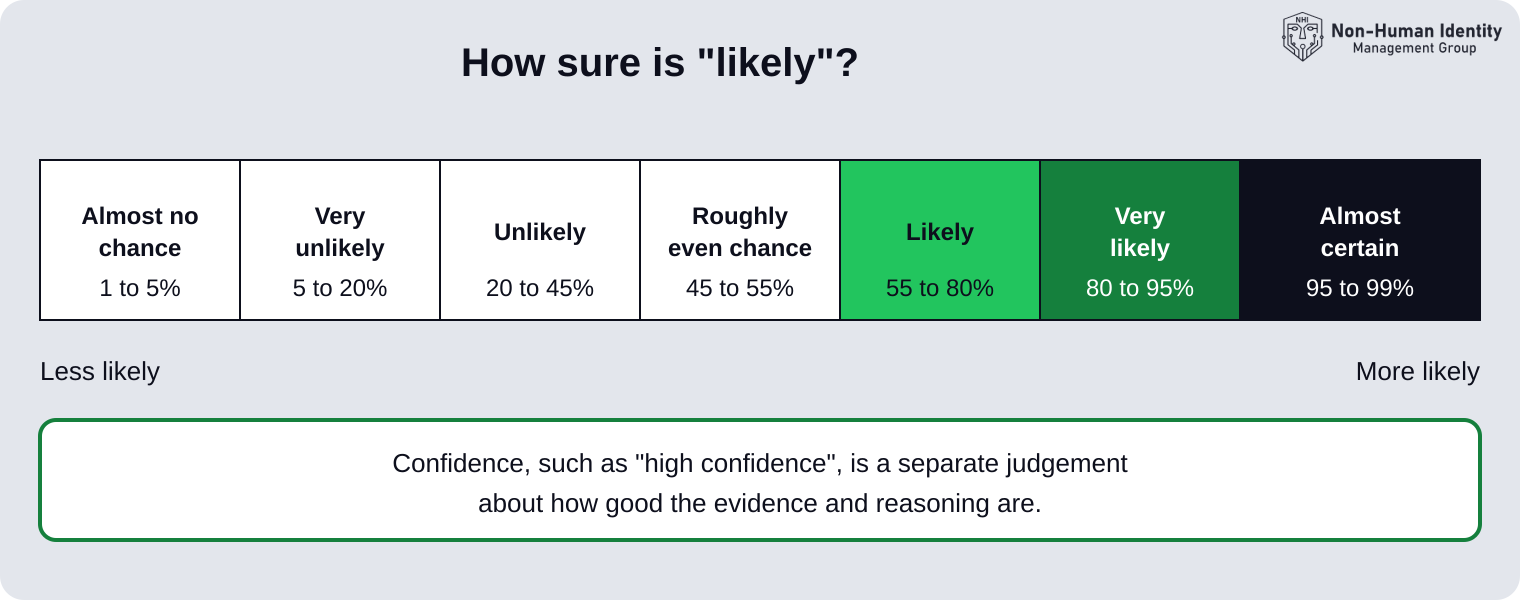
- State the confidence. The claim is written with careful words. US intelligence rules give a scale from "almost no chance" to "almost certain", and keep confidence separate from likelihood.[3]
Each level up needs stronger and different evidence. A security company can be very sure two attacks came from one group, yet have no firm view on which country is behind it.
Confidence words are a code worth learning. When a report says "likely", US intelligence rules match that to roughly 55 to 80 per cent. "Almost certain" means roughly 95 to 99 per cent.[3]
A worked example
Wanda Tanaka is studying for a first security certificate. Her friend Lars Zeller sends her a headline: "Foreign spies behind sports event hack". He asks if it is true.
Wanda goes to the original source. It is a UK government release from October 2020. It quotes the UK's National Cyber Security Centre. The centre assessed "with high confidence" that a named unit of Russian military intelligence almost certainly carried out the attacks.[4]
She notes three things for Lars. First, the claim came from a government, which can draw on secret sources. Second, it used the top confidence words, so the government was very sure. Third, it named a specific unit, which is one of the highest levels of attribution.
Then she spots something else. The same release says the unit "attempted to disguise itself as North Korean and Chinese hackers" during the 2018 Winter Olympics attack.[4] So early clues pointed the wrong way.
Wanda writes back: "The headline is fair, because the government said it with high confidence. But it shows why early guesses can be wrong. The attackers planted clues to blame someone else."
Lars now reads attack headlines differently. He looks for who made the claim, the level and the confidence words before he shares a story.
Myths and mistakes
| What people think | What is true |
|---|---|
| Experts can trace an attack straight back to a computer and a person. | Attackers hide behind borrowed computers and services. Attribution builds a picture from many clues over time. |
| A language in the code proves which country did it. | Single clues like this are easy to fake. Attackers have planted them to blame others.[4] |
| "Linked to a group" means "done by a country". | Those are different levels. Check which level the report claims. |
| A security company's report is the same as a government finding. | Companies make careful assessments from what they see. Governments may hold extra sources that companies do not. |
| You need to know who did it before you can respond. | Most fixes depend on what the attackers did, not who they are. Act on the behaviour first. |
What can I do this week?
- Pick one attack headline and find the original report it is based on.
- Write down who made the claim: a government, a security company or a journalist.
- Note the level of blame and the exact confidence words used.
- Look up the group name on a free public list, such as the MITRE ATT&CK groups pages.
Checklist
- I read the original report, not only the headline.
- I know who made the claim.
- I can say which level of attribution is being claimed.
- I note the confidence words and keep them when I repeat the claim.
- I treat a single clue, such as a language setting, as weak evidence.
- I remember that claims can change as new evidence appears.
- In an incident, I deal with the attack before arguing about the name.
Common questions
Can anyone ever be completely sure who did a cyber attack?
Rarely. Experts usually give a judgement with a confidence level, not proof. Court cases can name people, with the evidence tested by a judge. Most attributions stay as careful assessments, and they may change if new clues appear.
What is a false flag in cyber attacks?
A false flag is a clue planted to blame someone else. The UK government said Russian military hackers tried to look like North Korean and Chinese hackers during the 2018 Winter Olympics attack.[4] This is why experts rely on many clues together.
What does "high confidence" mean?
It means the experts think their evidence and reasoning are strong. It is a separate idea from likelihood words such as "likely". US intelligence rules say the two should not be mixed in the same sentence.[3]
Why do governments take so long to blame someone?
They need time to check evidence, often with allies, and to decide what to do next. Naming a country is also a political choice, so the timing can depend on policy as well as on the evidence.
Does attribution matter for a small business?
Usually less than people think. Knowing what the attackers did tells you what to fix. Knowing the likely group can still help you understand who targets businesses like yours and what they tend to try next.
Where next?
Ready for the detail? Read the practitioner guide: Cyber Threat Attribution Guide. It goes further into evidence types, official confidence language and a table of major government attributions with the actions that followed.
Also useful:
- Hacker Group Names for Beginners
- Nation-State Hacking and APTs for Beginners
- Diamond Model for Beginners
- APT vs Cybercrime vs Hacktivists
Related NHI Mgmt Group resources: Threat Actors for Beginners · Threat Intelligence for Beginners · APT28 (Fancy Bear) Threat Actor Profile
Key terms
- Attribution
- The careful, confidence-rated judgement of who is behind an attack.
- Confidence level
- A label, such as low, moderate or high, for how strong the evidence behind a judgement is.
- False-flag operation
- An attack made to look as if someone else carried it out.
- Intrusion set
- A linked collection of attack activity thought to come from the same group.
- Threat actor
- Any person or group that sets out on purpose to harm systems, data or trust.
- Indicator of compromise
- A sign that an attack may have happened, such as a known bad web address or file.
Sources and further reading
- How Mandiant tracks uncategorized threat actors. Mandiant (Google Cloud), 17 December 2020. https://cloud.google.com/blog/topics/threat-intelligence/how-mandiant-tracks-uncategorized-threat-actors, accessed 28 Nov 2026.
- How Microsoft names threat actors. Microsoft Learn, Microsoft. https://learn.microsoft.com/en-us/unified-secops/microsoft-threat-actor-naming, accessed 28 Nov 2026.
- Intelligence Community Directive 203: Analytic Standards. Office of the Director of National Intelligence, 2 January 2015. https://archive.dni.gov/files/documents/ICD/ICD-203.pdf, accessed 28 Nov 2026.
- UK exposes series of Russian cyber attacks against Olympic and Paralympic Games. UK Government (Foreign, Commonwealth and Development Office), 19 October 2020. https://www.gov.uk/government/news/uk-exposes-series-of-russian-cyber-attacks-against-olympic-and-paralympic-games, accessed 28 Nov 2026.