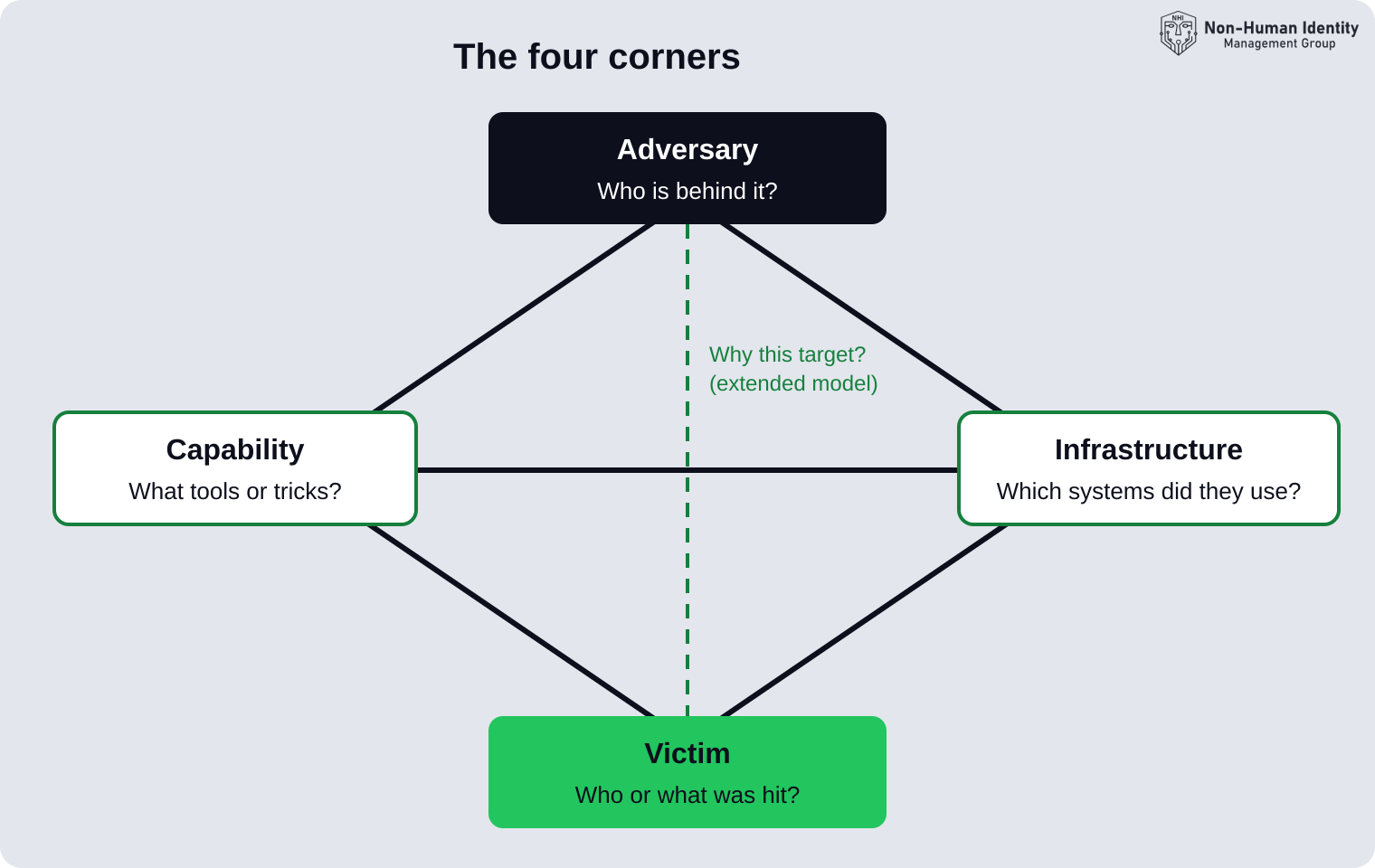
The Diamond Model is a simple way to describe any cyber attack using four linked corners.
This guide is for students, people studying for a security exam and anyone new to investigating attacks. You do not need deep technical skills: the model is a way of asking good questions, and you can use it with a pen and paper.
In short
- The four corners are the attacker (adversary), their tools (capability), the systems they used (infrastructure) and the target (victim).
- Each corner is linked to others, so one clue can lead you to the next.
- Moving from one known corner to find another is called pivoting.
- The model was published in 2013 and is often taught in security courses.
What you will learn
- Name the four corners of the Diamond Model and explain each one.
- Fill in a simple diamond for an attack you read about.
- Explain how pivoting turns one clue into more.
- Tell the Diamond Model apart from the Cyber Kill Chain.
- Single attack step (event)
- one action an attacker takes, such as sending one harmful email.
- Following a clue (pivoting)
- using one thing you know to find other, linked things.
What is the Diamond Model?
Think of a police report after a break-in. It answers four questions: who did it, what they used, how they got there, and who was hit.
The Diamond Model asks the same four questions about a cyber attack. It draws them as the four corners of a diamond shape.
- Adversary: the person or group behind the attack.
- Capability: the tools and tricks they used, from guessing passwords to harmful software (malware).
- Infrastructure: the systems they used to reach the target, such as web addresses and servers.
- Victim: the person, organisation or computer that was attacked.
Three analysts working for the US Department of Defense published the model in 2013.[1] Each diamond describes one step of an attack, called an event.
Where the comparison stops working: a police report is often filled in after the event, once the facts are known. In a cyber attack you may start with just one corner, such as a strange web address, and work outwards to the rest.
Why does it matter?
Attack evidence arrives in pieces. The Diamond Model gives those pieces a place, and it shows you which questions you have not answered yet.
If you are studying for a security exam
What could happen: you mix up the Diamond Model with the Cyber Kill Chain and lose easy marks.
Check this: the diamond has four corners about one step. The kill chain lists stages over time.
If you are new to a security team
What could happen: you block one bad web address and miss the other computers that also talked to it.
Check this: for every clue, ask which other corners it could lead you to.
What does it look like?
Here is a made-up diamond for one attack step, written as a simple card. Every value is invented.
Example only. All values are made up.
DIAMOND EVENT: EVENT-0000 (FAKE)
Adversary:      Unknown so far                      (1)
Capability:     Fake invoice email with a bad link  (2)
Infrastructure: invoices.example.invalid            (3)
Victim:         Finance inbox, Example Ltd          (4)
When:           01 Jan 0000, 09:00
Result:         One person clicked the link
Confidence:     Medium                              (5)
- It is normal to leave the adversary blank at first.
- The trick used. Here it is a fake invoice.
- In a real file, this line would contain the web address the attackers controlled.
- Who or what was hit.
- How sure the analyst is about this card.
Why this is risky: if clues stay in separate notes, nobody sees that the same web address appeared in three other events.
The safer way: write one card per attack step, so linked corners are easy to spot and search.
How does it work?
Here is how an analyst uses the model.
- Start with what you have. Write down the corner you already know. Often it is the victim, because someone has reported a problem.
- Follow the lines. The model links the corners. For example, the adversary uses infrastructure, and infrastructure reaches the victim.[1]
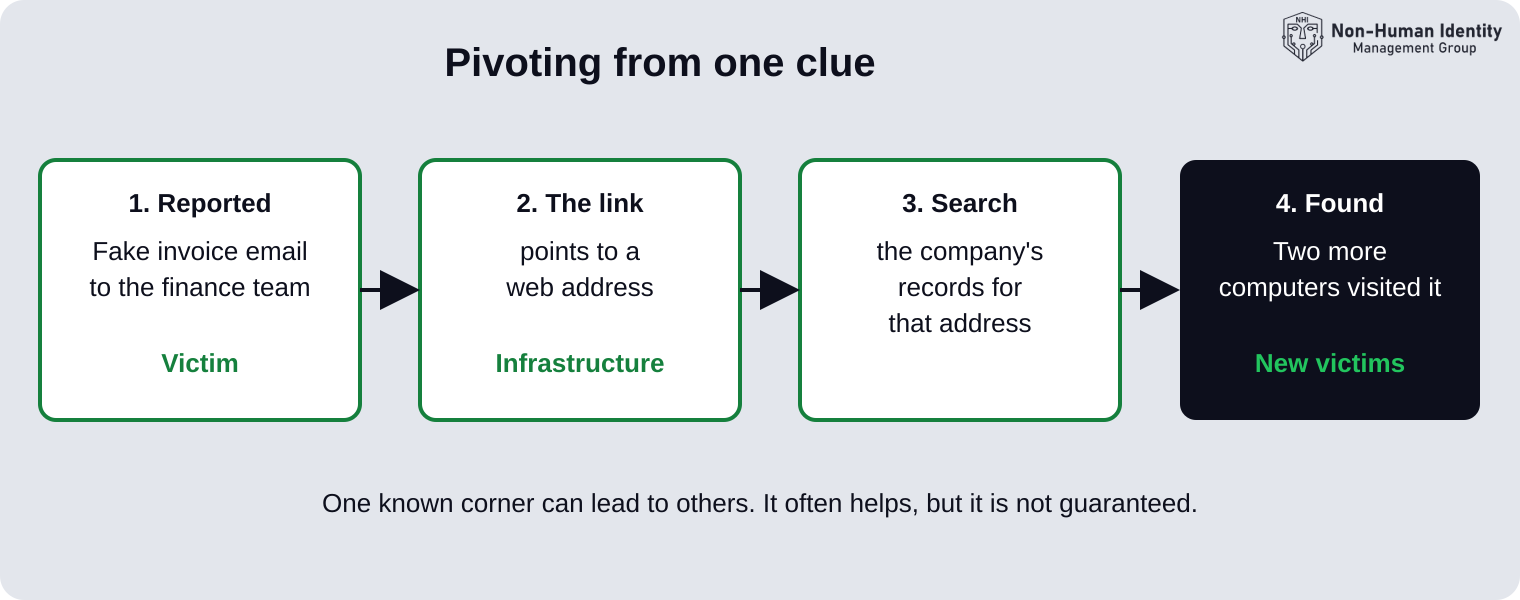
- Pivot to a new corner. Use one known clue to find another. The paper gives an example: logs showed other computers contacting a known attacker address, which revealed more victims.[1]
- Add the extra details. The model also records when it happened, which stage of the attack it was, the result and how confident you are.[1]
- Link the events. Put the diamonds in time order. Diamonds that share corners may belong to the same campaign.
Pivoting does not always work. The paper notes that one corner can help you find the others, but success is not guaranteed.[1]
A worked example
Bruno Grover has just joined the IT team at Larch Lane Books, a fictional online bookshop. His manager, Nils Gallardo, forwards a report from the finance team. Someone clicked a link in an invoice email that looked wrong.
Nils asks Bruno to use the Diamond Model. Bruno draws a diamond on the whiteboard.
He fills in the victim corner first: the finance inbox and one laptop. Then the capability corner: a fake invoice email with a link. The link points to a web address, so that goes in the infrastructure corner. He leaves the adversary corner blank.
Next, Bruno pivots from the infrastructure corner. He asks Nils to search the web filter records for that address. Two more laptops visited it on the same morning. Those are new victims that nobody had reported.
Nils blocks the address and checks the three laptops. He also changes the passwords of the three users, in case they typed them into a fake page.
Bruno writes one diamond card for each step and files them in the team folder. He notes "Adversary: unknown, medium confidence on the rest".
A month later, a new email arrives from a different address with the same fake invoice style. Bruno spots the match in the capability corner and links the two events. The team now knows to watch for that style.
Myths and mistakes
| What people think | What is true |
|---|---|
| You must know the attacker before you can use the model. | Most diamonds start with the adversary blank. The other corners are still useful. |
| The Diamond Model and the Cyber Kill Chain are rivals. | They work together. The kill chain orders stages over time, and each stage can be described as a diamond.[1] |
| One diamond describes a whole attack. | One diamond describes one step. A full attack is a series of linked diamonds. |
| Infrastructure always belongs to the attacker. | Attackers often use hacked or borrowed computers, so the owner may be another victim.[1] |
| Pivoting always finds the next clue. | It often helps, but the paper notes that success is not guaranteed.[1] |
What can I do this week?
- Draw a blank diamond and label the four corners from memory.
- Pick one attack from the news and fill in as many corners as the article allows.
- Write one question you would ask to fill each empty corner.
- Compare your diamond with the stages in the Cyber Kill Chain for the same attack.
Checklist
- I can name the four corners: adversary, capability, infrastructure and victim.
- I know one diamond describes one attack step.
- I start with the corner I know and leave unknowns blank.
- For each clue, I ask which other corner it could lead to.
- I record when it happened and how confident I am.
- I can explain the difference between the diamond and the kill chain.
Common questions
What are the four parts of the Diamond Model?
The four corners are adversary, capability, infrastructure and victim. In plain words: who did it, what they used, how they reached the target, and who was hit. Each diamond describes one step of an attack.
What is the difference between the Diamond Model and the Cyber Kill Chain?
The kill chain lists the stages of an attack in time order. The Diamond Model describes the four parts of one attack step. Many analysts use both: the kill chain shows where an event sits, and the diamond describes the event.
What does pivoting mean?
Pivoting means using one clue to find linked clues. For example, you take a bad web address from one email and search your records for other computers that visited it. Those computers may be victims nobody has reported yet.
Who created the Diamond Model?
Sergio Caltagirone, Andrew Pendergast and Christopher Betz published it in 2013, in a technical report for the US Department of Defense.[1] The full paper also adds extra details, such as time, result and confidence for each event.
Do I need special software to use it?
No. You can use a whiteboard, a notebook or a spreadsheet. Some threat intelligence tools can store diamond-style records, but the main value is the habit of asking the four questions for every attack step.
Where next?
Ready for the detail? Read the practitioner guide: Cyber Kill Chain and Diamond Model Guide. It goes further into the meta-features, activity threads and groups, and how analysts combine the diamond with MITRE ATT&CK.
Also useful:
- Cyber Kill Chain for Beginners
- MITRE ATT&CK for Beginners
- Threat Intelligence for Beginners
- Cyber Attack Attribution for Beginners
Related NHI Mgmt Group resources: Threat Actors for Beginners · Hacker Group Names for Beginners · Malware for Beginners
Key terms
- Diamond Model
- A way to describe an attack step through four linked corners: adversary, capability, infrastructure and victim.
- Adversary
- The person or group behind an attack.
- Infrastructure
- The systems an attacker uses to reach and control a target, such as servers and web addresses.
- Pivoting
- Using one known clue to find other, linked clues.
- Cyber kill chain
- A model that lists the stages of an attack in time order.
- Indicator of compromise
- A sign that an attack may have happened, such as a known bad web address or file.
Sources and further reading
- The Diamond Model of Intrusion Analysis. Sergio Caltagirone, Andrew Pendergast and Christopher Betz, technical report, US Department of Defense, 5 July 2013 (via the Defense Technical Information Center). https://apps.dtic.mil/sti/pdfs/ADA586960.pdf, accessed 28 Nov 2026.